ENGLISH 10
LESSON (QUARTER
3)
Most Essential Learning
Competency:
Using a Variety of
Informative, Persuasive,
and Argumentative
Writing Techniques
What is writing technique?
The style an author uses to convey
his/her message in a manner that
is effective and meaningful to the
audience
To organize knowledge
and belief
To convey meaning
through well-constructed
text
Argumentative
Informative
Persuasive
Writing Techniques
Argumentative
Writing
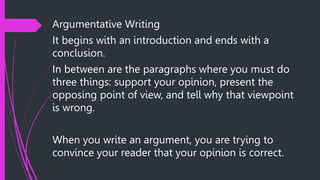
Argumentative Writing
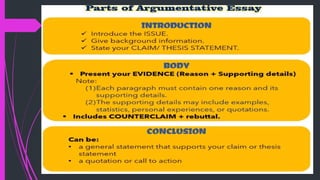
It begins with an introduction and ends with a
conclusion.
In between are the paragraphs where you must do
three things: support your opinion, present the
opposing point of view, and tell why that viewpoint
is wrong.
When you write an argument, you are trying to
convince your reader that your opinion is correct.
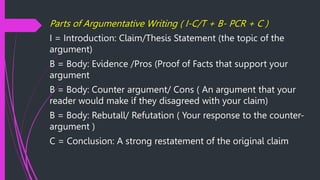
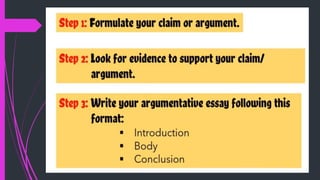
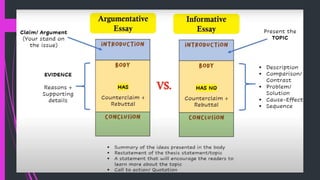
Parts of Argumentative Writing ( I-C/T + B- PCR + C )
I = Introduction: Claim/Thesis Statement (the topic of the
argument)
B = Body: Evidence /Pros (Proof of Facts that support your
argument
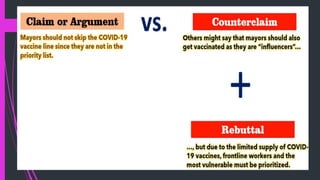
B = Body: Counter argument/ Cons ( An argument that your
reader would make if they disagreed with your claim)
B = Body: Rebutall/ Refutation ( Your response to the counter-
argument )
C = Conclusion: A strong restatement of the original claim
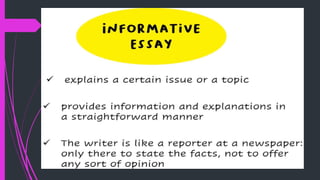
Informative Writing
Informative Writing
Educates the readers by imparting
straightforward information, facts, and
details on a certain topic
Gives new understanding or new
appreciation of some topics which one
might be familiar with
Writer answers questions of how and why
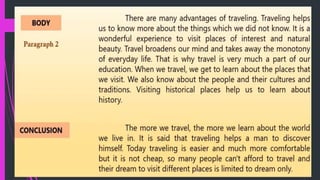
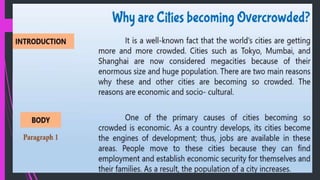
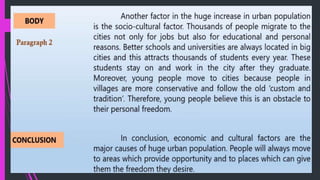
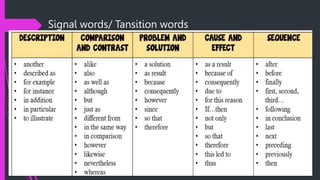
Signal words/ Tansition words
Persuasive Writing
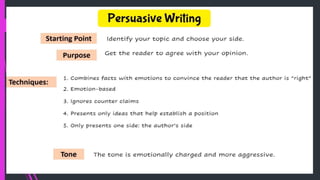
Persuasive Writing
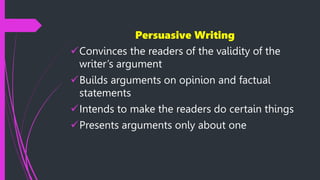
Convinces the readers of the validity of the
writer’s argument
Builds arguments on opinion and factual
statements
Intends to make the readers do certain things
Presents arguments only about one
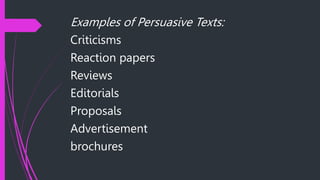
Examples of Persuasive Texts:
Criticisms
Reaction papers
Reviews
Editorials
Proposals
Advertisement
brochures
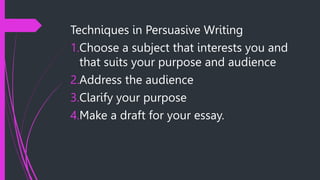
Techniques in Persuasive Writing
1.Choose a subject that interests you and
that suits your purpose and audience
2.Address the audience
3.Clarify your purpose
4.Make a draft for your essay.
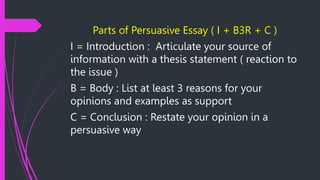
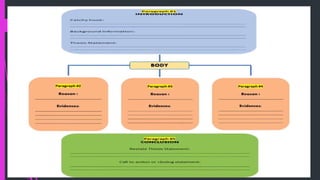
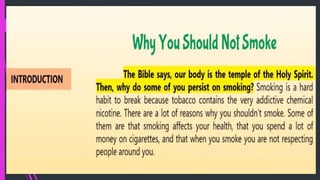
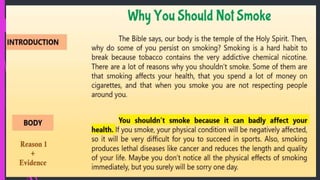
Parts of Persuasive Essay ( I + B3R + C )
I = Introduction : Articulate your source of
information with a thesis statement ( reaction to
the issue )
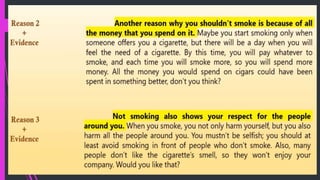
B = Body : List at least 3 reasons for your
opinions and examples as support
C = Conclusion : Restate your opinion in a
persuasive way
Conclusion:
Example:
Example:
Example:
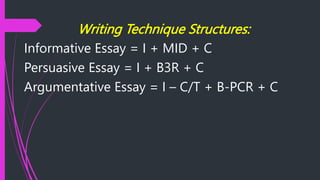
Writing Technique Structures:
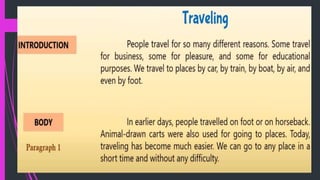
Informative Essay = I + MID + C
Persuasive Essay = I + B3R + C
Argumentative Essay = I – C/T + B-PCR + C
Try this!
Directions: Read the statements carefully.
Say YES if the statement expresses truth
about argumentative, informative and
persuasive writing; and NO if it says
otherwise.
1. The main objective of an
argumentative essay is to tell a
story.
2. Persuasive text combines facts
with emotions to convince the
reader that the author is right.
3. In developing body paragraphs in an
argumentative essay, you must state your
opinion, expand your claims, give reasons
to support your opinion and argue against
the opposing viewpoint.
4. Informative writing aims to give the
readers a new understanding or
appreciation of some topics with
which you might be familiar with.
5. There is no need to present the
pros and cons arguments in an issue
of an argumentative text.
6. The main purpose of informative
writing is to educate the readers.
7. Unbiased information is needed in
informative writing.
What type of writing is best to use in the following
topic/issue?
1.The Many Causes of Asthma Attack
2.Changing the Length of the School Day
3.Media Has Negative Effects on Children
4.How to Make Grandma’s Homemade Bread
5.Should Online Learning be Implemented in the Philippines
Even After the Pandemic?
6.How to Cope with Stressful Situation
7. Should parents be held responsible for actions of their
children?
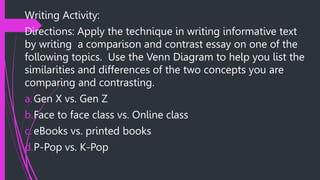
Writing Activity:
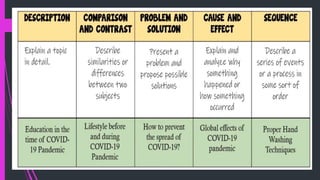
Directions: Apply the technique in writing informative text
by writing a comparison and contrast essay on one of the
following topics. Use the Venn Diagram to help you list the
similarities and differences of the two concepts you are
comparing and contrasting.
a.Gen X vs. Gen Z
b.Face to face class vs. Online class
c. eBooks vs. printed books
d.P-Pop vs. K-Pop
Ms. Cathlene
Mae Sanglay
“He who want to persuade
should put his trust not in
the right argument, but in the
right word. The power of
sound has always been
greater than the power of
sense.”
- Joseph Conrad
• 1.What is persuasion? How is it different from
argumentation?
• 2.Beyond writing academic essays, in which
other contexts do you find yourself using
persuasion?
• 3.How do you convince people to believe in
your views regarding the perspectives in life?
1. Why do we speak?
60
The Persuasive
Speech
61
What is
Persuasion?
62
63
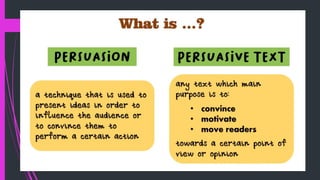
PERSUASION
-An act of influencing an
audience.
64
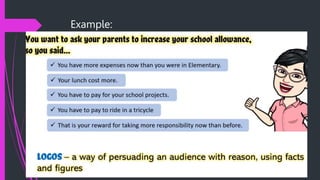
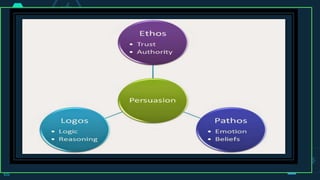
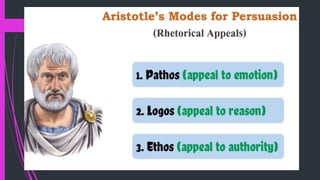
LOGOS
-Reasoning
-Logic
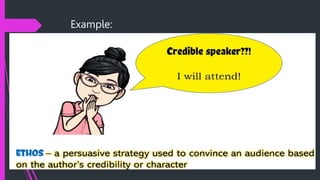
ETHOS
-Trust
-Authority
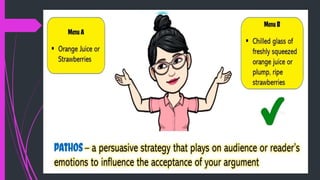
PATHOS
-Emotion
-Beliefs
65

ENGLISH-10-LESSON-QUARTER-3-Writing-Techniques.pptx

  • 1.
  • 2.
    Most Essential Learning Competency: Usinga Variety of Informative, Persuasive, and Argumentative Writing Techniques
  • 3.
    What is writingtechnique? The style an author uses to convey his/her message in a manner that is effective and meaningful to the audience
  • 4.
    To organize knowledge andbelief To convey meaning through well-constructed text
  • 5.
  • 6.
  • 8.
    Argumentative Writing It beginswith an introduction and ends with a conclusion. In between are the paragraphs where you must do three things: support your opinion, present the opposing point of view, and tell why that viewpoint is wrong. When you write an argument, you are trying to convince your reader that your opinion is correct.
  • 9.
    Parts of ArgumentativeWriting ( I-C/T + B- PCR + C ) I = Introduction: Claim/Thesis Statement (the topic of the argument) B = Body: Evidence /Pros (Proof of Facts that support your argument B = Body: Counter argument/ Cons ( An argument that your reader would make if they disagreed with your claim) B = Body: Rebutall/ Refutation ( Your response to the counter- argument ) C = Conclusion: A strong restatement of the original claim
  • 16.
  • 17.
    Informative Writing Educates thereaders by imparting straightforward information, facts, and details on a certain topic Gives new understanding or new appreciation of some topics which one might be familiar with Writer answers questions of how and why
  • 25.
  • 26.
  • 27.
    Persuasive Writing Convinces thereaders of the validity of the writer’s argument Builds arguments on opinion and factual statements Intends to make the readers do certain things Presents arguments only about one
  • 29.
    Examples of PersuasiveTexts: Criticisms Reaction papers Reviews Editorials Proposals Advertisement brochures
  • 30.
    Techniques in PersuasiveWriting 1.Choose a subject that interests you and that suits your purpose and audience 2.Address the audience 3.Clarify your purpose 4.Make a draft for your essay.
  • 31.
    Parts of PersuasiveEssay ( I + B3R + C ) I = Introduction : Articulate your source of information with a thesis statement ( reaction to the issue ) B = Body : List at least 3 reasons for your opinions and examples as support C = Conclusion : Restate your opinion in a persuasive way
  • 37.
  • 39.
  • 41.
  • 42.
  • 43.
    Writing Technique Structures: InformativeEssay = I + MID + C Persuasive Essay = I + B3R + C Argumentative Essay = I – C/T + B-PCR + C
  • 44.
    Try this! Directions: Readthe statements carefully. Say YES if the statement expresses truth about argumentative, informative and persuasive writing; and NO if it says otherwise.
  • 45.
    1. The mainobjective of an argumentative essay is to tell a story.
  • 46.
    2. Persuasive textcombines facts with emotions to convince the reader that the author is right.
  • 47.
    3. In developingbody paragraphs in an argumentative essay, you must state your opinion, expand your claims, give reasons to support your opinion and argue against the opposing viewpoint.
  • 48.
    4. Informative writingaims to give the readers a new understanding or appreciation of some topics with which you might be familiar with.
  • 49.
    5. There isno need to present the pros and cons arguments in an issue of an argumentative text.
  • 50.
    6. The mainpurpose of informative writing is to educate the readers.
  • 51.
    7. Unbiased informationis needed in informative writing.
  • 52.
    What type ofwriting is best to use in the following topic/issue? 1.The Many Causes of Asthma Attack 2.Changing the Length of the School Day 3.Media Has Negative Effects on Children 4.How to Make Grandma’s Homemade Bread 5.Should Online Learning be Implemented in the Philippines Even After the Pandemic? 6.How to Cope with Stressful Situation 7. Should parents be held responsible for actions of their children?
  • 53.
    Writing Activity: Directions: Applythe technique in writing informative text by writing a comparison and contrast essay on one of the following topics. Use the Venn Diagram to help you list the similarities and differences of the two concepts you are comparing and contrasting. a.Gen X vs. Gen Z b.Face to face class vs. Online class c. eBooks vs. printed books d.P-Pop vs. K-Pop
  • 54.
  • 57.
    “He who wantto persuade should put his trust not in the right argument, but in the right word. The power of sound has always been greater than the power of sense.” - Joseph Conrad
  • 58.
    • 1.What ispersuasion? How is it different from argumentation? • 2.Beyond writing academic essays, in which other contexts do you find yourself using persuasion? • 3.How do you convince people to believe in your views regarding the perspectives in life?
  • 60.
    1. Why dowe speak? 60
  • 61.
  • 62.
  • 63.
    63 PERSUASION -An act ofinfluencing an audience.
  • 64.
  • 65.