The IT landscape has changed.
Have you?

       Dr Kevin McIsaac
        kmcisaac@ibrs.com.au
          www.ibrs.com.au
The Mega Trends
n    The three iron laws of IT that drive
      infrastructure
n    Cloud Computing as seen from above
n    Integrated Systems: why the infrastructure
      of the future looks a lot like the
      infrastructure of the past!
Moore’s Law
n    Massive growth in computation, dramatic decline in
      unit cost
      n    Problem is no longer CPU power or processing costs
             n    Issues are power efficiency, utilisation and I/O performance
n    Number of cores doubles every 18 months
      n    10 core x64 CPUs today
      n    200+ cores/blade enclosure
      n    Tri-gate transistors, better power and performance
n    Fortunately DBMS, App Server & Web Servers and
      Hypervisors already scale to 100’s of cores!
Server Virtualisation
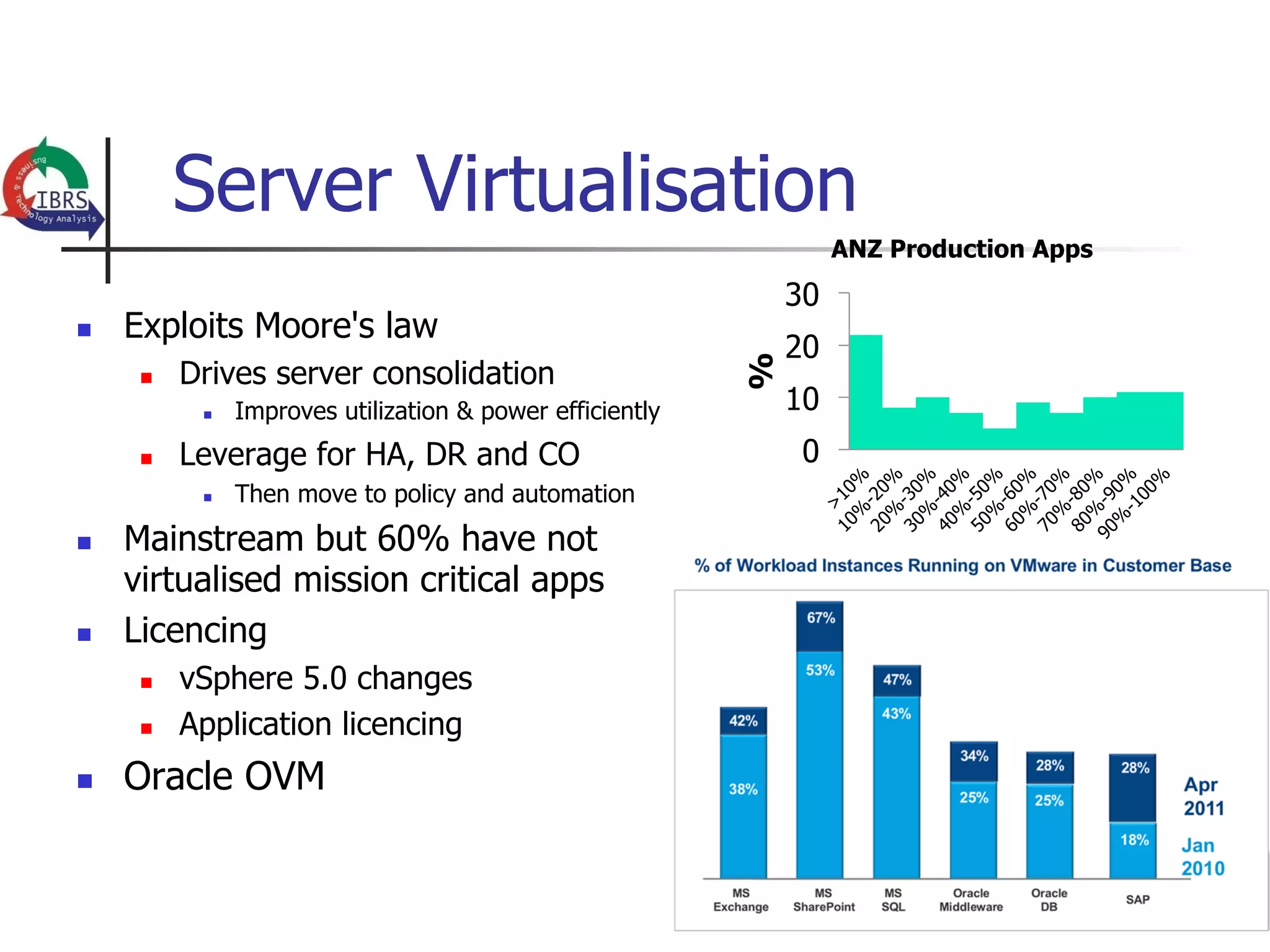
                                                                        ANZ Production Apps
                                                                   30
n    Exploits Moore's law
                                                                   20


                                                               %
       n    Drives server consolidation
              n    Improves utilization & power efficiently       10
       n    Leverage for HA, DR and CO                            0
              n    Then move to policy and automation
n    Mainstream but 60% have not
      virtualised mission critical apps
n    Licencing
       n    vSphere 5.0 changes
       n    Application licencing
n    Oracle OVM
Database consolidation
n    Another way to exploit Moore’s law
n    VMs vs. Instance vs. Schema
      n    O/S & DB version
      n    Patching and upgrading
      n    Workload compatibility
      n    Capacity management
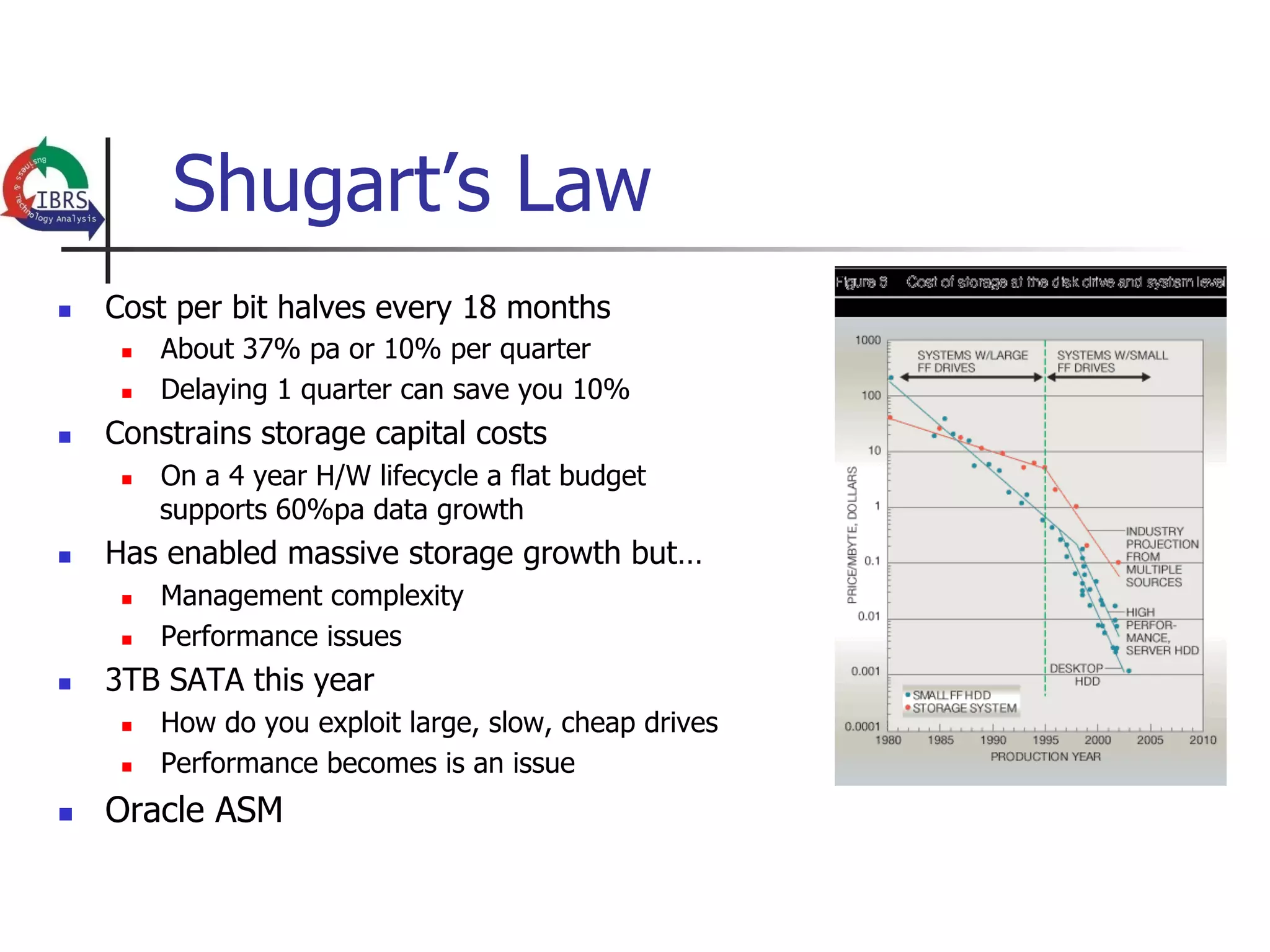
Shugart’s Law
n    Cost per bit halves every 18 months
       n    About 37% pa or 10% per quarter
       n    Delaying 1 quarter can save you 10%
n    Constrains storage capital costs
       n    On a 4 year H/W lifecycle a flat budget
             supports 60%pa data growth
n    Has enabled massive storage growth but…
       n    Management complexity
       n    Performance issues
n    3TB SATA this year
       n    How do you exploit large, slow, cheap drives
       n    Performance becomes is an issue
n    Oracle ASM
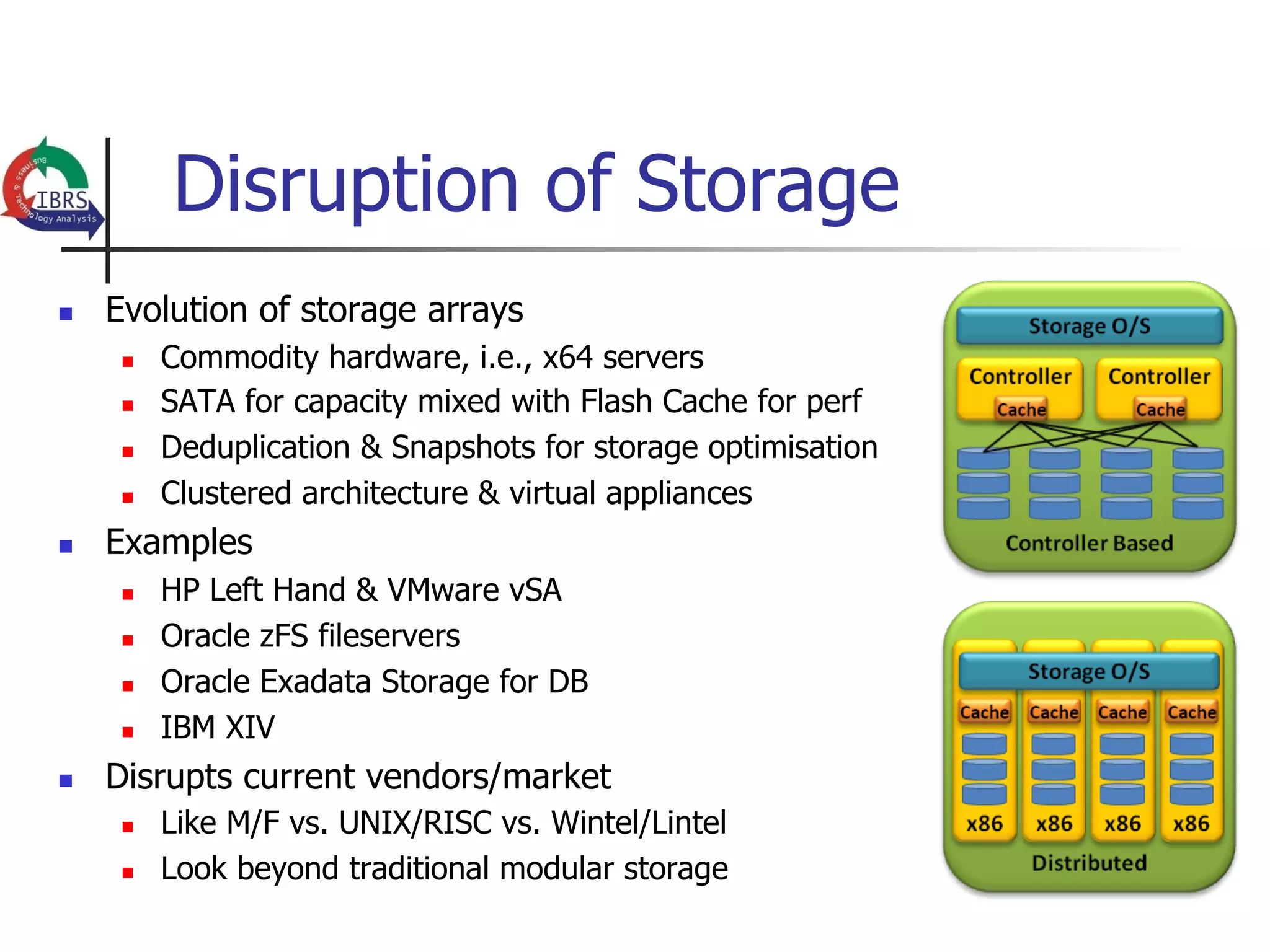
Disruption of Storage
n    Evolution of storage arrays
       n    Commodity hardware, i.e., x64 servers
       n    SATA for capacity mixed with Flash Cache for perf
       n    Deduplication & Snapshots for storage optimisation
       n    Clustered architecture & virtual appliances
n    Examples
       n    HP Left Hand & VMware vSA
       n    Oracle zFS fileservers
       n    Oracle Exadata Storage for DB
       n    IBM XIV
n    Disrupts current vendors/market
       n    Like M/F vs. UNIX/RISC vs. Wintel/Lintel
       n    Look beyond traditional modular storage
Storage Virtualisation
n    Network based storage virtualisation has limited
      adoption
      n    Additional cost is a major barrier (4K-6K/TB?)
      n    Need to be very, very large to justify cost/benefit
n    Vendors: IBM (SVC), HP, EMC v-Plex
      n    EMC new to this market the market with v-Plex
n    Use cases
      n    Mostly used for data migration (SVC)
      n    Cloud providers with unpredictable workloads.
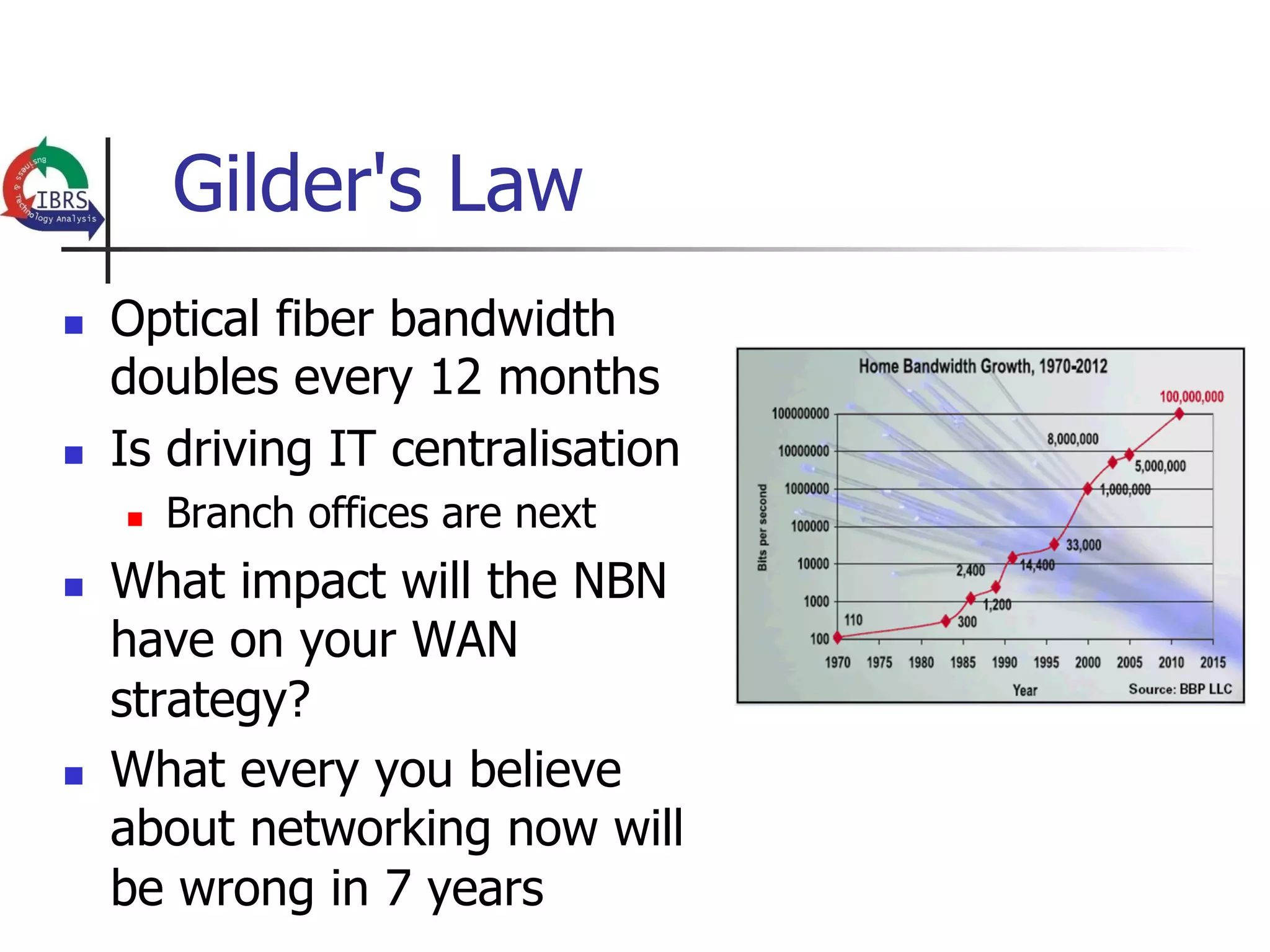
Gilder's Law
n    Optical fiber bandwidth
      doubles every 12 months
n    Is driving IT centralisation
      n    Branch offices are next
n    What impact will the NBN
      have on your WAN
      strategy?
n    What every you believe
      about networking now will
      be wrong in 7 years
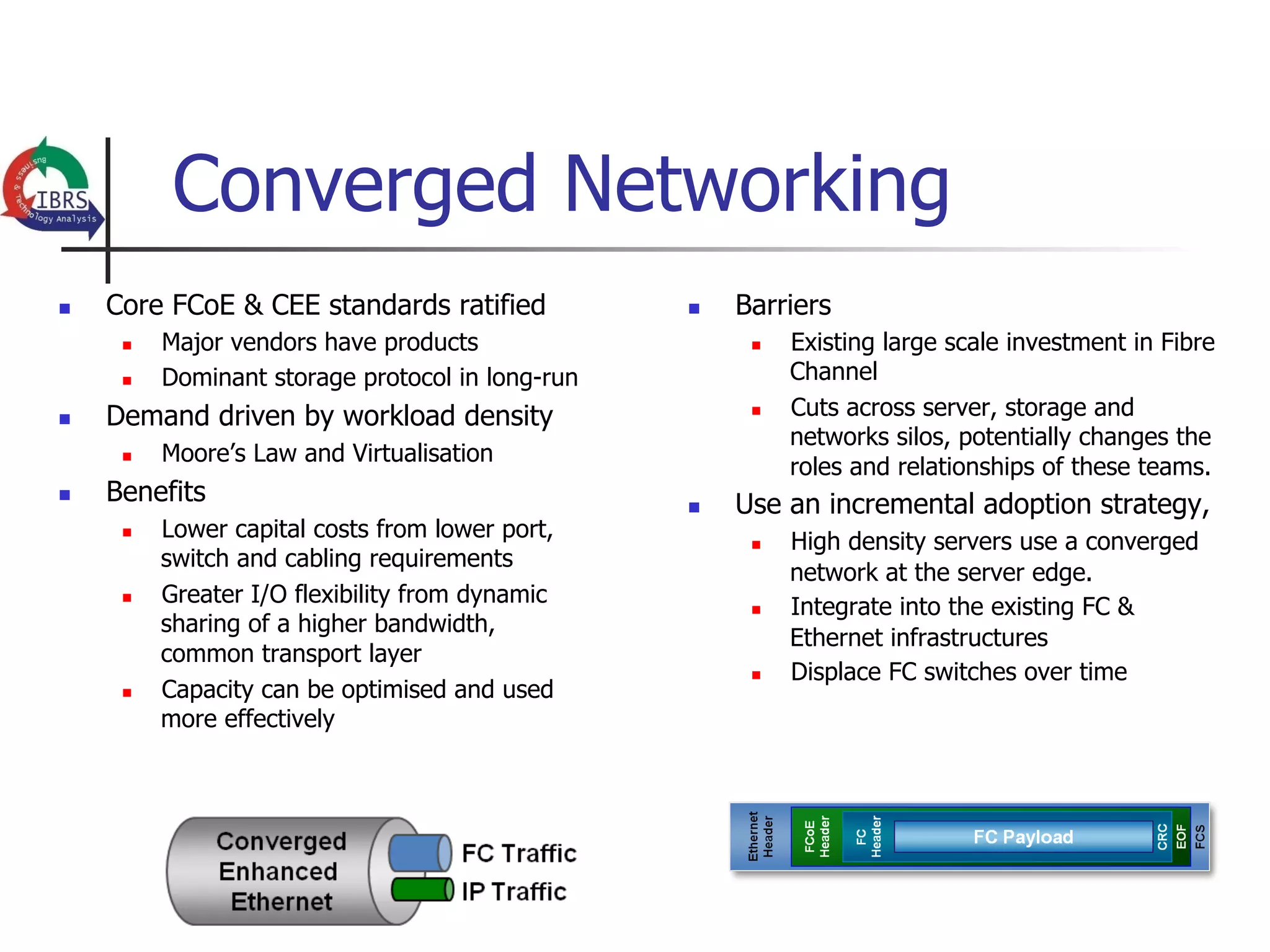
Converged Networking
n    Core FCoE & CEE standards ratified             n    Barriers
       n    Major vendors have products                    n    Existing large scale investment in Fibre
       n    Dominant storage protocol in long-run                Channel
n    Demand driven by workload density                     n    Cuts across server, storage and
                                                                  networks silos, potentially changes the
       n    Moore’s Law and Virtualisation
                                                                  roles and relationships of these teams.
n    Benefits                                       n    Use an incremental adoption strategy,
             Lower capital costs from lower port,                 High density servers use a converged
       n 
                                                            n 
             switch and cabling requirements
                                                                  network at the server edge.
             Greater I/O flexibility from dynamic                 Integrate into the existing FC &
       n 
                                                            n 
             sharing of a higher bandwidth,
                                                                  Ethernet infrastructures
             common transport layer
                                                            n    Displace FC switches over time
       n    Capacity can be optimised and used
             more effectively
Cloud Computing
•    Different ways of thinking about the cloud
•    How do clients view “The cloud”?
•    What does the business want
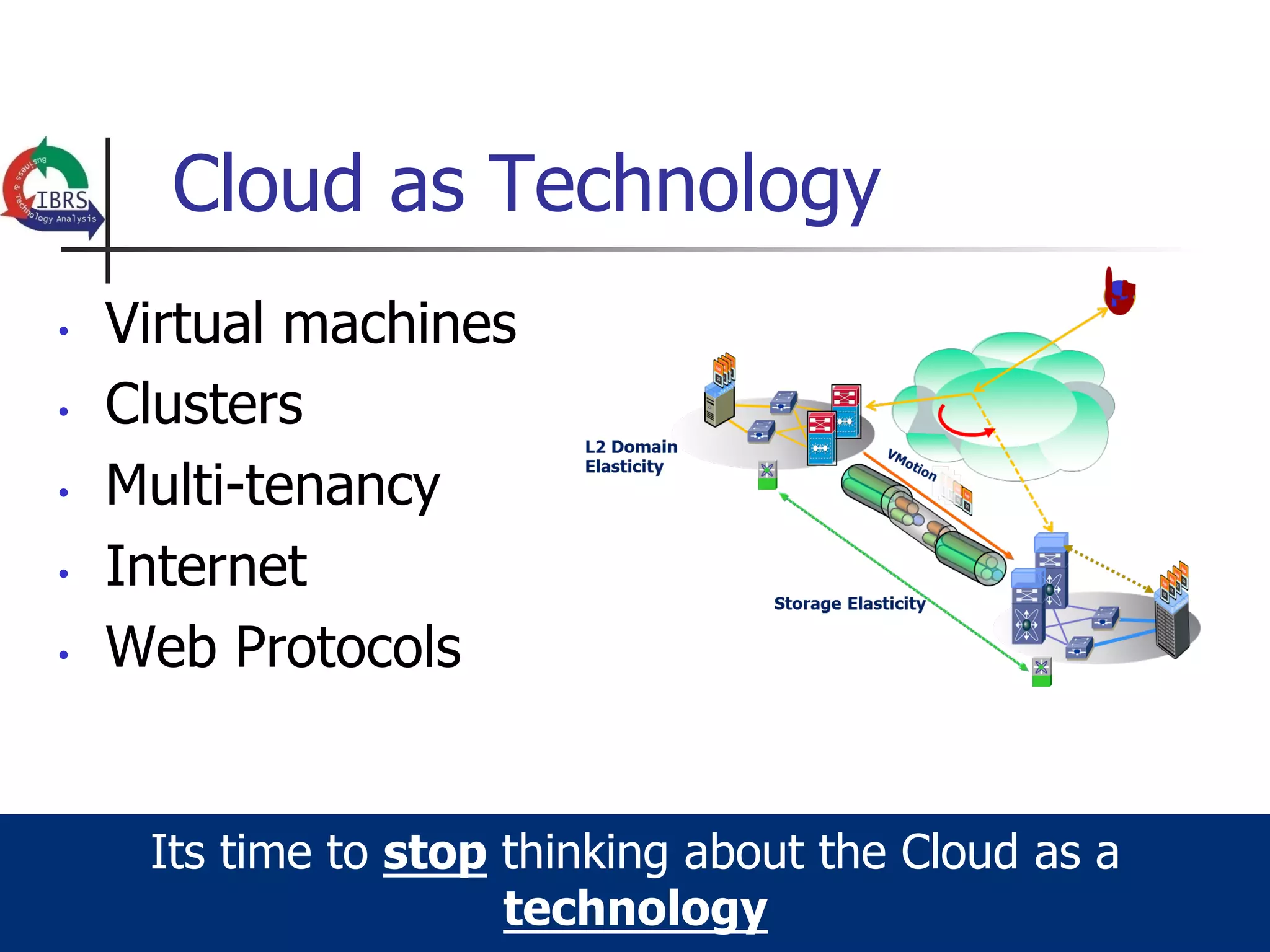
Cloud as Technology
•    Virtual machines
•    Clusters
•    Multi-tenancy
•    Internet
•    Web Protocols


      Its time to stop thinking about the Cloud as a
                       technology
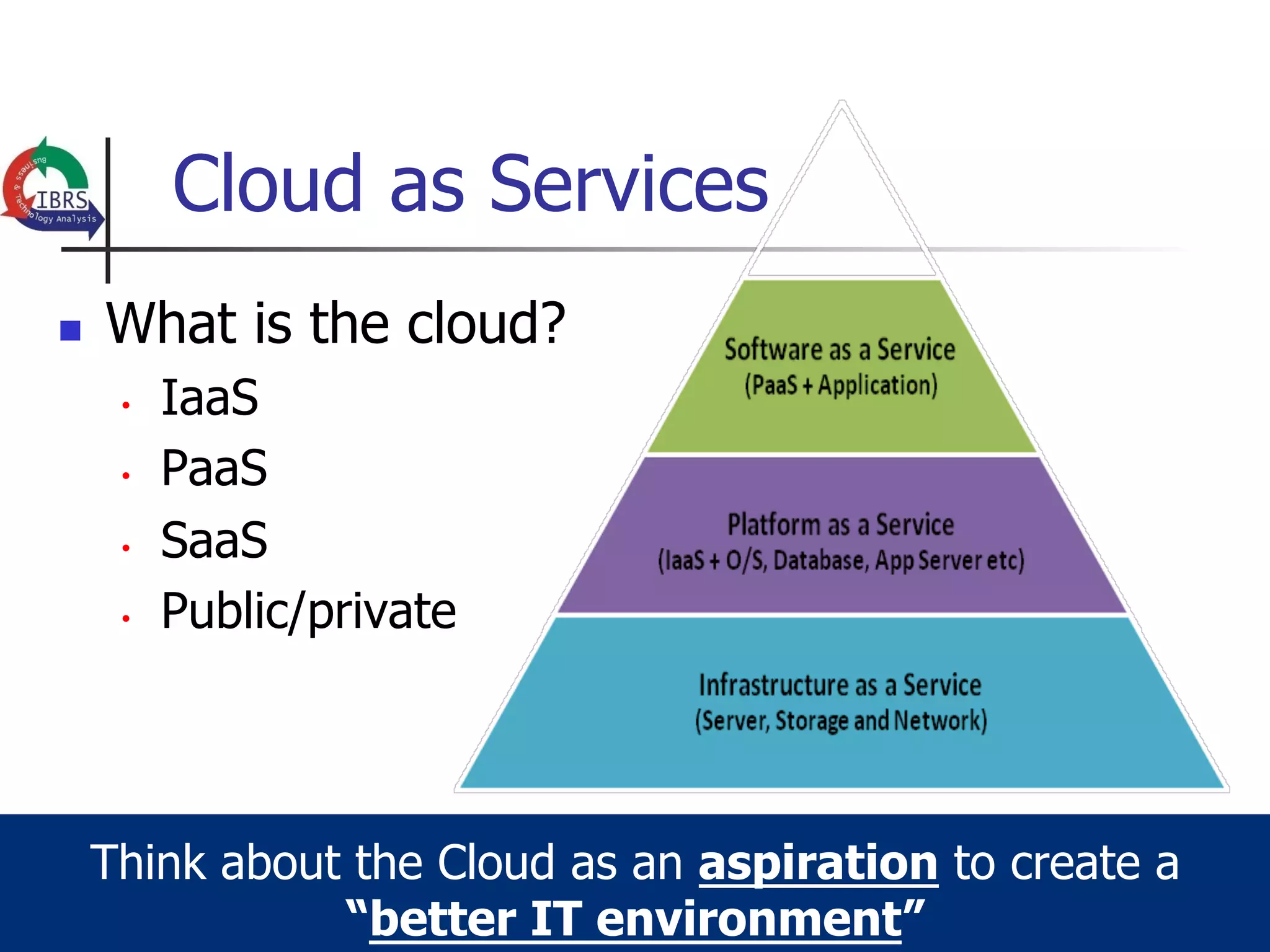
Cloud as Services
n    What is the cloud?
       •    IaaS
       •    PaaS
       •    SaaS
       •    Public/private


      Think about the Cloud as an aspiration to create a
                 “better IT environment”
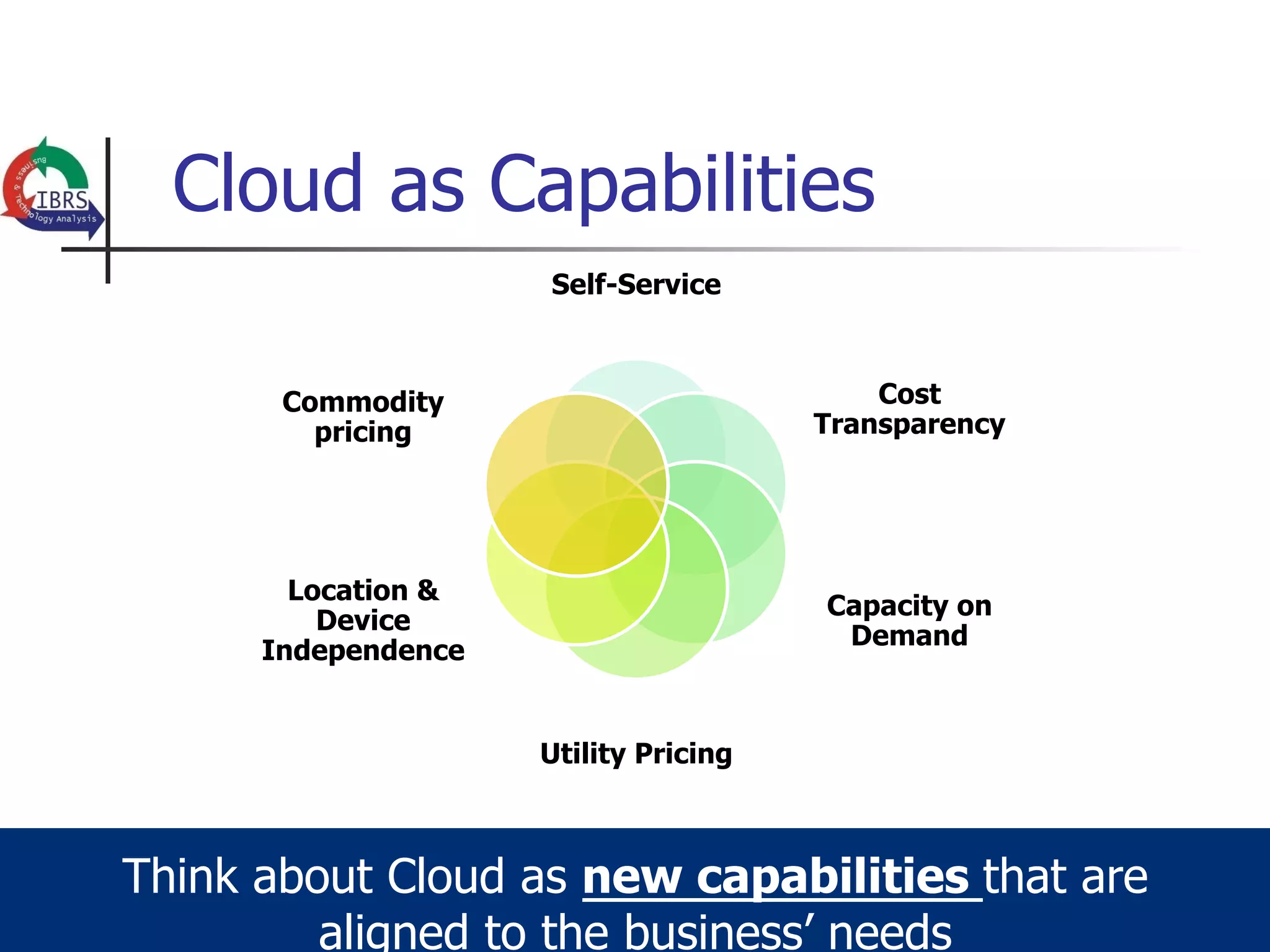
Cloud as Capabilities
                     Self-Service


       Commodity                           Cost
         pricing                       Transparency


        Location &
                                       Capacity on
          Device
                                        Demand
      Independence


                     Utility Pricing


Think about Cloud as new capabilities that are
         aligned to the business’ needs
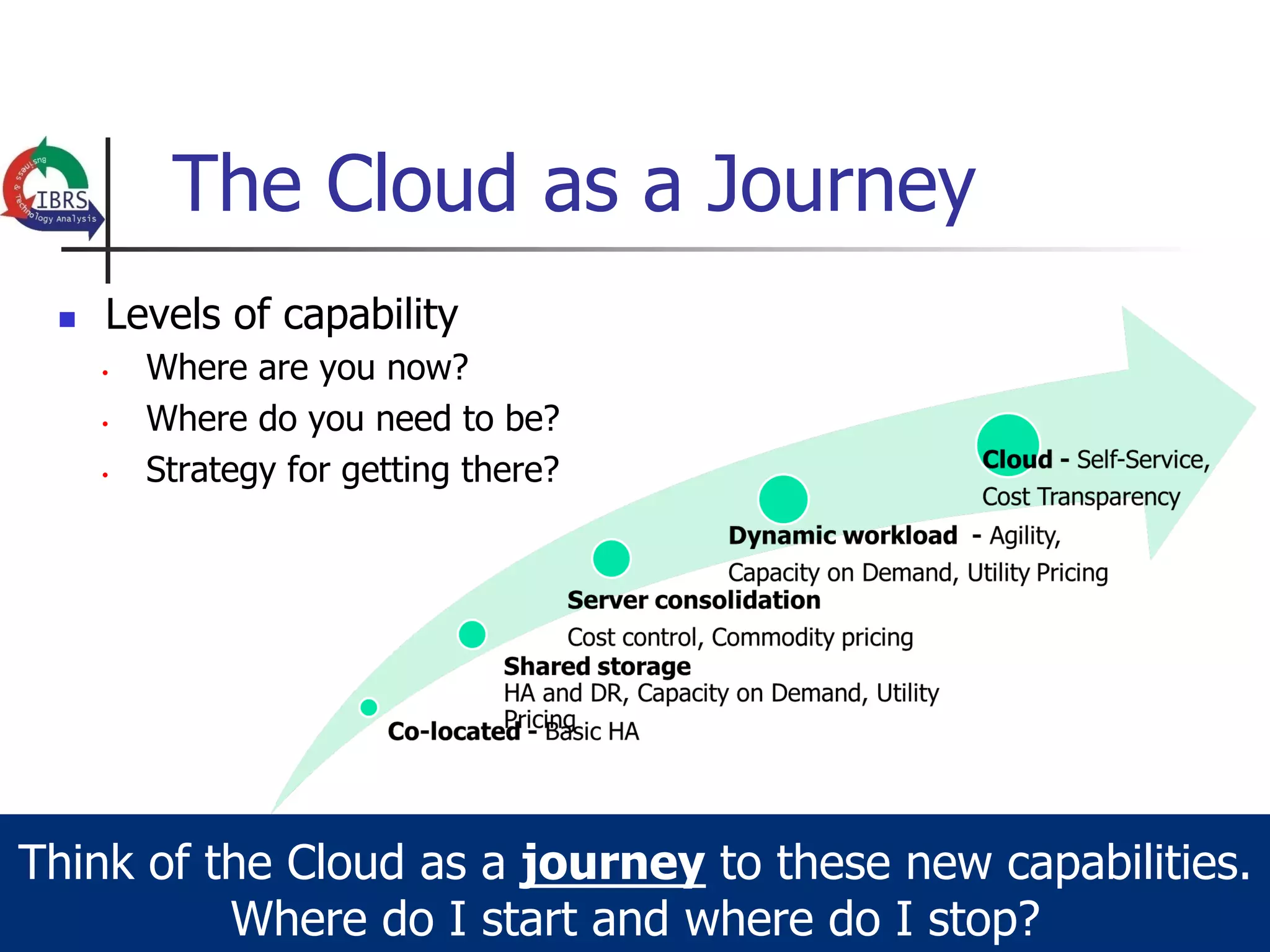
The Cloud as a Journey
 n    Levels of capability
       •    Where are you now?
       •    Where do you need to be?
       •    Strategy for getting there?


Think of the Cloud as a journey to these new capabilities.
          Where do I start and where do I stop?
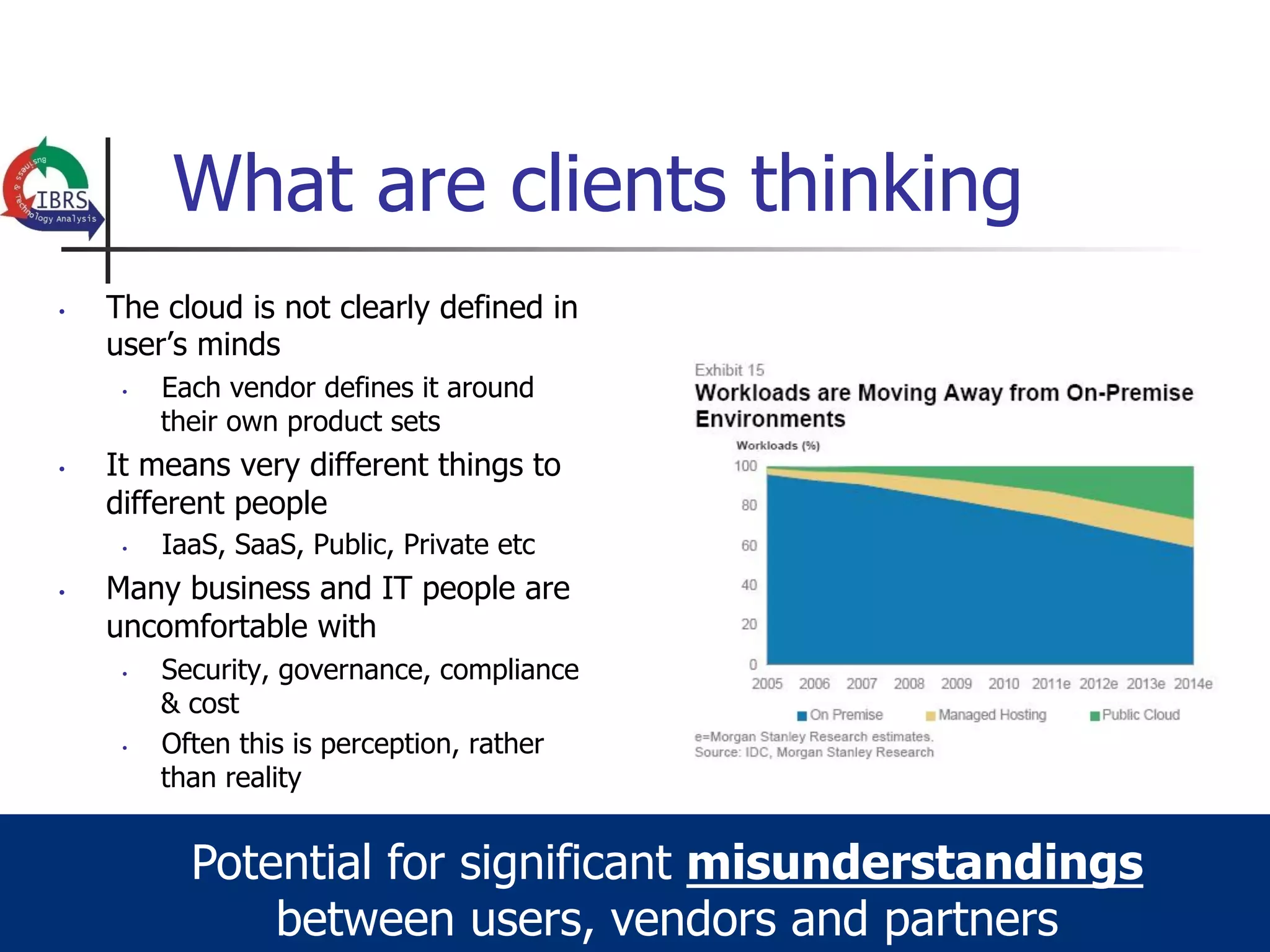
What are clients thinking
•    The cloud is not clearly defined in
     user’s minds
      •    Each vendor defines it around
           their own product sets
•    It means very different things to
     different people
      •    IaaS, SaaS, Public, Private etc
•    Many business and IT people are
     uncomfortable with
      •    Security, governance, compliance
           & cost
      •    Often this is perception, rather
           than reality


             Potential for significant misunderstandings
                 between users, vendors and partners
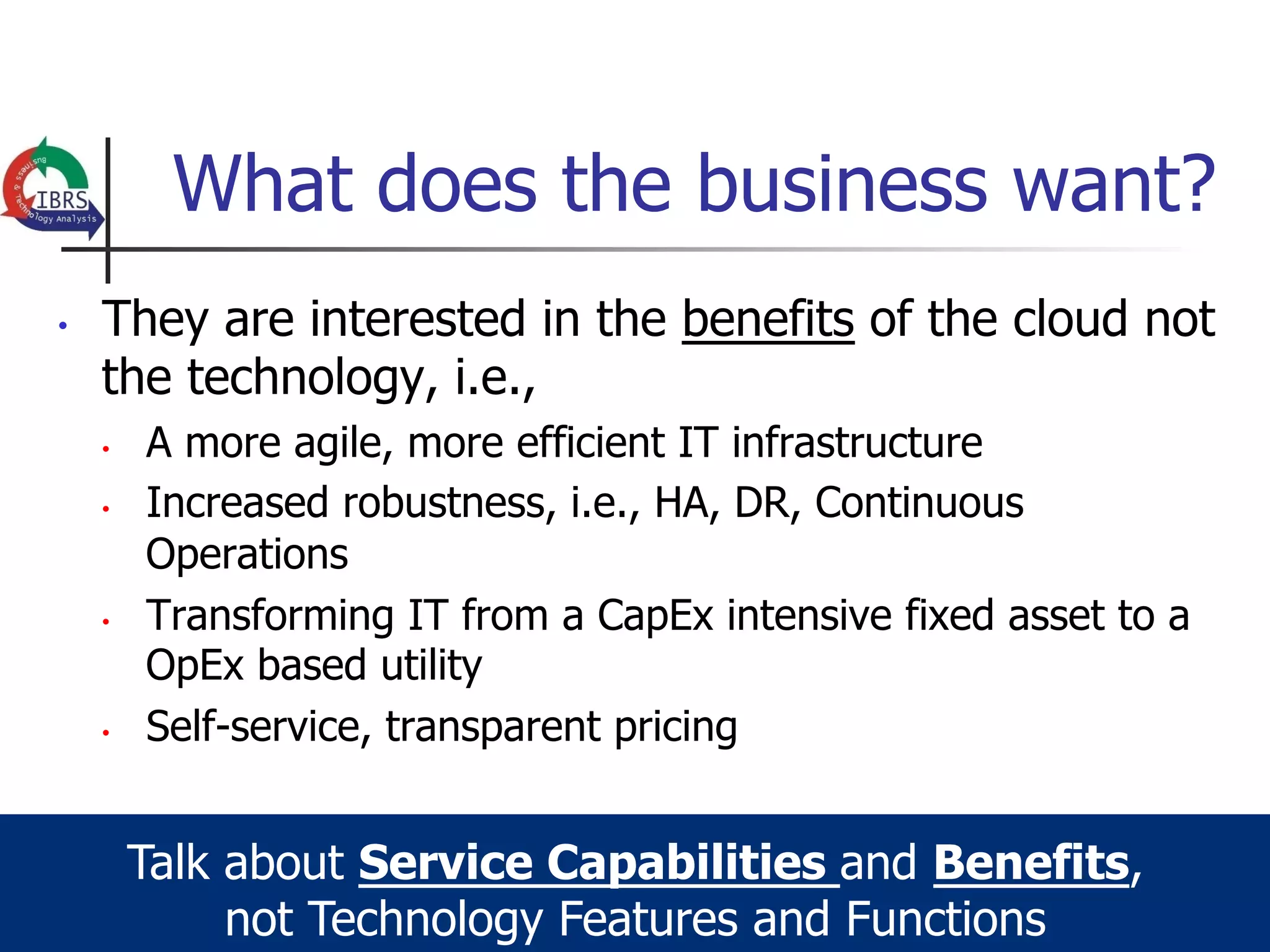
What does the business want?
•    They are interested in the benefits of the cloud not
     the technology, i.e.,
     •    A more agile, more efficient IT infrastructure
     •    Increased robustness, i.e., HA, DR, Continuous
          Operations
     •    Transforming IT from a CapEx intensive fixed asset to a
          OpEx based utility
     •    Self-service, transparent pricing


          Talk about Service Capabilities and Benefits,
               not Technology Features and Functions
The IT landscape has changed.
Have you?

       Dr Kevin McIsaac
        kmcisaac@ibrs.com.au
          www.ibrs.com.au
The empire, long divided, must unite;
long united, must divide. Thus it has
ever been.
        -- Three Kingdoms
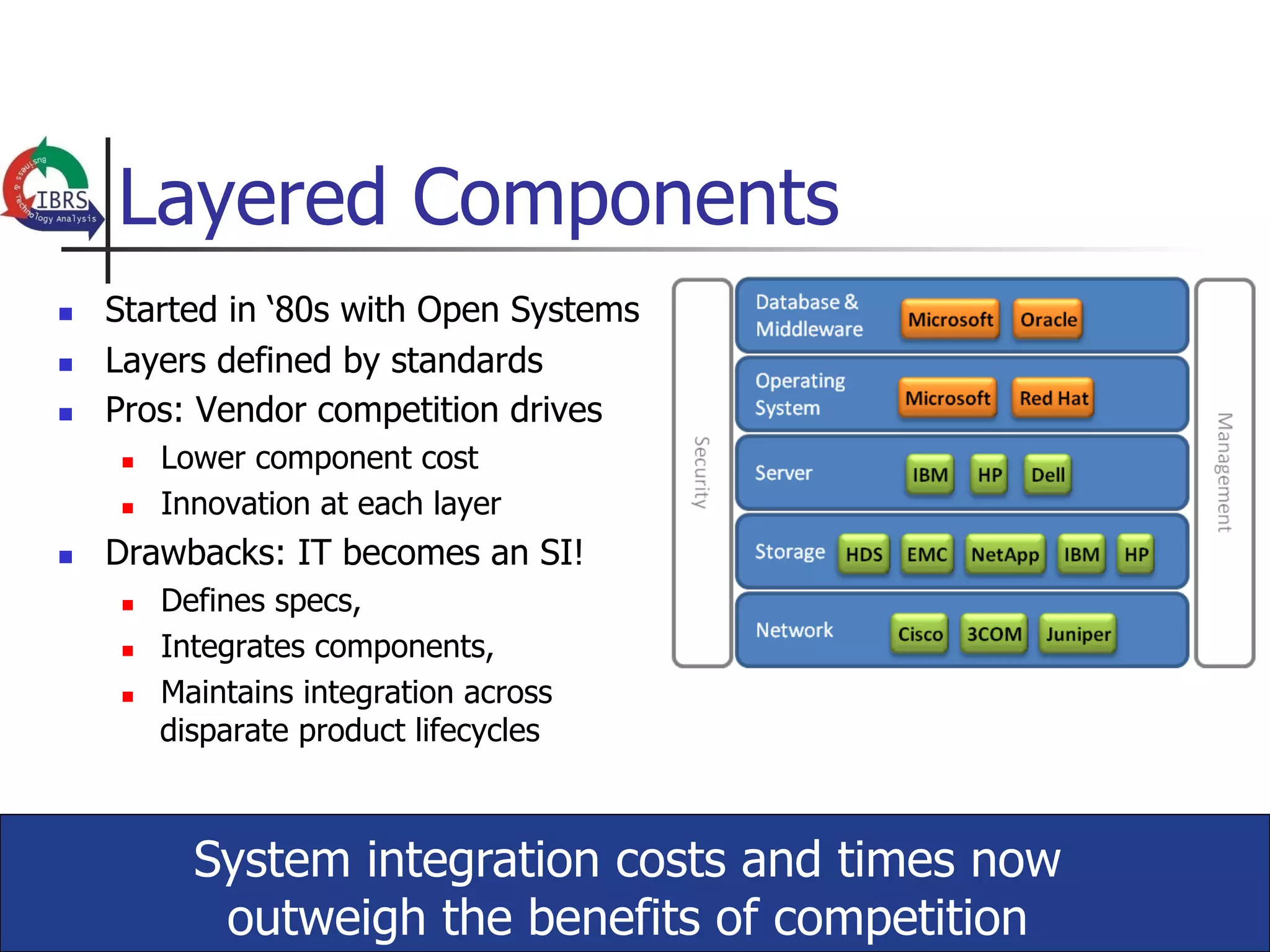
Layered Components
n    Started in ‘80s with Open Systems
n    Layers defined by standards
n    Pros: Vendor competition drives
      n    Lower component cost
      n    Innovation at each layer
n    Drawbacks: IT becomes an SI!
      n    Defines specs,
      n    Integrates components,
      n    Maintains integration across
            disparate product lifecycles


              System integration costs and times now
               outweigh the benefits of competition
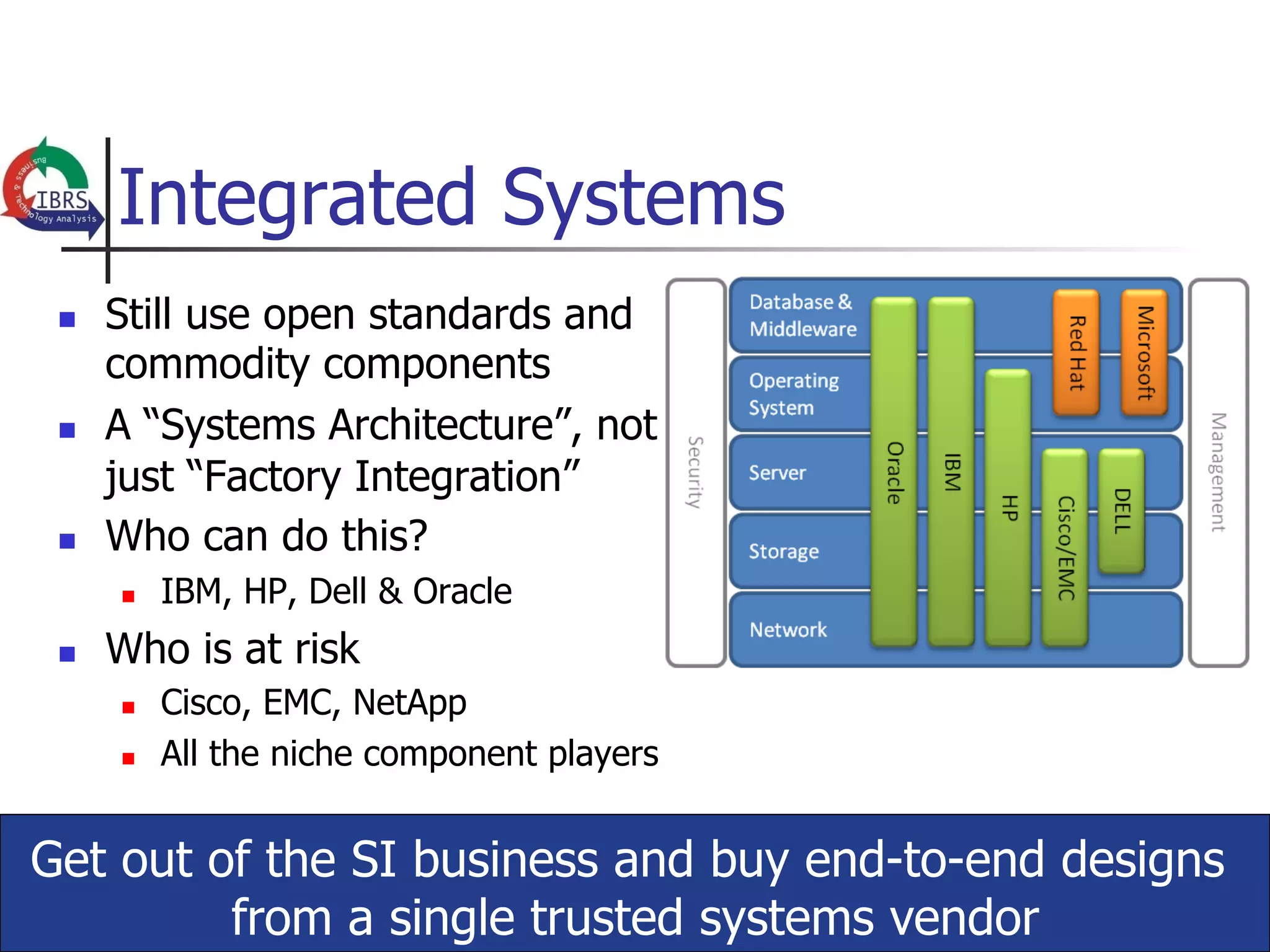
Integrated Systems
 n    Still use open standards and
       commodity components
 n    A “Systems Architecture”, not
       just “Factory Integration”
 n    Who can do this?
       n    IBM, HP, Dell & Oracle
 n    Who is at risk
       n    Cisco, EMC, NetApp
       n    All the niche component players


Get out of the SI business and buy end-to-end designs
         from a single trusted systems vendor
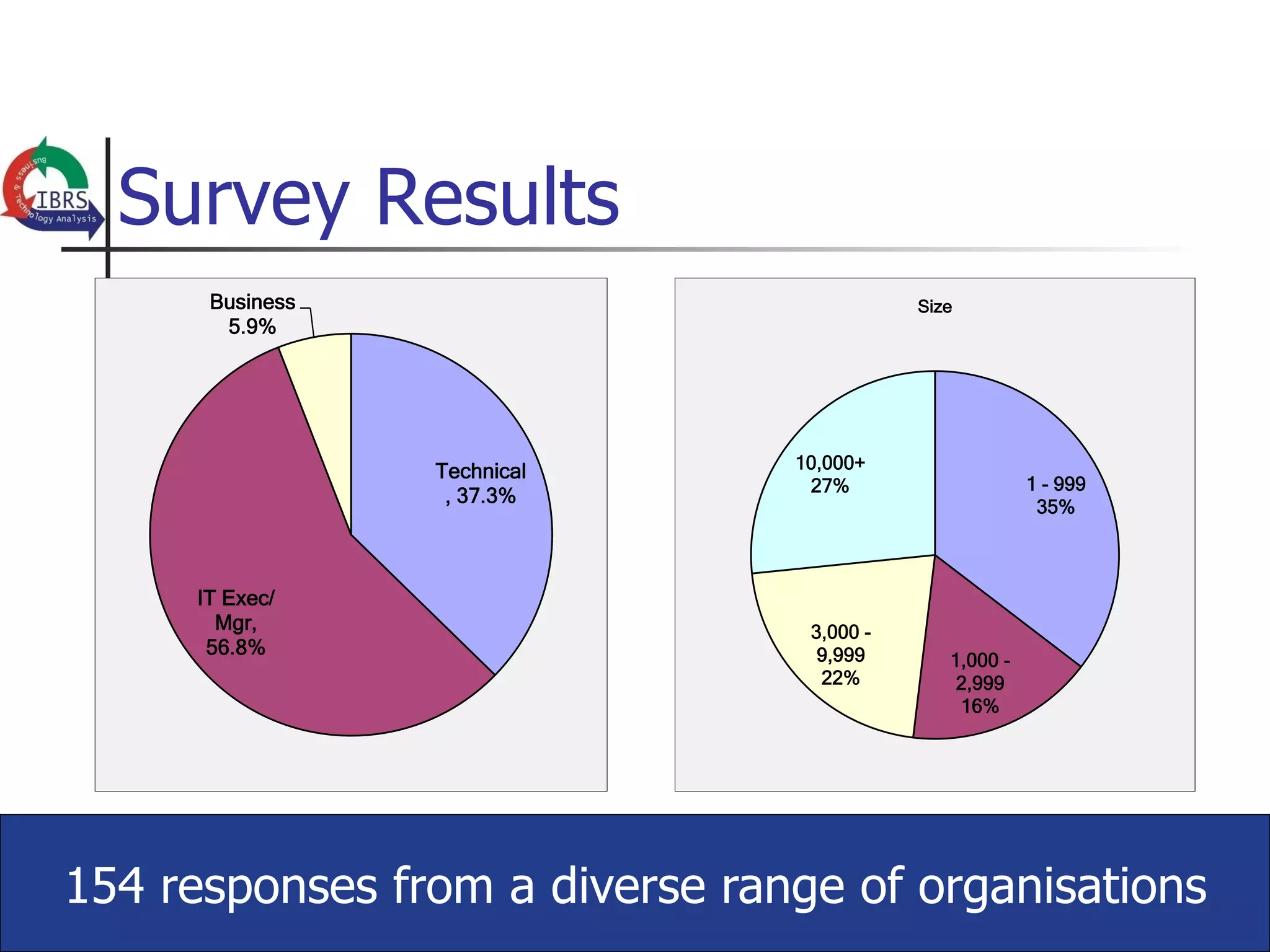
Survey Results
      Business                             Size
       5.9%


                 Technical      10,000+
                                 27%                    1 - 999
                  , 37.3%                                35%


     IT Exec/
       Mgr,                      3,000 -
      56.8%                       9,999       1,000 -
                                  22%          2,999
                                               16%


154 responses from a diverse range of organisations
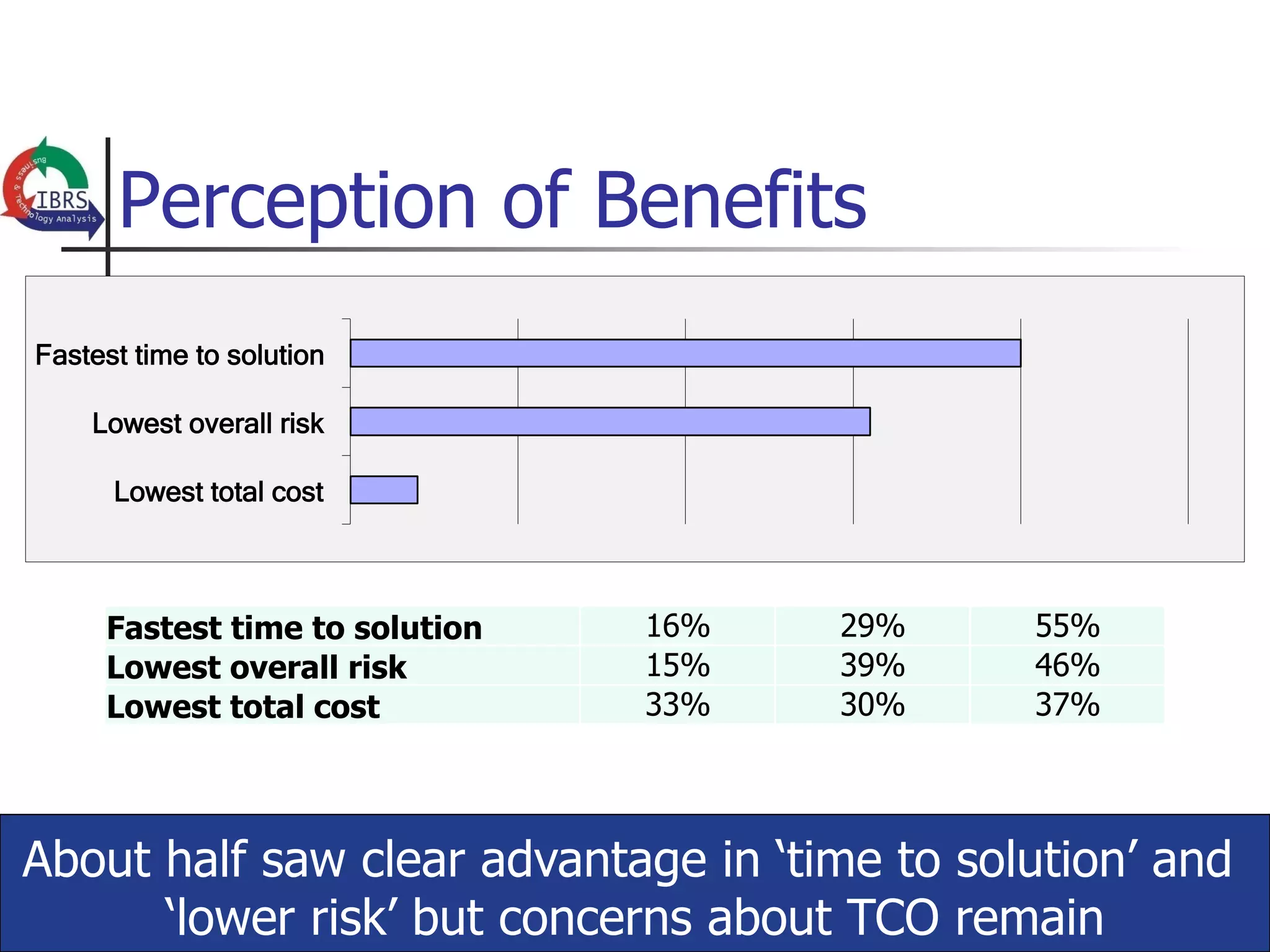
Perception of Benefits
Fastest time to solution

    Lowest overall risk

      Lowest total cost


     Fastest time to solution	
     16%	
     29%	
     55%	
  
     Lowest overall risk	
          15%	
     39%	
     46%	
  
     Lowest total cost	
            33%	
     30%	
     37%	


About half saw clear advantage in ‘time to solution’ and
      ‘lower risk’ but concerns about TCO remain
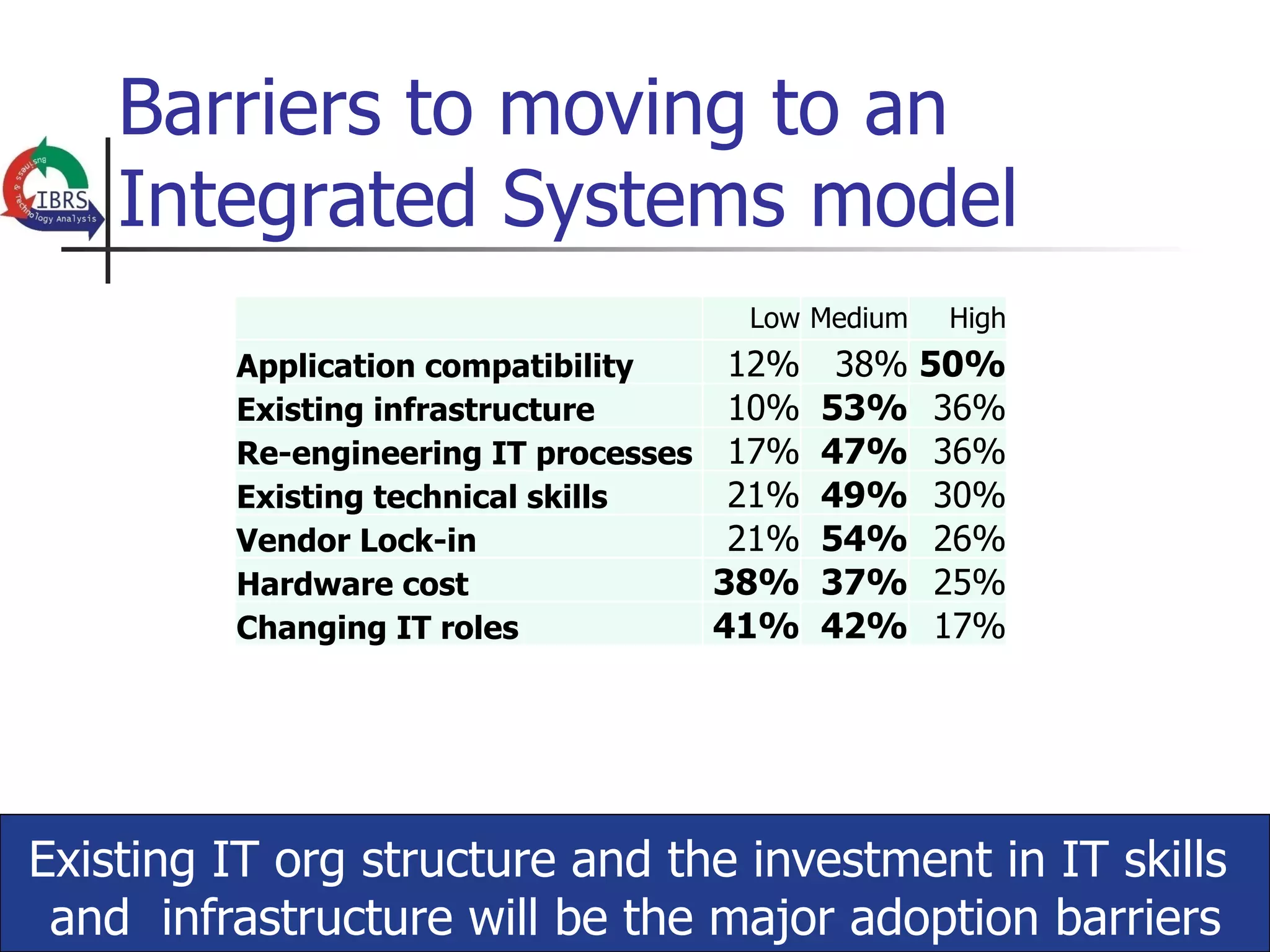
Barriers to moving to an
    Integrated Systems model
                                           Low Medium   High
         Application compatibility    12%	
   38%	
  50%	
  
         Existing infrastructure      10%	
   53%	
   36%	
  
         Re-engineering IT processes 17%	
   47%	
   36%	
  
         Existing technical skills    21%	
   49%	
   30%	
  
         Vendor Lock-in               21%	
   54%	
   26%	
  
         Hardware cost               38%	
   37%	
   25%	
  
         Changing IT roles           41%	
   42%	
   17%	


Existing IT org structure and the investment in IT skills
 and infrastructure will be the major adoption barriers
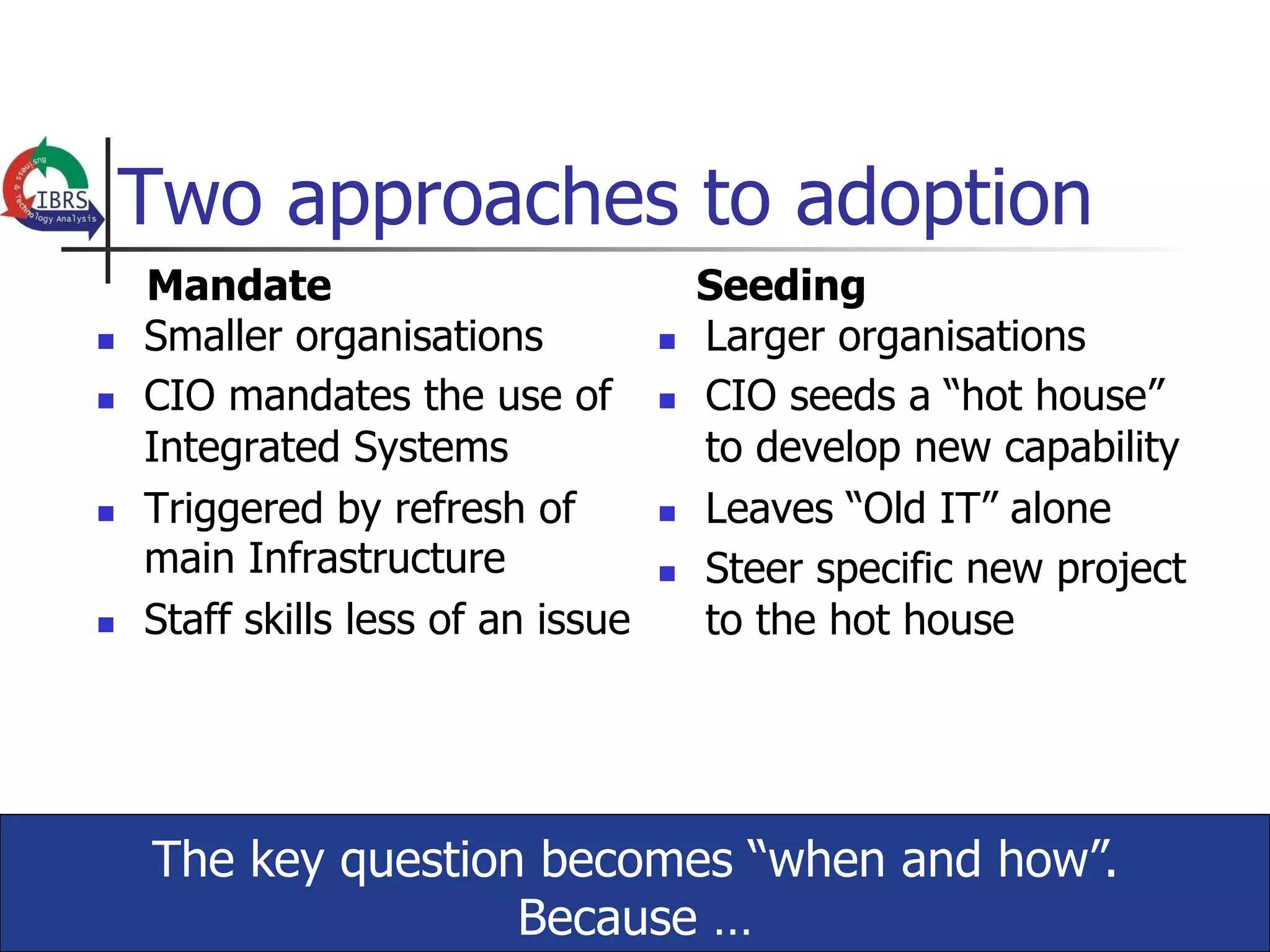
Two approaches to adoption
      Mandate                               Seeding
n    Smaller organisations           n    Larger organisations
n    CIO mandates the use of         n    CIO seeds a “hot house”
      Integrated Systems                    to develop new capability
n    Triggered by refresh of         n    Leaves “Old IT” alone
      main Infrastructure             n    Steer specific new project
n    Staff skills less of an issue         to the hot house


      The key question becomes “when and how”.
                      Because …
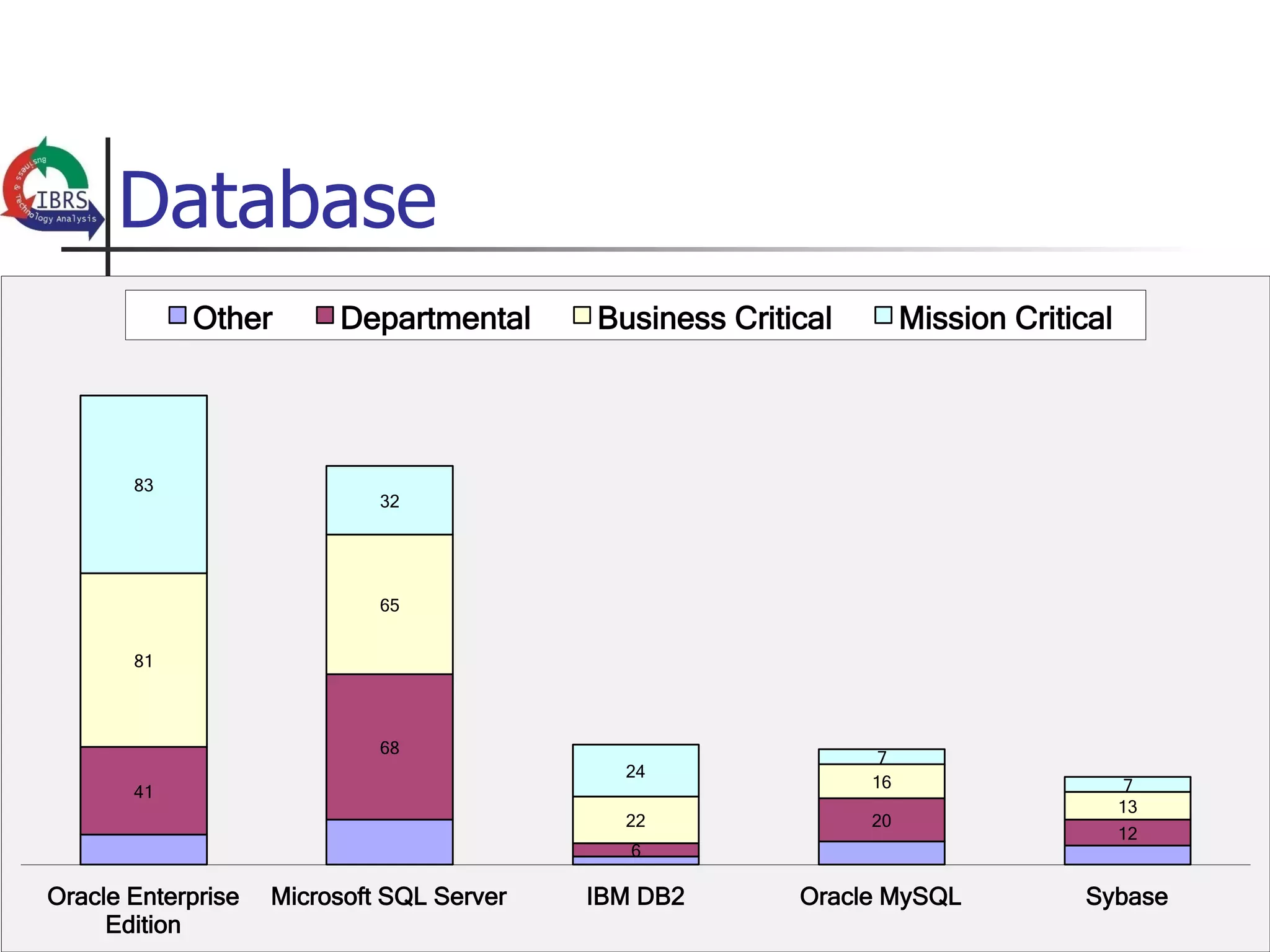
Database
            Other        Departmental      Business Critical        Mission Critical


       83
                             32


                             65


       81


                             68
                                                                7
                                             24
                                                               16                       7
       41
                                                                                       13
                                             22                20
                                                                                       12
                                              6

Oracle Enterprise   Microsoft SQL Server   IBM DB2       Oracle MySQL            Sybase
     Edition
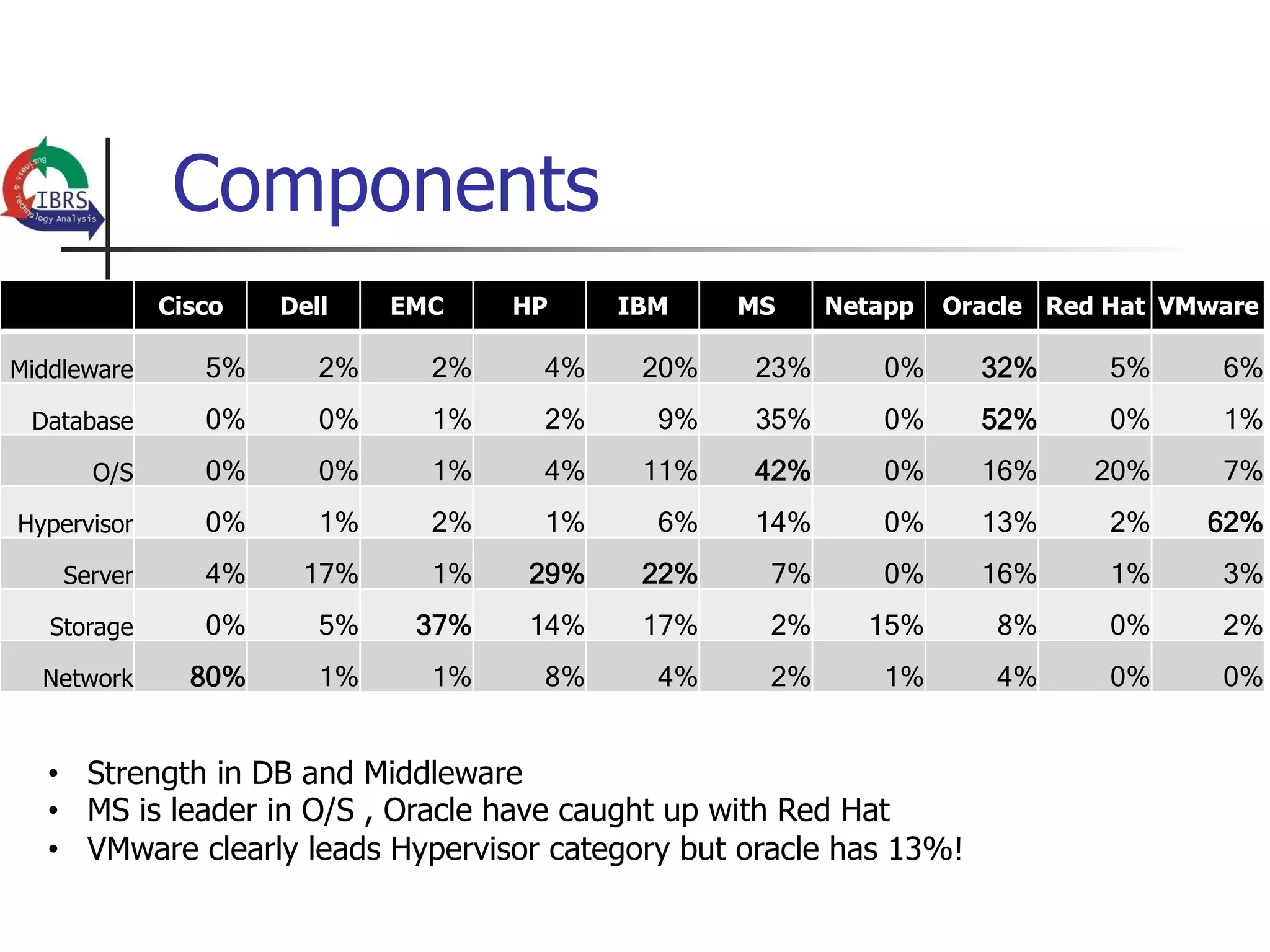
Components
             Cisco   Dell    EMC    HP    IBM     MS     Netapp   Oracle Red Hat VMware

Middleware      5%      2%     2%    4%    20%     23%      0%       32%     5%     6%
 Database       0%      0%     1%    2%     9%     35%      0%       52%     0%     1%
      O/S       0%      0%     1%    4%    11%     42%      0%       16%    20%     7%
Hypervisor      0%      1%     2%    1%     6%     14%      0%       13%     2%    62%
    Server      4%    17%      1%   29%    22%      7%      0%       16%     1%     3%
   Storage      0%      5%    37%   14%    17%      2%     15%       8%      0%     2%
  Network      80%      1%     1%    8%     4%      2%      1%       4%      0%     0%


   •  Strength in DB and Middleware
   •  MS is leader in O/S , Oracle have caught up with Red Hat
   •  VMware clearly leads Hypervisor category but oracle has 13%!
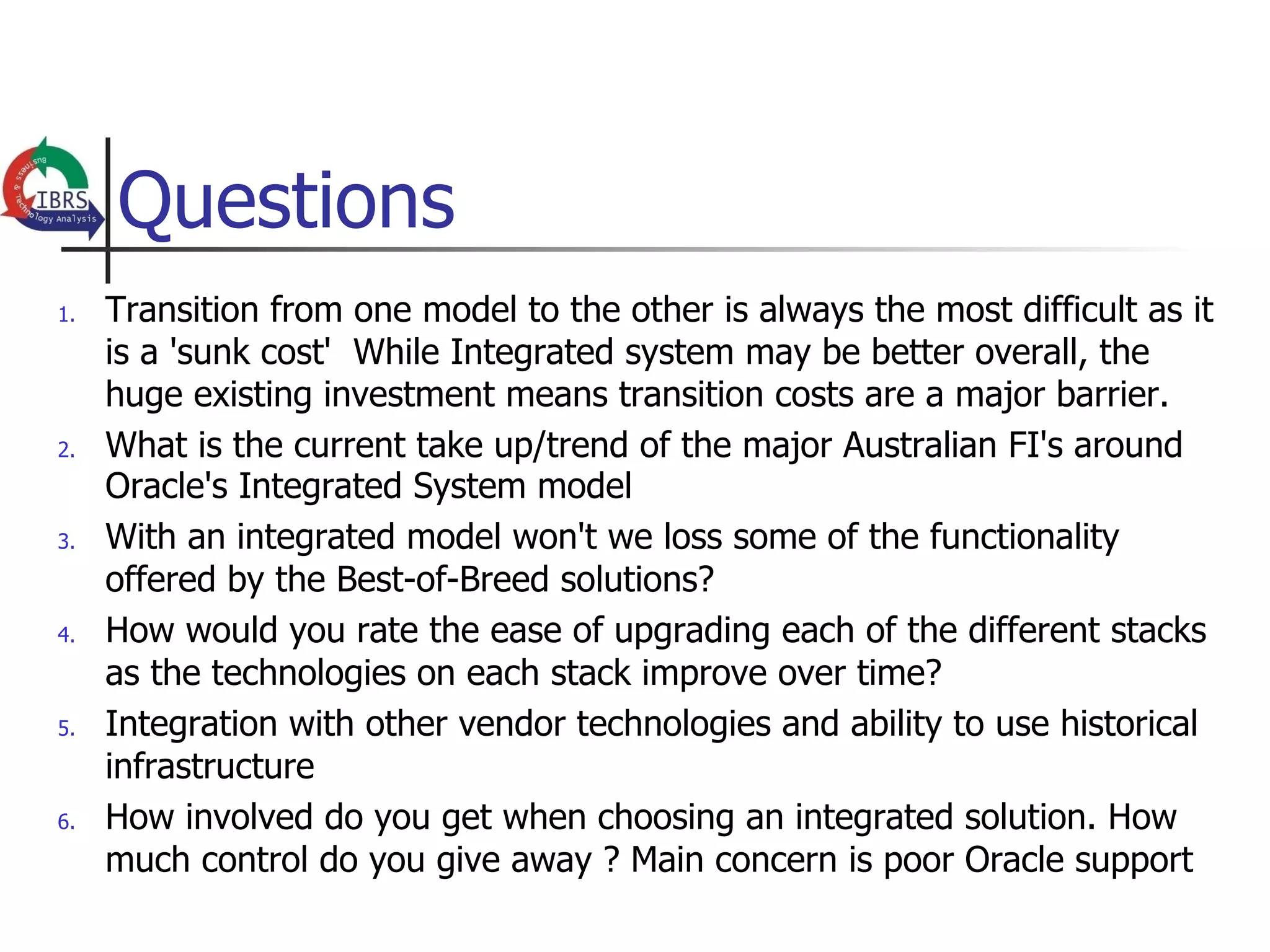
Questions
1.    Transition from one model to the other is always the most difficult as it
      is a 'sunk cost' While Integrated system may be better overall, the
      huge existing investment means transition costs are a major barrier.
2.    What is the current take up/trend of the major Australian FI's around
      Oracle's Integrated System model
3.    With an integrated model won't we loss some of the functionality
      offered by the Best-of-Breed solutions?
4.    How would you rate the ease of upgrading each of the different stacks
      as the technologies on each stack improve over time?
5.    Integration with other vendor technologies and ability to use historical
      infrastructure
6.    How involved do you get when choosing an integrated solution. How
      much control do you give away ? Main concern is poor Oracle support
Questions
1.    What type of resources are needed to support the Integrated
      systems model
2.    Should Customers be more concerned about vendor lock in when
      following an integrated systems model? If not, why not?
3.    By removing the Design and Integration layers of the model, how
      can we ensure the technologies align with business requirements? Is
      there an expectation that the business will follow the technology?
4.    What plans does Oracle have to eliminate complexity of licensing and
      provide financial incentive to leverage an integrated stack ? Why the
      Oracle licencing model is so complex? Why is Oracle so expensive?
5.    Is going Oracle to support small business or target Corporate clients
      only?
The IT landscape has changed.
Have you?

       Dr Kevin McIsaac
        kmcisaac@ibrs.com.au
          www.ibrs.com.au

Oracle Systems _ Kevin Mcisaac _ The IT Landscape has changes - have you_.pdf

  • 1.
    The IT landscapehas changed. Have you? Dr Kevin McIsaac kmcisaac@ibrs.com.au www.ibrs.com.au
  • 2.
    The Mega Trends n  The three iron laws of IT that drive infrastructure n  Cloud Computing as seen from above n  Integrated Systems: why the infrastructure of the future looks a lot like the infrastructure of the past!
  • 3.
    Moore’s Law n  Massive growth in computation, dramatic decline in unit cost n  Problem is no longer CPU power or processing costs n  Issues are power efficiency, utilisation and I/O performance n  Number of cores doubles every 18 months n  10 core x64 CPUs today n  200+ cores/blade enclosure n  Tri-gate transistors, better power and performance n  Fortunately DBMS, App Server & Web Servers and Hypervisors already scale to 100’s of cores!
  • 4.
    Server Virtualisation ANZ Production Apps 30 n  Exploits Moore's law 20 % n  Drives server consolidation n  Improves utilization & power efficiently 10 n  Leverage for HA, DR and CO 0 n  Then move to policy and automation n  Mainstream but 60% have not virtualised mission critical apps n  Licencing n  vSphere 5.0 changes n  Application licencing n  Oracle OVM
  • 5.
    Database consolidation n  Another way to exploit Moore’s law n  VMs vs. Instance vs. Schema n  O/S & DB version n  Patching and upgrading n  Workload compatibility n  Capacity management
  • 6.
    Shugart’s Law n  Cost per bit halves every 18 months n  About 37% pa or 10% per quarter n  Delaying 1 quarter can save you 10% n  Constrains storage capital costs n  On a 4 year H/W lifecycle a flat budget supports 60%pa data growth n  Has enabled massive storage growth but… n  Management complexity n  Performance issues n  3TB SATA this year n  How do you exploit large, slow, cheap drives n  Performance becomes is an issue n  Oracle ASM
  • 7.
    Disruption of Storage n  Evolution of storage arrays n  Commodity hardware, i.e., x64 servers n  SATA for capacity mixed with Flash Cache for perf n  Deduplication & Snapshots for storage optimisation n  Clustered architecture & virtual appliances n  Examples n  HP Left Hand & VMware vSA n  Oracle zFS fileservers n  Oracle Exadata Storage for DB n  IBM XIV n  Disrupts current vendors/market n  Like M/F vs. UNIX/RISC vs. Wintel/Lintel n  Look beyond traditional modular storage
  • 8.
    Storage Virtualisation n  Network based storage virtualisation has limited adoption n  Additional cost is a major barrier (4K-6K/TB?) n  Need to be very, very large to justify cost/benefit n  Vendors: IBM (SVC), HP, EMC v-Plex n  EMC new to this market the market with v-Plex n  Use cases n  Mostly used for data migration (SVC) n  Cloud providers with unpredictable workloads.
  • 9.
    Gilder's Law n  Optical fiber bandwidth doubles every 12 months n  Is driving IT centralisation n  Branch offices are next n  What impact will the NBN have on your WAN strategy? n  What every you believe about networking now will be wrong in 7 years
  • 10.
    Converged Networking n  Core FCoE & CEE standards ratified n  Barriers n  Major vendors have products n  Existing large scale investment in Fibre n  Dominant storage protocol in long-run Channel n  Demand driven by workload density n  Cuts across server, storage and networks silos, potentially changes the n  Moore’s Law and Virtualisation roles and relationships of these teams. n  Benefits n  Use an incremental adoption strategy, Lower capital costs from lower port, High density servers use a converged n  n  switch and cabling requirements network at the server edge. Greater I/O flexibility from dynamic Integrate into the existing FC & n  n  sharing of a higher bandwidth, Ethernet infrastructures common transport layer n  Displace FC switches over time n  Capacity can be optimised and used more effectively
  • 11.
    Cloud Computing •  Different ways of thinking about the cloud •  How do clients view “The cloud”? •  What does the business want
  • 12.
    Cloud as Technology •  Virtual machines •  Clusters •  Multi-tenancy •  Internet •  Web Protocols Its time to stop thinking about the Cloud as a technology
  • 13.
    Cloud as Services n  What is the cloud? •  IaaS •  PaaS •  SaaS •  Public/private Think about the Cloud as an aspiration to create a “better IT environment”
  • 14.
    Cloud as Capabilities Self-Service Commodity Cost pricing Transparency Location & Capacity on Device Demand Independence Utility Pricing Think about Cloud as new capabilities that are aligned to the business’ needs
  • 15.
    The Cloud asa Journey n  Levels of capability •  Where are you now? •  Where do you need to be? •  Strategy for getting there? Think of the Cloud as a journey to these new capabilities. Where do I start and where do I stop?
  • 16.
    What are clientsthinking •  The cloud is not clearly defined in user’s minds •  Each vendor defines it around their own product sets •  It means very different things to different people •  IaaS, SaaS, Public, Private etc •  Many business and IT people are uncomfortable with •  Security, governance, compliance & cost •  Often this is perception, rather than reality Potential for significant misunderstandings between users, vendors and partners
  • 17.
    What does thebusiness want? •  They are interested in the benefits of the cloud not the technology, i.e., •  A more agile, more efficient IT infrastructure •  Increased robustness, i.e., HA, DR, Continuous Operations •  Transforming IT from a CapEx intensive fixed asset to a OpEx based utility •  Self-service, transparent pricing Talk about Service Capabilities and Benefits, not Technology Features and Functions
  • 18.
    The IT landscapehas changed. Have you? Dr Kevin McIsaac kmcisaac@ibrs.com.au www.ibrs.com.au
  • 19.
    The empire, longdivided, must unite; long united, must divide. Thus it has ever been. -- Three Kingdoms
  • 20.
    Layered Components n  Started in ‘80s with Open Systems n  Layers defined by standards n  Pros: Vendor competition drives n  Lower component cost n  Innovation at each layer n  Drawbacks: IT becomes an SI! n  Defines specs, n  Integrates components, n  Maintains integration across disparate product lifecycles System integration costs and times now outweigh the benefits of competition
  • 21.
    Integrated Systems n  Still use open standards and commodity components n  A “Systems Architecture”, not just “Factory Integration” n  Who can do this? n  IBM, HP, Dell & Oracle n  Who is at risk n  Cisco, EMC, NetApp n  All the niche component players Get out of the SI business and buy end-to-end designs from a single trusted systems vendor
  • 22.
    Survey Results Business Size 5.9% Technical 10,000+ 27% 1 - 999 , 37.3% 35% IT Exec/ Mgr, 3,000 - 56.8% 9,999 1,000 - 22% 2,999 16% 154 responses from a diverse range of organisations
  • 23.
    Perception of Benefits Fastesttime to solution Lowest overall risk Lowest total cost Fastest time to solution   16%   29%   55%   Lowest overall risk   15%   39%   46%   Lowest total cost   33%   30%   37%   About half saw clear advantage in ‘time to solution’ and ‘lower risk’ but concerns about TCO remain
  • 24.
    Barriers to movingto an Integrated Systems model Low Medium High Application compatibility 12%   38%  50%   Existing infrastructure 10%   53%   36%   Re-engineering IT processes 17%   47%   36%   Existing technical skills 21%   49%   30%   Vendor Lock-in 21%   54%   26%   Hardware cost 38%   37%   25%   Changing IT roles 41%   42%   17%   Existing IT org structure and the investment in IT skills and infrastructure will be the major adoption barriers
  • 25.
    Two approaches toadoption Mandate Seeding n  Smaller organisations n  Larger organisations n  CIO mandates the use of n  CIO seeds a “hot house” Integrated Systems to develop new capability n  Triggered by refresh of n  Leaves “Old IT” alone main Infrastructure n  Steer specific new project n  Staff skills less of an issue to the hot house The key question becomes “when and how”. Because …
  • 26.
    Database Other Departmental Business Critical Mission Critical 83 32 65 81 68 7 24 16 7 41 13 22 20 12 6 Oracle Enterprise Microsoft SQL Server IBM DB2 Oracle MySQL Sybase Edition
  • 27.
    Components Cisco Dell EMC HP IBM MS Netapp Oracle Red Hat VMware Middleware 5% 2% 2% 4% 20% 23% 0% 32% 5% 6% Database 0% 0% 1% 2% 9% 35% 0% 52% 0% 1% O/S 0% 0% 1% 4% 11% 42% 0% 16% 20% 7% Hypervisor 0% 1% 2% 1% 6% 14% 0% 13% 2% 62% Server 4% 17% 1% 29% 22% 7% 0% 16% 1% 3% Storage 0% 5% 37% 14% 17% 2% 15% 8% 0% 2% Network 80% 1% 1% 8% 4% 2% 1% 4% 0% 0% •  Strength in DB and Middleware •  MS is leader in O/S , Oracle have caught up with Red Hat •  VMware clearly leads Hypervisor category but oracle has 13%!
  • 28.
    Questions 1.  Transition from one model to the other is always the most difficult as it is a 'sunk cost' While Integrated system may be better overall, the huge existing investment means transition costs are a major barrier. 2.  What is the current take up/trend of the major Australian FI's around Oracle's Integrated System model 3.  With an integrated model won't we loss some of the functionality offered by the Best-of-Breed solutions? 4.  How would you rate the ease of upgrading each of the different stacks as the technologies on each stack improve over time? 5.  Integration with other vendor technologies and ability to use historical infrastructure 6.  How involved do you get when choosing an integrated solution. How much control do you give away ? Main concern is poor Oracle support
  • 29.
    Questions 1.  What type of resources are needed to support the Integrated systems model 2.  Should Customers be more concerned about vendor lock in when following an integrated systems model? If not, why not? 3.  By removing the Design and Integration layers of the model, how can we ensure the technologies align with business requirements? Is there an expectation that the business will follow the technology? 4.  What plans does Oracle have to eliminate complexity of licensing and provide financial incentive to leverage an integrated stack ? Why the Oracle licencing model is so complex? Why is Oracle so expensive? 5.  Is going Oracle to support small business or target Corporate clients only?
  • 30.
    The IT landscapehas changed. Have you? Dr Kevin McIsaac kmcisaac@ibrs.com.au www.ibrs.com.au