Cloud Computing
  Is it right for you?
John Craddock   johncra@xtseminars.co.uk
What is Cloud Computing?
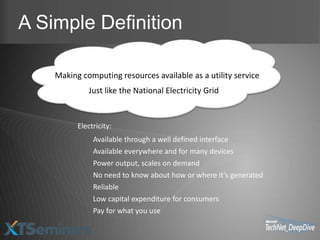
A Simple Definition

    Making computing resources available as a utility service
             Just like the National Electricity Grid


          Electricity:
               Available through a well defined interface
               Available everywhere and for many devices
               Power output, scales on demand
               No need to know about how or where it’s generated
               Reliable
               Low capital expenditure for consumers
               Pay for what you use
Not All Clouds Are Right for You
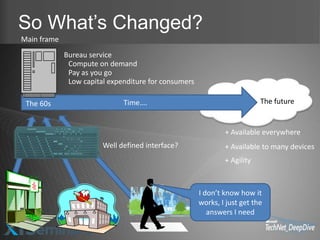
So What’s Changed?
Main frame
             Bureau service
              Compute on demand
              Pay as you go
              Low capital expenditure for consumers

 The 60s                      Time….                                      The future


                                                              + Available everywhere
                        Well defined interface?               + Available to many devices
                                                              + Agility


                                                      I don’t know how it
                                                      works, I just get the
                                                         answers I need
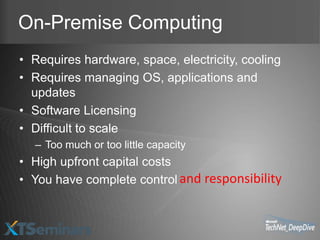
On-Premise Computing
• Requires hardware, space, electricity, cooling
• Requires managing OS, applications and
  updates
• Software Licensing
• Difficult to scale
  – Too much or too little capacity
• High upfront capital costs
• You have complete control and responsibility
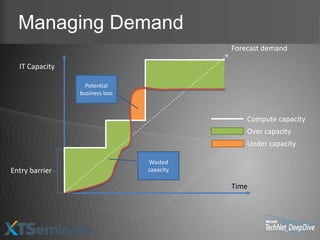
Managing Demand
                                           Forecast demand

  IT Capacity

                  Potential
                business loss


                                               Compute capacity
                                               Over capacity
                                               Under capacity

                                Wasted
Entry barrier                   capacity

                                           Time
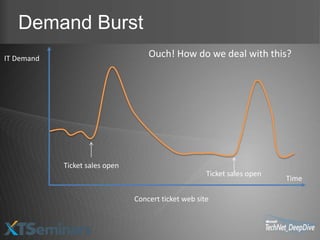
Demand Burst
IT Demand                           Ouch! How do we deal with this?


            Ticket sales open
                                                      Ticket sales open
                                                                          Time

                                Concert ticket web site
IT Agility
• How quickly can you
  – Scale up the infrastructure and applications?
  – Upgrade to the latest OS?
  – Respond to a company merger with new
    requirements for business process and IT capacity?
  – Respond to a divestiture
Cloud Computing
•   Shared, multi-tenant environment
•   Pools of computing resources
•   Resources can be requested as required
•   Available via the Internet
    – Private clouds can be available via private WAN
• Pay as you go
Cloud Services


  Software as a Service (SaaS)
  Platform as a Service (PaaS)
Infrastructure as a Service (IaaS)
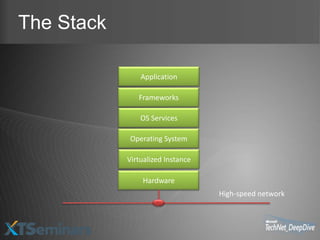
The Stack

                Application

               Frameworks

                OS Services

            Operating System

            Virtualized Instance

                Hardware
                                   High-speed network
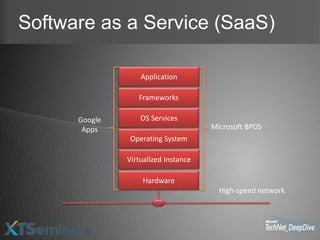
Software as a Service (SaaS)

                   Application

                  Frameworks

      Google       OS Services
       Apps                           Microsoft BPOS
               Operating System

               Virtualized Instance

                   Hardware
                                        High-speed network
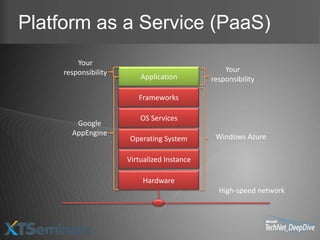
Platform as a Service (PaaS)
         Your
     responsibility                              Your
                          Application        responsibility

                         Frameworks

                          OS Services
        Google
       AppEngine                              Windows Azure
                      Operating System

                      Virtualized Instance

                          Hardware
                                               High-speed network
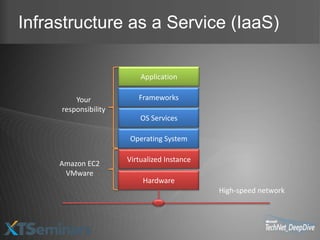
Infrastructure as a Service (IaaS)

                          Application

         Your            Frameworks
     responsibility
                          OS Services

                      Operating System

                      Virtualized Instance
     Amazon EC2
      VMware
                          Hardware
                                             High-speed network
Many Players in the Game
• To name a few
  – SaaS: Microsoft, Salesforce, Zimra, Oracle, Cisco,
    Google Apps
  – PaaS: Microsoft, Force.com, Spring Source, Google
    App Engine
  – IaaS: Amazon, IBM, VMware
• Expect change, the cloud is just beginning…
• In the future expect to see all large vendors
  riding the complete stack
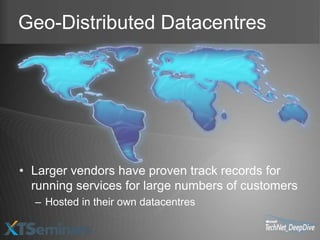
Geo-Distributed Datacentres


• Larger vendors have proven track records for
  running services for large numbers of customers
  – Hosted in their own datacentres
An example of SaaS
Let’s look at Microsoft BPOS
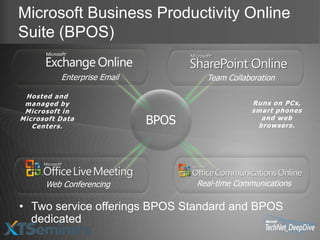
Microsoft Business Productivity Online
Suite (BPOS)

          Enterprise Email            Team Collaboration

 Hosted and
 managed by                                       Runs on PCs,
 Microsoft in                                     smart phones
Microsoft Data
   Centers.
                             BPOS                   and web
                                                   browsers.


      Web Conferencing              Real-time Communications

• Two service offerings BPOS Standard and BPOS
  dedicated
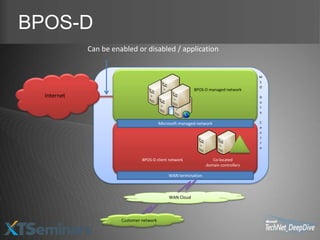
BPOS-D
             Can be enabled or disabled / application


                                                                                     M
                                                                                     S
                                                                                     O
                                                          BPOS-D managed network
  Internet                                                                           D
                                                                                     a
                                                                                     t
                                                                                     a


                                          Microsoft managed network                  C
                                                                                     e
                                                                                     n
                                                                                     t
                                                                                     r
                                                                                     e


                                BPOS-D client network              Co-located
                                                                domain controllers

                                              WAN termination


                                              WAN Cloud


                       Customer network
What We Get With SaaS
•   Lower capital expenditure
•   Fixed operational costs
•   Scalability
•   Reclaimed real estate
•   Innovation
    – Many vendors will have a forever green policy
       • Make sure it’s not forever beta
• Lower carbon footprint
    – Reduced power and cooling
• Agility
    – Customers get new services in months rather than years
What To Watch
• You are relinquishing control and responsibility to
  the vendor by moving the service to the Cloud
• For this to be a valid business proposition you must
  TRUST the vendor to deliver what they say they will
   – Financial penalties for failing to meet SLA are normally
     equated to service credits
      • May well be much less value than your business loss due to a
        failure
• Many solutions appear attractive because of the
  bottom line pay/user price
   – Buyer beware!
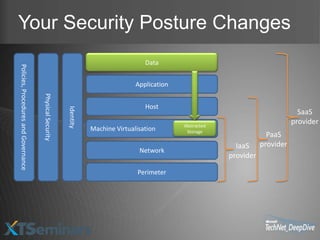
Your Security Posture Changes
                                                                                       Data
Policies, Procedures and Governance


                                                                                    Application
                                      Physical Security


                                                                                       Host
                                                          Identity


                                                                                                                                       SaaS
                                                                                                  Abstracted
                                                                                                                                     provider
                                                                     Machine Virtualisation        Storage
                                                                                                                            PaaS
                                                                                                                 IaaS     provider
                                                                                     Network
                                                                                                               provider

                                                                                    Perimeter
Does Their Security Match Your
Requirements?
• For 9X% of organizations, the Cloud providers
  probably offer better
  – Physical security
  – Policies, operational procedures and governance
  – And where supplied, OS and application updates
• In most cases you will not be allowed to audit
  this
  – You will have to trust that they operate to the
    standards that they state
     • This may be backed by a yearly independent audit, ask to
       see it
Data Compliance is Paramount
• How and where is it stored?
• How is it backed up and restored?
• Is data archived and what are the retention and
  disposal policies?
  – Do you have an on-premise policy?
• Is access audited and can you view the logs?
• What are the breach notification procedures?
  – Will they help you if litigation ensues
• Does the provider match your legal and
  compliance requirements?
It’s Up to You
• Just a few topics to get you thinking
   – There’s more…
• Only you will know if a Cloud solution is going to
  meet the security requirements of your
  organization
                Before you say NO
  Remember, security is about the pragmatic balance
 between keeping the bad guys out and allowing your
   organisation to be agile and operational efficient
My Final Tip
• Negotiate the contract and SLA from a position
  of strength
   – Know exactly what’s on offer
• Don’t assume that because you can do
  something with an on-premise enterprise
  application it will be available via the Cloud
• Read the small print
   “Downtime Period” means, for a domain, a period of ten consecutive
   minutes of Downtime. Intermittent Downtime for a period of less than ten
   minutes will not be counted towards any Downtime Periods
                                                                Google SLA
An example of PaaS
Let’s look at Microsoft Azure
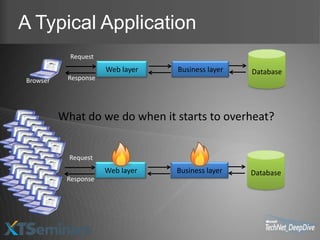
A Typical Application
            Request
                      Web layer   Business layer   Database
Browser    Response


          What do we do when it starts to overheat?


            Request
                      Web layer   Business layer   Database
           Response
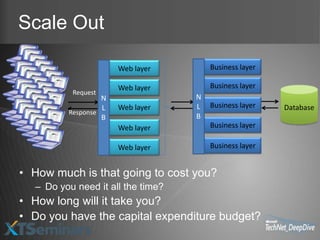
Scale Out

                      Web layer        Business layer

                      Web layer        Business layer
          Request
                  N                N
                  L   Web layer    L   Business layer   Database
         Response
                  B                B
                      Web layer        Business layer

                      Web layer        Business layer


• How much is that going to cost you?
  – Do you need it all the time?
• How long will it take you?
• Do you have the capital expenditure budget?
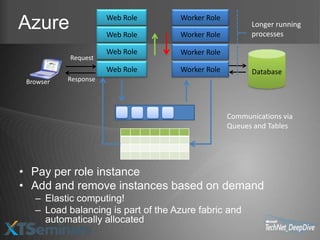
Web Role      Worker Role
Azure                 Web Role      Worker Role
                                                        Longer running
                                                        processes

                      Web Role      Worker Role
           Request
                      Web Role      Worker Role         Database
 Browser   Response


                                                  Communications via
                                                  Queues and Tables


• Pay per role instance
• Add and remove instances based on demand
   – Elastic computing!
   – Load balancing is part of the Azure fabric and
     automatically allocated
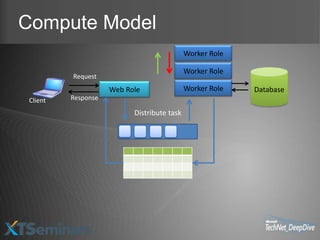
Compute Model
                                             Worker Role

                                             Worker Role
          Request
                     Web Role                Worker Role   Database
 Client   Response

                           Distribute task
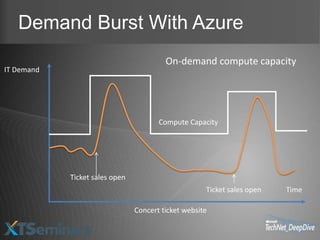
Demand Burst With Azure
                                         On-demand compute capacity
IT Demand


                                       Compute Capacity


            Ticket sales open
                                                     Ticket sales open   Time

                                Concert ticket website
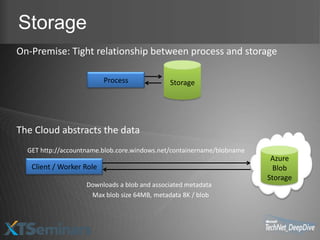
Storage
On-Premise: Tight relationship between process and storage

                          Process             Storage


The Cloud abstracts the data
  GET http://accountname.blob.core.windows.net/containername/blobname
                                                                         Azure
   Client / Worker Role                                                   Blob
                                                                        Storage
                    Downloads a blob and associated metadata
                     Max blob size 64MB, metadata 8K / blob
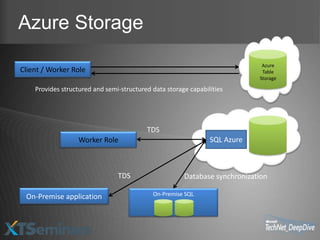
Azure Storage
                                                                             Azure
Client / Worker Role                                                         Table
                                                                            Storage

    Provides structured and semi-structured data storage capabilities


                                          TDS
                   Worker Role                                  SQL Azure


                                TDS                    Database synchronization

 On-Premise application                     On-Premise SQL
What We Get With PaaS
• An elastic computing platform
• Connect from anywhere, with any device
• Low barrier costs to deploying new applications
   – Rapid provisioning
• Pay as you go
   – Operational costs directly related to profit
• A marketplace through which to sell our services
   – Customers continue to pay as long as they use our
     services
   – Stop paying, stop providing service
      • No chance of licence abuse
What To Watch
• Check your security policies can be satisfied by
  the Cloud provider
• Does the SLA meet availability requirements?
• Don’t just port an existing app that have been
  sitting within your security perimeter
  – Make sure it has been engineered for Internet
    security
     • Follow Security Development Lifecycle (SDL) best practices
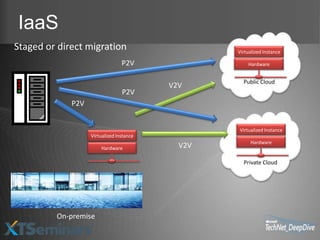
IaaS
Staged or direct migration                        Virtualized Instance

                                 P2V                  Hardware


                                                    Public Cloud
                                          V2V
                                 P2V
             P2V


                                                  Virtualized Instance
                   Virtualized Instance
                                                       Hardware
                       Hardware             V2V

                                                    Private Cloud


         On-premise
What to Watch?
• Check your security policies can be satisfied by
  the Cloud provider
• Does the SLA meet availability requirements?
• You are now porting your OS and upper stack
  – You will need to maintain it


             Remember the Cloud is its infancy
                    It’s immature
             We all have lots to learn
So everything is in the Cloud
     What do we do?


  Innovate
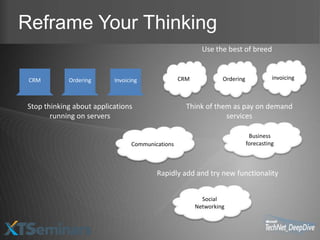
Reframe Your Thinking
                                                         Use the best of breed


 CRM        Ordering      Invoicing              CRM            Ordering             invoicing


Stop thinking about applications                   Think of them as pay on demand
       running on servers                                      services

                                                                            Business
                                Communications                             forecasting


                                        Rapidly add and try new functionality


                                                         Social
                                                       Networking
New Business Opportunities

                             ?

        Test out new ideas with small upfront costs

 Can you sell in-house expertise by packaging as a service?
            If you need to scale rapidly, you can


           More operational cost = More profit
Federate Identity
• We need to have an Identity that will be trusted
  everywhere

• Come to my session at 1:30 today on Active
  Directory Federation Services
Should We Move To The Cloud?
              Can we afford not to?

“By 2012, 80% of Fortune 1000 enterprises will be
 using some cloud computing services, 20% of
 businesses will own no IT assets.”

“The bottom line: Early adopters are finding serious
 benefits, meaning that cloud computing is real and
 warrants your scrutiny as a new set of platforms for
 business applications.”
So What is Cloud Computing?

             It’s a utility
          Providing us with
        New ways of working
        A chance to innovate
         A new market place
I’m in


         Are you?
Enjoy the rest
 of the day
Cloud computing

Cloud computing

  • 2.
    Cloud Computing Is it right for you? John Craddock johncra@xtseminars.co.uk
  • 3.
    What is CloudComputing?
  • 4.
    A Simple Definition Making computing resources available as a utility service Just like the National Electricity Grid Electricity: Available through a well defined interface Available everywhere and for many devices Power output, scales on demand No need to know about how or where it’s generated Reliable Low capital expenditure for consumers Pay for what you use
  • 5.
    Not All CloudsAre Right for You
  • 6.
    So What’s Changed? Mainframe Bureau service Compute on demand Pay as you go Low capital expenditure for consumers The 60s Time…. The future + Available everywhere Well defined interface? + Available to many devices + Agility I don’t know how it works, I just get the answers I need
  • 7.
    On-Premise Computing • Requireshardware, space, electricity, cooling • Requires managing OS, applications and updates • Software Licensing • Difficult to scale – Too much or too little capacity • High upfront capital costs • You have complete control and responsibility
  • 8.
    Managing Demand Forecast demand IT Capacity Potential business loss Compute capacity Over capacity Under capacity Wasted Entry barrier capacity Time
  • 9.
    Demand Burst IT Demand Ouch! How do we deal with this? Ticket sales open Ticket sales open Time Concert ticket web site
  • 10.
    IT Agility • Howquickly can you – Scale up the infrastructure and applications? – Upgrade to the latest OS? – Respond to a company merger with new requirements for business process and IT capacity? – Respond to a divestiture
  • 11.
    Cloud Computing • Shared, multi-tenant environment • Pools of computing resources • Resources can be requested as required • Available via the Internet – Private clouds can be available via private WAN • Pay as you go
  • 12.
    Cloud Services Software as a Service (SaaS) Platform as a Service (PaaS) Infrastructure as a Service (IaaS)
  • 13.
    The Stack Application Frameworks OS Services Operating System Virtualized Instance Hardware High-speed network
  • 14.
    Software as aService (SaaS) Application Frameworks Google OS Services Apps Microsoft BPOS Operating System Virtualized Instance Hardware High-speed network
  • 15.
    Platform as aService (PaaS) Your responsibility Your Application responsibility Frameworks OS Services Google AppEngine Windows Azure Operating System Virtualized Instance Hardware High-speed network
  • 16.
    Infrastructure as aService (IaaS) Application Your Frameworks responsibility OS Services Operating System Virtualized Instance Amazon EC2 VMware Hardware High-speed network
  • 17.
    Many Players inthe Game • To name a few – SaaS: Microsoft, Salesforce, Zimra, Oracle, Cisco, Google Apps – PaaS: Microsoft, Force.com, Spring Source, Google App Engine – IaaS: Amazon, IBM, VMware • Expect change, the cloud is just beginning… • In the future expect to see all large vendors riding the complete stack
  • 18.
    Geo-Distributed Datacentres • Largervendors have proven track records for running services for large numbers of customers – Hosted in their own datacentres
  • 19.
    An example ofSaaS Let’s look at Microsoft BPOS
  • 20.
    Microsoft Business ProductivityOnline Suite (BPOS) Enterprise Email Team Collaboration Hosted and managed by Runs on PCs, Microsoft in smart phones Microsoft Data Centers. BPOS and web browsers. Web Conferencing Real-time Communications • Two service offerings BPOS Standard and BPOS dedicated
  • 21.
    BPOS-D Can be enabled or disabled / application M S O BPOS-D managed network Internet D a t a Microsoft managed network C e n t r e BPOS-D client network Co-located domain controllers WAN termination WAN Cloud Customer network
  • 22.
    What We GetWith SaaS • Lower capital expenditure • Fixed operational costs • Scalability • Reclaimed real estate • Innovation – Many vendors will have a forever green policy • Make sure it’s not forever beta • Lower carbon footprint – Reduced power and cooling • Agility – Customers get new services in months rather than years
  • 23.
    What To Watch •You are relinquishing control and responsibility to the vendor by moving the service to the Cloud • For this to be a valid business proposition you must TRUST the vendor to deliver what they say they will – Financial penalties for failing to meet SLA are normally equated to service credits • May well be much less value than your business loss due to a failure • Many solutions appear attractive because of the bottom line pay/user price – Buyer beware!
  • 24.
    Your Security PostureChanges Data Policies, Procedures and Governance Application Physical Security Host Identity SaaS Abstracted provider Machine Virtualisation Storage PaaS IaaS provider Network provider Perimeter
  • 25.
    Does Their SecurityMatch Your Requirements? • For 9X% of organizations, the Cloud providers probably offer better – Physical security – Policies, operational procedures and governance – And where supplied, OS and application updates • In most cases you will not be allowed to audit this – You will have to trust that they operate to the standards that they state • This may be backed by a yearly independent audit, ask to see it
  • 26.
    Data Compliance isParamount • How and where is it stored? • How is it backed up and restored? • Is data archived and what are the retention and disposal policies? – Do you have an on-premise policy? • Is access audited and can you view the logs? • What are the breach notification procedures? – Will they help you if litigation ensues • Does the provider match your legal and compliance requirements?
  • 27.
    It’s Up toYou • Just a few topics to get you thinking – There’s more… • Only you will know if a Cloud solution is going to meet the security requirements of your organization Before you say NO Remember, security is about the pragmatic balance between keeping the bad guys out and allowing your organisation to be agile and operational efficient
  • 28.
    My Final Tip •Negotiate the contract and SLA from a position of strength – Know exactly what’s on offer • Don’t assume that because you can do something with an on-premise enterprise application it will be available via the Cloud • Read the small print “Downtime Period” means, for a domain, a period of ten consecutive minutes of Downtime. Intermittent Downtime for a period of less than ten minutes will not be counted towards any Downtime Periods Google SLA
  • 29.
    An example ofPaaS Let’s look at Microsoft Azure
  • 30.
    A Typical Application Request Web layer Business layer Database Browser Response What do we do when it starts to overheat? Request Web layer Business layer Database Response
  • 31.
    Scale Out Web layer Business layer Web layer Business layer Request N N L Web layer L Business layer Database Response B B Web layer Business layer Web layer Business layer • How much is that going to cost you? – Do you need it all the time? • How long will it take you? • Do you have the capital expenditure budget?
  • 32.
    Web Role Worker Role Azure Web Role Worker Role Longer running processes Web Role Worker Role Request Web Role Worker Role Database Browser Response Communications via Queues and Tables • Pay per role instance • Add and remove instances based on demand – Elastic computing! – Load balancing is part of the Azure fabric and automatically allocated
  • 33.
    Compute Model Worker Role Worker Role Request Web Role Worker Role Database Client Response Distribute task
  • 34.
    Demand Burst WithAzure On-demand compute capacity IT Demand Compute Capacity Ticket sales open Ticket sales open Time Concert ticket website
  • 35.
    Storage On-Premise: Tight relationshipbetween process and storage Process Storage The Cloud abstracts the data GET http://accountname.blob.core.windows.net/containername/blobname Azure Client / Worker Role Blob Storage Downloads a blob and associated metadata Max blob size 64MB, metadata 8K / blob
  • 36.
    Azure Storage Azure Client / Worker Role Table Storage Provides structured and semi-structured data storage capabilities TDS Worker Role SQL Azure TDS Database synchronization On-Premise application On-Premise SQL
  • 37.
    What We GetWith PaaS • An elastic computing platform • Connect from anywhere, with any device • Low barrier costs to deploying new applications – Rapid provisioning • Pay as you go – Operational costs directly related to profit • A marketplace through which to sell our services – Customers continue to pay as long as they use our services – Stop paying, stop providing service • No chance of licence abuse
  • 38.
    What To Watch •Check your security policies can be satisfied by the Cloud provider • Does the SLA meet availability requirements? • Don’t just port an existing app that have been sitting within your security perimeter – Make sure it has been engineered for Internet security • Follow Security Development Lifecycle (SDL) best practices
  • 39.
    IaaS Staged or directmigration Virtualized Instance P2V Hardware Public Cloud V2V P2V P2V Virtualized Instance Virtualized Instance Hardware Hardware V2V Private Cloud On-premise
  • 40.
    What to Watch? •Check your security policies can be satisfied by the Cloud provider • Does the SLA meet availability requirements? • You are now porting your OS and upper stack – You will need to maintain it Remember the Cloud is its infancy It’s immature We all have lots to learn
  • 41.
    So everything isin the Cloud What do we do? Innovate
  • 42.
    Reframe Your Thinking Use the best of breed CRM Ordering Invoicing CRM Ordering invoicing Stop thinking about applications Think of them as pay on demand running on servers services Business Communications forecasting Rapidly add and try new functionality Social Networking
  • 43.
    New Business Opportunities ? Test out new ideas with small upfront costs Can you sell in-house expertise by packaging as a service? If you need to scale rapidly, you can More operational cost = More profit
  • 44.
    Federate Identity • Weneed to have an Identity that will be trusted everywhere • Come to my session at 1:30 today on Active Directory Federation Services
  • 45.
    Should We MoveTo The Cloud? Can we afford not to? “By 2012, 80% of Fortune 1000 enterprises will be using some cloud computing services, 20% of businesses will own no IT assets.” “The bottom line: Early adopters are finding serious benefits, meaning that cloud computing is real and warrants your scrutiny as a new set of platforms for business applications.”
  • 46.
    So What isCloud Computing? It’s a utility Providing us with New ways of working A chance to innovate A new market place
  • 47.
    I’m in Are you?
  • 48.
    Enjoy the rest of the day