Ashwini Rathod
WORLD OPTOMETRY DAY
23 MARCH 2020
“……..the eye is the window of the body through which
it feels its way and enjoy the beauty of the world.
Owing to the eye the soul is content to stay in its bodily
prison, for without it such bodily prison is torture.”
Leonardo da vinci -
(1452-1519)
WHAT IS OPTOMETRY ?
• Optometry is defined by the World Council of
Optometry (WCO) as follows:
• “Optometry is a healthcare profession that is
autonomous, educated, and regulated
(licensed/registered), and optometrists are the primary
healthcare practitioners of the eye and visual system
who provide comprehensive eye and vision care, which
includes refraction and dispensing, detection/diagnosis
and management of disease in the eye and the
rehabilitation of condition of the visual system.”
WORD OPTOMETRY
• It comes from Greek Word
• Opsis + Metron
( Opsis means view and Metron means
rule/measurement)
• The root word opto derived from the greek word
opthalmus which means eye.
HISTORY
• “Those who don’t know history will repeat past mistakes”
• Optometry began about 100 years ago when the first optometry
licensure laws were passed in US.
• Optometry began with the pronouncement “Let there be light.”
• Optometric history is tied to the development of:
• Vision Science
• Optics, Optical aids
• Optical instruments, imaging techniques
• Other eye care professions
ORIGIN
Tradesmen who entered the respective professions
• Optometry :- they had the tools to work on spectacles
• Medicine :- they had the equipment with which early
surgeries could be done.
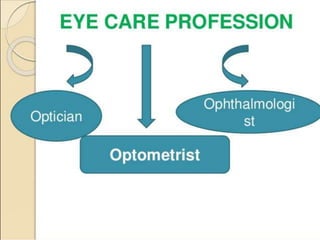
• Refracting opticians became known as optometrists
WHO IS AN OPTOMETRIST ?
• Optometrists are the primary healthcare practitioners of
the eye and visual system who provide comprehensive
eye and vision care
 Refracting and dispensing
 Detection/diagnosis and management of disease in the
eye
 Rehabilitation of conditions of the visual system
WHAT DOES AN OPTOMETRIST DO ?
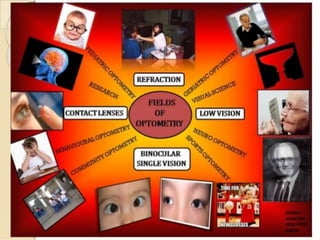
• Refraction
• Contact lens
• Orthoptics
• Low vision
• Perimetry
• Elctrophysiological test
• Vision therapy
• Visual rehabilitation
WHAT TYPE OF KNOWLEDGE DOES
AN OPTOMETRISTS HAVE..?
• Basic science
• Ocular science and applied optics
• Ocular disease, ocular pharmacology
• Visual science
• Contact lens, low vision, binocular single vision
• Ophthalmic dispensing
• Community science ad research
WORLD HEALTH ORGANIZATION
DEFINES OPTOMETRY AS :
• An independent primary health-care profession.
• Optometrists are the primary healthcare practitioners of
the eye and visual system. They provide
comprehensive eye and vision care – which includes
refraction, dispensing, the detection/diagnosis and
management of diseases in the eye, and the
rehabilitation of conditions of the visual system.
World optometry day

World optometry day

  • 1.
  • 2.
    “……..the eye isthe window of the body through which it feels its way and enjoy the beauty of the world. Owing to the eye the soul is content to stay in its bodily prison, for without it such bodily prison is torture.” Leonardo da vinci - (1452-1519)
  • 3.
    WHAT IS OPTOMETRY? • Optometry is defined by the World Council of Optometry (WCO) as follows: • “Optometry is a healthcare profession that is autonomous, educated, and regulated (licensed/registered), and optometrists are the primary healthcare practitioners of the eye and visual system who provide comprehensive eye and vision care, which includes refraction and dispensing, detection/diagnosis and management of disease in the eye and the rehabilitation of condition of the visual system.”
  • 4.
    WORD OPTOMETRY • Itcomes from Greek Word • Opsis + Metron ( Opsis means view and Metron means rule/measurement) • The root word opto derived from the greek word opthalmus which means eye.
  • 5.
    HISTORY • “Those whodon’t know history will repeat past mistakes” • Optometry began about 100 years ago when the first optometry licensure laws were passed in US. • Optometry began with the pronouncement “Let there be light.” • Optometric history is tied to the development of: • Vision Science • Optics, Optical aids • Optical instruments, imaging techniques • Other eye care professions
  • 6.
    ORIGIN Tradesmen who enteredthe respective professions • Optometry :- they had the tools to work on spectacles • Medicine :- they had the equipment with which early surgeries could be done. • Refracting opticians became known as optometrists
  • 8.
    WHO IS ANOPTOMETRIST ? • Optometrists are the primary healthcare practitioners of the eye and visual system who provide comprehensive eye and vision care  Refracting and dispensing  Detection/diagnosis and management of disease in the eye  Rehabilitation of conditions of the visual system
  • 10.
    WHAT DOES ANOPTOMETRIST DO ? • Refraction • Contact lens • Orthoptics • Low vision • Perimetry • Elctrophysiological test • Vision therapy • Visual rehabilitation
  • 11.
    WHAT TYPE OFKNOWLEDGE DOES AN OPTOMETRISTS HAVE..? • Basic science • Ocular science and applied optics • Ocular disease, ocular pharmacology • Visual science • Contact lens, low vision, binocular single vision • Ophthalmic dispensing • Community science ad research
  • 12.
    WORLD HEALTH ORGANIZATION DEFINESOPTOMETRY AS : • An independent primary health-care profession. • Optometrists are the primary healthcare practitioners of the eye and visual system. They provide comprehensive eye and vision care – which includes refraction, dispensing, the detection/diagnosis and management of diseases in the eye, and the rehabilitation of conditions of the visual system.