7th International Conference of Food
Industry at the Service Tourism.
March 31-April 3, 2017, Hurghada, Egypt.
Dr. Adel Gabr Abdel-Razek
Fats and Oils Dept., National Research Centre,
Cairo, Egypt.
adelgabr2@gmail.com
2
Introduction
DEEP FRYING
Art and Science
• Egypt’s Fats & Oils Profile
Oils and fats are staple products in the diet
of Egyptian consumers.
• Frying is one of the common and principal methods
for food preparation at homes; restaurants and food
ingredient factories.
• In this way, oil is not only act as a heat transfer, but
also it interacts with proteins and carbohydrates in the
food matrix and induces favorable odor and taste.
• Consumption of fried food should be considered as
part of an overall balanced diet, and in this context,
fried foods should be eaten with moderation.
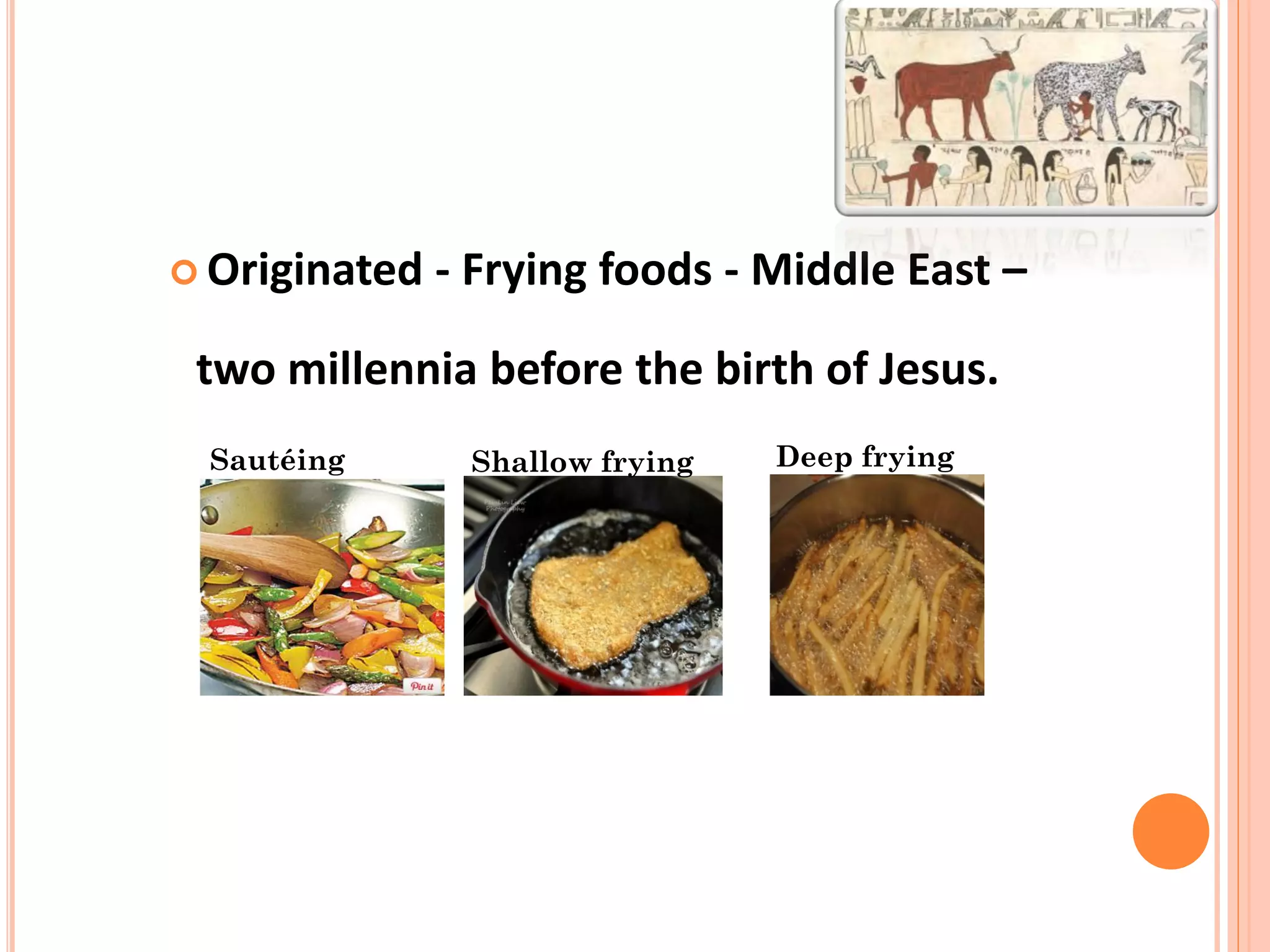
 Originated - Frying foods - Middle East –
two millennia before the birth of Jesus.
5
Sautéing Shallow frying Deep frying
• Shallow frying:
• is cooking process in highly heated oil, promoting browning of battered or
non battered foods.
• Deep Fat frying:
• is a cooking process that involves submerging a food in extremely hot oil in
the presence of air at a high temperature of 150°C to 190°C.
• Par-frying:
• is an industrial process, food is partially dehydrated in an industrial fryer
and flash frozen at -20°C and packaged par-fried food stored at -5°C to -
10°C before distribution in freezer trucks
• Frying oil plays a great role in quality of the fried product, acts as a heat
transfer medium and contributes to texture and flavor of fried food.
• Frying oil role in frying
 Texture
 Fried food flavor
 Mouthfeel
 Aftertaste
6
7
Deep-frying process –
Product safety and quality
During deep-frying not only desired changes occur, like
crusting of the outer area, cooking processes within the
food and the formation of typical flavor components.
Deep-frying also leads to unwanted changes, which
finally results in the deterioration of the frying oil/fat.
• These changes affect both the quality of the deep-
frying medium (Oil) and the quality of the fried food.
8
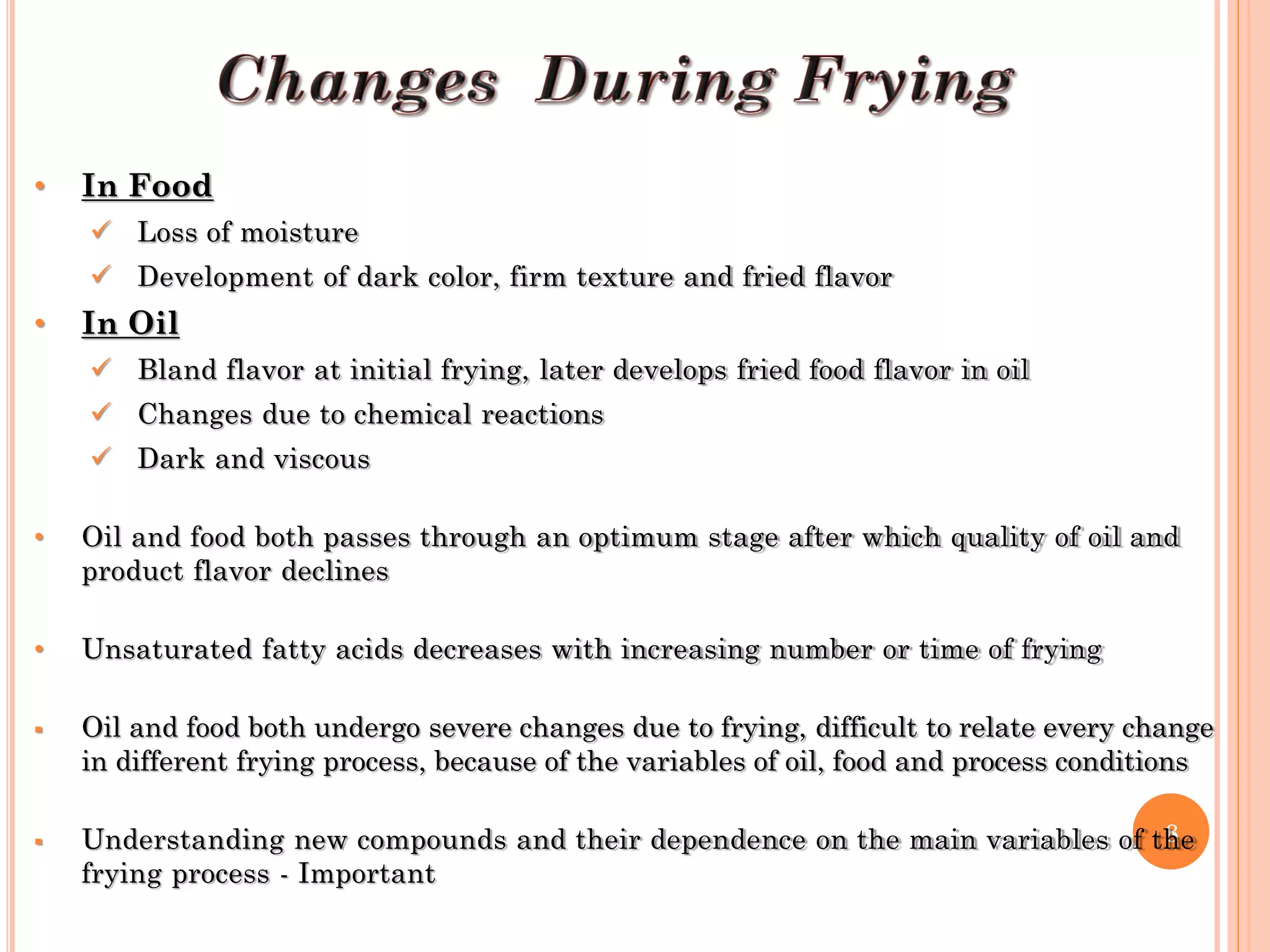
• In Food
 Loss of moisture
 Development of dark color, firm texture and fried flavor
• In Oil
 Bland flavor at initial frying, later develops fried food flavor in oil
 Changes due to chemical reactions
 Dark and viscous
• Oil and food both passes through an optimum stage after which quality of oil and
product flavor declines
• Unsaturated fatty acids decreases with increasing number or time of frying
 Oil and food both undergo severe changes due to frying, difficult to relate every change
in different frying process, because of the variables of oil, food and process conditions
 Understanding new compounds and their dependence on the main variables of the
frying process - Important
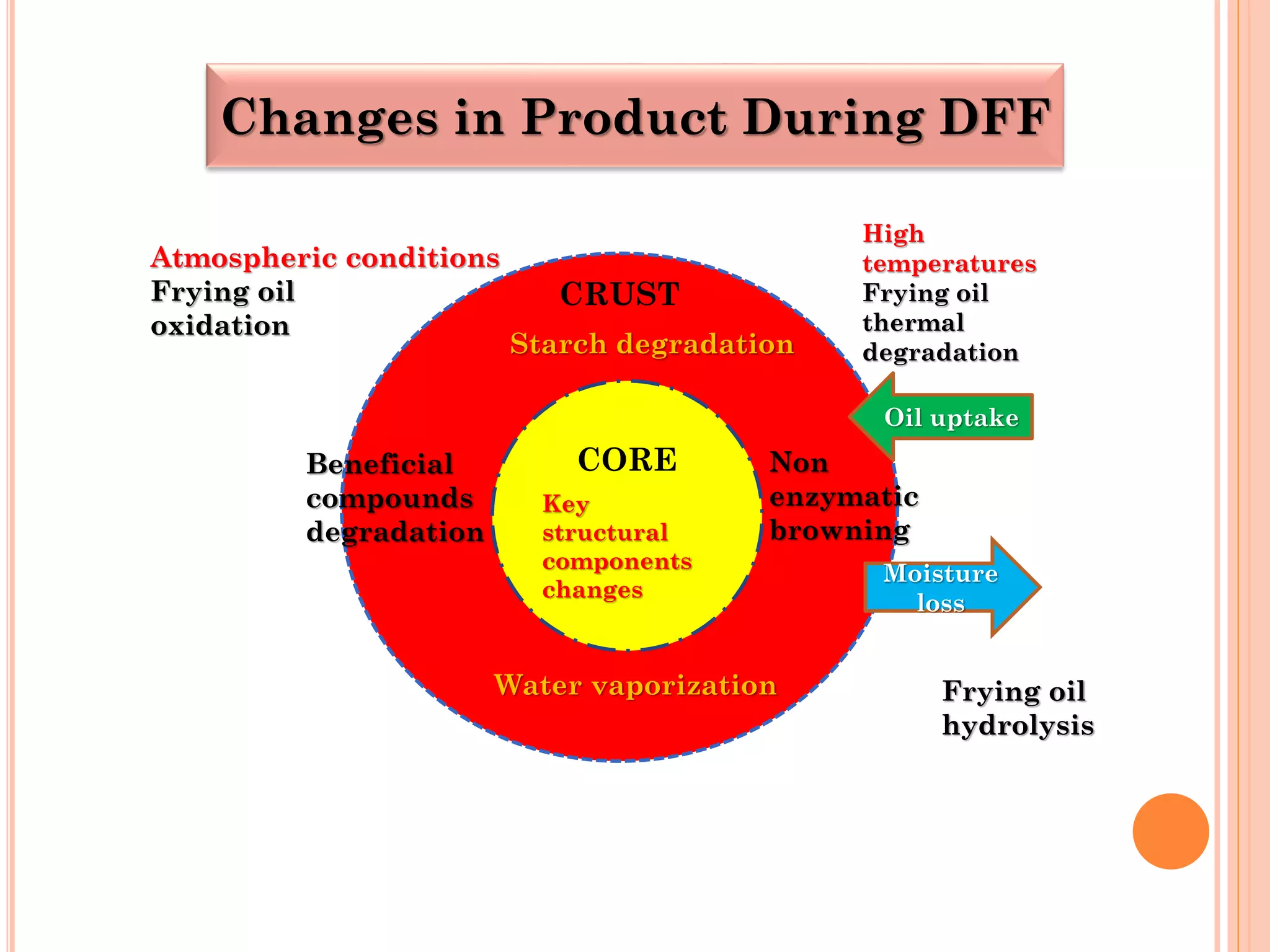
CRUST
CORE
Starch degradation
Non
enzymatic
browning
High
temperatures
Frying oil
thermal
degradation
Beneficial
compounds
degradation
Water vaporization
Atmospheric conditions
Frying oil
oxidation
Frying oil
hydrolysis
Moisture
loss
Oil uptake
Key
structural
components
changes
9
Changes in Product During DFF
OIL CONTENT IN SELECTED FRIED FOOD
Food Oil content (%)
Potato chips
Corn chips
Tortilla chips
French fries
Frozen pre-fried French fries
Battered products (chicken, fish)
Breaded products (chicken, fish)
Instant noodles
Doughnuts
30 - 40
33 - 38
22 - 26
12 - 15
4 - 7
14 - 17
13 - 20
18 - 21
15 - 24
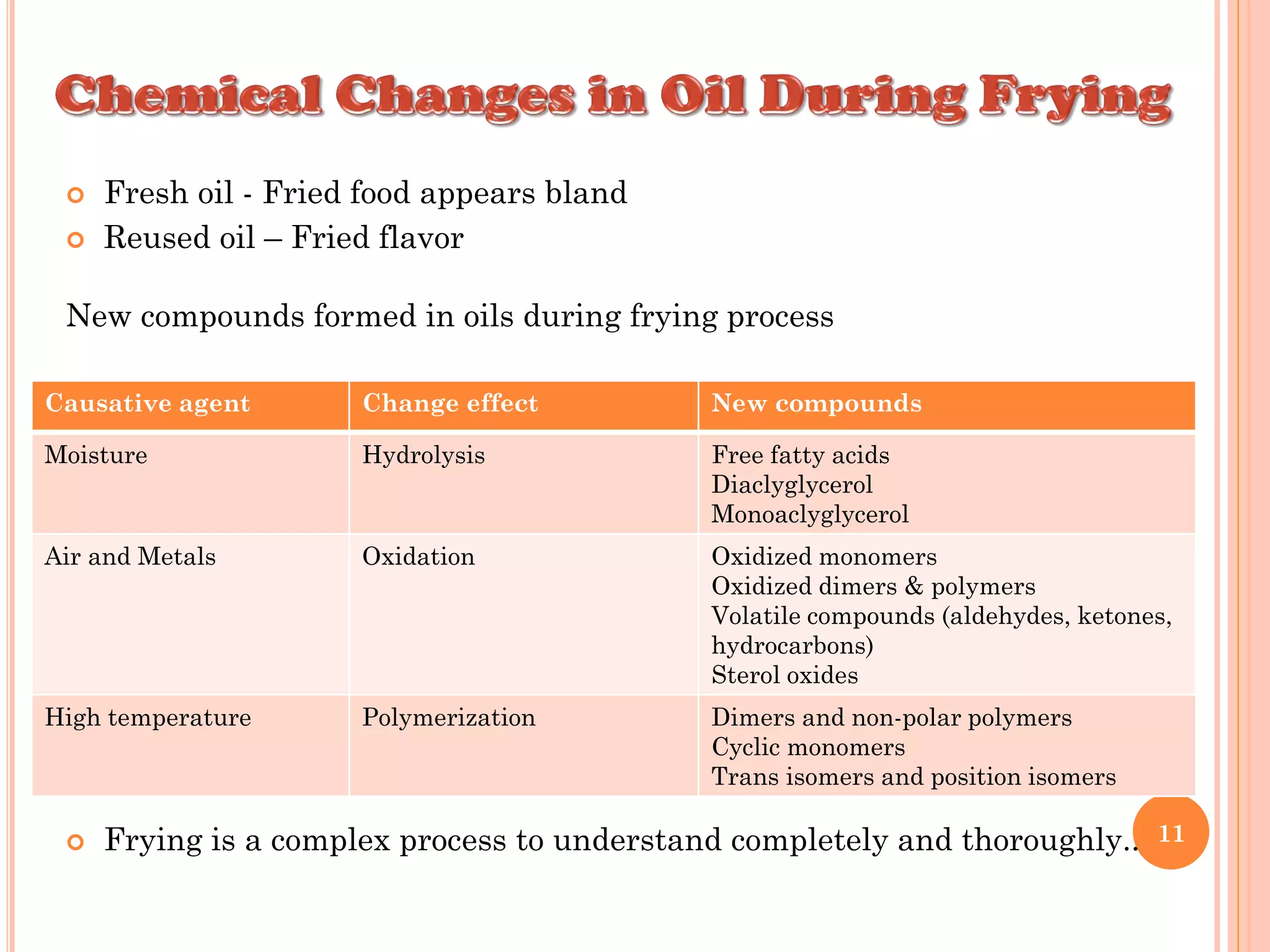
 Fresh oil - Fried food appears bland
 Reused oil – Fried flavor
New compounds formed in oils during frying process
 Frying is a complex process to understand completely and thoroughly.. 11
Causative agent Change effect New compounds
Moisture Hydrolysis Free fatty acids
Diaclyglycerol
Monoaclyglycerol
Air and Metals Oxidation Oxidized monomers
Oxidized dimers & polymers
Volatile compounds (aldehydes, ketones,
hydrocarbons)
Sterol oxides
High temperature Polymerization Dimers and non-polar polymers
Cyclic monomers
Trans isomers and position isomers
13
Physical and Chemical changes of oil during deep fat frying
14
“...As significant amount of frying oil is
becoming part of the fried food, oil
quality and stability is of major
concern to consumers...”
16
SELECTION OF SUITABLE OIL IS AN IMPORTANT
FACTOR THAT AFFECTS THE QUALITY OF FRIED FOODS.
 Product flavor
 Product texture
 Product appearance
 Mouthfeel
 Aftertaste
 Shelf life of the product
 Availability of the oil
 Cost
 Nutritional requirements
To meet current market desire, frying oil must be
 Low in saturated fat
 Low in linolenic acid
 High oxidative and flavor stability
 Non hydrogenated (trans-fat free)
17
18
• Polymers formed affects the quality of frying oil
 Accelerate further degradation of oil
 Increase oil viscosity
 Reduce heat transfer
 Induce foaming
 Develops undesirable color in fried food
 Increase absorption of oil in food
• Stability of oil for frying can be determined by relating to its
inherent stability to oxidation
• Inherent Stability relate to relative reaction rates of unsaturated
fatty acids with oxygen, hence oil with low inherent stability is
less susceptible to oxidation during frying
• Hence frying quality of oil with high unsaturated fatty acids and
free fatty acids is not as good as oil with low unsaturated fatty
acids and free fatty acids
19
• Selection of oil is dependent on factors other than their frying
 Appearance
 Fat retention
Ex. Doughnuts for serving fresh or packaged
• Depending upon the application, solid fats are sometimes blended with refined
vegetable oil (like shortenings).
• Comprehensive oil specification studies are needed to address any performance,
nutritional and labeling issues that may arise
Criterion Specification
Color Light
Flavor Bland
Phosphorus <1mg/kg
Trace metals Fe<0.1mg/kg Cu
<0.02mg/kg
Free fatty acids <0.05%
Peroxide value <1 meq O2/kg
Smoke point >220°C
Linolenic acid <2%
Dimethylpolysiloxane 2mg/kg
20
• NO ideal oil or shortening that satisfies each and every frying application
 Types of food products
 Frying conditions
 Further processing
 Storage
 Expected shelf life
• Any oil that is selected may compromise of at least these three factors
Ideal
Frying Oil?
Nutrition
Functionality
Cost
21
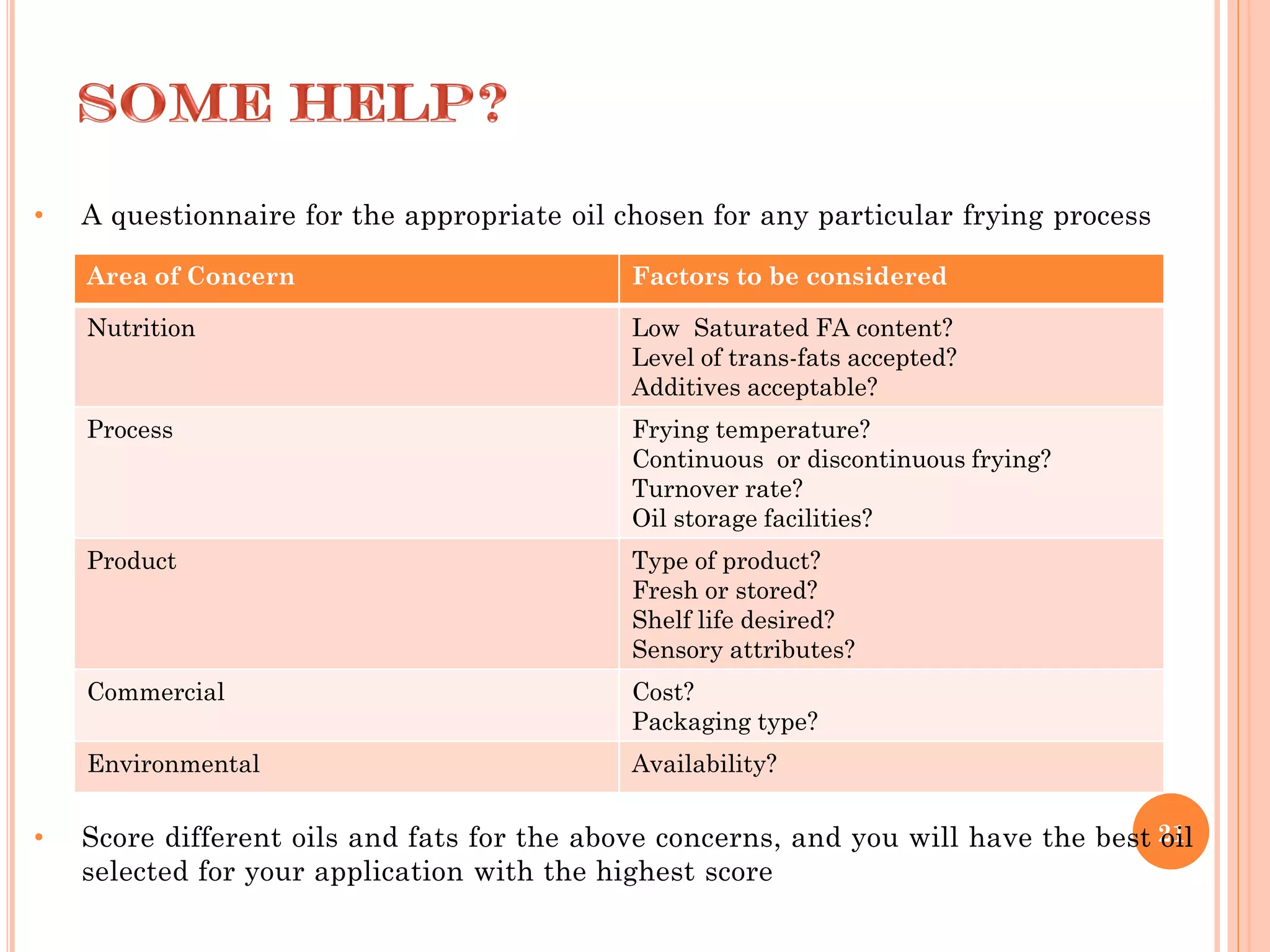
• A questionnaire for the appropriate oil chosen for any particular frying process
• Score different oils and fats for the above concerns, and you will have the best oil
selected for your application with the highest score
Area of Concern Factors to be considered
Nutrition Low Saturated FA content?
Level of trans-fats accepted?
Additives acceptable?
Process Frying temperature?
Continuous or discontinuous frying?
Turnover rate?
Oil storage facilities?
Product Type of product?
Fresh or stored?
Shelf life desired?
Sensory attributes?
Commercial Cost?
Packaging type?
Environmental Availability?
Properties Conditions
Free fatty acid < 0.1%
Peroxide value < 4 meq kg-1
Smoke point > 200oC
Polymer compounds < 1%
Lauric acid content (C12:0) < 1%
Linolenic acid content (C18:3) < 2%
Colour Light yellow
Flavour Bland
SPECIFICATIONS OF FRYING OIL
LIMITS OF USED FRYING OIL
Parameter Conditions
Free fatty acid (FFA) 0.5% (Potato chips, Instant noodles)
1% (Pre-fried French fries)
2 to 2.25% (Coated food)
Smoke point Minimum 170 oC
Polar compounds 25 - 27%
Polymer compounds 10 - 16%
Total Polar Compounds
In Egypt the common oils used for
frying are:
• Cottonseed oil ???
Soybean oil
Sunflower oil
Palm olein
One of the usual ways for increasing the oxidative
stability of soft oils (soybean and sunflower) is
blending with other oils that have less unsaturated
compounds and high oxidative stability [Chu & Kung, 1998].
Palm olein is one of the suitable oils for blending
with other sensitive oils.
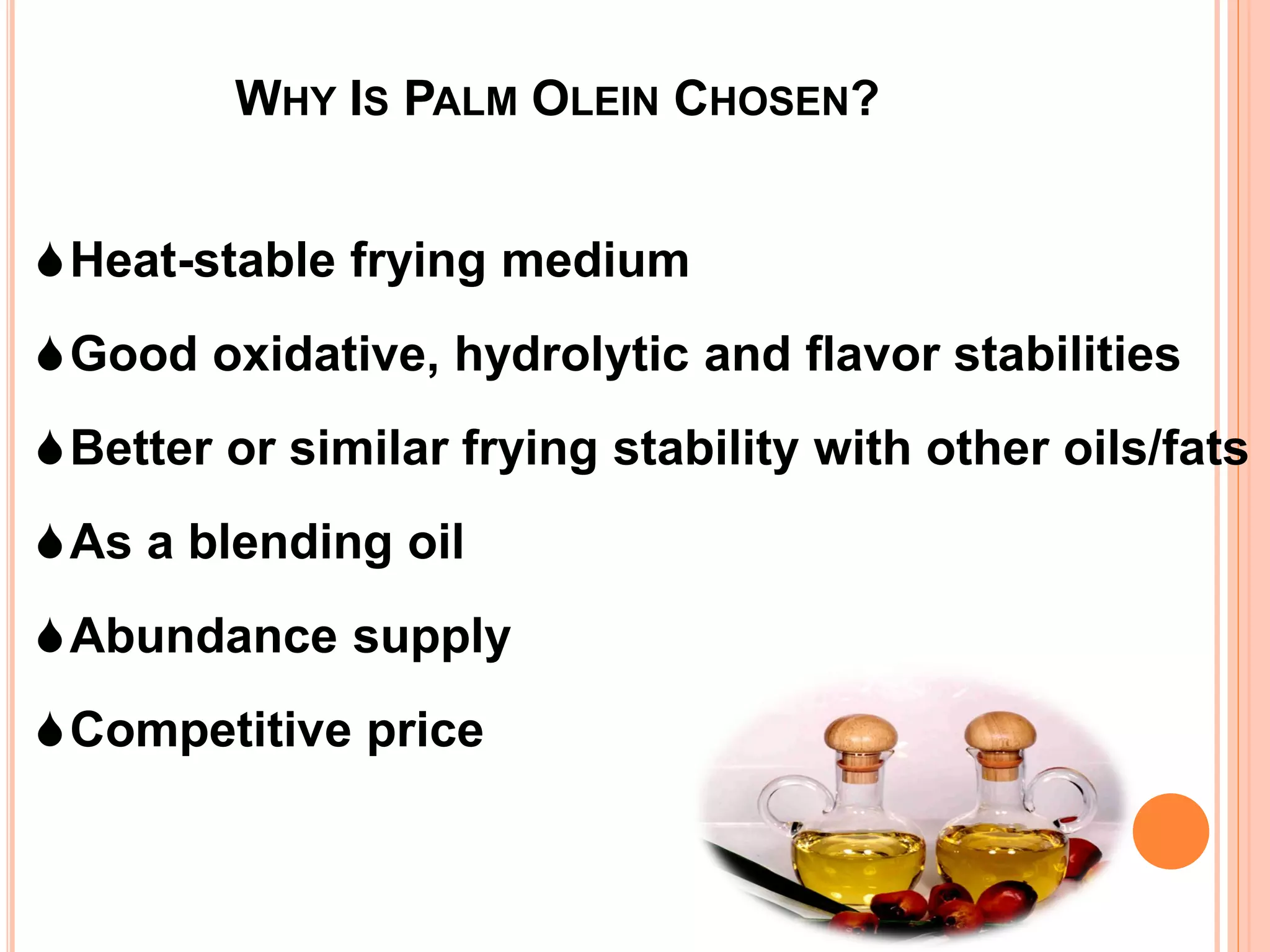
Heat-stable frying medium
Good oxidative, hydrolytic and flavor stabilities
Better or similar frying stability with other oils/fats
As a blending oil
Abundance supply
Competitive price
WHY IS PALM OLEIN CHOSEN?
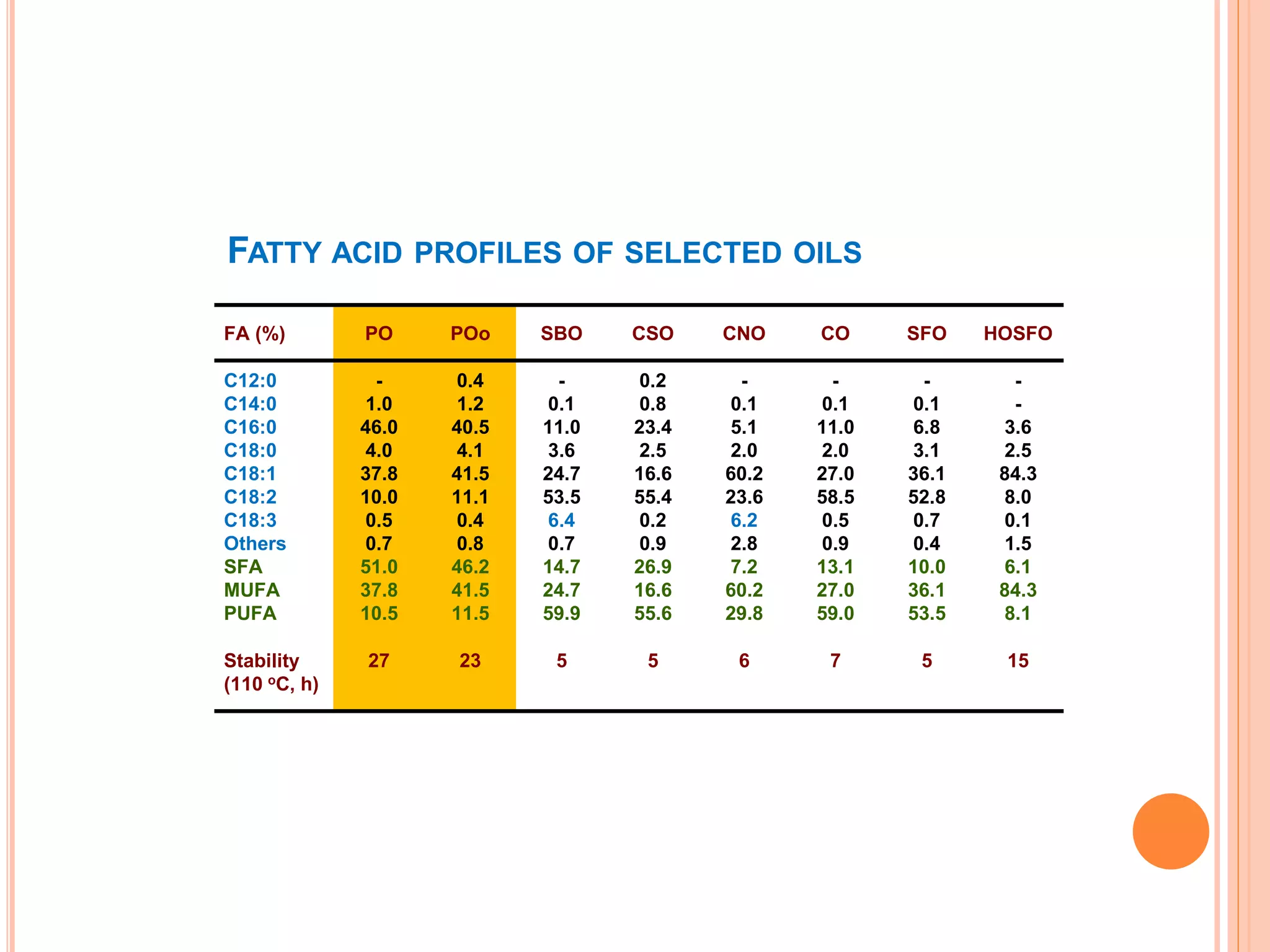
FATTY ACID PROFILES OF SELECTED OILS
FA (%) PO POo SBO CSO CNO CO SFO HOSFO
C12:0
C14:0
C16:0
C18:0
C18:1
C18:2
C18:3
Others
SFA
MUFA
PUFA
-
1.0
46.0
4.0
37.8
10.0
0.5
0.7
51.0
37.8
10.5
0.4
1.2
40.5
4.1
41.5
11.1
0.4
0.8
46.2
41.5
11.5
-
0.1
11.0
3.6
24.7
53.5
6.4
0.7
14.7
24.7
59.9
0.2
0.8
23.4
2.5
16.6
55.4
0.2
0.9
26.9
16.6
55.6
-
0.1
5.1
2.0
60.2
23.6
6.2
2.8
7.2
60.2
29.8
-
0.1
11.0
2.0
27.0
58.5
0.5
0.9
13.1
27.0
59.0
-
0.1
6.8
3.1
36.1
52.8
0.7
0.4
10.0
36.1
53.5
-
-
3.6
2.5
84.3
8.0
0.1
1.5
6.1
84.3
8.1
Stability
(110 oC, h)
27 23 5 5 6 7 5 15
29
Check list for deep-frying
30
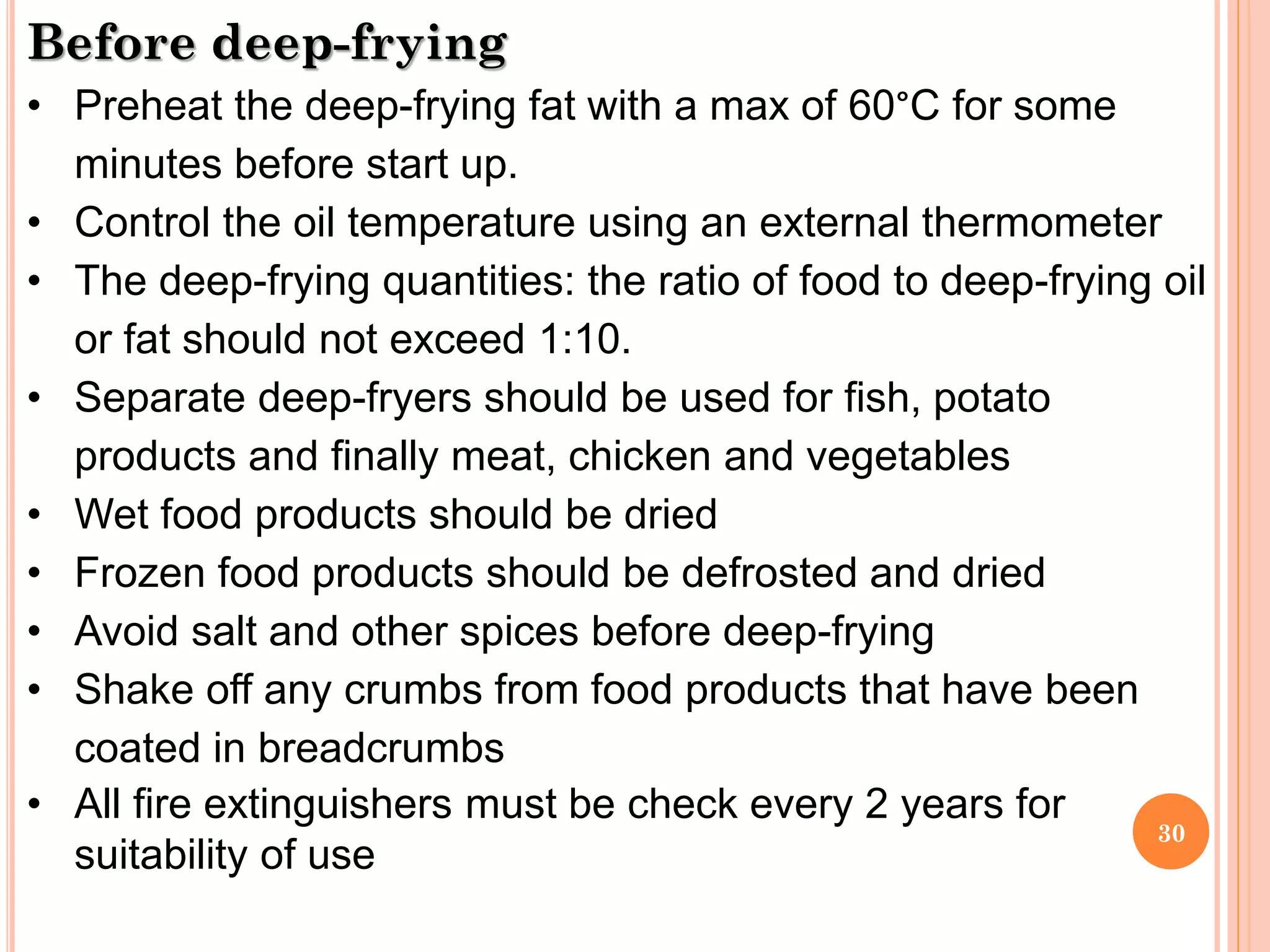
Before deep-frying
• Preheat the deep-frying fat with a max of 60°C for some
minutes before start up.
• Control the oil temperature using an external thermometer
• The deep-frying quantities: the ratio of food to deep-frying oil
or fat should not exceed 1:10.
• Separate deep-fryers should be used for fish, potato
products and finally meat, chicken and vegetables
• Wet food products should be dried
• Frozen food products should be defrosted and dried
• Avoid salt and other spices before deep-frying
• Shake off any crumbs from food products that have been
coated in breadcrumbs
• All fire extinguishers must be check every 2 years for
suitability of use
31
During deep-frying
 Ideally the temperature should lie between 150°C –175°C,
and preferably not exceed 180°C.
 The deep-frying temperature should be continually
controlled using an external thermometer.
 Avoid adding salts and other spices to the deep fryer.
 All control checks and changing of the deep-frying oils/fats
must be strictly documented
32
After deep-frying
The fat should be allowed to drip off while still warm
During long breaks in deep-frying the temperature should be
reduced, during short breaks the deep-frying temperature
should be maintained.
During breaks the deep-fryer should be covered
The deep-frying oil or fat quantities should be supplemented
The deep-frying oil or fat should be filtered to remove any
remaining food rests
The deep-fryer should be thoroughly cleaned
Replace the deep-frying oil or fat before total degradation
occurs
Unused deep-fryers should be emptied and cleaned carefully
33
Fat Evaluation
Sensory evaluation (smell and taste): gritty, rancid taste,
smoke development, increased foam formation.
Note! – darkening is not a measure for fat degradation
Quick tests for rough orientation
Laboratory tests – determination of polar components and
polymer triacylglycerols.
34

Optimum use of frying oils

  • 1.
    7th International Conferenceof Food Industry at the Service Tourism. March 31-April 3, 2017, Hurghada, Egypt. Dr. Adel Gabr Abdel-Razek Fats and Oils Dept., National Research Centre, Cairo, Egypt. adelgabr2@gmail.com
  • 2.
  • 3.
    • Egypt’s Fats& Oils Profile Oils and fats are staple products in the diet of Egyptian consumers.
  • 4.
    • Frying isone of the common and principal methods for food preparation at homes; restaurants and food ingredient factories. • In this way, oil is not only act as a heat transfer, but also it interacts with proteins and carbohydrates in the food matrix and induces favorable odor and taste. • Consumption of fried food should be considered as part of an overall balanced diet, and in this context, fried foods should be eaten with moderation.
  • 5.
     Originated -Frying foods - Middle East – two millennia before the birth of Jesus. 5 Sautéing Shallow frying Deep frying
  • 6.
    • Shallow frying: •is cooking process in highly heated oil, promoting browning of battered or non battered foods. • Deep Fat frying: • is a cooking process that involves submerging a food in extremely hot oil in the presence of air at a high temperature of 150°C to 190°C. • Par-frying: • is an industrial process, food is partially dehydrated in an industrial fryer and flash frozen at -20°C and packaged par-fried food stored at -5°C to - 10°C before distribution in freezer trucks • Frying oil plays a great role in quality of the fried product, acts as a heat transfer medium and contributes to texture and flavor of fried food. • Frying oil role in frying  Texture  Fried food flavor  Mouthfeel  Aftertaste 6
  • 7.
    7 Deep-frying process – Productsafety and quality During deep-frying not only desired changes occur, like crusting of the outer area, cooking processes within the food and the formation of typical flavor components. Deep-frying also leads to unwanted changes, which finally results in the deterioration of the frying oil/fat. • These changes affect both the quality of the deep- frying medium (Oil) and the quality of the fried food.
  • 8.
    8 • In Food Loss of moisture  Development of dark color, firm texture and fried flavor • In Oil  Bland flavor at initial frying, later develops fried food flavor in oil  Changes due to chemical reactions  Dark and viscous • Oil and food both passes through an optimum stage after which quality of oil and product flavor declines • Unsaturated fatty acids decreases with increasing number or time of frying  Oil and food both undergo severe changes due to frying, difficult to relate every change in different frying process, because of the variables of oil, food and process conditions  Understanding new compounds and their dependence on the main variables of the frying process - Important
  • 9.
    CRUST CORE Starch degradation Non enzymatic browning High temperatures Frying oil thermal degradation Beneficial compounds degradation Watervaporization Atmospheric conditions Frying oil oxidation Frying oil hydrolysis Moisture loss Oil uptake Key structural components changes 9 Changes in Product During DFF
  • 10.
    OIL CONTENT INSELECTED FRIED FOOD Food Oil content (%) Potato chips Corn chips Tortilla chips French fries Frozen pre-fried French fries Battered products (chicken, fish) Breaded products (chicken, fish) Instant noodles Doughnuts 30 - 40 33 - 38 22 - 26 12 - 15 4 - 7 14 - 17 13 - 20 18 - 21 15 - 24
  • 11.
     Fresh oil- Fried food appears bland  Reused oil – Fried flavor New compounds formed in oils during frying process  Frying is a complex process to understand completely and thoroughly.. 11 Causative agent Change effect New compounds Moisture Hydrolysis Free fatty acids Diaclyglycerol Monoaclyglycerol Air and Metals Oxidation Oxidized monomers Oxidized dimers & polymers Volatile compounds (aldehydes, ketones, hydrocarbons) Sterol oxides High temperature Polymerization Dimers and non-polar polymers Cyclic monomers Trans isomers and position isomers
  • 13.
    13 Physical and Chemicalchanges of oil during deep fat frying
  • 14.
  • 15.
    “...As significant amountof frying oil is becoming part of the fried food, oil quality and stability is of major concern to consumers...”
  • 16.
    16 SELECTION OF SUITABLEOIL IS AN IMPORTANT FACTOR THAT AFFECTS THE QUALITY OF FRIED FOODS.
  • 17.
     Product flavor Product texture  Product appearance  Mouthfeel  Aftertaste  Shelf life of the product  Availability of the oil  Cost  Nutritional requirements To meet current market desire, frying oil must be  Low in saturated fat  Low in linolenic acid  High oxidative and flavor stability  Non hydrogenated (trans-fat free) 17
  • 18.
    18 • Polymers formedaffects the quality of frying oil  Accelerate further degradation of oil  Increase oil viscosity  Reduce heat transfer  Induce foaming  Develops undesirable color in fried food  Increase absorption of oil in food • Stability of oil for frying can be determined by relating to its inherent stability to oxidation • Inherent Stability relate to relative reaction rates of unsaturated fatty acids with oxygen, hence oil with low inherent stability is less susceptible to oxidation during frying • Hence frying quality of oil with high unsaturated fatty acids and free fatty acids is not as good as oil with low unsaturated fatty acids and free fatty acids
  • 19.
    19 • Selection ofoil is dependent on factors other than their frying  Appearance  Fat retention Ex. Doughnuts for serving fresh or packaged • Depending upon the application, solid fats are sometimes blended with refined vegetable oil (like shortenings). • Comprehensive oil specification studies are needed to address any performance, nutritional and labeling issues that may arise Criterion Specification Color Light Flavor Bland Phosphorus <1mg/kg Trace metals Fe<0.1mg/kg Cu <0.02mg/kg Free fatty acids <0.05% Peroxide value <1 meq O2/kg Smoke point >220°C Linolenic acid <2% Dimethylpolysiloxane 2mg/kg
  • 20.
    20 • NO idealoil or shortening that satisfies each and every frying application  Types of food products  Frying conditions  Further processing  Storage  Expected shelf life • Any oil that is selected may compromise of at least these three factors Ideal Frying Oil? Nutrition Functionality Cost
  • 21.
    21 • A questionnairefor the appropriate oil chosen for any particular frying process • Score different oils and fats for the above concerns, and you will have the best oil selected for your application with the highest score Area of Concern Factors to be considered Nutrition Low Saturated FA content? Level of trans-fats accepted? Additives acceptable? Process Frying temperature? Continuous or discontinuous frying? Turnover rate? Oil storage facilities? Product Type of product? Fresh or stored? Shelf life desired? Sensory attributes? Commercial Cost? Packaging type? Environmental Availability?
  • 22.
    Properties Conditions Free fattyacid < 0.1% Peroxide value < 4 meq kg-1 Smoke point > 200oC Polymer compounds < 1% Lauric acid content (C12:0) < 1% Linolenic acid content (C18:3) < 2% Colour Light yellow Flavour Bland SPECIFICATIONS OF FRYING OIL
  • 23.
    LIMITS OF USEDFRYING OIL Parameter Conditions Free fatty acid (FFA) 0.5% (Potato chips, Instant noodles) 1% (Pre-fried French fries) 2 to 2.25% (Coated food) Smoke point Minimum 170 oC Polar compounds 25 - 27% Polymer compounds 10 - 16%
  • 24.
  • 25.
    In Egypt thecommon oils used for frying are: • Cottonseed oil ??? Soybean oil Sunflower oil Palm olein
  • 26.
    One of theusual ways for increasing the oxidative stability of soft oils (soybean and sunflower) is blending with other oils that have less unsaturated compounds and high oxidative stability [Chu & Kung, 1998]. Palm olein is one of the suitable oils for blending with other sensitive oils.
  • 27.
    Heat-stable frying medium Goodoxidative, hydrolytic and flavor stabilities Better or similar frying stability with other oils/fats As a blending oil Abundance supply Competitive price WHY IS PALM OLEIN CHOSEN?
  • 28.
    FATTY ACID PROFILESOF SELECTED OILS FA (%) PO POo SBO CSO CNO CO SFO HOSFO C12:0 C14:0 C16:0 C18:0 C18:1 C18:2 C18:3 Others SFA MUFA PUFA - 1.0 46.0 4.0 37.8 10.0 0.5 0.7 51.0 37.8 10.5 0.4 1.2 40.5 4.1 41.5 11.1 0.4 0.8 46.2 41.5 11.5 - 0.1 11.0 3.6 24.7 53.5 6.4 0.7 14.7 24.7 59.9 0.2 0.8 23.4 2.5 16.6 55.4 0.2 0.9 26.9 16.6 55.6 - 0.1 5.1 2.0 60.2 23.6 6.2 2.8 7.2 60.2 29.8 - 0.1 11.0 2.0 27.0 58.5 0.5 0.9 13.1 27.0 59.0 - 0.1 6.8 3.1 36.1 52.8 0.7 0.4 10.0 36.1 53.5 - - 3.6 2.5 84.3 8.0 0.1 1.5 6.1 84.3 8.1 Stability (110 oC, h) 27 23 5 5 6 7 5 15
  • 29.
    29 Check list fordeep-frying
  • 30.
    30 Before deep-frying • Preheatthe deep-frying fat with a max of 60°C for some minutes before start up. • Control the oil temperature using an external thermometer • The deep-frying quantities: the ratio of food to deep-frying oil or fat should not exceed 1:10. • Separate deep-fryers should be used for fish, potato products and finally meat, chicken and vegetables • Wet food products should be dried • Frozen food products should be defrosted and dried • Avoid salt and other spices before deep-frying • Shake off any crumbs from food products that have been coated in breadcrumbs • All fire extinguishers must be check every 2 years for suitability of use
  • 31.
    31 During deep-frying  Ideallythe temperature should lie between 150°C –175°C, and preferably not exceed 180°C.  The deep-frying temperature should be continually controlled using an external thermometer.  Avoid adding salts and other spices to the deep fryer.  All control checks and changing of the deep-frying oils/fats must be strictly documented
  • 32.
    32 After deep-frying The fatshould be allowed to drip off while still warm During long breaks in deep-frying the temperature should be reduced, during short breaks the deep-frying temperature should be maintained. During breaks the deep-fryer should be covered The deep-frying oil or fat quantities should be supplemented The deep-frying oil or fat should be filtered to remove any remaining food rests The deep-fryer should be thoroughly cleaned Replace the deep-frying oil or fat before total degradation occurs Unused deep-fryers should be emptied and cleaned carefully
  • 33.
    33 Fat Evaluation Sensory evaluation(smell and taste): gritty, rancid taste, smoke development, increased foam formation. Note! – darkening is not a measure for fat degradation Quick tests for rough orientation Laboratory tests – determination of polar components and polymer triacylglycerols.
  • 34.