Submitted to: DR. OP MALAV
Assistant professor
Deptt. of Livestock product
technology
Submitted by: Mehak Jandyal
Animals are mainly slaughtered for meat.
50% of slaughtered animal is converted into animal by-products.
They contribute to the value of the animal.
Protein rich solids include use in foods, pet food, livestock feeds,
and fertilizers.
Fats have been transformed into soaps and oleo-chemicals (fatty acid
derivatives) in addition to being used in food, pet foods and feed
applications.
Introduction
The need for new outlets of products has also been realized due to
commonly encountered zoonotic diseases.
Protein meals and animal fats are used as energy sources in combustion
units.
Animal by-products can lead to decomposition and environmental
pollution, if not properly stabilized.
The most conventional way of stabilizing raw material is to process
the raw material with heat:
 evaporates the water content
 sterilize the material
This process is known as “Rendering”
contd.
.
Meat
Rendering
Gelatin
production
Skin
Ediblefat
processing
Pet food
50%
27%
6%
11%
4%
Estimated Utilization of Animal
byproducts (by %weight)
(EFPRA,2004)
Tallow
and
Grease
lard Total
1968 4655 4440 9095
1978 5866 3663 9529
1988-89 6603 n.r
1998-99 8342 5800 13342
2000-01 8312 n.r
2008-09 8100 7700 15800
2%
Animal
fats
Year
World wide production of
fat
(1000 metric tonnes)
(US Govt., 2008)
Animal fat
It is "obtained from the tissues of mammals and/or poultry in the commercial
processes of rendering or extracting”. (AAFCO)
Types of
Animal fat
Lard
Caul fat
Rendered Pork fat
Chicken fat
Tallow-Dripping & Premier
Jus
Leaf Fat
Inedible Tallow and
Greases
Blubber fat
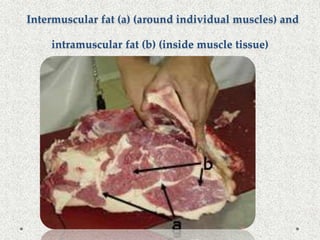
Intermuscular fat (a) (around individual muscles) and
intramuscular fat (b) (inside muscle tissue)
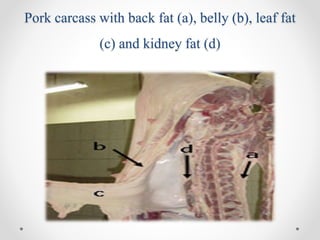
Pork carcass with back fat (a), belly (b), leaf fat
(c) and kidney fat (d)
Jowl fat removed from pig head (a) and cut into strips
(b). Behind: Rest of pork carcass with back fat.
Beef carcass, front part
with external
subcutaneous fat (a).
Kidney fat (a) in beef
carcass
Chicken skin to be removed from cuts and
used as fat ingredient.
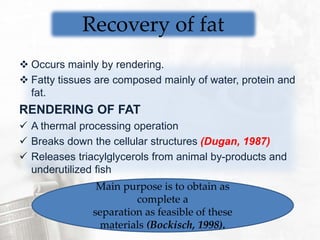
Recovery Of Fat
 Occurs mainly by rendering.
 Fatty tissues are composed mainly of water, protein and
fat.
RENDERING OF FAT
 A thermal processing operation
 Breaks down the cellular structures (Dugan, 1987)
 Releases triacylglycerols from animal by-products and
underutilized fish
Recovery of fat
Main purpose is to obtain as
complete a
separation as feasible of these
materials (Bockisch, 1998).
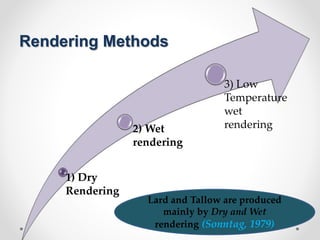
1) Dry
Rendering
2) Wet
rendering
3) Low
Temperature
wet
rendering
Rendering Methods
Lard and Tallow are produced
mainly by Dry and Wet
rendering (Sonntag, 1979)
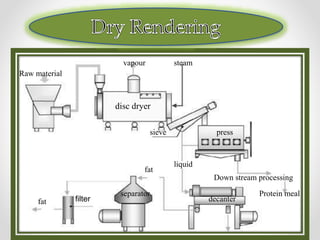
Raw material
vapour steam
disc dryer
sieve press
liquid
Down stream processing
Protein meal
decanter
fat
separator
filterfat
Yield is 20% higher.
Process requires less labor and less floor
area
Recovery of steam from cookers to
provide hot water
Color of tallow is poorer
Material cannot be pressurized.
Difficulty in rendering gelatinous
material such as slunk
Advantages and Disadvantages
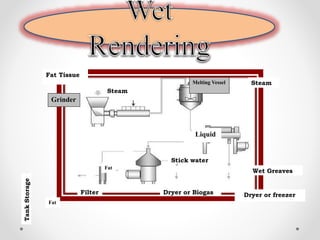
Fat Tissue
Grinder
Steam
Melting Vessel Steam
Liquid
TankStorage
Fat
Filter
Fat
Stick water
Dryer or Biogas Dryer or freezer
Wet Greaves
Can produce a good quality tallow
Recovery of fat is better
Time consuming
Labor intensive
Up to 25% of meal is lost in the
gravy
For good tallow viscera, viscera
must be cut and washed
Advantages and
Disadvantages
Drying
Pressing
Meal
Separatio
n
Crushing
+
Pre-heating
Evaporatio
n
•High quality fat with
excellent color
characteristics and
increased fat yields
•Meat and bone meal and
poultry meal are low in fat
content, of upgraded
quality, of light color and
highly digestible.
esters of 3-C carboxylic trihydroxy alcohol, glycerol,
and various monocarboxylic acids known as fatty acids
Lard- considerable proportions of palmitic acid,
stearic acid, oleic acid and linoleic acid
Tallow-contains approximately 6% of trans-oleic acid
formed by the action of rumen bacteria on vegetable
oils found in food (Sonntag, 1979)
Lard Fat : Rendered fat of Pig.
titre - <40ºc
Tallow Fat : Rendered fat of cattle, sheep, and
goat.
titre - >40ºc
Titre :
 signifies the degree of softness and hardness
of the
 healthy animal have more titre.
Purifying
Steps
Settling and degumming
Neutralization
Bleaching
Deodorization
Processing Of Fat
Settling and Degumming
 Settling involves storing heated fats quiescently in tanks with conical
bottoms.
 Degumming removes phospholipids by the addition of water at 1-3% at
60-800 C for 30-60 mts.
 Water and materials associated with water are denser than melted fat
and settle into the cone
 Coalesced “gum” formed by phospholipid and water is removed.
This Process removes animal or plant
proteins, carbohydrates residues,
phosphatides and water.
Neutralization/ Refining with
alkali
 Removal of non-glyceride fatty materials by washing the oils with
strong alkaline water solutions
Caustic soda solutions are added to the heated fat and stirred
vigorously. After a short period, the mixture is allowed to settle.
The oil can be separated from the soap by gravity.
The settlings, called “foots” are collected and sold as “soap stock”.
It can be applied if FFA> 0.3% or if collagenous or proteinaceus
material is present (Pietroszek, 1979)
RCO2H + NaOH → RCO2Na + H2O
Advantages:
 It reduces the loss of oil due to saponification.
 Short time of reaction occurs in modern continuous centrifugal processes.
Disadvantages:
If this refining is allowed to occur by standing,
the time taken is lengthy.
 Reduces the colour of fat and oil by adsorbing on bleaching
earth or by chemical reactions (Young, 1980)
 Chemical methods of bleaching are seldom applied to
edible fats.
 The process is also known as “ Adsorptive Cleansing”
 Specific recommendations for bleaching lards and tallow are
reported. (Patterson, 1992)
Bleaching clay (bentonite) contains not less than 85% of the mineral
montmorillonite Al4Si8O20 (OH)4.n H2O.
Activated clay contains higher percentage of hydrated silica and
increased adsorptive capacity (Dugan, 1987)
Natural bleaching earth consists mainly of hydrated aluminium silicates.
Natural clay is bentonite in which some of the Al has been naturally
replaced by H.
The most important adsorbent used in bleaching fats and oils is
bleaching earth or clay.
How Bleaching Is Done?
 mixing 0.2 to 1.0 percent of earth with the oil, heating to 1000C
with stirring under vacuum and then, filtering.
The clay is added at a temperature lower than optimum
Bleaching clay more effectively removes the green color
Efficiency of the bleaching process is determined by
Lovibond Colorimeter.
Most high quality lards generally do not require bleaching,
but tallow may be bleached to remove the color bodies.
Absence of moisture is necessary
Rate of bleaching increases with temperature
Bleaching process is done under vacuum
Triglycerides have extremely low vapour pressures
Aldehydes, ketones, alcohols and free fatty acids are removed by steam
distillation.
Hydrolysis of glycerides is minimal.
Steam distillation under reduced pressure designed to remove unacceptable
odors and flavors form oils and fats.
Injecting high pressure steam into the fat at temperatures between 180-2500C
with a vacuum of about 1kPa (Norris and Mattil, 1964)
citric acid is commonly added to fats.
Modification of Fat
Chemically
Hydrogenatio
n
Interesterificatio
n
Physically
Fractionation
Partial crystallization of fat or oil at specific temperature.
Once partial crystallization is complete, the actual fractionation is
accomplished by effecting the liquid-solid separation.
Different melting points of the mixed triacylglycerols in a fat, such as
tallow, provide the basis for fractionation processes.
Major objective-to optimize separation of the liquid (olein) and solid
(stearin) fractions (Timms et al., 1997)
An effective early method of separating olein and stearin phases is
known as winterization.
Fractionation
Powerpoint Templates
Page 32
Different Methods of Fractionation
METHODS
Type of addition reactions accepting hydrogen at the double bonds of
unsaturated fatty acids
Alter the physical and chemical properties of fat
Hydrogenation is usually carried out before bleaching.
Done under high pressure of hydrogen and catalyzed by finely divided
nickel (@ 0.001-0.002%) or copper and heat (Russel,1987)
Generally, it is not taken to completion.
The rate of hydrogenation of polyunsaturated fatty acids is faster than
monounsaturated fatty acids. (Johnson, 2002)
Requirements for hydrogenation
(Johnson2002)
catalyst
Hydrogen
Gas Agitation
Temperature
control
Procedure for Hydrogenation
Done as a batch or continuous process (250-300 0C)
The nickel is incorporated onto a porous support
Continuous mixing is a critical parameter.
The reaction takes 40-60 min during which progress is monitored by change in
refractive index.
Upon completion, catalysts are removed by filtration.
Advantages:
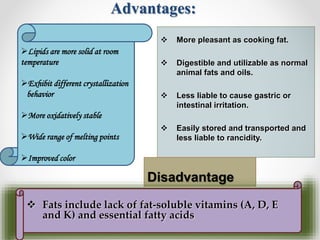
 More pleasant as cooking fat.
 Digestible and utilizable as normal
animal fats and oils.
 Less liable to cause gastric or
intestinal irritation.
 Easily stored and transported and
less liable to rancidity.
Disadvantage
 Fats include lack of fat-soluble vitamins (A, D, E
and K) and essential fatty acids
Lipids are more solid at room
temperature
Exhibit different crystallization
behavior
More oxidatively stable
Wide range of melting points
Improved color
Metallic sodium and sodium methoxide are used as catalysts which are
low-temperature catalysts and are used at a low level, i.e. 0.02-2.0%
(Bhati, 1980)
For Interesterification to take place the reaction medium must have, low
levels of water, free fatty acids, and peroxides.
Results in significant changes in the melting profiles of lipids without
changing fatty acid composition.
Performed by acidolysis, alcoholysis, glycerolysis, and transesterification
(common) (Rousseau,2002)
Involves an interchange of an acyl groups among triacylglycerols
(Dugan, 1976).
Random Esterification of Lard
Lard typically contains
 2% saturated triacylglycerols (GS3),
27% disaturated triacylglycerols (GS2U),
47% monosaturated triacylglycerols (GSU2) and
 24% triunsaturated triacylglycerols (GU3).
The GS2U fraction is mostly composed of oleopalmitostearin (OPS), which plays major
role in consistency of lard (Lutton et al.,1962)
OPS leads to aggregation of crystals in unmodified lard → Graininess
Randomized lard crystallizes from b’-3 → b’-2 form, which is characteristic of
hydrogenated vegetable oil shortenings (Sreenivasan, 1978)
Results in improved creaming power and highly regarded ingredient for quality
shortenings
Direct Interesterification
 Produces lard with increased solid content at high
temperatures, and thus results in an extended plastic range.
 Can be used as a shortening without any addition of fully
saturated acylglycerols (Wiess,1983)
Interesterification can also be performed by using lipases as
catalysts. (Willis et al.,2002)
Enzymatic transesterification is limited by its high cost
Fat constants or numbers are tests used for:
 Checking the purity of fat for detection of
adulteration.
 To quantitatively estimate certain properties of fat.
 To identify the biological value and natural
characteristics of fat.
 Detection of fat rancidity and presence of toxic
hydroxy fatty acids.
Iodine Number
• It is the number of grams of iodine absorbed by 100 grams of fat or
oil.
• Measures the degree of unsaturation in a given amount of fat or oil
• The iodine value is low for animal fats and high for vegetable oils.
• The higher the iodine value, the lower becomes the melting point.
Animal
Fat
Lard Rendered pork
fat
Tallow Premier Jus
Iodine Value
(g/100g of fat)
55-65 60-72 36-47 40-53
(WHO, 1999)
Free fatty Acid
expressed as percentage of free oleic acid of total sample weight.
The fat is mixed with alcohol (in which the carboxylic acids are soluble
but the fat is insoluble)
Generally the FFA content should not be more than 2%.
Amount of FFA in tallow indicates the degree of spoilage that has
taken place.
Peroxide value
Determines the rancidity of tallow
Fresh fats have a peroxide value of 1-2, whereas rancid fats have a
peroxide value of 15-20.
 Indicates purity or identity of the substance.
Smoke Point
Temperature to which the fat may be heated before it begins to smoke.
Indirect relationship with FFA.
Tallow with FFA of 0.2% has smoke point of 2250C
Lard has smoke point of 121-2180C.
Refractive Index
Animal Fat Lard Rendered Pork Tallow Premier Jus
Refractive
Index
1.448-1.460 1.448-1.461 1.448-1.460 1.448-1.460
(WHO, 1999)
Represents the number of milligrams of KOH or NaOH required
to saponify 1g of fat under the conditions specified
measure of the average molecular weight (or chain length) of all
the fatty acids present
The long chain fatty acids found in fats have low saponification value
Animal fat Lard Tallow
Saponification Value
(mg KOH/g of fat)
192-203 190-202
(WHO, 1999)
Melting Point
The melting point of a solid is the temperature at which it changes
state from solid to liquid.
Pork fat Back fat Leaf Fat Mixed
Fat
Melting Point
(0C)
30-40 43-48 36-45
(WHO,1999)
MIU
• Moisture ,impurities, unsaponifiable.
• Moisture- not >2%
• Impurities – less
• Unsaponifiable- which cannot be converted
into soap by the use of alkali or no fatty acid is
released by alkali treatment
• small quantity may exist like cholesterol.
Animal fat process final ppt.

Animal fat process final ppt.

  • 1.
    Submitted to: DR.OP MALAV Assistant professor Deptt. of Livestock product technology Submitted by: Mehak Jandyal
  • 2.
    Animals are mainlyslaughtered for meat. 50% of slaughtered animal is converted into animal by-products. They contribute to the value of the animal. Protein rich solids include use in foods, pet food, livestock feeds, and fertilizers. Fats have been transformed into soaps and oleo-chemicals (fatty acid derivatives) in addition to being used in food, pet foods and feed applications. Introduction
  • 3.
    The need fornew outlets of products has also been realized due to commonly encountered zoonotic diseases. Protein meals and animal fats are used as energy sources in combustion units. Animal by-products can lead to decomposition and environmental pollution, if not properly stabilized. The most conventional way of stabilizing raw material is to process the raw material with heat:  evaporates the water content  sterilize the material This process is known as “Rendering” contd. .
  • 4.
    Meat Rendering Gelatin production Skin Ediblefat processing Pet food 50% 27% 6% 11% 4% Estimated Utilizationof Animal byproducts (by %weight) (EFPRA,2004) Tallow and Grease lard Total 1968 4655 4440 9095 1978 5866 3663 9529 1988-89 6603 n.r 1998-99 8342 5800 13342 2000-01 8312 n.r 2008-09 8100 7700 15800 2% Animal fats Year World wide production of fat (1000 metric tonnes) (US Govt., 2008)
  • 5.
    Animal fat It is"obtained from the tissues of mammals and/or poultry in the commercial processes of rendering or extracting”. (AAFCO) Types of Animal fat Lard Caul fat Rendered Pork fat Chicken fat Tallow-Dripping & Premier Jus Leaf Fat Inedible Tallow and Greases Blubber fat
  • 6.
    Intermuscular fat (a)(around individual muscles) and intramuscular fat (b) (inside muscle tissue)
  • 7.
    Pork carcass withback fat (a), belly (b), leaf fat (c) and kidney fat (d)
  • 8.
    Jowl fat removedfrom pig head (a) and cut into strips (b). Behind: Rest of pork carcass with back fat.
  • 9.
    Beef carcass, frontpart with external subcutaneous fat (a). Kidney fat (a) in beef carcass
  • 10.
    Chicken skin tobe removed from cuts and used as fat ingredient.
  • 11.
  • 12.
     Occurs mainlyby rendering.  Fatty tissues are composed mainly of water, protein and fat. RENDERING OF FAT  A thermal processing operation  Breaks down the cellular structures (Dugan, 1987)  Releases triacylglycerols from animal by-products and underutilized fish Recovery of fat Main purpose is to obtain as complete a separation as feasible of these materials (Bockisch, 1998).
  • 13.
    1) Dry Rendering 2) Wet rendering 3)Low Temperature wet rendering Rendering Methods Lard and Tallow are produced mainly by Dry and Wet rendering (Sonntag, 1979)
  • 14.
    Raw material vapour steam discdryer sieve press liquid Down stream processing Protein meal decanter fat separator filterfat
  • 15.
    Yield is 20%higher. Process requires less labor and less floor area Recovery of steam from cookers to provide hot water Color of tallow is poorer Material cannot be pressurized. Difficulty in rendering gelatinous material such as slunk Advantages and Disadvantages
  • 16.
    Fat Tissue Grinder Steam Melting VesselSteam Liquid TankStorage Fat Filter Fat Stick water Dryer or Biogas Dryer or freezer Wet Greaves
  • 17.
    Can produce agood quality tallow Recovery of fat is better Time consuming Labor intensive Up to 25% of meal is lost in the gravy For good tallow viscera, viscera must be cut and washed Advantages and Disadvantages
  • 18.
    Drying Pressing Meal Separatio n Crushing + Pre-heating Evaporatio n •High quality fatwith excellent color characteristics and increased fat yields •Meat and bone meal and poultry meal are low in fat content, of upgraded quality, of light color and highly digestible.
  • 19.
    esters of 3-Ccarboxylic trihydroxy alcohol, glycerol, and various monocarboxylic acids known as fatty acids Lard- considerable proportions of palmitic acid, stearic acid, oleic acid and linoleic acid Tallow-contains approximately 6% of trans-oleic acid formed by the action of rumen bacteria on vegetable oils found in food (Sonntag, 1979)
  • 20.
    Lard Fat :Rendered fat of Pig. titre - <40ºc Tallow Fat : Rendered fat of cattle, sheep, and goat. titre - >40ºc Titre :  signifies the degree of softness and hardness of the  healthy animal have more titre.
  • 22.
  • 23.
    Settling and Degumming Settling involves storing heated fats quiescently in tanks with conical bottoms.  Degumming removes phospholipids by the addition of water at 1-3% at 60-800 C for 30-60 mts.  Water and materials associated with water are denser than melted fat and settle into the cone  Coalesced “gum” formed by phospholipid and water is removed. This Process removes animal or plant proteins, carbohydrates residues, phosphatides and water.
  • 24.
    Neutralization/ Refining with alkali Removal of non-glyceride fatty materials by washing the oils with strong alkaline water solutions Caustic soda solutions are added to the heated fat and stirred vigorously. After a short period, the mixture is allowed to settle. The oil can be separated from the soap by gravity. The settlings, called “foots” are collected and sold as “soap stock”. It can be applied if FFA> 0.3% or if collagenous or proteinaceus material is present (Pietroszek, 1979) RCO2H + NaOH → RCO2Na + H2O
  • 25.
    Advantages:  It reducesthe loss of oil due to saponification.  Short time of reaction occurs in modern continuous centrifugal processes. Disadvantages: If this refining is allowed to occur by standing, the time taken is lengthy.
  • 26.
     Reduces thecolour of fat and oil by adsorbing on bleaching earth or by chemical reactions (Young, 1980)  Chemical methods of bleaching are seldom applied to edible fats.  The process is also known as “ Adsorptive Cleansing”  Specific recommendations for bleaching lards and tallow are reported. (Patterson, 1992)
  • 27.
    Bleaching clay (bentonite)contains not less than 85% of the mineral montmorillonite Al4Si8O20 (OH)4.n H2O. Activated clay contains higher percentage of hydrated silica and increased adsorptive capacity (Dugan, 1987) Natural bleaching earth consists mainly of hydrated aluminium silicates. Natural clay is bentonite in which some of the Al has been naturally replaced by H. The most important adsorbent used in bleaching fats and oils is bleaching earth or clay.
  • 28.
    How Bleaching IsDone?  mixing 0.2 to 1.0 percent of earth with the oil, heating to 1000C with stirring under vacuum and then, filtering. The clay is added at a temperature lower than optimum Bleaching clay more effectively removes the green color Efficiency of the bleaching process is determined by Lovibond Colorimeter. Most high quality lards generally do not require bleaching, but tallow may be bleached to remove the color bodies. Absence of moisture is necessary Rate of bleaching increases with temperature Bleaching process is done under vacuum
  • 29.
    Triglycerides have extremelylow vapour pressures Aldehydes, ketones, alcohols and free fatty acids are removed by steam distillation. Hydrolysis of glycerides is minimal. Steam distillation under reduced pressure designed to remove unacceptable odors and flavors form oils and fats. Injecting high pressure steam into the fat at temperatures between 180-2500C with a vacuum of about 1kPa (Norris and Mattil, 1964) citric acid is commonly added to fats.
  • 30.
  • 31.
    Partial crystallization offat or oil at specific temperature. Once partial crystallization is complete, the actual fractionation is accomplished by effecting the liquid-solid separation. Different melting points of the mixed triacylglycerols in a fat, such as tallow, provide the basis for fractionation processes. Major objective-to optimize separation of the liquid (olein) and solid (stearin) fractions (Timms et al., 1997) An effective early method of separating olein and stearin phases is known as winterization. Fractionation
  • 32.
    Powerpoint Templates Page 32 DifferentMethods of Fractionation METHODS
  • 33.
    Type of additionreactions accepting hydrogen at the double bonds of unsaturated fatty acids Alter the physical and chemical properties of fat Hydrogenation is usually carried out before bleaching. Done under high pressure of hydrogen and catalyzed by finely divided nickel (@ 0.001-0.002%) or copper and heat (Russel,1987) Generally, it is not taken to completion. The rate of hydrogenation of polyunsaturated fatty acids is faster than monounsaturated fatty acids. (Johnson, 2002)
  • 34.
    Requirements for hydrogenation (Johnson2002) catalyst Hydrogen GasAgitation Temperature control Procedure for Hydrogenation Done as a batch or continuous process (250-300 0C) The nickel is incorporated onto a porous support Continuous mixing is a critical parameter. The reaction takes 40-60 min during which progress is monitored by change in refractive index. Upon completion, catalysts are removed by filtration.
  • 35.
    Advantages:  More pleasantas cooking fat.  Digestible and utilizable as normal animal fats and oils.  Less liable to cause gastric or intestinal irritation.  Easily stored and transported and less liable to rancidity. Disadvantage  Fats include lack of fat-soluble vitamins (A, D, E and K) and essential fatty acids Lipids are more solid at room temperature Exhibit different crystallization behavior More oxidatively stable Wide range of melting points Improved color
  • 36.
    Metallic sodium andsodium methoxide are used as catalysts which are low-temperature catalysts and are used at a low level, i.e. 0.02-2.0% (Bhati, 1980) For Interesterification to take place the reaction medium must have, low levels of water, free fatty acids, and peroxides. Results in significant changes in the melting profiles of lipids without changing fatty acid composition. Performed by acidolysis, alcoholysis, glycerolysis, and transesterification (common) (Rousseau,2002) Involves an interchange of an acyl groups among triacylglycerols (Dugan, 1976).
  • 37.
    Random Esterification ofLard Lard typically contains  2% saturated triacylglycerols (GS3), 27% disaturated triacylglycerols (GS2U), 47% monosaturated triacylglycerols (GSU2) and  24% triunsaturated triacylglycerols (GU3). The GS2U fraction is mostly composed of oleopalmitostearin (OPS), which plays major role in consistency of lard (Lutton et al.,1962) OPS leads to aggregation of crystals in unmodified lard → Graininess Randomized lard crystallizes from b’-3 → b’-2 form, which is characteristic of hydrogenated vegetable oil shortenings (Sreenivasan, 1978) Results in improved creaming power and highly regarded ingredient for quality shortenings
  • 38.
    Direct Interesterification  Produceslard with increased solid content at high temperatures, and thus results in an extended plastic range.  Can be used as a shortening without any addition of fully saturated acylglycerols (Wiess,1983) Interesterification can also be performed by using lipases as catalysts. (Willis et al.,2002) Enzymatic transesterification is limited by its high cost
  • 40.
    Fat constants ornumbers are tests used for:  Checking the purity of fat for detection of adulteration.  To quantitatively estimate certain properties of fat.  To identify the biological value and natural characteristics of fat.  Detection of fat rancidity and presence of toxic hydroxy fatty acids.
  • 41.
    Iodine Number • Itis the number of grams of iodine absorbed by 100 grams of fat or oil. • Measures the degree of unsaturation in a given amount of fat or oil • The iodine value is low for animal fats and high for vegetable oils. • The higher the iodine value, the lower becomes the melting point. Animal Fat Lard Rendered pork fat Tallow Premier Jus Iodine Value (g/100g of fat) 55-65 60-72 36-47 40-53 (WHO, 1999)
  • 42.
    Free fatty Acid expressedas percentage of free oleic acid of total sample weight. The fat is mixed with alcohol (in which the carboxylic acids are soluble but the fat is insoluble) Generally the FFA content should not be more than 2%. Amount of FFA in tallow indicates the degree of spoilage that has taken place. Peroxide value Determines the rancidity of tallow Fresh fats have a peroxide value of 1-2, whereas rancid fats have a peroxide value of 15-20.
  • 43.
     Indicates purityor identity of the substance. Smoke Point Temperature to which the fat may be heated before it begins to smoke. Indirect relationship with FFA. Tallow with FFA of 0.2% has smoke point of 2250C Lard has smoke point of 121-2180C. Refractive Index Animal Fat Lard Rendered Pork Tallow Premier Jus Refractive Index 1.448-1.460 1.448-1.461 1.448-1.460 1.448-1.460 (WHO, 1999)
  • 44.
    Represents the numberof milligrams of KOH or NaOH required to saponify 1g of fat under the conditions specified measure of the average molecular weight (or chain length) of all the fatty acids present The long chain fatty acids found in fats have low saponification value Animal fat Lard Tallow Saponification Value (mg KOH/g of fat) 192-203 190-202 (WHO, 1999)
  • 45.
    Melting Point The meltingpoint of a solid is the temperature at which it changes state from solid to liquid. Pork fat Back fat Leaf Fat Mixed Fat Melting Point (0C) 30-40 43-48 36-45 (WHO,1999)
  • 46.
    MIU • Moisture ,impurities,unsaponifiable. • Moisture- not >2% • Impurities – less • Unsaponifiable- which cannot be converted into soap by the use of alkali or no fatty acid is released by alkali treatment • small quantity may exist like cholesterol.