Presented By:
Shirin Fatima
B.tech Food Technology
(3rd sem.)
Jamia Hamdard
New Delhi
Contamination, Spoilage and Preservation of Egg and Poultry
Index
 Introduction
 Contaminatio
n of Egg
 Spoilage of
Egg
 Preservation
of Egg
 Contamination
of Poultry
 Spoilage of
Poultry
 Preservation of
Poultry
 References
Introduction
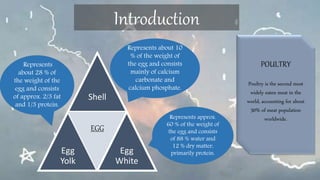
Shell
Egg
Yolk
EGG
Egg
White
Represents about 10
% of the weight of
the egg and consists
mainly of calcium
carbonate and
calcium phosphate.
Represents approx.
60 % of the weight of
the egg and consists
of 88 % water and
12 % dry matter,
primarily protein.
Represents
about 28 % of
the weight of the
egg and consists
of approx. 2/3 fat
and 1/3 protein.
POULTRY
Poultry is the second most
widely eaten meat in the
world, accounting for about
30% of meat population
worldwide.
Contamination of Egg
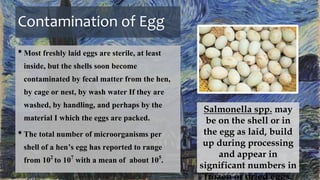
•Most freshly laid eggs are sterile, at least
inside, but the shells soon become
contaminated by fecal matter from the hen,
by cage or nest, by wash water If they are
washed, by handling, and perhaps by the
material I which the eggs are packed.
•The total number of microorganisms per
shell of a hen’s egg has reported to range
from 102 to 107 with a mean of about 105.
Salmonella spp. may
be on the shell or in
the egg as laid, build
up during processing
and appear in
significant numbers in
frozen or dried eggs.
SPOILAGE OF EGG
Defects in the
Fresh egg
May exhibit cracks, leaks,
loss or blossom or gloss,
or stained or dirty spots
on the exterior as well as
“meat spots” (blood
clots), general bloodiness
or translucent spots in
the yolk when candled.
From among these, any
breaks in the shell or dirt
on the egg will favor
spoilage on storage.
Changes during
Storage
The changes that takes
place in eggs while they
care being held or stored
may be divided into these
due to non-microbial
causes and those
resulting from the growth
of the micro-organisms.
Changes not
caused by
Microorganisms
Untreated eggs lose
moisture and weight
during storage. Also,
during storage, the
alkalinity of the white of
the egg increases from a
normal pH from about
7.6 to 9.5. any marked
growth of the chick
embryos in fertilized eggs
also serve to condemn
the eggs.
Changes caused by
Microorganisms
Contaminate the shell.
Penetrate the pores of
the shell to the
membrane (on moist
shell).
Grow through the shell
membranes to reach the
white (the yolk too if it
touches the membrane).
Preservation of egg
Asepsis
Great care is taken to reduce the
contamination of the outside of the
shell by hen faeces and dirt from the
nests. When the eggs are broken for
drying or freezing, care is taken to
discard those in which microbial
growth has taken place and to reduce
contamination from equipment by
cleaning and sanitizing it
Removal of micro-organisms
Because dirty eggs command a lower
price than clean ones, various methods
have been tried for the removal of soil.
Dry cleaning, as by sandblasting,
removes dirt and also the bloom
(mucin). Washing with warm, plain
water removes dirt, the bloom and part
of microorganisms but
Use of Heat
Treatments suggested include heating
shell eggs in oil for 10 min at 60 C or
in water for 30 min at 54.4 C;
immersion of shell eggs in boiling
water for a few seconds or in hot oil
(57.2 C) with or without a vacuum. A
thermo stabilization method of dipping
eggs into hot water reduces
evaporation of moisture from the egg
by a slight coagulation of the
outermost part of the albumen.
• Preservation of egg
Drying
Most of the drying of eggs utilizes the
spray dryer, where the liquid is
sprayed into a current of dry heat.
Another method is the roller or drum
process, in which the liquid egg is
passed over a heated drum, with or
without vacuum.
Air drying is accomplished by means
of open pans, or by the belt system,
where egg liquid is on a belt that
passes through a heated tunnel.
By Preservatives
Materials used in dry packaging of
eggs in the home include salt, lime,
sand, sawdust, and ashes. Immersion
in water glass, a solution of solution of
sodium silicate, long has been a
successful home method of
preservation. The solution is inhibitory
because of its alkalinity. Other
inhibitory chemicals that have been
used or tried are borates,
permanganates, benzoates, salicylates,
formats, and a host of other
compounds.
Freezing
The eggs are selected by candling then
washed mechanically with a final rinse
in 200 to 500 ppm chlorine (or iodine)
and then broken on automatic breaking
machines. They are then broken in
inspection cups and the whites and
yolks get separated with its action and
then filtered, mixed or churned,
standardized as to solids content and
frozen in 30 or 50 lb tin cans or other
containers, usually by a sharp freezing
process.
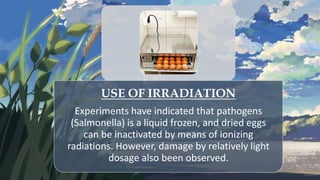
USE OF IRRADIATION
Experiments have indicated that pathogens
(Salmonella) is a liquid frozen, and dried eggs
can be inactivated by means of ionizing
radiations. However, damage by relatively light
dosage also been observed.
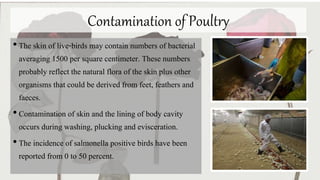
Contamination of Poultry
•The skin of live-birds may contain numbers of bacterial
averaging 1500 per square centimeter. These numbers
probably reflect the natural flora of the skin plus other
organisms that could be derived from feet, feathers and
faeces.
•Contamination of skin and the lining of body cavity
occurs during washing, plucking and evisceration.
•The incidence of salmonella positive birds have been
reported from 0 to 50 percent.
Spoilage of Poultry
• While the enzymes of the foul contribute to the deterioration of the dressed bird,
bacteria are the chief cause of spoilage, with the intense a primary source of these
organisms.
• Most bacterial growth takes place on the surfaces and the decomposition products
diffuse slowly into the meat.
• Eviscerated poultry held at 10C or below is spoiled mostly by Pseudomonas and to a
lesser extent by yeasts. Example: Toruloposis and Plavbacterium. In time the surface of
the meat usually becomes slimy. Small amounts (1 to 5 ppm) of iron in the wash water
may be favored by Pseudomonas.
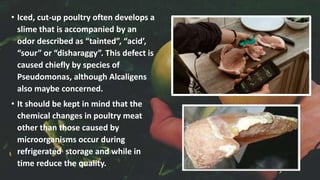
• Iced, cut-up poultry often develops a
slime that is accompanied by an
odor described as “tainted”, “acid’,
“sour” or “disharaggy”. This defect is
caused chiefly by species of
Pseudomonas, although Alcaligens
also maybe concerned.
• It should be kept in mind that the
chemical changes in poultry meat
other than those caused by
microorganisms occur during
refrigerated storage and while in
time reduce the quality.
PRESERVATION OF POULTRY
As in the slaughter of animals foe meat, the
methods of killing and bleeding the fowl has
an important effect on the quality of product.
Modern methods involve serving of the jugular
vein while the bird is suspended by its feet and
draining the blood.
Methods of Preservation
Asepsis
The sanitation of the housing of birds
before killing has some influence on
the numbers of microorganisms on the
skin at dressing, but even under the
best conditions spoilage organisms
contaminate the skin to permit
microbial deterioration if conditions of
handling and storage are not good.
Freezing
Poultry can be kept in good condition
for months if freezing is prompt and
rapid and the storage temperature is
low enough. It should be frozen fast
enough to retain most of natural bloom
or external appearance of freshly
dressed fowl. The storage temperature
should be below -17.8 C and the
relative humidity above 95 % to
reduce surface drying.
Use of Heat
Dressed chickens and other fowls may
be canned, whole or dissected, in their
own juices or in jelly. Heat processes
are analogous to those for canned
meats. The chickens or other fowl may
be salted in a weak brine solution
before being packed into the glass jars
or cans.
Carbon Dioxide Atmosphere
Increasing CO2 concentrations (10-
20%) in the atmosphere of stored
chickens inhibits the growth of
psychotrophs. Dry ice packed with the
carcasses may serve as the source of
the carbon dioxide. The use of the
films of both high and low gas
permeability in combination with CO2
atmosphere is the significant factor in
reducing microbial counts.
Use of Preservatives
Soaking cut-up poultry in solutions of
organic acids (acetic, adipic, succinic,
etc.) at pH 2.5 has also been reported
to lengthen shelf life. Turkey
sometimes is cured in a solution of
salt, sugar and sodium nitrate for
several weeks at about 3.3C, washed,
dried and then smoked.
Use of Irradiation
Irradiation of poultry with cathode or
gamma rays could be a successful
preservation method since the rays
apparently produce less objectionable
change in appearance and flavor than
in other foods, but to this date this
method is not practiced commercially.
Chicken carcasses have been treated
with 2.5 kilograys to effectively
destroy salmonellae.
REFERENCES
• Food microbiology (5th edition) by
William C Frazier and Dennis C
Westhoff
• www.slideshare.net/
mobile/IlyanaC/poultry
• www.slideshare.net/
mobile/Mariajosphine9/eggs
THANKYOU

Egg & poultry

  • 1.
    Presented By: Shirin Fatima B.techFood Technology (3rd sem.) Jamia Hamdard New Delhi Contamination, Spoilage and Preservation of Egg and Poultry
  • 2.
    Index  Introduction  Contaminatio nof Egg  Spoilage of Egg  Preservation of Egg  Contamination of Poultry  Spoilage of Poultry  Preservation of Poultry  References
  • 3.
    Introduction Shell Egg Yolk EGG Egg White Represents about 10 %of the weight of the egg and consists mainly of calcium carbonate and calcium phosphate. Represents approx. 60 % of the weight of the egg and consists of 88 % water and 12 % dry matter, primarily protein. Represents about 28 % of the weight of the egg and consists of approx. 2/3 fat and 1/3 protein. POULTRY Poultry is the second most widely eaten meat in the world, accounting for about 30% of meat population worldwide.
  • 4.
    Contamination of Egg •Mostfreshly laid eggs are sterile, at least inside, but the shells soon become contaminated by fecal matter from the hen, by cage or nest, by wash water If they are washed, by handling, and perhaps by the material I which the eggs are packed. •The total number of microorganisms per shell of a hen’s egg has reported to range from 102 to 107 with a mean of about 105. Salmonella spp. may be on the shell or in the egg as laid, build up during processing and appear in significant numbers in frozen or dried eggs.
  • 5.
    SPOILAGE OF EGG Defectsin the Fresh egg May exhibit cracks, leaks, loss or blossom or gloss, or stained or dirty spots on the exterior as well as “meat spots” (blood clots), general bloodiness or translucent spots in the yolk when candled. From among these, any breaks in the shell or dirt on the egg will favor spoilage on storage. Changes during Storage The changes that takes place in eggs while they care being held or stored may be divided into these due to non-microbial causes and those resulting from the growth of the micro-organisms. Changes not caused by Microorganisms Untreated eggs lose moisture and weight during storage. Also, during storage, the alkalinity of the white of the egg increases from a normal pH from about 7.6 to 9.5. any marked growth of the chick embryos in fertilized eggs also serve to condemn the eggs. Changes caused by Microorganisms Contaminate the shell. Penetrate the pores of the shell to the membrane (on moist shell). Grow through the shell membranes to reach the white (the yolk too if it touches the membrane).
  • 6.
    Preservation of egg Asepsis Greatcare is taken to reduce the contamination of the outside of the shell by hen faeces and dirt from the nests. When the eggs are broken for drying or freezing, care is taken to discard those in which microbial growth has taken place and to reduce contamination from equipment by cleaning and sanitizing it Removal of micro-organisms Because dirty eggs command a lower price than clean ones, various methods have been tried for the removal of soil. Dry cleaning, as by sandblasting, removes dirt and also the bloom (mucin). Washing with warm, plain water removes dirt, the bloom and part of microorganisms but Use of Heat Treatments suggested include heating shell eggs in oil for 10 min at 60 C or in water for 30 min at 54.4 C; immersion of shell eggs in boiling water for a few seconds or in hot oil (57.2 C) with or without a vacuum. A thermo stabilization method of dipping eggs into hot water reduces evaporation of moisture from the egg by a slight coagulation of the outermost part of the albumen.
  • 7.
    • Preservation ofegg Drying Most of the drying of eggs utilizes the spray dryer, where the liquid is sprayed into a current of dry heat. Another method is the roller or drum process, in which the liquid egg is passed over a heated drum, with or without vacuum. Air drying is accomplished by means of open pans, or by the belt system, where egg liquid is on a belt that passes through a heated tunnel. By Preservatives Materials used in dry packaging of eggs in the home include salt, lime, sand, sawdust, and ashes. Immersion in water glass, a solution of solution of sodium silicate, long has been a successful home method of preservation. The solution is inhibitory because of its alkalinity. Other inhibitory chemicals that have been used or tried are borates, permanganates, benzoates, salicylates, formats, and a host of other compounds. Freezing The eggs are selected by candling then washed mechanically with a final rinse in 200 to 500 ppm chlorine (or iodine) and then broken on automatic breaking machines. They are then broken in inspection cups and the whites and yolks get separated with its action and then filtered, mixed or churned, standardized as to solids content and frozen in 30 or 50 lb tin cans or other containers, usually by a sharp freezing process.
  • 8.
    USE OF IRRADIATION Experimentshave indicated that pathogens (Salmonella) is a liquid frozen, and dried eggs can be inactivated by means of ionizing radiations. However, damage by relatively light dosage also been observed.
  • 9.
    Contamination of Poultry •Theskin of live-birds may contain numbers of bacterial averaging 1500 per square centimeter. These numbers probably reflect the natural flora of the skin plus other organisms that could be derived from feet, feathers and faeces. •Contamination of skin and the lining of body cavity occurs during washing, plucking and evisceration. •The incidence of salmonella positive birds have been reported from 0 to 50 percent.
  • 10.
    Spoilage of Poultry •While the enzymes of the foul contribute to the deterioration of the dressed bird, bacteria are the chief cause of spoilage, with the intense a primary source of these organisms. • Most bacterial growth takes place on the surfaces and the decomposition products diffuse slowly into the meat. • Eviscerated poultry held at 10C or below is spoiled mostly by Pseudomonas and to a lesser extent by yeasts. Example: Toruloposis and Plavbacterium. In time the surface of the meat usually becomes slimy. Small amounts (1 to 5 ppm) of iron in the wash water may be favored by Pseudomonas.
  • 11.
    • Iced, cut-uppoultry often develops a slime that is accompanied by an odor described as “tainted”, “acid’, “sour” or “disharaggy”. This defect is caused chiefly by species of Pseudomonas, although Alcaligens also maybe concerned. • It should be kept in mind that the chemical changes in poultry meat other than those caused by microorganisms occur during refrigerated storage and while in time reduce the quality.
  • 12.
    PRESERVATION OF POULTRY Asin the slaughter of animals foe meat, the methods of killing and bleeding the fowl has an important effect on the quality of product. Modern methods involve serving of the jugular vein while the bird is suspended by its feet and draining the blood.
  • 13.
    Methods of Preservation Asepsis Thesanitation of the housing of birds before killing has some influence on the numbers of microorganisms on the skin at dressing, but even under the best conditions spoilage organisms contaminate the skin to permit microbial deterioration if conditions of handling and storage are not good. Freezing Poultry can be kept in good condition for months if freezing is prompt and rapid and the storage temperature is low enough. It should be frozen fast enough to retain most of natural bloom or external appearance of freshly dressed fowl. The storage temperature should be below -17.8 C and the relative humidity above 95 % to reduce surface drying. Use of Heat Dressed chickens and other fowls may be canned, whole or dissected, in their own juices or in jelly. Heat processes are analogous to those for canned meats. The chickens or other fowl may be salted in a weak brine solution before being packed into the glass jars or cans.
  • 14.
    Carbon Dioxide Atmosphere IncreasingCO2 concentrations (10- 20%) in the atmosphere of stored chickens inhibits the growth of psychotrophs. Dry ice packed with the carcasses may serve as the source of the carbon dioxide. The use of the films of both high and low gas permeability in combination with CO2 atmosphere is the significant factor in reducing microbial counts. Use of Preservatives Soaking cut-up poultry in solutions of organic acids (acetic, adipic, succinic, etc.) at pH 2.5 has also been reported to lengthen shelf life. Turkey sometimes is cured in a solution of salt, sugar and sodium nitrate for several weeks at about 3.3C, washed, dried and then smoked. Use of Irradiation Irradiation of poultry with cathode or gamma rays could be a successful preservation method since the rays apparently produce less objectionable change in appearance and flavor than in other foods, but to this date this method is not practiced commercially. Chicken carcasses have been treated with 2.5 kilograys to effectively destroy salmonellae.
  • 15.
    REFERENCES • Food microbiology(5th edition) by William C Frazier and Dennis C Westhoff • www.slideshare.net/ mobile/IlyanaC/poultry • www.slideshare.net/ mobile/Mariajosphine9/eggs
  • 16.