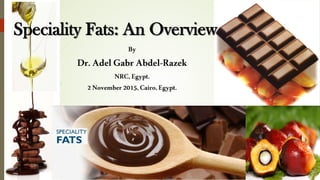
Speciality Fats: An Overview
By
Dr.AdelGabr Abdel-Razek
NRC,Egypt.
2November2015, Cairo,Egypt.
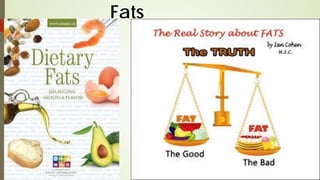
Fats
Classification of Edible Lipids
Fats – solid at room temp
Oils
Visible
 Invisible
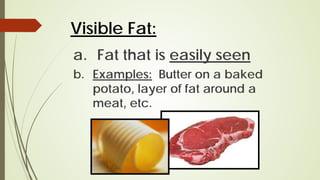
Visible Fat:
a. Fat that is easily seen
b. Examples: Butter on a baked
potato, layer of fat around a
meat, etc.
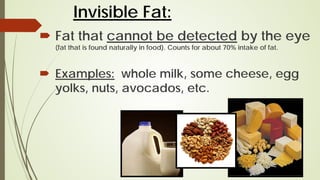
Invisible Fat:
 Fat that cannot be detected by the eye
(fat that is found naturally in food). Counts for about 70% intake of fat.
 Examples: whole milk, some cheese, egg
yolks, nuts, avocados, etc.
Role and importance of fats in a diet
 Fats are one of the important food groups that are
included in your diet.
 Over the years, fats have got a bad name.
 Most nutritionists talk about reducing fats in your diet.
 However, all fats are not equal.
 There are so called good fats and bad fats.
 The good fats, also known as essential fatty acids perform
a number of important functions in your body.
 So, you should not eliminate them completely from your
diet.
 But, since fats contain a lot of calories, even good fats
should not be consumed in excess.
(We should EAT SPARINGLY from the Fats & Oils Food Group)
 There are a number of factors that determine the
optimum amount of fat that you should consume. These
include age, sex, level of physical activities etc.
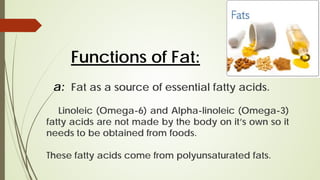
a: Fat as a source of essential fatty acids.
Linoleic (Omega-6) and Alpha-linoleic (Omega-3)
fatty acids are not made by the body on it’s own so it
needs to be obtained from foods.
These fatty acids come from polyunsaturated fats.
Functions of Fat:
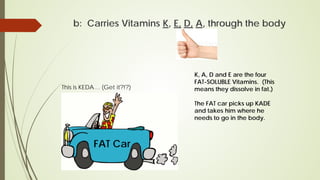
b: Carries Vitamins K, E, D, A, through the body
This is KEDA… (Get it?!?)
FAT Car
K, A, D and E are the four
FAT-SOLUBLE Vitamins. (This
means they dissolve in fat.)
The FAT car picks up KADE
and takes him where he
needs to go in the body.
c. As a main source of energy 1g = 9kCal,
as well as Provides a RESERVE store of energy.
d. Promotes healthy skin
e. Promotes normal cell growth
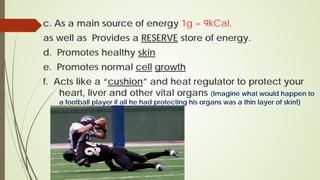
f. Acts like a “cushion” and heat regulator to protect your
heart, liver and other vital organs (Imagine what would happen to
a football player if all he had protecting his organs was a thin layer of skin!)
g. Satisfies hunger and helps you feel full longer (value which is due partly
by the slower rate of digestion of fats in comparison to carbohydrate and protein).
h. Fats bring important ‘mouth feel’ and flavor to many foods, are
necessary for the palatability in the diet.
i. Tenderization – EX: cake, add fat to tenderize and control gluten
development
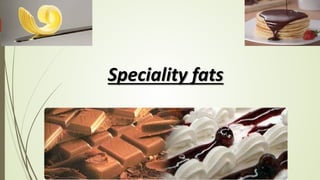
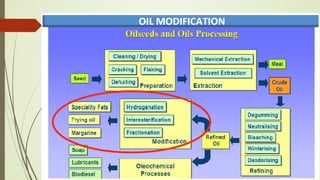
Speciality fats
What are speciality fats?
Speciality Fats are thus, tailor made to imitate
the many positive traits of cocoa butter or other
properties to make them more suitable for
specific applications.
Speciality fats are not only used in the Chocolate Industry but also
find uses in:
• Ice Cream Industry- ice cream fats, ice cream chocolate coatings.
• Confectionery
• Pharmaceuticals-suppositories/binders.
• Milk fat replacers
• Non Dairy Whipped Toppings
• Cosmetics - lipsticks
Speciality fats perform functions that normal
fats are not capable of.
For instance, a chocolate fat is capable of
setting or hardening on the surface of a cake
when cooled and then melting completely to
give a smooth clean mouth feel with full
release of sweetness and chocolate flavor
when eaten.
In contrast a normal shortening would not
harden completely when cooled.
Also, shortening gives a waxy mouth feel and it
does not allow full release of flavors when
eaten.
 In reality, the chocolate fat (itself a speciality fat) has
been carefully and purposefully developed to impart
specific product characteristics expected by the
consumer.
 Chocolate fat was customized to set at 20 ⁰C (when
cooled inside a cooling tunnel), to become softer at
32 ⁰C and to melt completely at body temperature
(37 ⁰C) when the chocolate coating is eaten.
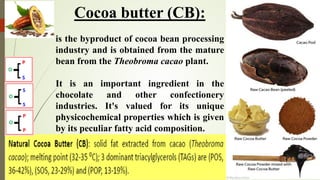
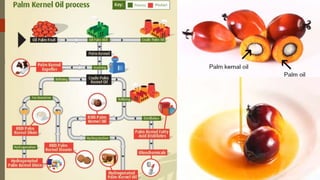
Cocoa butter (CB):
is the byproduct of cocoa bean processing
industry and is obtained from the mature
bean from the Theobroma cacao plant.
It is an important ingredient in the
chocolate and other confectionery
industries. It's valued for its unique
physicochemical properties which is given
by its peculiar fatty acid composition.
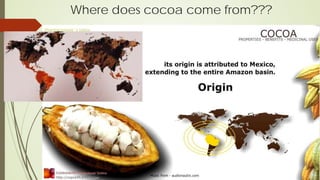
Where does cocoa come from???
Why use speciality fats?
 Food manufacturers are in business to supply needs dictated
by consumers.
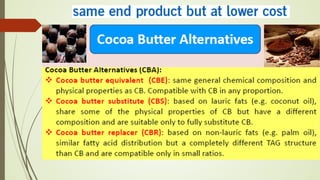
 Increasing demand and shortage of supply for CB, poor
quality of individual harvests, economic advantages and
some technological benefits have induce for the
development of its alternative called cocoa butter replacer
(CBR).
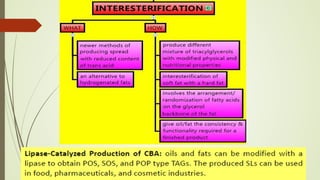
 In the CBRs the TAG compositions are similar but are not
identical to genuine CB.
 Most of them are produced by either modification of
natural fat or by their blending in different proportion.
Equipped with advanced knowledge of:
fat chemistry & fat modification technologies.
Speciality fat manufacturers offer the food industry a large
selection of speciality fats, such as chocolate and chocolate
confectionary, bakery products and ice cream, targeted to meet
food characteristics requested by their client.
HISTORY
 1528: Hernán Cortéz came to Spain with cocoa beans and the
formula for the chocolate drink
 1615: The Spanish princess Anne of Austria married Luis XIII of
France, so chocolate came to France
 1657: A Frenchman opened the first “Chocolate House” in London
 became as popular as Coffee Houses.
 1674: The first solid chocolate in a stick form had been sold
 End of 17th century: chocolate came to Germany
 first pralines were made by a German cook
 1792: A chocolate factory was opened in Berlin
 1875: The first milk chocolate was put on the market.
INDUSTRILIZATION
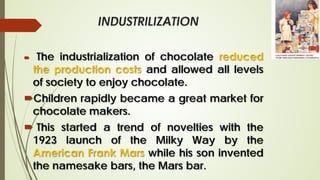
 The industrialization of chocolate reduced
the production costs and allowed all levels
of society to enjoy chocolate.
Children rapidly became a great market for
chocolate makers.
 This started a trend of novelties with the
1923 launch of the Milky Way by the
American Frank Mars while his son invented
the namesake bars, the Mars bar.
At the same time, Milton Hershey, another
American chocolate producer vastly
expanded his chocolate sales through
clever marketing and capitalizing on
impulse purchases of chocolate in main
street grocery stores.
Hershey was called the "Henry Ford" of
chocolate because he produced a
quality chocolate bar at a price everyone
could afford.
TODAY
The chocolate industry has grown to a worldwide
industry topping $50 Billion in retail sales
worldwide and continues to show healthy growth.
 Recently, there has been an increasing trend
towards high quality chocolates such as
chocolates with high cocoa content and or
chocolates flavored with natural flavors and rich
spices.
During this event we will discuss:
how speciality fats can be used advantageously in the
area of food applications?
Specialty fats: An Overview

Specialty fats: An Overview

  • 1.
    Speciality Fats: AnOverview By Dr.AdelGabr Abdel-Razek NRC,Egypt. 2November2015, Cairo,Egypt.
  • 2.
  • 3.
    Classification of EdibleLipids Fats – solid at room temp Oils Visible  Invisible
  • 4.
    Visible Fat: a. Fatthat is easily seen b. Examples: Butter on a baked potato, layer of fat around a meat, etc.
  • 5.
    Invisible Fat:  Fatthat cannot be detected by the eye (fat that is found naturally in food). Counts for about 70% intake of fat.  Examples: whole milk, some cheese, egg yolks, nuts, avocados, etc.
  • 6.
    Role and importanceof fats in a diet  Fats are one of the important food groups that are included in your diet.  Over the years, fats have got a bad name.  Most nutritionists talk about reducing fats in your diet.  However, all fats are not equal.  There are so called good fats and bad fats.
  • 7.
     The goodfats, also known as essential fatty acids perform a number of important functions in your body.  So, you should not eliminate them completely from your diet.  But, since fats contain a lot of calories, even good fats should not be consumed in excess. (We should EAT SPARINGLY from the Fats & Oils Food Group)  There are a number of factors that determine the optimum amount of fat that you should consume. These include age, sex, level of physical activities etc.
  • 9.
    a: Fat asa source of essential fatty acids. Linoleic (Omega-6) and Alpha-linoleic (Omega-3) fatty acids are not made by the body on it’s own so it needs to be obtained from foods. These fatty acids come from polyunsaturated fats. Functions of Fat:
  • 10.
    b: Carries VitaminsK, E, D, A, through the body This is KEDA… (Get it?!?) FAT Car K, A, D and E are the four FAT-SOLUBLE Vitamins. (This means they dissolve in fat.) The FAT car picks up KADE and takes him where he needs to go in the body.
  • 11.
    c. As amain source of energy 1g = 9kCal, as well as Provides a RESERVE store of energy. d. Promotes healthy skin e. Promotes normal cell growth f. Acts like a “cushion” and heat regulator to protect your heart, liver and other vital organs (Imagine what would happen to a football player if all he had protecting his organs was a thin layer of skin!)
  • 12.
    g. Satisfies hungerand helps you feel full longer (value which is due partly by the slower rate of digestion of fats in comparison to carbohydrate and protein). h. Fats bring important ‘mouth feel’ and flavor to many foods, are necessary for the palatability in the diet. i. Tenderization – EX: cake, add fat to tenderize and control gluten development
  • 13.
  • 14.
    What are specialityfats? Speciality Fats are thus, tailor made to imitate the many positive traits of cocoa butter or other properties to make them more suitable for specific applications.
  • 15.
    Speciality fats arenot only used in the Chocolate Industry but also find uses in: • Ice Cream Industry- ice cream fats, ice cream chocolate coatings. • Confectionery • Pharmaceuticals-suppositories/binders. • Milk fat replacers • Non Dairy Whipped Toppings • Cosmetics - lipsticks
  • 16.
    Speciality fats performfunctions that normal fats are not capable of. For instance, a chocolate fat is capable of setting or hardening on the surface of a cake when cooled and then melting completely to give a smooth clean mouth feel with full release of sweetness and chocolate flavor when eaten.
  • 17.
    In contrast anormal shortening would not harden completely when cooled. Also, shortening gives a waxy mouth feel and it does not allow full release of flavors when eaten.
  • 18.
     In reality,the chocolate fat (itself a speciality fat) has been carefully and purposefully developed to impart specific product characteristics expected by the consumer.  Chocolate fat was customized to set at 20 ⁰C (when cooled inside a cooling tunnel), to become softer at 32 ⁰C and to melt completely at body temperature (37 ⁰C) when the chocolate coating is eaten.
  • 19.
    Cocoa butter (CB): isthe byproduct of cocoa bean processing industry and is obtained from the mature bean from the Theobroma cacao plant. It is an important ingredient in the chocolate and other confectionery industries. It's valued for its unique physicochemical properties which is given by its peculiar fatty acid composition.
  • 20.
    Where does cocoacome from???
  • 21.
    Why use specialityfats?  Food manufacturers are in business to supply needs dictated by consumers.  Increasing demand and shortage of supply for CB, poor quality of individual harvests, economic advantages and some technological benefits have induce for the development of its alternative called cocoa butter replacer (CBR).
  • 22.
     In theCBRs the TAG compositions are similar but are not identical to genuine CB.  Most of them are produced by either modification of natural fat or by their blending in different proportion. Equipped with advanced knowledge of: fat chemistry & fat modification technologies.
  • 29.
    Speciality fat manufacturersoffer the food industry a large selection of speciality fats, such as chocolate and chocolate confectionary, bakery products and ice cream, targeted to meet food characteristics requested by their client.
  • 30.
    HISTORY  1528: HernánCortéz came to Spain with cocoa beans and the formula for the chocolate drink  1615: The Spanish princess Anne of Austria married Luis XIII of France, so chocolate came to France  1657: A Frenchman opened the first “Chocolate House” in London  became as popular as Coffee Houses.  1674: The first solid chocolate in a stick form had been sold  End of 17th century: chocolate came to Germany  first pralines were made by a German cook  1792: A chocolate factory was opened in Berlin  1875: The first milk chocolate was put on the market.
  • 31.
    INDUSTRILIZATION  The industrializationof chocolate reduced the production costs and allowed all levels of society to enjoy chocolate. Children rapidly became a great market for chocolate makers.  This started a trend of novelties with the 1923 launch of the Milky Way by the American Frank Mars while his son invented the namesake bars, the Mars bar.
  • 32.
    At the sametime, Milton Hershey, another American chocolate producer vastly expanded his chocolate sales through clever marketing and capitalizing on impulse purchases of chocolate in main street grocery stores. Hershey was called the "Henry Ford" of chocolate because he produced a quality chocolate bar at a price everyone could afford.
  • 33.
    TODAY The chocolate industryhas grown to a worldwide industry topping $50 Billion in retail sales worldwide and continues to show healthy growth.  Recently, there has been an increasing trend towards high quality chocolates such as chocolates with high cocoa content and or chocolates flavored with natural flavors and rich spices.
  • 34.
    During this eventwe will discuss: how speciality fats can be used advantageously in the area of food applications?