Versatile
Economic
Nutritious
Malaysian Palm Oil
in Cooking
Palm Oil; Introduction & History
2
 One of the 10 major oils in edible fats market
 Originates 5000 years ago, as per Egyptian
tomb findings!
 Since 18th Century industrial use
 Since 20th Century in food applications
 1 out of every 10 food products worldwide
contain palm oil
Malaysia
3
 Southeast Asia
 Capital Kuala Lumpur
 Population 30 million
Climate:
 Humid tropical
 Temperature between 24°C – 32°C
 Ample sunshine
 Sufficient rainfall
 Ideal for cultivation of oil palms
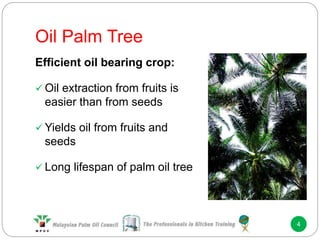
Oil Palm Tree
4
Efficient oil bearing crop:
 Oil extraction from fruits is
easier than from seeds
 Yields oil from fruits and
seeds
 Long lifespan of palm oil tree
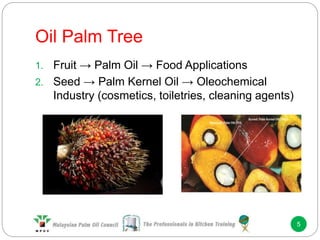
Oil Palm Tree
5
1. Fruit → Palm Oil → Food Applications
2. Seed → Palm Kernel Oil → Oleochemical
Industry (cosmetics, toiletries, cleaning agents)
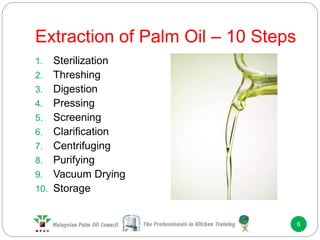
Extraction of Palm Oil – 10 Steps
6
1. Sterilization
2. Threshing
3. Digestion
4. Pressing
5. Screening
6. Clarification
7. Centrifuging
8. Purifying
9. Vacuum Drying
10. Storage
“Crude” or “Virgin” Oil
7
Extraction of palm oil is:
 Solely mechanical
 No solvent used
 No alternation of the nature of the oil
 Making it a “Virgin Palm Oil”
Food Applications of Palm Oil
8
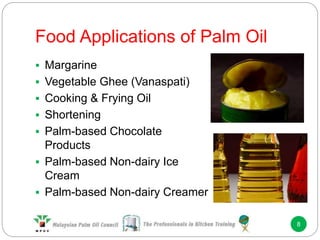
 Margarine
 Vegetable Ghee (Vanaspati)
 Cooking & Frying Oil
 Shortening
 Palm-based Chocolate
Products
 Palm-based Non-dairy Ice
Cream
 Palm-based Non-dairy Creamer
Margarine & Vegetable Ghee
9
With palm oil:
 No need for hydrogenation → no trans-fatty acids
 Based on vegetable fat, not animal fats (as in
butter oil)
Cooking & Frying Oil
10
Palm oil & palm olein are excellent frying oils:
 Good resistance to oxidation
 Can resist high temperatures
Palm oil is liquid fraction of palm olein
Solid content at room temperature → cloudy
appearance, no effect on quality of the oil
 Dip bottle of oil in hot water → cloudiness disappears
and easy to pour the oil
Shortening
11
 Used in baking, also known as solid shortenings
Needs to have the following properties for
baking:
 High plasticity
 Smooth & consistent texture
 Higher melting point
Palm-based Chocolate Products
12
Advantages using palm-based fats in chocolate
products:
 Do not require tempering
 Less subject to bloom, stays shiny and attractive
 Suitable for production lines
 Stable in hot climates, higher melting point
 Low level of unsaturated fatty acids
 Reliable supply the whole year
 Versatile in use
 Cheaper than cocoa butter
Palm-based Non-dairy Creamer &
Ice Cream
13
Advantages using palm-based fats in Creamers
and Ice cream:
 Sharp melting properties with 5% solids at 35°C
 Ideal for people who are lactose-intolerant
 Ideal for people who refrain from eating animal
products
 Cholesterol-free properties
 Available whole year
 Inexpensive compared to milk fats
Understanding Fats
14
Function of fats:
Provide calories
Help carry fatty-soluble vitamins
Give food a creamy, pleasant mouth feel
 A healthy diet contains a moderate amount of fat
 Saturated fats → animal products
 Monounsaturated fats → plants & plant products
 Polyunsaturated fats → plants & fish
Understanding Fats & Cholesterol
15
 Saturated fats are solid at room temperature
 Monounsaturated & polyunsaturated fats are soft
or liquid at room temperature
 High proportion of LDL cholesterol → increases
risk of heart disease
 High proportion of HDL cholesterol → lowers risk
of heart disease
 All vegetable oils are cholesterol-free
Hydrogenation
16
Hydrogenation = liquid fat made solid (saturated)
 Reduces tendency of rancidity
 Increases shelf life
But Causes:
Formation of trans-fats → bad for health
Palm oil → natural solid contents → no need for
hydrogenation
Nutritional Benefits & Health Facts
17
Palm Oil ≠ Coconut Oil or Palm
Kernel Oil
 Contains 50% Unsaturated fats
50% Saturated fats
 Cholesterol-free
 Beneficial cholesterol
modulating effects
 Rich source of carotenoids and
vitamin E & pro-vitamin A
 Easy digested, absorbed and
utilized as energy
 No need for hydrogenation
Techno-Economic Advantages
18
 Consistent supply
 Competitive price (see table student manual)
 Versatile
Frying Foods
19
Quality of oil in frying foods effects:
 Eating quality of food product
 Nutritional properties of food product
 Flavor of food product
Most foods are fried at 175°C – 185°C
 Larger pieces → lower temperature and longer time
 Frying at too high temperature → food surface
burned, inside not cooked
 Frying at too low temperature → food absorbs too
much oil, greasy
Frying Foods Safety Alert
20
 Slide food into frying pan to avoid splatters
 Pat moist foods dry before adding to deep fryer
 Do not heat oil to its flash point
 Do not exceed oil temperature of 180°C
 Do not heat oil for long at its smoke point
 Smoking oil needs changing
 Cool down oil completely before discarding
Specification for Frying Oil
21
Good frying oil:
 Free fatty acids below 0.1%
 Odor and flavor bland
 Smoke point above 215°C
 Melting point at maximum 40°C
 Stability at high temperature use
 High degree of resistance to oxidation
 Not harmful to our health
Maintaining Frying Oil Quality
22
Frying oil loses its quality by:
 Contact with salt → do not salt foods above fryer
 Contact with water → pat foods dry before adding
to the deep fryer
 Overheating oil → heat at 180°C max
 Food particles left in fryer → skim & remove food
particles
 Exposure to oxygen → cover fryer when not in
use
 Do not keep oil heated for long time when not in
use
 Filter the oil
Maintaining Frying Oil Quality
23
When to change the oil?
 Color, when oil becomes dark
 Foaming
 Smoking
 Bad odor
 Length of time used
 Always evaluate quality of fried food product
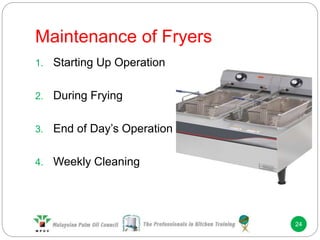
Maintenance of Fryers
24
1. Starting Up Operation
2. During Frying
3. End of Day’s Operation
4. Weekly Cleaning
Testing & Recycling Frying Oil
25
Use test kits to determine rejection point of oil.
Oil should be changed if:
 Taste or flavor is unacceptable
 Smoke point is below 170°C
 Petroleum ether insoluble oxidized fatty acids are
above 0.75%
 Oxidized fatty acids are above 1%
 Recycle used frying oil for biodiesel production
www.tagadded.com
Industry Trends
26
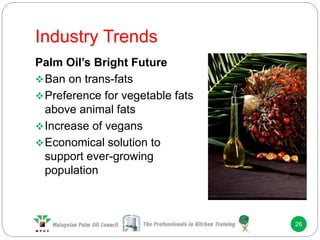
Palm Oil’s Bright Future
Ban on trans-fats
Preference for vegetable fats
above animal fats
Increase of vegans
Economical solution to
support ever-growing
population
Questions & Answers
27
Thank You!
28
www.slideshare.net/MPOCEgypt

Palm Oil in cooking

  • 1.
  • 2.
    Palm Oil; Introduction& History 2  One of the 10 major oils in edible fats market  Originates 5000 years ago, as per Egyptian tomb findings!  Since 18th Century industrial use  Since 20th Century in food applications  1 out of every 10 food products worldwide contain palm oil
  • 3.
    Malaysia 3  Southeast Asia Capital Kuala Lumpur  Population 30 million Climate:  Humid tropical  Temperature between 24°C – 32°C  Ample sunshine  Sufficient rainfall  Ideal for cultivation of oil palms
  • 4.
    Oil Palm Tree 4 Efficientoil bearing crop:  Oil extraction from fruits is easier than from seeds  Yields oil from fruits and seeds  Long lifespan of palm oil tree
  • 5.
    Oil Palm Tree 5 1.Fruit → Palm Oil → Food Applications 2. Seed → Palm Kernel Oil → Oleochemical Industry (cosmetics, toiletries, cleaning agents)
  • 6.
    Extraction of PalmOil – 10 Steps 6 1. Sterilization 2. Threshing 3. Digestion 4. Pressing 5. Screening 6. Clarification 7. Centrifuging 8. Purifying 9. Vacuum Drying 10. Storage
  • 7.
    “Crude” or “Virgin”Oil 7 Extraction of palm oil is:  Solely mechanical  No solvent used  No alternation of the nature of the oil  Making it a “Virgin Palm Oil”
  • 8.
    Food Applications ofPalm Oil 8  Margarine  Vegetable Ghee (Vanaspati)  Cooking & Frying Oil  Shortening  Palm-based Chocolate Products  Palm-based Non-dairy Ice Cream  Palm-based Non-dairy Creamer
  • 9.
    Margarine & VegetableGhee 9 With palm oil:  No need for hydrogenation → no trans-fatty acids  Based on vegetable fat, not animal fats (as in butter oil)
  • 10.
    Cooking & FryingOil 10 Palm oil & palm olein are excellent frying oils:  Good resistance to oxidation  Can resist high temperatures Palm oil is liquid fraction of palm olein Solid content at room temperature → cloudy appearance, no effect on quality of the oil  Dip bottle of oil in hot water → cloudiness disappears and easy to pour the oil
  • 11.
    Shortening 11  Used inbaking, also known as solid shortenings Needs to have the following properties for baking:  High plasticity  Smooth & consistent texture  Higher melting point
  • 12.
    Palm-based Chocolate Products 12 Advantagesusing palm-based fats in chocolate products:  Do not require tempering  Less subject to bloom, stays shiny and attractive  Suitable for production lines  Stable in hot climates, higher melting point  Low level of unsaturated fatty acids  Reliable supply the whole year  Versatile in use  Cheaper than cocoa butter
  • 13.
    Palm-based Non-dairy Creamer& Ice Cream 13 Advantages using palm-based fats in Creamers and Ice cream:  Sharp melting properties with 5% solids at 35°C  Ideal for people who are lactose-intolerant  Ideal for people who refrain from eating animal products  Cholesterol-free properties  Available whole year  Inexpensive compared to milk fats
  • 14.
    Understanding Fats 14 Function offats: Provide calories Help carry fatty-soluble vitamins Give food a creamy, pleasant mouth feel  A healthy diet contains a moderate amount of fat  Saturated fats → animal products  Monounsaturated fats → plants & plant products  Polyunsaturated fats → plants & fish
  • 15.
    Understanding Fats &Cholesterol 15  Saturated fats are solid at room temperature  Monounsaturated & polyunsaturated fats are soft or liquid at room temperature  High proportion of LDL cholesterol → increases risk of heart disease  High proportion of HDL cholesterol → lowers risk of heart disease  All vegetable oils are cholesterol-free
  • 16.
    Hydrogenation 16 Hydrogenation = liquidfat made solid (saturated)  Reduces tendency of rancidity  Increases shelf life But Causes: Formation of trans-fats → bad for health Palm oil → natural solid contents → no need for hydrogenation
  • 17.
    Nutritional Benefits &Health Facts 17 Palm Oil ≠ Coconut Oil or Palm Kernel Oil  Contains 50% Unsaturated fats 50% Saturated fats  Cholesterol-free  Beneficial cholesterol modulating effects  Rich source of carotenoids and vitamin E & pro-vitamin A  Easy digested, absorbed and utilized as energy  No need for hydrogenation
  • 18.
    Techno-Economic Advantages 18  Consistentsupply  Competitive price (see table student manual)  Versatile
  • 19.
    Frying Foods 19 Quality ofoil in frying foods effects:  Eating quality of food product  Nutritional properties of food product  Flavor of food product Most foods are fried at 175°C – 185°C  Larger pieces → lower temperature and longer time  Frying at too high temperature → food surface burned, inside not cooked  Frying at too low temperature → food absorbs too much oil, greasy
  • 20.
    Frying Foods SafetyAlert 20  Slide food into frying pan to avoid splatters  Pat moist foods dry before adding to deep fryer  Do not heat oil to its flash point  Do not exceed oil temperature of 180°C  Do not heat oil for long at its smoke point  Smoking oil needs changing  Cool down oil completely before discarding
  • 21.
    Specification for FryingOil 21 Good frying oil:  Free fatty acids below 0.1%  Odor and flavor bland  Smoke point above 215°C  Melting point at maximum 40°C  Stability at high temperature use  High degree of resistance to oxidation  Not harmful to our health
  • 22.
    Maintaining Frying OilQuality 22 Frying oil loses its quality by:  Contact with salt → do not salt foods above fryer  Contact with water → pat foods dry before adding to the deep fryer  Overheating oil → heat at 180°C max  Food particles left in fryer → skim & remove food particles  Exposure to oxygen → cover fryer when not in use  Do not keep oil heated for long time when not in use  Filter the oil
  • 23.
    Maintaining Frying OilQuality 23 When to change the oil?  Color, when oil becomes dark  Foaming  Smoking  Bad odor  Length of time used  Always evaluate quality of fried food product
  • 24.
    Maintenance of Fryers 24 1.Starting Up Operation 2. During Frying 3. End of Day’s Operation 4. Weekly Cleaning
  • 25.
    Testing & RecyclingFrying Oil 25 Use test kits to determine rejection point of oil. Oil should be changed if:  Taste or flavor is unacceptable  Smoke point is below 170°C  Petroleum ether insoluble oxidized fatty acids are above 0.75%  Oxidized fatty acids are above 1%  Recycle used frying oil for biodiesel production www.tagadded.com
  • 26.
    Industry Trends 26 Palm Oil’sBright Future Ban on trans-fats Preference for vegetable fats above animal fats Increase of vegans Economical solution to support ever-growing population
  • 27.
  • 28.