Unit-2
By
T.Raviteja
Oil and fat processing
Introduction
 Fats and oils comprises of 3 major classes of
foods –carbohydrates, proteins and fats.
 It is chemically defines as the esters of the three
carbon trihydroxy alcohol, glycerol and various
monocarboxylic acids known as fatty acids.
 All fats and oils are mixture of both saturated and
unsaturated fatty acids.
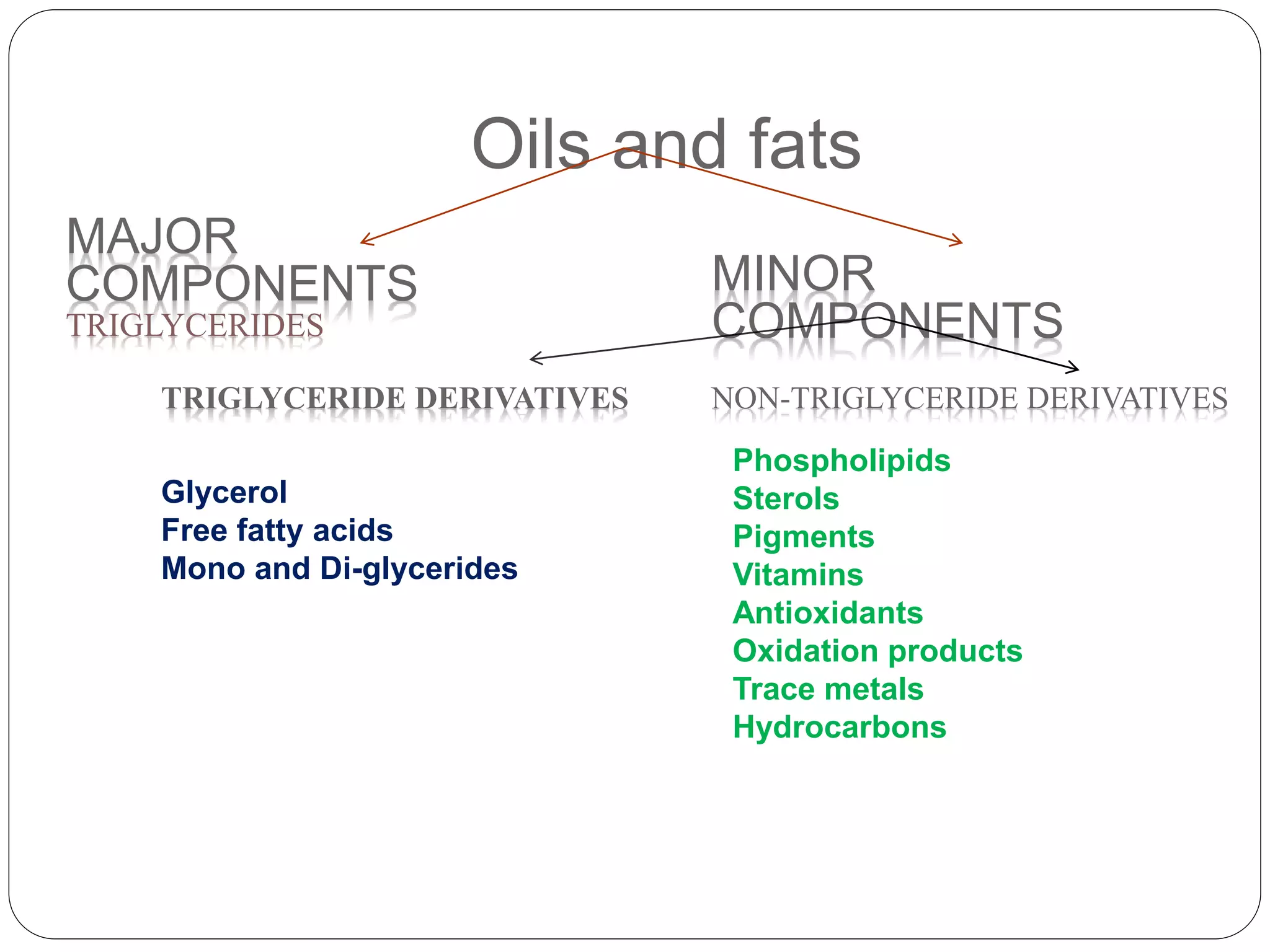
Oils and fats
MAJOR
COMPONENTS
TRIGLYCERIDES
MINOR
COMPONENTS
TRIGLYCERIDE DERIVATIVES NON-TRIGLYCERIDE DERIVATIVES
Glycerol
Free fatty acids
Mono and Di-glycerides
Phospholipids
Sterols
Pigments
Vitamins
Antioxidants
Oxidation products
Trace metals
Hydrocarbons
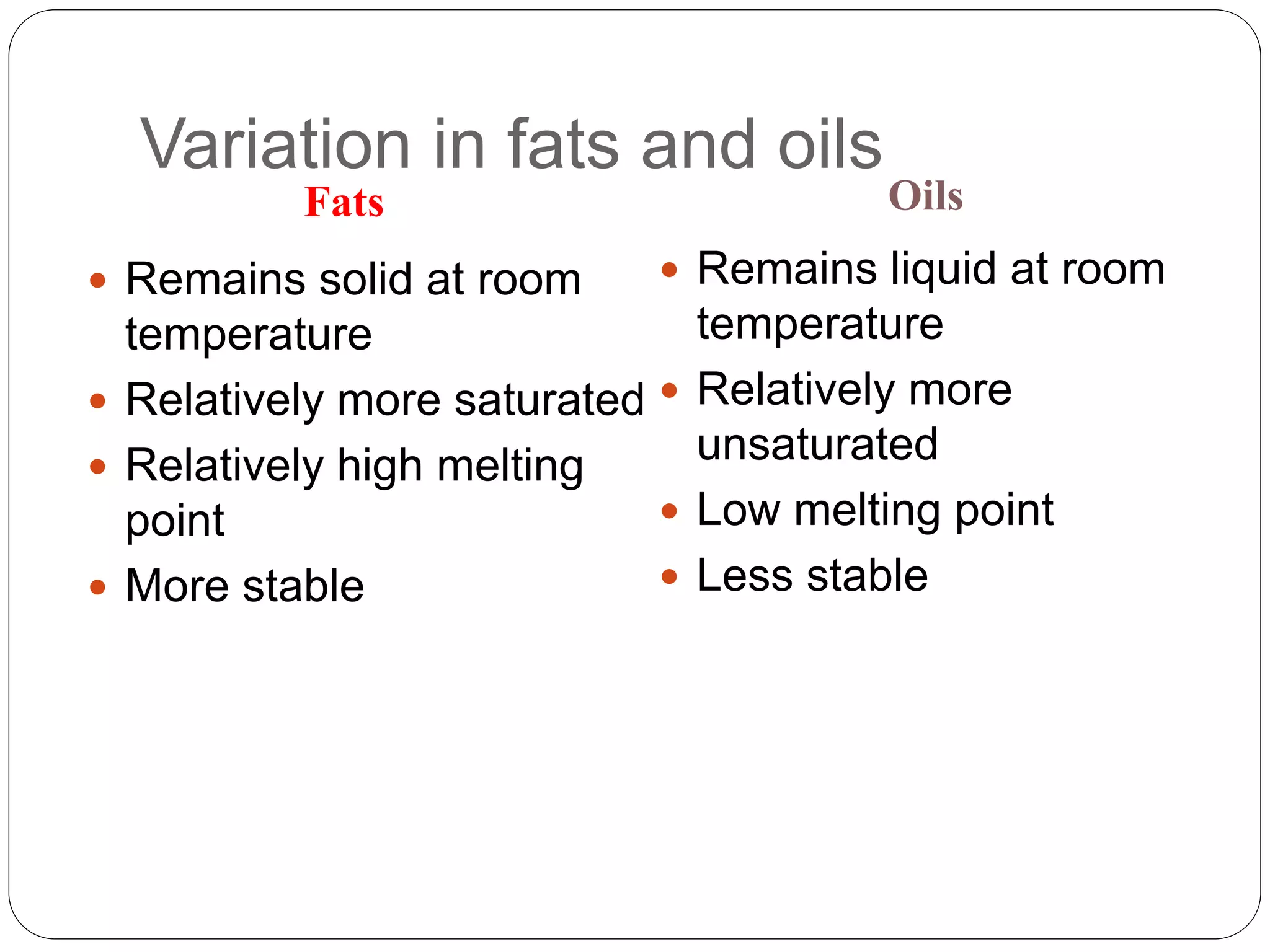
Variation in fats and oils
Fats Oils
 Remains solid at room
temperature
 Relatively more saturated
 Relatively high melting
point
 More stable
 Remains liquid at room
temperature
 Relatively more
unsaturated
 Low melting point
 Less stable
Refining of oils and fats
Oil refining objectives
1. Removal of undesirable products from crude
oil
• Free fatty acids(FFA)
• Phospholipids (gums)
• Oxidized products
• Metal ions
• Color pigments
• Other impurities
2. Preservation of valuable vitamins
vitamin E or Tocopherol- natural anti-
oxidants)
3. Minimizeoil losses
4.Improve shelf life of oil from degradation
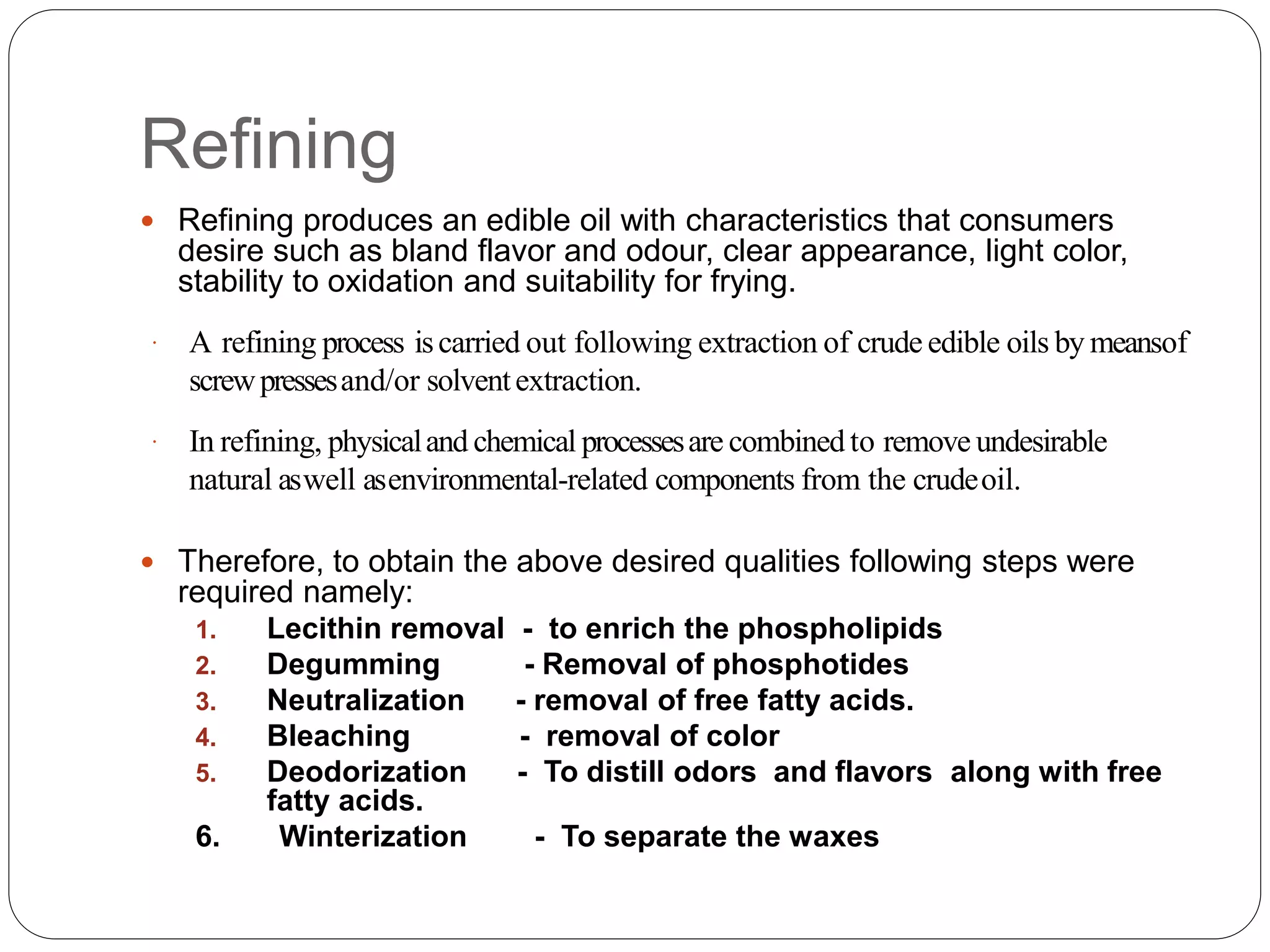
Refining
 Refining produces an edible oil with characteristics that consumers
desire such as bland flavor and odour, clear appearance, light color,
stability to oxidation and suitability for frying.
 A refining process iscarried out following extraction of crude edible oils by meansof
screwpressesand/or solventextraction.
 In refining, physicaland chemical processesare combined to remove undesirable
natural aswell asenvironmental-related components from the crudeoil.
 Therefore, to obtain the above desired qualities following steps were
required namely:
1. Lecithin removal - to enrich the phospholipids
2. Degumming - Removal of phosphotides
3. Neutralization - removal of free fatty acids.
4. Bleaching - removal of color
5. Deodorization - To distill odors and flavors along with free
fatty acids.
6. Winterization - To separate the waxes
Lecithin removal
 The processing step is primarily important
soybean which consist of high amount of
phosphotides.
 During the process (2-3%) water is added to
crude oil, thereby enriching the phospholipids in
the oil/water interface.
 The emulsion, thus formed is heated up to 80°C
and then separated or clarified by centrifugation.
Flow chart with equipment for Degumming - a. water degumming
b. acid degumming
c. enzyme degumming
Water-degumming
 Water degumming is the initial
step for the refining
processing, used to separate
phospholipids, proteins etc.
which are insoluble in oil when
hydrated.
 The emulsifying action of
phospholipids increases oil
losses during alkali refining.
 Gums lead brown discoloration
of oil after heating during
deodouration.
 Salts could be formed with cu,
mg, ca and iron accerlating
oxidative degradation of oil.
 Certain phospholipids such as
lecithin, find widespread of
Untreated oil
Heat
In line mixer ( acid
addition)
Acid reacts with
phosphotides (gums) in
the oil to make
hydratable.
Water may be
added to
hydrate to
remove
phosphotides
before
removal in
the separator
oil may pass
straight to
neutralizing or
bleaching
without
removal of
gums ( acid
degumming)
Separator
degummed oil
Gums
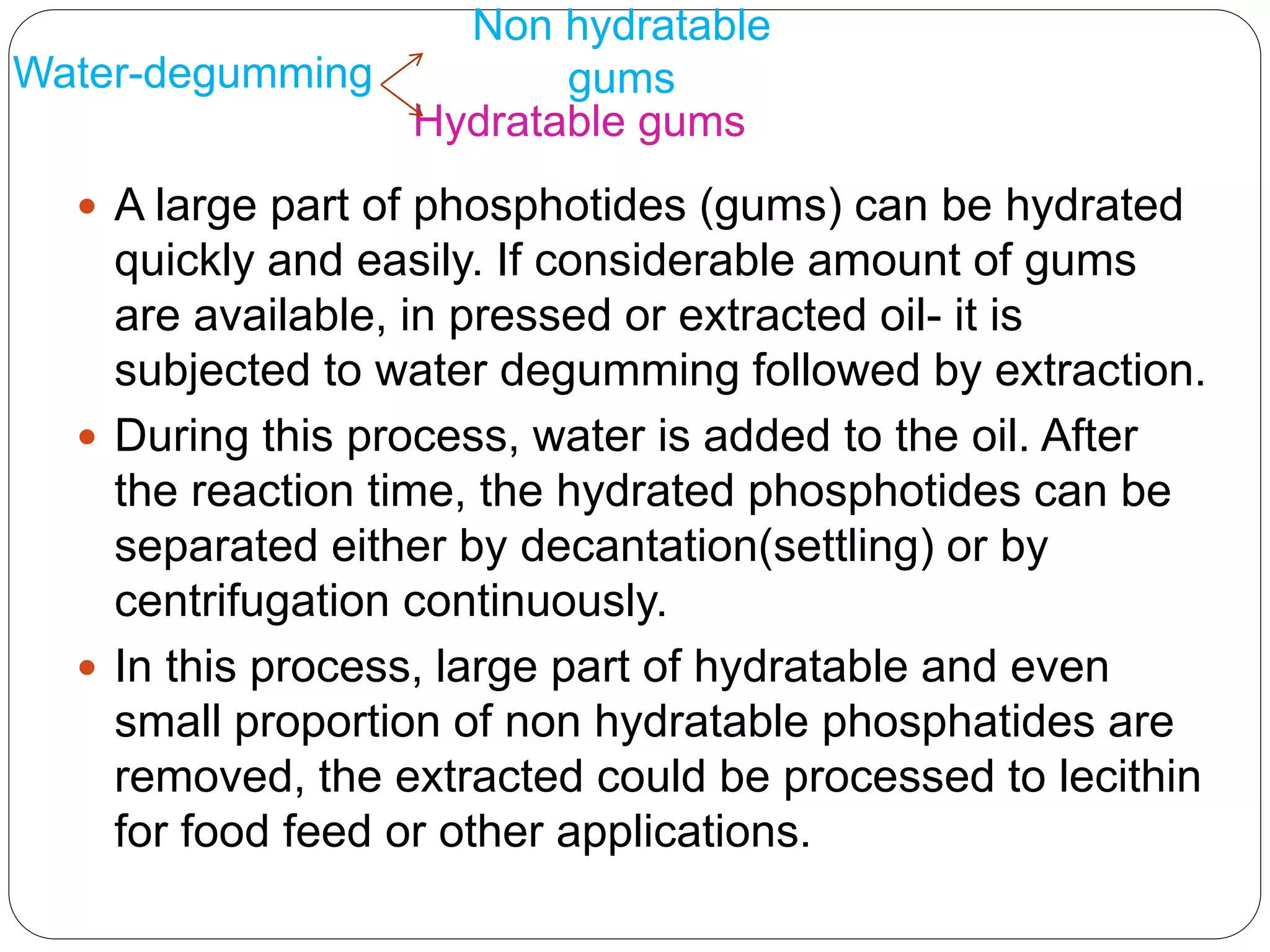
Water-degumming
 A large part of phosphotides (gums) can be hydrated
quickly and easily. If considerable amount of gums
are available, in pressed or extracted oil- it is
subjected to water degumming followed by extraction.
 During this process, water is added to the oil. After
the reaction time, the hydrated phosphotides can be
separated either by decantation(settling) or by
centrifugation continuously.
 In this process, large part of hydratable and even
small proportion of non hydratable phosphatides are
removed, the extracted could be processed to lecithin
for food feed or other applications.
Non hydratable
gums
Hydratable gums
Comparative study on degumming
Dry acid degumming Wet acid degumming
 Suitable for processing oils of
low gum content.
 It consists of palm oil, palm
kernel oil, animal fats, coconut
oils.
 Intensive mixing is
implemented following addition
of acid to the preheated crude
oil.
 The conditioned gums are
absorbed into the bleaching
earth and are separated by
filtration.
 Low energy consumption,
maintenance and operational
cost.
 Long service life.
 Low investments and
environment friendly.
 Suitable for processing oils
of high gum content.
 It consists of soybean,
rapeseed, corn oil etc.
 Water is added following to
Acid apportioning to
achieve gum hydration
 therefore gums are
removed by separator prior
to bleaching.
 Comparatively high energy
consumption
 Long service life
 Comparatively high
investment and
environmental friendly.
Enzymatic degumming
 The prepared enzyme solution (i.e. aqueous solution of
citric acid, caustic soda and enzymes) is dispersed into
filtered oil @ mild temperature.
 To attain conversion of non hydrated phospholipids to
hydrated phospho-lipids, a high speed mixer is utilized for
effective mising of enzyme.
 Followed by separation of gums by mechanical
separator.
 hence, the degummed oil is dried under vacuum and
suitable for further processing.Adjusting parameters during process:
1. Adjustment of citrate buffer and optimal temperature required.
2. Adjustment of enzyme solution
3. Time require for enzyme reaction time.
4. The reaction of lysophosphatide from the oil at 75°C
5. Enzymes name
• Lecitase®10L(pancreatic phospholipaseA2); Lecitase®Novo(microbiallipase)
• Lecitase®Ultra (microbiallipase)
NEUTRALIZATION
 Alkali refining
 Here, an alkali solution react
with oil and remove other
impurities such as
phosphatides, proteineceous
and mucilaginous
substances.
 This process results in large
reduction of FFA through
their coversion in to high
specific gravity soaps.
 Still minor impurities present
, soluble in the oil only in
anhydrous form and upon
hydration with caustic or
other refining solution it
would be separated.
 After this Alkali refining,
oil/fat is water washed to
remove residual soap
 Physical refining
 The physical-refining is done
to oil containing low in
phosphatide content(palm
oil,, palm kernel oil and
coconut oil).
 Here the FFA is removed by
Evaporation rather than by
Neutralization and soap
removal by alkali refining
process.
Bleaching-removal of color
 Principle-adsorption
 Mathematical representation
log(x/m) = logK + nlogc
Process would continue till thermodynamic
equilibrium is attained.
Here in this process trace metals, color bodies
likewise chlorophyll, soaps and oxidised products
are removed using bleaching clays, which absorb
impurities.
Parameters required :
 Temperature-90-110°C
 Reduced pressure
 Acid activated bleaching
earth/clay or bentonite.
 Time period-20-30
minutes
A : Bleacher A1 : Oil inlet
B : Barometric condenser B1 : Oil adsorbent outlet
C : Vacuum pump C1 : Steam inlet
D1: Condensate outlet
E1 : Bleaching Material inlet F1: Water Inlet
Importance of bleaching
agent
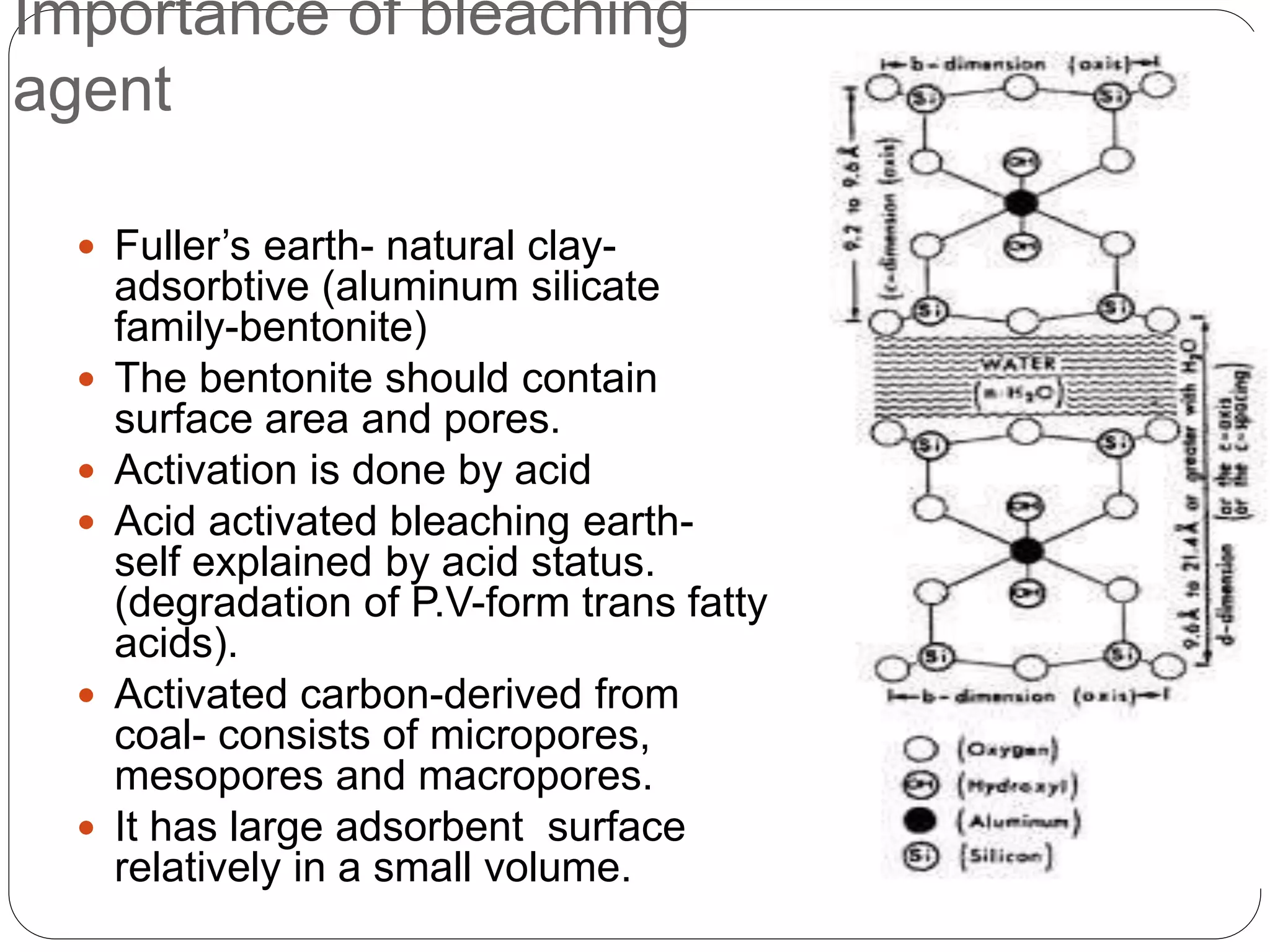
 Fuller’s earth- natural clay-
adsorbtive (aluminum silicate
family-bentonite)
 The bentonite should contain
surface area and pores.
 Activation is done by acid
 Acid activated bleaching earth-
self explained by acid status.
(degradation of P.V-form trans fatty
acids).
 Activated carbon-derived from
coal- consists of micropores,
mesopores and macropores.
 It has large adsorbent surface
relatively in a small volume.
Deodourisation
 Deodorization is steam distillation process carried
out in a vacuum, to remove the volatile
compounds in the oil.
 The process may be continuous, semi-continuous
and batch.
 The end product would be bland oil with low level
of FFA and zero P.V.
 This step also removes residual metabolites or
pesticides.
Deodourisation process
 Deodourization is a vaccum stripping process in which neutral oil is
treated to remove malodorous compound ( volatile compound in
general) to obtain fully refined oil.
 This process is similar to steam refining of neutral oil where along
with malodorous compound even fatty acids are also removed.The
above process is then known as steam deodourization.
• Deodorization is actually a combination of Two different effects on
oil
1) Stripping
• Temperature effect
• Deodorization is a multi-step process
comprising de-aeration, heating,
deodorization- deacidification, and cooling of
the oil.
De-aeration
1. Carried out in order to avoid oxidation and hence avoid
risk of polymerization.
2. Oil is heated to 800c and sprayed in a tank, which is
kept at a pressure below 50 mbar.
3. Lower the pressure lower is residual air left in the oil.
Heating and cooling
• The subsequent heating of the oil is usually accomplished in two stages.
• In the first stage, the incoming oil is heated counter currently in an oil-oil
heat exchanger (economizer), with the finished oil leaving the deodorizer.
• Finally, the oil is heated under reduced pressure to the final deodorization
temperature with a high-temperature source.
• Source of Heating in the final stages are
1) High-pressure steam boilers
2) Thermal Oil Heaters
3) Downtherm A (diphenyl/diphenyloxide)
 In this process the heat recovery, has become an important industrial
application, since it minimizes the cost of additional heating of the oil to
the deodourisation temperature.
 Hence to obtain above conditions following heat exchangers were
evolved
1. External heat exchanger
2. Internal heat exchanger
 Final cooling of the oil is usually conducted under reduced pressure to
prevent the possible production of degradation by products
 As a result of the technological complexity and for cost reasons,
cooling under vacuum is usually applied only in a large capacity
deodorizer. Small capacity plants often make use of external oil–oil
heat-exchanging devices.
Steam stripping
• Amount of stripping agent is proportional to its
molecular weight.
• Hence steam is being used for stripping.
• But N2 is being experimented to be used as stripping agent.
• studies have indicated that color, residual
 FFA, oxidative stability, as well as the formation of trans-fatty
acids and the stripping of tocopherols are not affected by the
nature of the stripping agent.
• Stripping agent must be dry and free from oxygen.
• Deodorization only occurs at the vapor-liquid contact zone
where the lowest operating pressure exists.
• Hence there are different Deodorizer design which attempt to
provide the best contact between the gas phase and the oil
phase by creating a large contact surface, together with an
optimal sparge steam distribution.
Steam Stripping
Vapor scrubbing system
• Composition of vapor phase
- Volatile components (FFA, odor
components)
- Stripping steam
- Non condensable gases(air,…).
• The volatile substances are condensed by
creating an intimate contact between the
vapor and the fatty acid distillate circulating
in the scrubber.
Vapor scrubbing
system
• Condensation of vapour phase is achieved by
1. series of sprayers or packed bed in vacuum
duct.
2. Installation of demister at the top.
3. improved scrubbers operating at two different
temperatures (so-called dual condensation
principle) have been introduced.
Vapor scrubbing system
Vacuum
systems
• Combination of steam jet ejectors
(boosters), vapor condensers and
mechanical (liquid-ring) vacuum pump
• High motive steam consumption (60-
85% of total steam).
Thank you

Oil and fat processing

  • 1.
  • 2.
    Introduction  Fats andoils comprises of 3 major classes of foods –carbohydrates, proteins and fats.  It is chemically defines as the esters of the three carbon trihydroxy alcohol, glycerol and various monocarboxylic acids known as fatty acids.  All fats and oils are mixture of both saturated and unsaturated fatty acids.
  • 3.
    Oils and fats MAJOR COMPONENTS TRIGLYCERIDES MINOR COMPONENTS TRIGLYCERIDEDERIVATIVES NON-TRIGLYCERIDE DERIVATIVES Glycerol Free fatty acids Mono and Di-glycerides Phospholipids Sterols Pigments Vitamins Antioxidants Oxidation products Trace metals Hydrocarbons
  • 4.
    Variation in fatsand oils Fats Oils  Remains solid at room temperature  Relatively more saturated  Relatively high melting point  More stable  Remains liquid at room temperature  Relatively more unsaturated  Low melting point  Less stable
  • 5.
  • 6.
    Oil refining objectives 1.Removal of undesirable products from crude oil • Free fatty acids(FFA) • Phospholipids (gums) • Oxidized products • Metal ions • Color pigments • Other impurities 2. Preservation of valuable vitamins vitamin E or Tocopherol- natural anti- oxidants) 3. Minimizeoil losses 4.Improve shelf life of oil from degradation
  • 7.
    Refining  Refining producesan edible oil with characteristics that consumers desire such as bland flavor and odour, clear appearance, light color, stability to oxidation and suitability for frying.  A refining process iscarried out following extraction of crude edible oils by meansof screwpressesand/or solventextraction.  In refining, physicaland chemical processesare combined to remove undesirable natural aswell asenvironmental-related components from the crudeoil.  Therefore, to obtain the above desired qualities following steps were required namely: 1. Lecithin removal - to enrich the phospholipids 2. Degumming - Removal of phosphotides 3. Neutralization - removal of free fatty acids. 4. Bleaching - removal of color 5. Deodorization - To distill odors and flavors along with free fatty acids. 6. Winterization - To separate the waxes
  • 8.
    Lecithin removal  Theprocessing step is primarily important soybean which consist of high amount of phosphotides.  During the process (2-3%) water is added to crude oil, thereby enriching the phospholipids in the oil/water interface.  The emulsion, thus formed is heated up to 80°C and then separated or clarified by centrifugation.
  • 9.
    Flow chart withequipment for Degumming - a. water degumming b. acid degumming c. enzyme degumming
  • 10.
    Water-degumming  Water degummingis the initial step for the refining processing, used to separate phospholipids, proteins etc. which are insoluble in oil when hydrated.  The emulsifying action of phospholipids increases oil losses during alkali refining.  Gums lead brown discoloration of oil after heating during deodouration.  Salts could be formed with cu, mg, ca and iron accerlating oxidative degradation of oil.  Certain phospholipids such as lecithin, find widespread of Untreated oil Heat In line mixer ( acid addition) Acid reacts with phosphotides (gums) in the oil to make hydratable. Water may be added to hydrate to remove phosphotides before removal in the separator oil may pass straight to neutralizing or bleaching without removal of gums ( acid degumming) Separator degummed oil Gums
  • 11.
    Water-degumming  A largepart of phosphotides (gums) can be hydrated quickly and easily. If considerable amount of gums are available, in pressed or extracted oil- it is subjected to water degumming followed by extraction.  During this process, water is added to the oil. After the reaction time, the hydrated phosphotides can be separated either by decantation(settling) or by centrifugation continuously.  In this process, large part of hydratable and even small proportion of non hydratable phosphatides are removed, the extracted could be processed to lecithin for food feed or other applications. Non hydratable gums Hydratable gums
  • 12.
    Comparative study ondegumming Dry acid degumming Wet acid degumming  Suitable for processing oils of low gum content.  It consists of palm oil, palm kernel oil, animal fats, coconut oils.  Intensive mixing is implemented following addition of acid to the preheated crude oil.  The conditioned gums are absorbed into the bleaching earth and are separated by filtration.  Low energy consumption, maintenance and operational cost.  Long service life.  Low investments and environment friendly.  Suitable for processing oils of high gum content.  It consists of soybean, rapeseed, corn oil etc.  Water is added following to Acid apportioning to achieve gum hydration  therefore gums are removed by separator prior to bleaching.  Comparatively high energy consumption  Long service life  Comparatively high investment and environmental friendly.
  • 13.
    Enzymatic degumming  Theprepared enzyme solution (i.e. aqueous solution of citric acid, caustic soda and enzymes) is dispersed into filtered oil @ mild temperature.  To attain conversion of non hydrated phospholipids to hydrated phospho-lipids, a high speed mixer is utilized for effective mising of enzyme.  Followed by separation of gums by mechanical separator.  hence, the degummed oil is dried under vacuum and suitable for further processing.Adjusting parameters during process: 1. Adjustment of citrate buffer and optimal temperature required. 2. Adjustment of enzyme solution 3. Time require for enzyme reaction time. 4. The reaction of lysophosphatide from the oil at 75°C 5. Enzymes name • Lecitase®10L(pancreatic phospholipaseA2); Lecitase®Novo(microbiallipase) • Lecitase®Ultra (microbiallipase)
  • 14.
    NEUTRALIZATION  Alkali refining Here, an alkali solution react with oil and remove other impurities such as phosphatides, proteineceous and mucilaginous substances.  This process results in large reduction of FFA through their coversion in to high specific gravity soaps.  Still minor impurities present , soluble in the oil only in anhydrous form and upon hydration with caustic or other refining solution it would be separated.  After this Alkali refining, oil/fat is water washed to remove residual soap  Physical refining  The physical-refining is done to oil containing low in phosphatide content(palm oil,, palm kernel oil and coconut oil).  Here the FFA is removed by Evaporation rather than by Neutralization and soap removal by alkali refining process.
  • 15.
    Bleaching-removal of color Principle-adsorption  Mathematical representation log(x/m) = logK + nlogc Process would continue till thermodynamic equilibrium is attained. Here in this process trace metals, color bodies likewise chlorophyll, soaps and oxidised products are removed using bleaching clays, which absorb impurities.
  • 16.
    Parameters required : Temperature-90-110°C  Reduced pressure  Acid activated bleaching earth/clay or bentonite.  Time period-20-30 minutes A : Bleacher A1 : Oil inlet B : Barometric condenser B1 : Oil adsorbent outlet C : Vacuum pump C1 : Steam inlet D1: Condensate outlet E1 : Bleaching Material inlet F1: Water Inlet
  • 17.
    Importance of bleaching agent Fuller’s earth- natural clay- adsorbtive (aluminum silicate family-bentonite)  The bentonite should contain surface area and pores.  Activation is done by acid  Acid activated bleaching earth- self explained by acid status. (degradation of P.V-form trans fatty acids).  Activated carbon-derived from coal- consists of micropores, mesopores and macropores.  It has large adsorbent surface relatively in a small volume.
  • 18.
    Deodourisation  Deodorization issteam distillation process carried out in a vacuum, to remove the volatile compounds in the oil.  The process may be continuous, semi-continuous and batch.  The end product would be bland oil with low level of FFA and zero P.V.  This step also removes residual metabolites or pesticides.
  • 19.
    Deodourisation process  Deodourizationis a vaccum stripping process in which neutral oil is treated to remove malodorous compound ( volatile compound in general) to obtain fully refined oil.  This process is similar to steam refining of neutral oil where along with malodorous compound even fatty acids are also removed.The above process is then known as steam deodourization. • Deodorization is actually a combination of Two different effects on oil 1) Stripping • Temperature effect • Deodorization is a multi-step process comprising de-aeration, heating, deodorization- deacidification, and cooling of the oil.
  • 21.
    De-aeration 1. Carried outin order to avoid oxidation and hence avoid risk of polymerization. 2. Oil is heated to 800c and sprayed in a tank, which is kept at a pressure below 50 mbar. 3. Lower the pressure lower is residual air left in the oil. Heating and cooling • The subsequent heating of the oil is usually accomplished in two stages. • In the first stage, the incoming oil is heated counter currently in an oil-oil heat exchanger (economizer), with the finished oil leaving the deodorizer. • Finally, the oil is heated under reduced pressure to the final deodorization temperature with a high-temperature source. • Source of Heating in the final stages are 1) High-pressure steam boilers 2) Thermal Oil Heaters 3) Downtherm A (diphenyl/diphenyloxide)
  • 22.
     In thisprocess the heat recovery, has become an important industrial application, since it minimizes the cost of additional heating of the oil to the deodourisation temperature.  Hence to obtain above conditions following heat exchangers were evolved 1. External heat exchanger 2. Internal heat exchanger  Final cooling of the oil is usually conducted under reduced pressure to prevent the possible production of degradation by products  As a result of the technological complexity and for cost reasons, cooling under vacuum is usually applied only in a large capacity deodorizer. Small capacity plants often make use of external oil–oil heat-exchanging devices.
  • 23.
    Steam stripping • Amountof stripping agent is proportional to its molecular weight. • Hence steam is being used for stripping. • But N2 is being experimented to be used as stripping agent. • studies have indicated that color, residual  FFA, oxidative stability, as well as the formation of trans-fatty acids and the stripping of tocopherols are not affected by the nature of the stripping agent. • Stripping agent must be dry and free from oxygen. • Deodorization only occurs at the vapor-liquid contact zone where the lowest operating pressure exists. • Hence there are different Deodorizer design which attempt to provide the best contact between the gas phase and the oil phase by creating a large contact surface, together with an optimal sparge steam distribution.
  • 24.
  • 27.
    Vapor scrubbing system •Composition of vapor phase - Volatile components (FFA, odor components) - Stripping steam - Non condensable gases(air,…). • The volatile substances are condensed by creating an intimate contact between the vapor and the fatty acid distillate circulating in the scrubber.
  • 28.
    Vapor scrubbing system • Condensationof vapour phase is achieved by 1. series of sprayers or packed bed in vacuum duct. 2. Installation of demister at the top. 3. improved scrubbers operating at two different temperatures (so-called dual condensation principle) have been introduced.
  • 29.
  • 30.
    Vacuum systems • Combination ofsteam jet ejectors (boosters), vapor condensers and mechanical (liquid-ring) vacuum pump • High motive steam consumption (60- 85% of total steam).
  • 31.

Editor's Notes

  • #12 Steps in Acid Degumming Heat oil to 60 -70 °C Acid addition and mixing Hydration mixing 30 minutes Centrifugal separation of hydrated gums Vacuum drying of degummedoil Gums -recombined in meal