Abhishek Pathak
Research Scholar
Dept. of Biotechnology
Dr. HSGU, Sagar, M.P.
Hershey A. D. and Chase M., 1952, J. General Physiology.
Deoxyribo Nucleic Acid
 Before 1940 nobody knew that the genetic material is DNA.
 In 1928 the Griffith discovered transformation in bacteria.
 In 1944 Avery O. T., et al., repeat the Griffith’s experiments and they conclude
that DNA may be genetic material.
 The experiment on bacteriophage by Hershey A. D. and Chase M., in 1952
confirmed that DNA is a genetic material.
Griffith Fred, 1928, J. Hygiene
Something inside of S type bacteria induced “R--->S”
transformation
Experiment Result
S
R
Dead S + R
S
R
S
Experiment Result
S
R
DNA S
R
Protein
Lipid
Carbohydrate
R
R
Avery O. T., 1944, J. Expt. Med.
S
4
CRISPR: Clustered Regularly-Interspaced Short Palindromic Repeats
spacer
Cas9: CRISPR associated nuclease protein9
CRISPR/Cas9 is a genome editing tool that is creating a buzz in the science world.
It is faster, cheaper and more accurate than previous techniques of editing DNA
and has a wide range of potential applications.
CRISPER: Clustered Regularly Interspaced Palindromic Repeats.
Cas9: CRISPR associated protein9, a nuclease.
gRNA: guide RNA- a construct/chimera of CRISPR RNA (crRNA) and trans-activating CRISPR
RNA (tracrRNA).
PAM: protospacer adjacent motif with sequence NGG specific to Strptococcus pyogenes and 5’-
NAG PAM tolerated in human cells.
CRISPR/CAS9 system includes:
The CRISPR/Cas9 system consists of two key molecules that introduce a
change into the DNA. These are:
1. An enzyme called cas9
2. Guide RNA (gRNA)
It is CRISPR associated protein9 nuclease that is isolated from Streptococcus pyogenes.
It acts as a molecular scissor that can cut both the strands of DNA.
It is a chimera of crRNA and tracrRNA. This consists of a small piece of predesigned
RNA sequence (about 20 bases long) located within a longer RNA scaffold.
 The guide RNA is designed to find and
bind to a specific sequence in the DNA.
 The Cas9 follows the guide RNA to the
same location in the DNA sequence and
makes a cut across both strands of the
DNA.
 At this stage the cell recognizes that the
DNA is damaged and tries to repair it.
 Scientists can use the DNA repair
machinery to introduce changes to one
or more genes in the genome of a cell of
interest.
DNA
DNA sequence
disrupted
NHEJ: Non-homologous end joining
+donor DNA
DNA sequence
replaced
HDR: homology directed repair
11
(1) acquisition of foreign DNA
(2) synthesis and maturation of CRISPR
RNA (crRNA) followed by formation of
RNA-Cas nuclease protein complexes
(3) target recognition by crRNA and
destruction of foreign DNA by
Cas nuclease cleavage
The functions of CRISPR and CRISPR
associated (Cas) genes are essential in adaptive
immunity in select bacteria and archaea,
enabling the organisms to respond to and
eliminate invading genetic material.
Genome editing is a type of a genetic engineering in which DNA is inserted, deleted
or replaced in the genome of a living organism using engineered nucleases, or
“molecular scissors”.
ZNFs: Zink Finger Nucleases
TALEN: Transcription-activator Like Effecter Nucleases
Meganucleases- found in microbial system (recognition sequence >14 bases)
Restriction enzymes
Tools which are using in gene editing:
CRISPR/Cas9
Cas9
gRNA
Not enough meganucleases are known, or may ever be known, to cover all the
possible target sequences.
ZFNs are seldom completely specific, and some may cause a toxic reaction.
The construction of sequence specific enzymes for all possible sequences is costly
and time consuming, as one is not benefiting from combinatorial possibilities that
methods such as ZFNs and TALEN based fusions utilize.
CRISPR/Cas9
Cost-effective Eco-friendly Sustainable Renewable
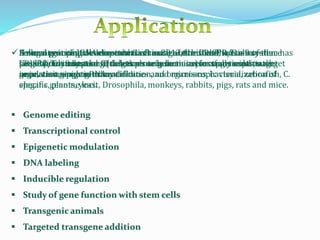
 Genome editing
 Transcriptional control
 Epigenetic modulation
 DNA labeling
 Inducible regulation
 Study of gene function with stem cells
 Transgenic animals
 Targeted transgene addition
Following its initial demonstration in 2012, the CRISPR/Cas9 system has
been widely adopted. This has already been successfully used to target
important genes in many cell lines and organisms, bacteria, zebrafish, C.
elegans, plants, yeast, Drosophila, monkeys, rabbits, pigs, rats and mice.
Several groups have now taken advantage of this method to introduce
single point mutations (deletions or insertions) in a particular target
gene, via a single gRNA.
Using a pair of gRNA directed Cas9 nucleases instead, it is also
possible to induce large deletions or genomic rearrangements, such
as inversions or translocations
A recent exciting development is the use of the dCas9 version of the
CRISPR/Cas9 system to target protein domains for transcriptional
regulation, epigenetic modification, and microscopic visualization of
specific genome loci.
Targeted transgene addition
desired DNA sequence
Targeted DNA sequence
Cleaved by CRISPR/Cas9
Adding desired sequence by HDR system
Targeted DNA with desired sequence
DNA labeling Epigenetic modulation
Cleaved by CRISPR/Cas9 Cleaved by CRISPR/Cas9
Radio labeled sequence
Methylated sequence
Targeted DNA sequence
Adding desired sequence by HDR system
Radio labeled DNA Methylated DNA sequence
 Transcription activation
 Transcription repression
 visualization
Deficient Cas9: lack of Ruv-C and HNH like nuclease domains
(Lack of nuclease activity)
Sickle cell anemia is a great example of a disease in which mutation of
a single base mutation (T to A) could be edited by CRISPR and the
disease cured.
In human intestinal stem cells collected from patients with cystic
fibrosis, the culprit defective gene CFTR (cystic fibrosis
transmembrane conductance regulator) was rectified by homologous
recombination during CRISPR‐Cas9 genome editing while the
pluripotency was retained as demonstrated by formations of organ‐like
expansions in cell culture.
 Chronic hepatitis B is one the most common infectious diseases world‐wide,
which can lead to liver cirrhosis and cancer.
 HepG2 cells expressing hepatitis B virus (HBV), the introduction of
CRISPR‐Cas9 system resulted in both decreased hepatitis B core antigen
expression which provides an impetus for further research on the possibility
of CRISPR‐Cas9‐mediated hepatitis B prevention.
 CRISPR‐Cas9 can mutate long terminal repeat (LTR) sequence of HIV‐1 in
vitro, resulting in removal of the integrated pro viral DNA from the part of
the host cells and a significant drop in virus expression.
CRISPR Abhi Pathak.pptx

CRISPR Abhi Pathak.pptx

  • 1.
    Abhishek Pathak Research Scholar Dept.of Biotechnology Dr. HSGU, Sagar, M.P.
  • 3.
    Hershey A. D.and Chase M., 1952, J. General Physiology. Deoxyribo Nucleic Acid  Before 1940 nobody knew that the genetic material is DNA.  In 1928 the Griffith discovered transformation in bacteria.  In 1944 Avery O. T., et al., repeat the Griffith’s experiments and they conclude that DNA may be genetic material.  The experiment on bacteriophage by Hershey A. D. and Chase M., in 1952 confirmed that DNA is a genetic material. Griffith Fred, 1928, J. Hygiene Something inside of S type bacteria induced “R--->S” transformation Experiment Result S R Dead S + R S R S Experiment Result S R DNA S R Protein Lipid Carbohydrate R R Avery O. T., 1944, J. Expt. Med. S
  • 4.
  • 6.
    CRISPR: Clustered Regularly-InterspacedShort Palindromic Repeats spacer Cas9: CRISPR associated nuclease protein9
  • 7.
    CRISPR/Cas9 is agenome editing tool that is creating a buzz in the science world. It is faster, cheaper and more accurate than previous techniques of editing DNA and has a wide range of potential applications. CRISPER: Clustered Regularly Interspaced Palindromic Repeats. Cas9: CRISPR associated protein9, a nuclease. gRNA: guide RNA- a construct/chimera of CRISPR RNA (crRNA) and trans-activating CRISPR RNA (tracrRNA). PAM: protospacer adjacent motif with sequence NGG specific to Strptococcus pyogenes and 5’- NAG PAM tolerated in human cells. CRISPR/CAS9 system includes:
  • 8.
    The CRISPR/Cas9 systemconsists of two key molecules that introduce a change into the DNA. These are: 1. An enzyme called cas9 2. Guide RNA (gRNA) It is CRISPR associated protein9 nuclease that is isolated from Streptococcus pyogenes. It acts as a molecular scissor that can cut both the strands of DNA. It is a chimera of crRNA and tracrRNA. This consists of a small piece of predesigned RNA sequence (about 20 bases long) located within a longer RNA scaffold.
  • 9.
     The guideRNA is designed to find and bind to a specific sequence in the DNA.  The Cas9 follows the guide RNA to the same location in the DNA sequence and makes a cut across both strands of the DNA.  At this stage the cell recognizes that the DNA is damaged and tries to repair it.  Scientists can use the DNA repair machinery to introduce changes to one or more genes in the genome of a cell of interest.
  • 10.
    DNA DNA sequence disrupted NHEJ: Non-homologousend joining +donor DNA DNA sequence replaced HDR: homology directed repair
  • 11.
  • 13.
    (1) acquisition offoreign DNA (2) synthesis and maturation of CRISPR RNA (crRNA) followed by formation of RNA-Cas nuclease protein complexes (3) target recognition by crRNA and destruction of foreign DNA by Cas nuclease cleavage The functions of CRISPR and CRISPR associated (Cas) genes are essential in adaptive immunity in select bacteria and archaea, enabling the organisms to respond to and eliminate invading genetic material.
  • 15.
    Genome editing isa type of a genetic engineering in which DNA is inserted, deleted or replaced in the genome of a living organism using engineered nucleases, or “molecular scissors”. ZNFs: Zink Finger Nucleases TALEN: Transcription-activator Like Effecter Nucleases Meganucleases- found in microbial system (recognition sequence >14 bases) Restriction enzymes Tools which are using in gene editing:
  • 16.
  • 18.
    Not enough meganucleasesare known, or may ever be known, to cover all the possible target sequences. ZFNs are seldom completely specific, and some may cause a toxic reaction. The construction of sequence specific enzymes for all possible sequences is costly and time consuming, as one is not benefiting from combinatorial possibilities that methods such as ZFNs and TALEN based fusions utilize. CRISPR/Cas9 Cost-effective Eco-friendly Sustainable Renewable
  • 20.
     Genome editing Transcriptional control  Epigenetic modulation  DNA labeling  Inducible regulation  Study of gene function with stem cells  Transgenic animals  Targeted transgene addition Following its initial demonstration in 2012, the CRISPR/Cas9 system has been widely adopted. This has already been successfully used to target important genes in many cell lines and organisms, bacteria, zebrafish, C. elegans, plants, yeast, Drosophila, monkeys, rabbits, pigs, rats and mice. Several groups have now taken advantage of this method to introduce single point mutations (deletions or insertions) in a particular target gene, via a single gRNA. Using a pair of gRNA directed Cas9 nucleases instead, it is also possible to induce large deletions or genomic rearrangements, such as inversions or translocations A recent exciting development is the use of the dCas9 version of the CRISPR/Cas9 system to target protein domains for transcriptional regulation, epigenetic modification, and microscopic visualization of specific genome loci.
  • 21.
    Targeted transgene addition desiredDNA sequence Targeted DNA sequence Cleaved by CRISPR/Cas9 Adding desired sequence by HDR system Targeted DNA with desired sequence
  • 22.
    DNA labeling Epigeneticmodulation Cleaved by CRISPR/Cas9 Cleaved by CRISPR/Cas9 Radio labeled sequence Methylated sequence Targeted DNA sequence Adding desired sequence by HDR system Radio labeled DNA Methylated DNA sequence
  • 23.
     Transcription activation Transcription repression  visualization Deficient Cas9: lack of Ruv-C and HNH like nuclease domains (Lack of nuclease activity)
  • 25.
    Sickle cell anemiais a great example of a disease in which mutation of a single base mutation (T to A) could be edited by CRISPR and the disease cured. In human intestinal stem cells collected from patients with cystic fibrosis, the culprit defective gene CFTR (cystic fibrosis transmembrane conductance regulator) was rectified by homologous recombination during CRISPR‐Cas9 genome editing while the pluripotency was retained as demonstrated by formations of organ‐like expansions in cell culture.  Chronic hepatitis B is one the most common infectious diseases world‐wide, which can lead to liver cirrhosis and cancer.  HepG2 cells expressing hepatitis B virus (HBV), the introduction of CRISPR‐Cas9 system resulted in both decreased hepatitis B core antigen expression which provides an impetus for further research on the possibility of CRISPR‐Cas9‐mediated hepatitis B prevention.  CRISPR‐Cas9 can mutate long terminal repeat (LTR) sequence of HIV‐1 in vitro, resulting in removal of the integrated pro viral DNA from the part of the host cells and a significant drop in virus expression.