1



 



Chapter 2
Chapter 2
Finite Automata
Finite Automata



 



2
A Finite-State Machine (1)
 A finite state machine is a mathematical model of a
A finite state machine is a mathematical model of a
system, with discrete inputs and outputs



 



3
A Finite-State Machine (2)
 Finite Automata FA:
Finite Automata FA:
 a finite set of states
 a set of transitions (edges)
 a start state
 a set of final states
Defining a FA is a kind of programming.
 Problem definition
Problem definition
 Includes defining possible actions & accepting
condition.
 States
States 
 structure of program
structure of program
 Includes designating which are initial & final.
 Transitions
Transitions 
 program
program



 



4
2.1: Deterministic Finite Automata (1)
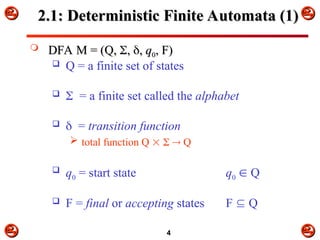
 DFA M = (Q,
DFA M = (Q, 
,
, 
,
, q
q0
0, F)
, F)
 Q = a finite set of states
 = a finite set called the alphabet
 = transition function
 total function Q    Q
 q0 = start state q0  Q
 F = final or accepting states F  Q



 



5
Deterministic Finite Automata (2)
 DFA M
DFA M
 Q = {q0, q1}
 = {a, b}
 F = {q1}
 The transition function  is given in a tabular
form called the transition table
 (q0, a) = q1 (q0, b) = q0
 (q1, a) = q1 (q1, b) = q0



 



6
Deterministic Finite Automata (3)
 A
A DFA
DFA M can be considered to be a language
M can be considered to be a language
acceptor.
acceptor.
 The
The language
language of M,
of M, L(M)
L(M), is the set of strings
, is the set of strings 
*
*
accepted by M.
accepted by M.
 A
A DFA
DFA M reads an input string from left to right.
M reads an input string from left to right.
 The
The next state
next state depends on the
depends on the current state
current state and
and
the
the unread (unprocessed) symbol
unread (unprocessed) symbol.
.



 



7
Deterministic Finite Automata (5)
 The DFA
The DFA M
M accepts the set of strings over {a, b} that
accepts the set of strings over {a, b} that
contain the substring
contain the substring bb
bb
 M : Q = {q0, q1, q2}, = {a, b}, F = {q2}
 The transition function  is given in a tabular form
called the transition table
 (q0, a) = q0 (q0, b) = q1
 (q1, a) = q0 (q1, b) = q2
 (q2, a) = q2 (q2, b) = q2
 Is
Is abba
abba 
 L(M)? Yes, since the computation halts in state
L(M)? Yes, since the computation halts in state
q
q2
2, which is a final state
, which is a final state
 Is
Is abab
abab 
 L(M)? No, since the computation halts in state
L(M)? No, since the computation halts in state
q
q1
1, which is
, which is NOT
NOT a final state
a final state



 



8
Deterministic Finite Automata (6)
 Extended transition function
Extended transition function 
*
*
of a DFA with
of a DFA with
transition function
transition function 
 is a function from Q
is a function from Q 
 
*
*

 Q
Q
defined recursively on the length of the input string
w
w
 Basis: |w| = 0. Then w =  and *
(qi, ) = qi
 Recursive step: Let |w| = 1. Then
*
(qi, av) = *
((qi, a), v)
  qi  Q,  a  ,  v  *



 



9
Deterministic Finite Automata (7)
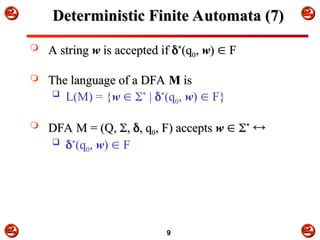
 A string
A string w
w is accepted if
is accepted if 
*
*
(q
(q0
0,
, w
w)
) 
 F
F
 The language of a DFA
The language of a DFA M
M is
is
 L(M) = {w  *
| *
(q0, w)  F}
 DFA M = (Q,
DFA M = (Q, 
,
, 
, q
, q0
0, F) accepts
, F) accepts w
w 
 
*
*


 *
(q0, w)  F



 



10
Deterministic Finite Automata (8)
 Two possibilities for DFA M running on
Two possibilities for DFA M running on w
w
 M accepts w
 M accepts w iff the computation of M on w ends up
(halts) in an accepting configuration
 *
(q0, w)  F
 M rejects w
 M rejects w iff the computation of M on w ends up
(halts) in a rejecting configuration
 *
(q0, w)  F



 



11
 The state diagram of a DFA M =
The state diagram of a DFA M = (Q,
(Q, 
,
, 
,q
,q0
0, F)
, F) is a
is a
labeled graph
labeled graph G
G defined by the following
defined by the following
conditions:
conditions:
 The nodes of G are the elements of Q
 The labels on the arcs of G are elements of 
 q0 is the start node, denoted by
 F is the set of accepting nodes, denoted by
 There is an arc from node qi to qj labeled a if
(qi, a) = qj
 For every node qi and symbol a  , there is
exactly one arc labeled a leaving qi
State Diagrams and Examples (1)
q0
a



 



12
State Diagrams and Examples (2)
 Deterministic Finite Automata DFA
Deterministic Finite Automata DFA
 all outgoing edges are labelled with an input
character
 no state has - transition, transition on input 
 no two edges leaving a given state have the
same label
 for each state s and input symbol a, there is at most
one edge label a leaving s
 Therefore: the next state can be determined
uniquely, given the current state and the current
input character



 



13
State Diagrams and Examples (1)
strings over {
strings over {a
a,
,b
b} with at least 3
} with at least 3 a
a’s
’s
1 a 2 a 3+ a
0 a
a a a
b b b 



 



14
State Diagrams and Examples (2)
strings over {
strings over {a
a,
,b
b} with length mod 3 = 0
} with length mod 3 = 0
1 2
0
 




 



15
State Diagrams and Examples (3)
strings over {
strings over {a
a,
,b
b}
} without
without 3 consecutive
3 consecutive a
a’s
’s
A simple example of “strings not of the form …”.
1 a 2 a
Has
aaa
0 a
a a a
b
b
b




 



16
State Diagrams and Examples (4)
 Draw a state diagram for DFA
Draw a state diagram for DFA M
M that accepts the
that accepts the
set of strings over {a, b} that contain the substring
bb
bb
 The string
The string ababb
ababb is accepted since the halting state
is accepted since the halting state
is the accepting state
is the accepting state q
q2
2
q1 q2
q0
b b
a
a
a, b



 



17
State Diagrams and Examples (5)
 The DFA
The DFA
 accepts (
accepts (b
b|
|ab
ab)
)*
*
(
(a
a|
|
)
)
 the set of strings over {a, b} that
the set of strings over {a, b} that do not
do not contain
contain
the substring
the substring aa
aa
1 a 2 a
0 a
a a
b
b




 



18
State Diagrams and Examples (6)
 The language {
The language {a
an
n
b
bn
n
,
, n
n
0} is not regular, so we can not
0} is not regular, so we can not
build a DFA that accept this language
 It needs an infinite number of states
It needs an infinite number of states
 But {
But {a
an
n
b
bn
n
, 1
, 1 
 n
n 
 3} is regular and its DFA is
3} is regular and its DFA is
q0
a q1
a q2
a q3
q4
b
q5
b
b
q6
b
b
This DFA is NOT
Complete



 



19
State Diagrams and Examples (7)
 strings over {a, b} that contain the substring
strings over {a, b} that contain the substring bb
bb OR
OR
do not
do not contain the substring
contain the substring aa
aa
 This language is the union of the languages of the
This language is the union of the languages of the
previous examples
previous examples
1 a 2 a
0 a
a a
b
a
1 b 2 b
b
b
a

2 a
b
a
b



 



20
State Diagrams and Examples (8)
 strings over {a, b} that contain an
strings over {a, b} that contain an even
even number of
number of
a
a’s
’s AND
AND an
an odd
odd number of
number of b
b’s
’s
[ea, eb] [ea, ob]
a
[oa, eb] [oa, ob]
b
a a
a
b
b
b



 



21
State Diagrams and Examples (9)
 Let
Let M
M be the DFA previous slide
be the DFA previous slide
 A DFA
A DFA M’
M’ that accepts all strings over {a, b} that
that accepts all strings over {a, b} that do not
do not
contain an
contain an even
even number of
number of a
a’s
’s AND
AND an
an odd
odd number of
number of b
b’s
’s
is shown below
is shown below
 L(M’) = {a, b}*
- L(M) = *
- L(M)
 Any string accepted by
Any string accepted by M
M is rejected by
is rejected by M’
M’ and vice versa
and vice versa
[ea, eb] [ea, ob]
a
[oa, eb] [oa, ob]
b
a a
a
b
b
b



 



22
State Diagrams and Examples (10)
 Let
Let 
 = {0, 1, 2, 3}. A string in
= {0, 1, 2, 3}. A string in 
*
*
is a sequence of integers
from
from 

 The DFA
The DFA M
M determines whether the
determines whether the sum of elements
sum of elements of a
of a
string is
string is divisible by 4
divisible by 4
 The string
The string 12302
12302 and
and 0130
0130 should be accepted and
should be accepted and 0111
0111
rejected by M
rejected by M
w mod 4 = 0
0
2 2
1
3
w mod 4 = 1
0
w mod 4 = 2
0
1
3
w mod 4 = 3
0
2 2
1
3
1
3



 



23
State Diagrams and Examples (11)
 DFA
DFA M1
M1 accepts
accepts (ab)
(ab)*
*
c
c
 M1
M1 is
is incomplete determinism
incomplete determinism
 The string
The string abcc
abcc is
is rejected
rejected since
since M1
M1 is unable to process
is unable to process
the final
the final c
c from state
from state q
q2
2
q0 q1
c
q2
a
b
M1



 



24
State Diagrams and Examples (12)
 M2
M2 accepts the same language as
accepts the same language as M1
M1 in previous example
in previous example
(ab)
(ab)*
*
c
c
 The state
The state q
qe
e is the error state (dead end)
is the error state (dead end)
q0 q1
c
q2
a
b
qe
b
a, c
a, b, c
M2




 



25
State Diagrams and Examples (13)
strings over {
strings over {a
a,
,b
b} with next-to-last symbol =
} with next-to-last symbol = a
a
…aa …ab
a
…ba …bb

a
b
b
a
b
b
b
a
a
a
a
a
b
b
b



 



26
State Diagrams and Examples (14)
start
0 3
b
2
1 b
a
b
a
b
a
a
What Language is Accepted?



 



27
2.2: Nondeterministic Finite Automata (1)
Finite Automata : A recognizer that takes an input
string & determines whether it’s a
valid sentence of the language
Non-Deterministic : Has more than one (or no)
alternative action for the same input
symbol.
Deterministic : Has at most one action for every
given input symbol.



 



28
Nondeterministic Finite Automata (2)
NFA: Formal Definition
 NFA M = (Q,
NFA M = (Q, 
,
, 
, q
, q0
0, F)
, F)
 Q = a finite set of states
 = a finite set alphabet
 = transition function
 total function Q    (Q) = 2Q
- power set of Q
 q0 = initial/starting state q0  Q
 F = final or accepting states F  Q



 



29
Nondeterministic Finite Automata (3)
Q = { 0, 1, 2, 3 }
q0 = 0
F = { 3 }
 = { a, b }
start
0 3
b
2
1 b
a
a
b
What Language is defined ?
What is the Transition Table ?
s
t
a
t
e
i n p u t
0
1
2
a b
{ 0, 1 }
 { 2 }
 { 3 }
{ 0 }



 



30
Nondeterministic Finite Automata (4)
 Change in
Change in 

 For an DFA M, (q, a) results in one and only
one state for all states q and alphabet a
 For an NFA M, (q, a) can result in a set of
states, zero, one, or more states:
qn
a
qi qn
a
qi
qj
qk
a
a
qn

(q
(qn
n, a) = {q
, a) = {qi
i}
} 
(q
(qn
n, a) = {q
, a) = {qi
i, q
, qj ,
j , q
qk
k }
} 
(q
(qn
n, a) = {} =
, a) = {} = 




 



31
Nondeterministic Finite Automata (5)
1 2 3 4
a a a
b
a,b a,b
•Why is this only an NFA and not an DFA?
5



 



32
Nondeterministic Finite Automata (6)
Computing with NFA’s
 Computations are different
Computations are different
 We always start from start state. Call it the root of
We always start from start state. Call it the root of
the computation.
the computation.
 Then we might go to different states on one symbol.
Then we might go to different states on one symbol.
 Then from those states to new sets of states,
Then from those states to new sets of states,
creating a
creating a tree-like
tree-like computation.
computation.
 If one path ends up in a final state, then ACCEPT,
If one path ends up in a final state, then ACCEPT,
else REJECT
else REJECT



 



33
Nondeterministic Finite Automata (7)
start
0 3
b
2
1 b
a
a
b • Given an input string, we trace moves
• If no more input & in final state, ACCEPT
EXAMPLE:
Input: ababb
Path 1: 0 -> 0 -> 0 -> 0 -> 0 -> 0
(REJECT)
Path 2: 0 -> 0 -> 0 -> 1 -> 2 -> 3
(ACCEPT)



 



34
Nondeterministic Finite Automata (8)
 Extended transition function
Extended transition function 
*
*
of a NFA with
of a NFA with
transition function
transition function 
 is a function from Q
is a function from Q 
 
*
*


2
2Q
Q
(power set) defined recursively on the length of
the input string
the input string w
w
 Basis: |w| = 0. Then w =  and *
(qi, ) = {qi}
 Recursive step: Let |w| = 1. Then
*
(qi, av) = U *
(qj, v), qj  (qi, a)
  qi  Q,  qj  Q , a  ,  v *
 The language of a NFA
The language of a NFA M
M is
is
 L(M) = {w  *
| *
(q0, w)  F ≠ 
}



 



35
NFA (9)
NFA (9)
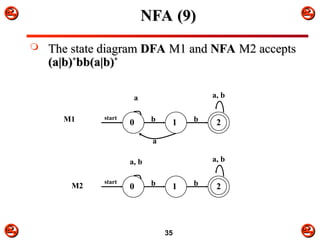
 The state diagram
The state diagram DFA
DFA M1 and
M1 and NFA
NFA M2 accepts
M2 accepts
(a|b)
(a|b)*
*
bb(a|b)
bb(a|b)*
*
a a, b
start
0 2
1 b
b
a
M1
start
0 2
1 b
b
a, b a, b
M2



 



36
NFA (10)
NFA (10)
 An NFA that accepts string over {a, b} with
An NFA that accepts string over {a, b} with
substring
substring aa
aa or
or bb
bb
 There are 2 distinct acceptance paths for the string
There are 2 distinct acceptance paths for the string
abaaabb
abaaabb
start
0 2
1 a
a
a, b a, b
4
3 b
b a, b



 



37
NFA (11)
NFA (11)
 The state diagram
The state diagram DFA
DFA M1 and
M1 and NFA
NFA M2 accepts
M2 accepts
(a|b)
(a|b)*
*
abba(a|b)
abba(a|b)*
*
start
0 4
1 b
a
b a, b
a
M1 2 b 3 a
a
b
start
0 4
1 b
a
a, b a, b
M2 2 b 3 a



 



38
NFA with
NFA with
-Transitions (1)
-Transitions (1)
NFA with
NFA with 
-transitions, denoted by NFA-
-transitions, denoted by NFA-

Formal Definition
Formal Definition
 NFA-
NFA-
 M = (Q,
M = (Q, 
,
, 
, q
, q0
0, F)
, F)
 Q = a finite set of states
 = a finite set alphabet
 = transition function
 total function Q  (  (Q)
 q0 = initial/starting state q0  Q
 F = final or accepting states F  Q

 transitions
j
i 

Switch state but do not
use any input symbol



 



39

-Transitions (2)
-Transitions (2)
 The input string
The input string w
w is accepted using
is accepted using NFA-
NFA-
 if there
if there
is a computation that processes the
is a computation that processes the entire string
entire string
and halts in an
and halts in an accepting state
accepting state
 A computation may continue using
A computation may continue using 
-transition
-transition
after the input string has been completely
processed
processed



 



40

-Transitions (3)
-Transitions (3)
 L(M
L(M1
1) = (a|b)
) = (a|b)*
*
bb(a|b)
bb(a|b)*
*
, L(M
, L(M2
2) = (b|ab)
) = (b|ab)*
*
(a|
(a|
)
)
 L(M) = L(M
L(M) = L(M1
1)
) 
 L(M
L(M2
2)
)
q1,1 q1,2
a, b
b
b
q1,0
b
a
q2,0
0



a, b
q2,1
b
q1,1 q1,2
a, b
b
b
q1,0
a, b
b
a
q2,0 q2,1
b
M1
M
M2



 



41

-Transitions (4)
-Transitions (4)
 L(M
L(M1
1) = (a|b)
) = (a|b)*
*
bb(a|b)
bb(a|b)*
*
, L(M
, L(M2
2) = (b|ab)
) = (b|ab)*
*
(a|
(a|
)
)
 L(M) = L(M
L(M) = L(M1
1)L(M
)L(M2
2)
)
q1,1 q1,2
a, b
b
b
q1,0
b
a
q2,0

a, b
q2,1
b
q1,1 q1,2
a, b
b
b
q1,0
a, b
b
a
q2,0 q2,1
b
M1
M
M2



 



42

-Transitions (5)
-Transitions (5)
 M
M accepts all strings over {a, b} of
accepts all strings over {a, b} of even
even length
length
q1 q2
a, b
q0
a, b





 



43

-Transitions (6)
-Transitions (6)
 Let M
Let M1
1 and M
and M2
2 be 2 NFA-
be 2 NFA-
’s as follows
’s as follows
q1,0 q1,f
M1
q2,0 q2,f
M2
M1 = (Q1, , , q1,0, F1)
M2 = (Q2, , , q2,0, F2)



 



44

-Transitions (7)
-Transitions (7)
 L(M) = L(M
L(M) = L(M1
1)
) 
 L(M
L(M2
2)
)
q1,0 q1,f
M1
q2,0 q2,f
M2
q0


M = (Q1  Q2  {q0}, , , q0, F1 
F2)
is the same as in 1 and 2, but
add: (q0, ) = {q1,0, q2,0}



 



45

-Transitions (8)
-Transitions (8)
 L(M) = L(M
L(M) = L(M1
1)L(M
)L(M2
2)
)
q1,0 q1,f
M1 q2,0 q2,f
M2

M = (Q1  Q2, , , q1,0, F2)
is the same as in 1 and 2, but
add: (q, ) = {q2,0}, where q  F1



 



46

-Transitions (9)
-Transitions (9)
 L(M) = L(M
L(M) = L(M1
1)
)*
*
q1,0 q1,f
M1
 qf
q0



M = (Q1  {q0, qf}, , , q0, {qf})
is the same as in 1, but add:
(q0, ) = {q1,0 ,qf}
(q1,f, ) = {q1,0 ,qf}, where q1,f F1



 



47

-Transitions (10)
-Transitions (10)
Given the regular expression : a(b*
c) | a( b | c+
| )
Find a transition diagram NFA-
 that recognizes it.



 



48

-Transitions (11)
-Transitions (11)
3
2
b
c
a
1
6
5
7
c
a
c
4 b
a (b*
c)
a( b | c+
| )
Now that you have the individual
diagrams, “or” them as follows:



 



49

-Transitions (12)
-Transitions (12)
3
2
b
c
a
1
6
5
7
c
a
c
4 b
0





 



50

-Transitions (12)
-Transitions (12)
 See examples 2.7, 2.8, 2.9, and 2.10
See examples 2.7, 2.8, 2.9, and 2.10



 



51
2.3: Equivalence of DFA & NFA (1)
 Is NFA more powerful than DFA? NO!
Is NFA more powerful than DFA? NO!
 NFA inefficient to implement directly, so
convert to a DFA that recognizes the same
strings
 Is there a language accepted by an NFA that is not
Is there a language accepted by an NFA that is not
accepted by any DFA? No
 NFA is equivalent to DFA.
NFA is equivalent to DFA.
 Each state in DFA corresponds to a SET of
states of the NFA



 



52
Removing Nondeterminism (2)
 
-closure
-closure
 In an NFA-
In an NFA-
, the
, the 
-closure(
-closure(q
q)
) of a state
of a state q
q is the set
is the set
of all states that can be reached from
of all states that can be reached from q
q by
by
following a path whose edges are all labeled by
following a path whose edges are all labeled by 
.
.
q0 q1
q2
q3
b



a
 b
Start
-closure(q0) = {q0, q1, q2, q3}

-
-closure(q1) = {q1,q3}

-
-closure(q2) = {q1,q2,q3}



 



53
Removing Nondeterminism (3)
NFA- N = (Q, , , q0, F)
-closure(q) : q  Q
: set of NFA- states that are reachable from q
on -transitions only
-closure(T) : T  Q
: NFA- states reachable from some state t  T
on -transitions only
move(T, a) : T  Q, a  
: set of states to which there is a transition on
input a from some state t  T
move({q1, q2, …, qi}, a) = (q1, a)  (q2, a)  …  (qi, a)
These 3 operations are utilized by algorithms /
techniques to facilitate the conversion process
No input is
consumed



 



54
Removing Nondeterminism (4)
 -closure(0) = {0, 1, 2, 4, 7} (all states reachable from 0 on -moves)
 -closure(0, 6) = -closure(0)  -closure(6)
= {0, 1, 2, 4, 7}  {6, 1, 2, 4,7} = {0, 1, 2, 4,
6, 7}
 move({0, 1, 2, 4, 7}, a) = {3, 8} (since move(2, a)=3 and move(7, a)=8)
0 1
2 3
5
4
6 7 8 9
10







 a
a
b
b
b
start



 



55
NFA-
NFA-
 
DFA
DFA with Subset Construction
with Subset Construction
NFA- N  DFA M construction:
Given N = (Q, , , q0, F), define M = (Q’, , ’, q’0, F’)
Q’  P(Q), all the possible NFA- states M could be in.
q’0 = -closure(q0)
F’ = {q’  Q’ | q’  F  }
’(q’, a) = -closure(move(q’, a))
 DFA M has a state ERR
DFA M has a state ERR 
 Q’ = P(Q)
Q’ = P(Q)
 serves as the “error” state, when needed
 ’(ERR, a) = ERR, a   By definition of ’



 



56
Subset Construction
Subset Construction
Algorithm Concepts
Algorithm Concepts
First we calculate: -closure(0) (i.e., state 0)
-closure(0) = {0, 1, 2, 4, 7} (all states reachable from 0 on -moves)
Let A = {0, 1, 2, 4, 7} be a state of new DFA M
Start with NFA-: (a | b)*abb
0 1
2 3
5
4
6 7 8 9
10







 a
a
b
b
b
start



 



57
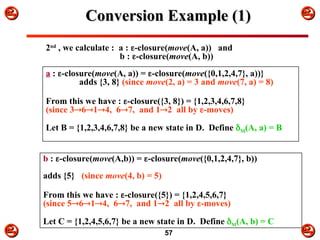
Conversion Example (1)
b : -closure(move(A,b)) = -closure(move({0,1,2,4,7}, b))
adds {5} (since move(4, b) = 5)
From this we have : -closure({5}) = {1,2,4,5,6,7}
(since 5614, 67, and 12 all by -moves)
Let C = {1,2,4,5,6,7} be a new state in D. Define M(A, b) = C
2nd
, we calculate : a : -closure(move(A, a)) and
b : -closure(move(A, b))
a : -closure(move(A, a)) = -closure(move({0,1,2,4,7}, a))}
adds {3, 8} (since move(2, a) = 3 and move(7, a) = 8)
From this we have : -closure({3, 8}) = {1,2,3,4,6,7,8}
(since 3614, 67, and 12 all by -moves)
Let B = {1,2,3,4,6,7,8} be a new state in D. Define M(A, a) = B



 



58
Conversion Example (2)
3rd
, we calculate for state B on {a, b}
a : -closure(move(B, a)) = -closure(move({1,2,3,4,6,7,8}, a))}
= {1,2,3,4,6,7,8} = B
Define M(B, a) = B
b : -closure(move(B, b)) = -closure(move({1,2,3,4,6,7,8}, b))}
= {1,2,4,5,6,7,9} = D
Define M(B, b) = D
4th
, we calculate for state C on {a, b}
a : -closure(move(C, a)) = -closure(move({1,2,4,5,6,7}, a))}
= {1,2,3,4,6,7,8} = B
Define M(C, a) = B
b : -closure(move(C, b)) = -closure(move({1,2,4,5,6,7}, b))}
= {1,2,4,5,6,7} = C
Define M(C, b) = C



 



59
Conversion Example (3)
5th
, we calculate for state D on {a, b}
a : -closure(move(D, a)) = -closure(move({1,2,4,5,6,7,9}, a))}
= {1,2,3,4,6,7,8} = B
Define M(D, a) = B
b : -closure(move(D, b)) = -closure(move({1,2,4,5,6,7,9}, b))}
= {1,2,4,5,6,7,10} = E
Define M(D, b) = E
Finally, we calculate for state E on {a, b}
a : -closure(move(E, a)) = -closure(move({1,2,4,5,6,7,10}, a))}
= {1,2,3,4,6,7,8} = B
Define M(E, a) = B
b : -closure(move(E, b)) = -closure(move({1,2,4,5,6,7,10}, b))}
= {1,2,4,5,6,7} = C
Define M(E, b) = C



 



60
Conversion Example (4)
State
Input Symbol
a b
A B C
B B D
C B C
E B C
D B E
…
A
…b
C
…a
B
…
abD
…
abbE
start b
b
b
b
b
a
a
a
a
This gives the transition table for the DFA M of:
a



 



61
Converting NFA-
Converting NFA-
 to DFA – 2
to DFA – 2nd
nd
Example
Example
0 8
5
4
7
3
6
2
1














b
a
c


RE: c*(ab)*c*
1st
we calculate: -closure(0) -closure(0) = {0, 1, 2, 6, 8}
(all states reachable from 0 on -moves)
Let A={0, 1, 2, 6, 8} be a state of new DFA M



 



62
Conversion Example (1)
b : -closure(move(A,b)) = -closure(move({0,1,2,6,8}, b))
There is NO transition on b for all states 0,1,2,6 and 8
Define M(A, b) = Reject
2nd
, we calculate : a : -closure(move(A, a)) and
b : -closure(move(A, b))
c : -closure(move(A, c))
a : -closure(move(A, a)) = -closure(move({0,1,2,6,8}, a))}
adds {3} (since move(2, a) = 3)
From this we have : -closure({3}) = {3} (since 33 by -moves)
Let B = {3} be a new state. Define M(A, a) = B
c : -closure(move(A, c)) = -closure(move({0,1,2,6,8}, c))
adds {7} (since move(6, c) = 7)
From this we have : -closure({7}) = {1,2,5,6,7,8}
(since 758, 7512, and 7516 by -moves)
Let C = {1,2,5,6,7,8} be a new state. Define M(A, c) = C



 



63
Conversion Example (2)
b : -closure(move(B, b)) = -closure(move({3}, b))
adds {4} (since move(3, b) = 4)
From this we have : -closure({4}) = {1,2,4,5,6,8}
(since 458, 4512, and 4516 by -moves)
Let D = {1,2,4,5,6,8} be a new state. Define M(B, b) = D
3rd
, we calculate : a : -closure(move(B, a)) and
b : -closure(move(B, b))
c : -closure(move(B, c))
a : -closure(move(B, a)) = -cclosure(move({3}, a))}
There is NO transition on a for state 3
Define M(B, a) = Reject
c : -closure(move(B, c)) = -closure(move({3}, c))
There is NO transition on c for state 3
Define M(B, c) = Reject



 



64
Conversion Example (3)
b : -closure(move(C, b)) = -closure(move({1,2,5,6,7,8},b))
There is NO transition on b for all states 1,2,5,6, and 7
Define M(C, b) = Reject
4th
, we calculate : a : -closure(move(C, a)) and
b : -closure(move(C, b))
c : -closure(move(C, c))
a : -cclosure(move(C, a)) = -closure(move({1,2,5,6,7,8},a))}
adds {3} (since move(2, a) = 3)
-closure({3}) = {3} Define M(C, a) = B
c : -closure(move(C, c)) = -closure(move({1,2,5,6,7,8},c))
adds {7} (since move(6, c) = 7)
From this we have : -closure({7}) = {1,2,5,6,7,8}
(since 758, 7512, and 7516 by -moves)
Define M(C, c) = C



 



65
Conversion Example (4)
b : -closure(move(D, b)) = -closure(move({1,2,4,5,6,8}, b))
There is NO transition on b for all states 1,2,4,5,6, and 8
Define M(D, b) = Reject
5th
, we calculate : a : -closure(move(D, a)) and
b : -closure(move(D, b))
c : -closure(move(D, c))
a : -closure(move(D, a)) = -closure(move({1,2,4,5,6,8},a))}
adds {3} (since move(2, a) = 3)
-closure({3}) = {3} Define M(D, a) = B
c : -closure(move(D, c)) = -closure(move({1,2,4,5,6,8},c))
adds {7} (since move(6, c) = 7)
From this we have : -closure({7}) = {1,2,5,6,7,8}
(since 758, 7512, and 7516 by -moves)
Define M(D, c) = C



 



66
The Resulting DFA M
The Resulting DFA M
Which States are FINAL States ?
1, 2, 5, 6, 7, 8
1, 2, 4, 5, 6, 8
0, 1, 2, 6, 8 3
c
b
a
a
a
c
c
D
C
A
B
c
b
a
a
a
c
c



 



67
NFA-
NFA-
 
 DFA: Example
DFA: Example
strings over {a,b} with next-to-last symbol = a
a
a/b
a/b
q2
q1
q0
 a b 
q0 {q0, q1} {q0} 
q1
{q2} {q2} 
q2
  
M = ({q0, q1, q2}, {a,b}, , q0, {q2})
q0
q2
q0
q0
q1
q0
q1
q2
a
a
a
a
b
b
b
b
Equivalent DFA
Equivalent DFA



 



68
An Example of NFA-
An Example of NFA-
 
 DFA
DFA
Consider a simple NFA:
Construct a corresponding DFA:
0
1
1
Start
0 1
q0 q1
{q0}
{q0, q1}
{q1}
ERR
ERR
Start 1
0 1
0
1,0 1,0



 



69
Examples
Examples
 See examples 2.11, 2.12, and 2.13
See examples 2.11, 2.12, and 2.13



 



70
Class Discussion
Class Discussion
Construct a DFA equivalent to this NFA:
Start
0,1
q0 q1
0 q2
1
{q0, q1}
Start
1
{q0}
0 1 {q0,q2}
0
1
0
0



 



71
b
a,b,c
An NFA
a
1 2
a
0
b,c
c
start
Notice that the state with label {0, 1, 2} is from the set of states given by the
nondeterministic transition (0, a) = {0, 1, 2}. Also notice that any state
whose label contains an accepting state is defined as an accepting state in the
deterministic machine.
{0,1,2}
{2}
a
a
{1,2}
b
c
b
c
c
Converted DFA
0
start
b,c
Class Discussion
Class Discussion



 



72
2.4 Reduction of the Number of States in FA
 Self study
Self study
 but not included in the exams material

finitw automata2, Computer theory computure science

  • 1.
    1         Chapter 2 Chapter2 Finite Automata Finite Automata
  • 2.
            2 A Finite-StateMachine (1) A Finite-State Machine (1)  A finite state machine is a mathematical model of a A finite state machine is a mathematical model of a system, with discrete inputs and outputs system, with discrete inputs and outputs
  • 3.
            3 A Finite-StateMachine (2) A Finite-State Machine (2)  Finite Automata FA: Finite Automata FA:  a finite set of states  a set of transitions (edges)  a start state  a set of final states Defining a FA is a kind of programming. Defining a FA is a kind of programming.  Problem definition Problem definition  Includes defining possible actions & accepting condition.  States States   structure of program structure of program  Includes designating which are initial & final.  Transitions Transitions   program program
  • 4.
            4 2.1: DeterministicFinite Automata (1) 2.1: Deterministic Finite Automata (1)  DFA M = (Q, DFA M = (Q,  , ,  , , q q0 0, F) , F)  Q = a finite set of states  = a finite set called the alphabet  = transition function  total function Q    Q  q0 = start state q0  Q  F = final or accepting states F  Q
  • 5.
            5 Deterministic FiniteAutomata (2) Deterministic Finite Automata (2)  DFA M DFA M  Q = {q0, q1}  = {a, b}  F = {q1}  The transition function  is given in a tabular form called the transition table  (q0, a) = q1 (q0, b) = q0  (q1, a) = q1 (q1, b) = q0
  • 6.
            6 Deterministic FiniteAutomata (3) Deterministic Finite Automata (3)  A A DFA DFA M can be considered to be a language M can be considered to be a language acceptor. acceptor.  The The language language of M, of M, L(M) L(M), is the set of strings , is the set of strings  * * accepted by M. accepted by M.  A A DFA DFA M reads an input string from left to right. M reads an input string from left to right.  The The next state next state depends on the depends on the current state current state and and the the unread (unprocessed) symbol unread (unprocessed) symbol. .
  • 7.
            7 Deterministic FiniteAutomata (5) Deterministic Finite Automata (5)  The DFA The DFA M M accepts the set of strings over {a, b} that accepts the set of strings over {a, b} that contain the substring contain the substring bb bb  M : Q = {q0, q1, q2}, = {a, b}, F = {q2}  The transition function  is given in a tabular form called the transition table  (q0, a) = q0 (q0, b) = q1  (q1, a) = q0 (q1, b) = q2  (q2, a) = q2 (q2, b) = q2  Is Is abba abba   L(M)? Yes, since the computation halts in state L(M)? Yes, since the computation halts in state q q2 2, which is a final state , which is a final state  Is Is abab abab   L(M)? No, since the computation halts in state L(M)? No, since the computation halts in state q q1 1, which is , which is NOT NOT a final state a final state
  • 8.
            8 Deterministic FiniteAutomata (6) Deterministic Finite Automata (6)  Extended transition function Extended transition function  * * of a DFA with of a DFA with transition function transition function   is a function from Q is a function from Q    * *   Q Q defined recursively on the length of the input string defined recursively on the length of the input string w w  Basis: |w| = 0. Then w =  and * (qi, ) = qi  Recursive step: Let |w| = 1. Then * (qi, av) = * ((qi, a), v)   qi  Q,  a  ,  v  *
  • 9.
            9 Deterministic FiniteAutomata (7) Deterministic Finite Automata (7)  A string A string w w is accepted if is accepted if  * * (q (q0 0, , w w) )   F F  The language of a DFA The language of a DFA M M is is  L(M) = {w  * | * (q0, w)  F}  DFA M = (Q, DFA M = (Q,  , ,  , q , q0 0, F) accepts , F) accepts w w    * *    * (q0, w)  F
  • 10.
            10 Deterministic FiniteAutomata (8) Deterministic Finite Automata (8)  Two possibilities for DFA M running on Two possibilities for DFA M running on w w  M accepts w  M accepts w iff the computation of M on w ends up (halts) in an accepting configuration  * (q0, w)  F  M rejects w  M rejects w iff the computation of M on w ends up (halts) in a rejecting configuration  * (q0, w)  F
  • 11.
            11  Thestate diagram of a DFA M = The state diagram of a DFA M = (Q, (Q,  , ,  ,q ,q0 0, F) , F) is a is a labeled graph labeled graph G G defined by the following defined by the following conditions: conditions:  The nodes of G are the elements of Q  The labels on the arcs of G are elements of   q0 is the start node, denoted by  F is the set of accepting nodes, denoted by  There is an arc from node qi to qj labeled a if (qi, a) = qj  For every node qi and symbol a  , there is exactly one arc labeled a leaving qi State Diagrams and Examples (1) State Diagrams and Examples (1) q0 a
  • 12.
            12 State Diagramsand Examples (2) State Diagrams and Examples (2)  Deterministic Finite Automata DFA Deterministic Finite Automata DFA  all outgoing edges are labelled with an input character  no state has - transition, transition on input   no two edges leaving a given state have the same label  for each state s and input symbol a, there is at most one edge label a leaving s  Therefore: the next state can be determined uniquely, given the current state and the current input character
  • 13.
            13 State Diagramsand Examples (1) State Diagrams and Examples (1) strings over { strings over {a a, ,b b} with at least 3 } with at least 3 a a’s ’s 1 a 2 a 3+ a 0 a a a a b b b 
  • 14.
            14 State Diagramsand Examples (2) State Diagrams and Examples (2) strings over { strings over {a a, ,b b} with length mod 3 = 0 } with length mod 3 = 0 1 2 0   
  • 15.
            15 State Diagramsand Examples (3) State Diagrams and Examples (3) strings over { strings over {a a, ,b b} } without without 3 consecutive 3 consecutive a a’s ’s A simple example of “strings not of the form …”. A simple example of “strings not of the form …”. 1 a 2 a Has aaa 0 a a a a b b b 
  • 16.
            16 State Diagramsand Examples (4) State Diagrams and Examples (4)  Draw a state diagram for DFA Draw a state diagram for DFA M M that accepts the that accepts the set of strings over {a, b} that contain the substring set of strings over {a, b} that contain the substring bb bb  The string The string ababb ababb is accepted since the halting state is accepted since the halting state is the accepting state is the accepting state q q2 2 q1 q2 q0 b b a a a, b
  • 17.
            17 State Diagramsand Examples (5) State Diagrams and Examples (5)  The DFA The DFA  accepts ( accepts (b b| |ab ab) )* * ( (a a| | ) )  the set of strings over {a, b} that the set of strings over {a, b} that do not do not contain contain the substring the substring aa aa 1 a 2 a 0 a a a b b 
  • 18.
            18 State Diagramsand Examples (6) State Diagrams and Examples (6)  The language { The language {a an n b bn n , , n n 0} is not regular, so we can not 0} is not regular, so we can not build a DFA that accept this language build a DFA that accept this language  It needs an infinite number of states It needs an infinite number of states  But { But {a an n b bn n , 1 , 1   n n   3} is regular and its DFA is 3} is regular and its DFA is q0 a q1 a q2 a q3 q4 b q5 b b q6 b b This DFA is NOT Complete
  • 19.
            19 State Diagramsand Examples (7) State Diagrams and Examples (7)  strings over {a, b} that contain the substring strings over {a, b} that contain the substring bb bb OR OR do not do not contain the substring contain the substring aa aa  This language is the union of the languages of the This language is the union of the languages of the previous examples previous examples 1 a 2 a 0 a a a b a 1 b 2 b b b a  2 a b a b
  • 20.
            20 State Diagramsand Examples (8) State Diagrams and Examples (8)  strings over {a, b} that contain an strings over {a, b} that contain an even even number of number of a a’s ’s AND AND an an odd odd number of number of b b’s ’s [ea, eb] [ea, ob] a [oa, eb] [oa, ob] b a a a b b b
  • 21.
            21 State Diagramsand Examples (9) State Diagrams and Examples (9)  Let Let M M be the DFA previous slide be the DFA previous slide  A DFA A DFA M’ M’ that accepts all strings over {a, b} that that accepts all strings over {a, b} that do not do not contain an contain an even even number of number of a a’s ’s AND AND an an odd odd number of number of b b’s ’s is shown below is shown below  L(M’) = {a, b}* - L(M) = * - L(M)  Any string accepted by Any string accepted by M M is rejected by is rejected by M’ M’ and vice versa and vice versa [ea, eb] [ea, ob] a [oa, eb] [oa, ob] b a a a b b b
  • 22.
            22 State Diagramsand Examples (10) State Diagrams and Examples (10)  Let Let   = {0, 1, 2, 3}. A string in = {0, 1, 2, 3}. A string in  * * is a sequence of integers is a sequence of integers from from    The DFA The DFA M M determines whether the determines whether the sum of elements sum of elements of a of a string is string is divisible by 4 divisible by 4  The string The string 12302 12302 and and 0130 0130 should be accepted and should be accepted and 0111 0111 rejected by M rejected by M w mod 4 = 0 0 2 2 1 3 w mod 4 = 1 0 w mod 4 = 2 0 1 3 w mod 4 = 3 0 2 2 1 3 1 3
  • 23.
            23 State Diagramsand Examples (11) State Diagrams and Examples (11)  DFA DFA M1 M1 accepts accepts (ab) (ab)* * c c  M1 M1 is is incomplete determinism incomplete determinism  The string The string abcc abcc is is rejected rejected since since M1 M1 is unable to process is unable to process the final the final c c from state from state q q2 2 q0 q1 c q2 a b M1
  • 24.
            24 State Diagramsand Examples (12) State Diagrams and Examples (12)  M2 M2 accepts the same language as accepts the same language as M1 M1 in previous example in previous example (ab) (ab)* * c c  The state The state q qe e is the error state (dead end) is the error state (dead end) q0 q1 c q2 a b qe b a, c a, b, c M2 
  • 25.
            25 State Diagramsand Examples (13) State Diagrams and Examples (13) strings over { strings over {a a, ,b b} with next-to-last symbol = } with next-to-last symbol = a a …aa …ab a …ba …bb  a b b a b b b a a a a a b b b
  • 26.
            26 State Diagramsand Examples (14) State Diagrams and Examples (14) start 0 3 b 2 1 b a b a b a a What Language is Accepted?
  • 27.
            27 2.2: NondeterministicFinite Automata (1) 2.2: Nondeterministic Finite Automata (1) Finite Automata : A recognizer that takes an input string & determines whether it’s a valid sentence of the language Non-Deterministic : Has more than one (or no) alternative action for the same input symbol. Deterministic : Has at most one action for every given input symbol.
  • 28.
            28 Nondeterministic FiniteAutomata (2) Nondeterministic Finite Automata (2) NFA: Formal Definition NFA: Formal Definition  NFA M = (Q, NFA M = (Q,  , ,  , q , q0 0, F) , F)  Q = a finite set of states  = a finite set alphabet  = transition function  total function Q    (Q) = 2Q - power set of Q  q0 = initial/starting state q0  Q  F = final or accepting states F  Q
  • 29.
            29 Nondeterministic FiniteAutomata (3) Nondeterministic Finite Automata (3) Q = { 0, 1, 2, 3 } q0 = 0 F = { 3 }  = { a, b } start 0 3 b 2 1 b a a b What Language is defined ? What is the Transition Table ? s t a t e i n p u t 0 1 2 a b { 0, 1 }  { 2 }  { 3 } { 0 }
  • 30.
            30 Nondeterministic FiniteAutomata (4) Nondeterministic Finite Automata (4)  Change in Change in    For an DFA M, (q, a) results in one and only one state for all states q and alphabet a  For an NFA M, (q, a) can result in a set of states, zero, one, or more states: qn a qi qn a qi qj qk a a qn  (q (qn n, a) = {q , a) = {qi i} }  (q (qn n, a) = {q , a) = {qi i, q , qj , j , q qk k } }  (q (qn n, a) = {} = , a) = {} =  
  • 31.
            31 Nondeterministic FiniteAutomata (5) Nondeterministic Finite Automata (5) 1 2 3 4 a a a b a,b a,b •Why is this only an NFA and not an DFA? 5
  • 32.
            32 Nondeterministic FiniteAutomata (6) Nondeterministic Finite Automata (6) Computing with NFA’s Computing with NFA’s  Computations are different Computations are different  We always start from start state. Call it the root of We always start from start state. Call it the root of the computation. the computation.  Then we might go to different states on one symbol. Then we might go to different states on one symbol.  Then from those states to new sets of states, Then from those states to new sets of states, creating a creating a tree-like tree-like computation. computation.  If one path ends up in a final state, then ACCEPT, If one path ends up in a final state, then ACCEPT, else REJECT else REJECT
  • 33.
            33 Nondeterministic FiniteAutomata (7) Nondeterministic Finite Automata (7) start 0 3 b 2 1 b a a b • Given an input string, we trace moves • If no more input & in final state, ACCEPT EXAMPLE: Input: ababb Path 1: 0 -> 0 -> 0 -> 0 -> 0 -> 0 (REJECT) Path 2: 0 -> 0 -> 0 -> 1 -> 2 -> 3 (ACCEPT)
  • 34.
            34 Nondeterministic FiniteAutomata (8) Nondeterministic Finite Automata (8)  Extended transition function Extended transition function  * * of a NFA with of a NFA with transition function transition function   is a function from Q is a function from Q    * *   2 2Q Q (power set) defined recursively on the length of (power set) defined recursively on the length of the input string the input string w w  Basis: |w| = 0. Then w =  and * (qi, ) = {qi}  Recursive step: Let |w| = 1. Then * (qi, av) = U * (qj, v), qj  (qi, a)   qi  Q,  qj  Q , a  ,  v *  The language of a NFA The language of a NFA M M is is  L(M) = {w  * | * (q0, w)  F ≠  }
  • 35.
            35 NFA (9) NFA(9)  The state diagram The state diagram DFA DFA M1 and M1 and NFA NFA M2 accepts M2 accepts (a|b) (a|b)* * bb(a|b) bb(a|b)* * a a, b start 0 2 1 b b a M1 start 0 2 1 b b a, b a, b M2
  • 36.
            36 NFA (10) NFA(10)  An NFA that accepts string over {a, b} with An NFA that accepts string over {a, b} with substring substring aa aa or or bb bb  There are 2 distinct acceptance paths for the string There are 2 distinct acceptance paths for the string abaaabb abaaabb start 0 2 1 a a a, b a, b 4 3 b b a, b
  • 37.
            37 NFA (11) NFA(11)  The state diagram The state diagram DFA DFA M1 and M1 and NFA NFA M2 accepts M2 accepts (a|b) (a|b)* * abba(a|b) abba(a|b)* * start 0 4 1 b a b a, b a M1 2 b 3 a a b start 0 4 1 b a a, b a, b M2 2 b 3 a
  • 38.
            38 NFA with NFAwith -Transitions (1) -Transitions (1) NFA with NFA with  -transitions, denoted by NFA- -transitions, denoted by NFA-  Formal Definition Formal Definition  NFA- NFA-  M = (Q, M = (Q,  , ,  , q , q0 0, F) , F)  Q = a finite set of states  = a finite set alphabet  = transition function  total function Q  (  (Q)  q0 = initial/starting state q0  Q  F = final or accepting states F  Q   transitions j i   Switch state but do not use any input symbol
  • 39.
            39  -Transitions (2) -Transitions(2)  The input string The input string w w is accepted using is accepted using NFA- NFA-  if there if there is a computation that processes the is a computation that processes the entire string entire string and halts in an and halts in an accepting state accepting state  A computation may continue using A computation may continue using  -transition -transition after the input string has been completely after the input string has been completely processed processed
  • 40.
            40  -Transitions (3) -Transitions(3)  L(M L(M1 1) = (a|b) ) = (a|b)* * bb(a|b) bb(a|b)* * , L(M , L(M2 2) = (b|ab) ) = (b|ab)* * (a| (a| ) )  L(M) = L(M L(M) = L(M1 1) )   L(M L(M2 2) ) q1,1 q1,2 a, b b b q1,0 b a q2,0 0    a, b q2,1 b q1,1 q1,2 a, b b b q1,0 a, b b a q2,0 q2,1 b M1 M M2
  • 41.
            41  -Transitions (4) -Transitions(4)  L(M L(M1 1) = (a|b) ) = (a|b)* * bb(a|b) bb(a|b)* * , L(M , L(M2 2) = (b|ab) ) = (b|ab)* * (a| (a| ) )  L(M) = L(M L(M) = L(M1 1)L(M )L(M2 2) ) q1,1 q1,2 a, b b b q1,0 b a q2,0  a, b q2,1 b q1,1 q1,2 a, b b b q1,0 a, b b a q2,0 q2,1 b M1 M M2
  • 42.
            42  -Transitions (5) -Transitions(5)  M M accepts all strings over {a, b} of accepts all strings over {a, b} of even even length length q1 q2 a, b q0 a, b  
  • 43.
            43  -Transitions (6) -Transitions(6)  Let M Let M1 1 and M and M2 2 be 2 NFA- be 2 NFA- ’s as follows ’s as follows q1,0 q1,f M1 q2,0 q2,f M2 M1 = (Q1, , , q1,0, F1) M2 = (Q2, , , q2,0, F2)
  • 44.
            44  -Transitions (7) -Transitions(7)  L(M) = L(M L(M) = L(M1 1) )   L(M L(M2 2) ) q1,0 q1,f M1 q2,0 q2,f M2 q0   M = (Q1  Q2  {q0}, , , q0, F1  F2) is the same as in 1 and 2, but add: (q0, ) = {q1,0, q2,0}
  • 45.
            45  -Transitions (8) -Transitions(8)  L(M) = L(M L(M) = L(M1 1)L(M )L(M2 2) ) q1,0 q1,f M1 q2,0 q2,f M2  M = (Q1  Q2, , , q1,0, F2) is the same as in 1 and 2, but add: (q, ) = {q2,0}, where q  F1
  • 46.
            46  -Transitions (9) -Transitions(9)  L(M) = L(M L(M) = L(M1 1) )* * q1,0 q1,f M1  qf q0    M = (Q1  {q0, qf}, , , q0, {qf}) is the same as in 1, but add: (q0, ) = {q1,0 ,qf} (q1,f, ) = {q1,0 ,qf}, where q1,f F1
  • 47.
            47  -Transitions (10) -Transitions(10) Given the regular expression : a(b* c) | a( b | c+ | ) Find a transition diagram NFA-  that recognizes it.
  • 48.
            48  -Transitions (11) -Transitions(11) 3 2 b c a 1 6 5 7 c a c 4 b a (b* c) a( b | c+ | ) Now that you have the individual diagrams, “or” them as follows:
  • 49.
  • 50.
            50  -Transitions (12) -Transitions(12)  See examples 2.7, 2.8, 2.9, and 2.10 See examples 2.7, 2.8, 2.9, and 2.10
  • 51.
            51 2.3: Equivalenceof DFA & NFA (1) 2.3: Equivalence of DFA & NFA (1)  Is NFA more powerful than DFA? NO! Is NFA more powerful than DFA? NO!  NFA inefficient to implement directly, so convert to a DFA that recognizes the same strings  Is there a language accepted by an NFA that is not Is there a language accepted by an NFA that is not accepted by any DFA? No accepted by any DFA? No  NFA is equivalent to DFA. NFA is equivalent to DFA.  Each state in DFA corresponds to a SET of states of the NFA
  • 52.
            52 Removing Nondeterminism(2) Removing Nondeterminism (2)   -closure -closure  In an NFA- In an NFA- , the , the  -closure( -closure(q q) ) of a state of a state q q is the set is the set of all states that can be reached from of all states that can be reached from q q by by following a path whose edges are all labeled by following a path whose edges are all labeled by  . . q0 q1 q2 q3 b    a  b Start -closure(q0) = {q0, q1, q2, q3}  - -closure(q1) = {q1,q3}  - -closure(q2) = {q1,q2,q3}
  • 53.
            53 Removing Nondeterminism(3) Removing Nondeterminism (3) NFA- N = (Q, , , q0, F) -closure(q) : q  Q : set of NFA- states that are reachable from q on -transitions only -closure(T) : T  Q : NFA- states reachable from some state t  T on -transitions only move(T, a) : T  Q, a   : set of states to which there is a transition on input a from some state t  T move({q1, q2, …, qi}, a) = (q1, a)  (q2, a)  …  (qi, a) These 3 operations are utilized by algorithms / techniques to facilitate the conversion process No input is consumed
  • 54.
            54 Removing Nondeterminism(4) Removing Nondeterminism (4)  -closure(0) = {0, 1, 2, 4, 7} (all states reachable from 0 on -moves)  -closure(0, 6) = -closure(0)  -closure(6) = {0, 1, 2, 4, 7}  {6, 1, 2, 4,7} = {0, 1, 2, 4, 6, 7}  move({0, 1, 2, 4, 7}, a) = {3, 8} (since move(2, a)=3 and move(7, a)=8) 0 1 2 3 5 4 6 7 8 9 10         a a b b b start
  • 55.
            55 NFA- NFA-   DFA DFAwith Subset Construction with Subset Construction NFA- N  DFA M construction: Given N = (Q, , , q0, F), define M = (Q’, , ’, q’0, F’) Q’  P(Q), all the possible NFA- states M could be in. q’0 = -closure(q0) F’ = {q’  Q’ | q’  F  } ’(q’, a) = -closure(move(q’, a))  DFA M has a state ERR DFA M has a state ERR   Q’ = P(Q) Q’ = P(Q)  serves as the “error” state, when needed  ’(ERR, a) = ERR, a   By definition of ’
  • 56.
            56 Subset Construction SubsetConstruction Algorithm Concepts Algorithm Concepts First we calculate: -closure(0) (i.e., state 0) -closure(0) = {0, 1, 2, 4, 7} (all states reachable from 0 on -moves) Let A = {0, 1, 2, 4, 7} be a state of new DFA M Start with NFA-: (a | b)*abb 0 1 2 3 5 4 6 7 8 9 10         a a b b b start
  • 57.
            57 Conversion Example(1) Conversion Example (1) b : -closure(move(A,b)) = -closure(move({0,1,2,4,7}, b)) adds {5} (since move(4, b) = 5) From this we have : -closure({5}) = {1,2,4,5,6,7} (since 5614, 67, and 12 all by -moves) Let C = {1,2,4,5,6,7} be a new state in D. Define M(A, b) = C 2nd , we calculate : a : -closure(move(A, a)) and b : -closure(move(A, b)) a : -closure(move(A, a)) = -closure(move({0,1,2,4,7}, a))} adds {3, 8} (since move(2, a) = 3 and move(7, a) = 8) From this we have : -closure({3, 8}) = {1,2,3,4,6,7,8} (since 3614, 67, and 12 all by -moves) Let B = {1,2,3,4,6,7,8} be a new state in D. Define M(A, a) = B
  • 58.
            58 Conversion Example(2) Conversion Example (2) 3rd , we calculate for state B on {a, b} a : -closure(move(B, a)) = -closure(move({1,2,3,4,6,7,8}, a))} = {1,2,3,4,6,7,8} = B Define M(B, a) = B b : -closure(move(B, b)) = -closure(move({1,2,3,4,6,7,8}, b))} = {1,2,4,5,6,7,9} = D Define M(B, b) = D 4th , we calculate for state C on {a, b} a : -closure(move(C, a)) = -closure(move({1,2,4,5,6,7}, a))} = {1,2,3,4,6,7,8} = B Define M(C, a) = B b : -closure(move(C, b)) = -closure(move({1,2,4,5,6,7}, b))} = {1,2,4,5,6,7} = C Define M(C, b) = C
  • 59.
            59 Conversion Example(3) Conversion Example (3) 5th , we calculate for state D on {a, b} a : -closure(move(D, a)) = -closure(move({1,2,4,5,6,7,9}, a))} = {1,2,3,4,6,7,8} = B Define M(D, a) = B b : -closure(move(D, b)) = -closure(move({1,2,4,5,6,7,9}, b))} = {1,2,4,5,6,7,10} = E Define M(D, b) = E Finally, we calculate for state E on {a, b} a : -closure(move(E, a)) = -closure(move({1,2,4,5,6,7,10}, a))} = {1,2,3,4,6,7,8} = B Define M(E, a) = B b : -closure(move(E, b)) = -closure(move({1,2,4,5,6,7,10}, b))} = {1,2,4,5,6,7} = C Define M(E, b) = C
  • 60.
            60 Conversion Example(4) Conversion Example (4) State Input Symbol a b A B C B B D C B C E B C D B E … A …b C …a B … abD … abbE start b b b b b a a a a This gives the transition table for the DFA M of: a
  • 61.
            61 Converting NFA- ConvertingNFA-  to DFA – 2 to DFA – 2nd nd Example Example 0 8 5 4 7 3 6 2 1               b a c   RE: c*(ab)*c* 1st we calculate: -closure(0) -closure(0) = {0, 1, 2, 6, 8} (all states reachable from 0 on -moves) Let A={0, 1, 2, 6, 8} be a state of new DFA M
  • 62.
            62 Conversion Example(1) Conversion Example (1) b : -closure(move(A,b)) = -closure(move({0,1,2,6,8}, b)) There is NO transition on b for all states 0,1,2,6 and 8 Define M(A, b) = Reject 2nd , we calculate : a : -closure(move(A, a)) and b : -closure(move(A, b)) c : -closure(move(A, c)) a : -closure(move(A, a)) = -closure(move({0,1,2,6,8}, a))} adds {3} (since move(2, a) = 3) From this we have : -closure({3}) = {3} (since 33 by -moves) Let B = {3} be a new state. Define M(A, a) = B c : -closure(move(A, c)) = -closure(move({0,1,2,6,8}, c)) adds {7} (since move(6, c) = 7) From this we have : -closure({7}) = {1,2,5,6,7,8} (since 758, 7512, and 7516 by -moves) Let C = {1,2,5,6,7,8} be a new state. Define M(A, c) = C
  • 63.
            63 Conversion Example(2) Conversion Example (2) b : -closure(move(B, b)) = -closure(move({3}, b)) adds {4} (since move(3, b) = 4) From this we have : -closure({4}) = {1,2,4,5,6,8} (since 458, 4512, and 4516 by -moves) Let D = {1,2,4,5,6,8} be a new state. Define M(B, b) = D 3rd , we calculate : a : -closure(move(B, a)) and b : -closure(move(B, b)) c : -closure(move(B, c)) a : -closure(move(B, a)) = -cclosure(move({3}, a))} There is NO transition on a for state 3 Define M(B, a) = Reject c : -closure(move(B, c)) = -closure(move({3}, c)) There is NO transition on c for state 3 Define M(B, c) = Reject
  • 64.
            64 Conversion Example(3) Conversion Example (3) b : -closure(move(C, b)) = -closure(move({1,2,5,6,7,8},b)) There is NO transition on b for all states 1,2,5,6, and 7 Define M(C, b) = Reject 4th , we calculate : a : -closure(move(C, a)) and b : -closure(move(C, b)) c : -closure(move(C, c)) a : -cclosure(move(C, a)) = -closure(move({1,2,5,6,7,8},a))} adds {3} (since move(2, a) = 3) -closure({3}) = {3} Define M(C, a) = B c : -closure(move(C, c)) = -closure(move({1,2,5,6,7,8},c)) adds {7} (since move(6, c) = 7) From this we have : -closure({7}) = {1,2,5,6,7,8} (since 758, 7512, and 7516 by -moves) Define M(C, c) = C
  • 65.
            65 Conversion Example(4) Conversion Example (4) b : -closure(move(D, b)) = -closure(move({1,2,4,5,6,8}, b)) There is NO transition on b for all states 1,2,4,5,6, and 8 Define M(D, b) = Reject 5th , we calculate : a : -closure(move(D, a)) and b : -closure(move(D, b)) c : -closure(move(D, c)) a : -closure(move(D, a)) = -closure(move({1,2,4,5,6,8},a))} adds {3} (since move(2, a) = 3) -closure({3}) = {3} Define M(D, a) = B c : -closure(move(D, c)) = -closure(move({1,2,4,5,6,8},c)) adds {7} (since move(6, c) = 7) From this we have : -closure({7}) = {1,2,5,6,7,8} (since 758, 7512, and 7516 by -moves) Define M(D, c) = C
  • 66.
            66 The ResultingDFA M The Resulting DFA M Which States are FINAL States ? 1, 2, 5, 6, 7, 8 1, 2, 4, 5, 6, 8 0, 1, 2, 6, 8 3 c b a a a c c D C A B c b a a a c c
  • 67.
            67 NFA- NFA-   DFA: Example DFA: Example strings over {a,b} with next-to-last symbol = a a a/b a/b q2 q1 q0  a b  q0 {q0, q1} {q0}  q1 {q2} {q2}  q2    M = ({q0, q1, q2}, {a,b}, , q0, {q2}) q0 q2 q0 q0 q1 q0 q1 q2 a a a a b b b b Equivalent DFA Equivalent DFA
  • 68.
            68 An Exampleof NFA- An Example of NFA-    DFA DFA Consider a simple NFA: Consider a simple NFA: Construct a corresponding DFA: Construct a corresponding DFA: 0 1 1 Start 0 1 q0 q1 {q0} {q0, q1} {q1} ERR ERR Start 1 0 1 0 1,0 1,0
  • 69.
            69 Examples Examples  Seeexamples 2.11, 2.12, and 2.13 See examples 2.11, 2.12, and 2.13
  • 70.
            70 Class Discussion ClassDiscussion Construct a DFA equivalent to this NFA: Construct a DFA equivalent to this NFA: Start 0,1 q0 q1 0 q2 1 {q0, q1} Start 1 {q0} 0 1 {q0,q2} 0 1 0 0
  • 71.
            71 b a,b,c An NFA a 12 a 0 b,c c start Notice that the state with label {0, 1, 2} is from the set of states given by the nondeterministic transition (0, a) = {0, 1, 2}. Also notice that any state whose label contains an accepting state is defined as an accepting state in the deterministic machine. {0,1,2} {2} a a {1,2} b c b c c Converted DFA 0 start b,c Class Discussion Class Discussion
  • 72.
            72 2.4 Reductionof the Number of States in FA 2.4 Reduction of the Number of States in FA  Self study Self study  but not included in the exams material