Opportunistic Routing Algorithm for Relay Node Selection
in Wireless Sensor Networks
ABSTRACT:
Energy savings optimization becomes one of the major concerns in the wireless
sensor network (WSN) routing protocol design, due to the fact that most sensor
nodes are equipped with the limited nonrechargeable battery power. In this paper,
we focus onminimizing energy consumption and maximizing network lifetime for
data relay in one-dimensional (1-D) queue network. Following the principle of
opportunistic routing theory, multihop relay decision to optimize the network
energy efficiency is made based on the differences among sensor nodes, in terms
of both their distance to sink and the residual energy of each other. Specifically, an
Energy Saving via Opportunistic Routing (ENS_OR) algorithm is designed to
ensure minimum power cost during data relay and protect the nodes with relatively
low residual energy. Extensive simulations and real testbed results show that the
proposed solution ENS_OR can significantly improve the network performance on
energy saving and wireless connectivity in comparison with other existingWSN
routing schemes.
EXISTING SYSTEM:
The most forward within range (MFR) routing approach has also been considered
in 1-D queue networks, which chooses the farthest away neighboring node as the
next forwarder, and eventually results in less multihop delay, less power
consumption. Another approach proposed to reduces the total consumed energy
based on two optimization objectives, i.e., path selection and bit allocation.
Geographic random forwarding (GeRaF), and efficient QoS-aware geographic
opportunistic routing (EQGOR), take advantage of the broadcast nature of the
wireless medium, and allow multiple neighbors that can overhear the transmission
to participate in forwarding packets. However, these routing protocols did not
address exploiting OR for selecting the appropriate forwarding list to minimize the
energy consumption, and optimize the design of an energy-efficient OR protocol
for wireless networks.
DISADVANTAGES OF EXISTING SYSTEM:
 Increase the energy consumption
 Decrease the network lifetime
 Existing protocols did not address the opportunistic routing
PROPOSED SYSTEM:
In this project, we propose an energy-efficient routing algorithm for above 1-D
queue network, namely, Energy Saving via Opportunistic Routing (ENS_OR).
ENS_OR adopts a new concept called energy equivalent node (EEN), which
selecting relay nodes based on opportunistic routing theory, to virtually derive the
optimal transmission distance for energy saving and maximizing the lifetime of
whole network. ENS_OR selects a forwarder set and prioritizes nodes in it,
according to their virtual optimal transmission distance and residual energy level.
Nodes in this forwarder set that are closer to EENs and have more residual energy
than the sender can be selected as forwarder candidates.
ADVANTAGES OF PROPOSED SYSTEM:
 Increase the network lifetime
 Decrease the energy consumption
SYSTEM ARCHITECTURE:
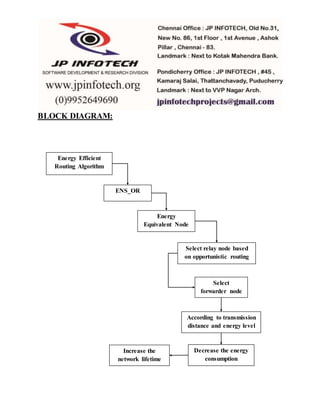
BLOCK DIAGRAM:
Energy Efficient
Routing Algorithm
ENS_OR
Select
forwarder node
Select relay node based
on opportunistic routing
Energy
Equivalent Node
Increase the
network lifetime
Decrease the energy
consumption
According to transmission
distance and energy level
SYSTEM REQUIREMENTS:
HARDWARE REQUIREMENTS:
 System : Pentium IV 2.4 GHz.
 Hard Disk : 40 GB.
 Floppy Drive : 1.44 Mb.
 Monitor : 15 VGA Colour.
 Mouse : Logitech.
 Ram : 512 Mb.
SOFTWARE REQUIREMENTS:
 Operating system : Windows XP/7/LINUX.
 Implementation : NS2
 NS2 Version : NS2.2.28
 Front End : OTCL (Object Oriented Tool Command
Language)
 Tool : Cygwin (To simulate in Windows OS)
REFERENCE:
Juan Luo, Member, IEEE, Jinyu Hu, Di Wu, Member, IEEE, and Renfa Li, Senior
Member, IEEE, “Opportunistic Routing Algorithm for Relay Node Selection in
Wireless Sensor Networks”, IEEE TRANSACTIONS ON INDUSTRIAL
INFORMATICS, VOL. 11, NO. 1, FEBRUARY 2015.

Opportunistic routing algorithm for relay node

  • 1.
    Opportunistic Routing Algorithmfor Relay Node Selection in Wireless Sensor Networks ABSTRACT: Energy savings optimization becomes one of the major concerns in the wireless sensor network (WSN) routing protocol design, due to the fact that most sensor nodes are equipped with the limited nonrechargeable battery power. In this paper, we focus onminimizing energy consumption and maximizing network lifetime for data relay in one-dimensional (1-D) queue network. Following the principle of opportunistic routing theory, multihop relay decision to optimize the network energy efficiency is made based on the differences among sensor nodes, in terms of both their distance to sink and the residual energy of each other. Specifically, an Energy Saving via Opportunistic Routing (ENS_OR) algorithm is designed to ensure minimum power cost during data relay and protect the nodes with relatively low residual energy. Extensive simulations and real testbed results show that the proposed solution ENS_OR can significantly improve the network performance on energy saving and wireless connectivity in comparison with other existingWSN routing schemes.
  • 2.
    EXISTING SYSTEM: The mostforward within range (MFR) routing approach has also been considered in 1-D queue networks, which chooses the farthest away neighboring node as the next forwarder, and eventually results in less multihop delay, less power consumption. Another approach proposed to reduces the total consumed energy based on two optimization objectives, i.e., path selection and bit allocation. Geographic random forwarding (GeRaF), and efficient QoS-aware geographic opportunistic routing (EQGOR), take advantage of the broadcast nature of the wireless medium, and allow multiple neighbors that can overhear the transmission to participate in forwarding packets. However, these routing protocols did not address exploiting OR for selecting the appropriate forwarding list to minimize the energy consumption, and optimize the design of an energy-efficient OR protocol for wireless networks. DISADVANTAGES OF EXISTING SYSTEM:  Increase the energy consumption  Decrease the network lifetime  Existing protocols did not address the opportunistic routing
  • 3.
    PROPOSED SYSTEM: In thisproject, we propose an energy-efficient routing algorithm for above 1-D queue network, namely, Energy Saving via Opportunistic Routing (ENS_OR). ENS_OR adopts a new concept called energy equivalent node (EEN), which selecting relay nodes based on opportunistic routing theory, to virtually derive the optimal transmission distance for energy saving and maximizing the lifetime of whole network. ENS_OR selects a forwarder set and prioritizes nodes in it, according to their virtual optimal transmission distance and residual energy level. Nodes in this forwarder set that are closer to EENs and have more residual energy than the sender can be selected as forwarder candidates. ADVANTAGES OF PROPOSED SYSTEM:  Increase the network lifetime  Decrease the energy consumption
  • 4.
  • 5.
    BLOCK DIAGRAM: Energy Efficient RoutingAlgorithm ENS_OR Select forwarder node Select relay node based on opportunistic routing Energy Equivalent Node Increase the network lifetime Decrease the energy consumption According to transmission distance and energy level
  • 6.
    SYSTEM REQUIREMENTS: HARDWARE REQUIREMENTS: System : Pentium IV 2.4 GHz.  Hard Disk : 40 GB.  Floppy Drive : 1.44 Mb.  Monitor : 15 VGA Colour.  Mouse : Logitech.  Ram : 512 Mb. SOFTWARE REQUIREMENTS:  Operating system : Windows XP/7/LINUX.  Implementation : NS2  NS2 Version : NS2.2.28  Front End : OTCL (Object Oriented Tool Command Language)  Tool : Cygwin (To simulate in Windows OS)
  • 7.
    REFERENCE: Juan Luo, Member,IEEE, Jinyu Hu, Di Wu, Member, IEEE, and Renfa Li, Senior Member, IEEE, “Opportunistic Routing Algorithm for Relay Node Selection in Wireless Sensor Networks”, IEEE TRANSACTIONS ON INDUSTRIAL INFORMATICS, VOL. 11, NO. 1, FEBRUARY 2015.