Opportunistic Networking Noorin Fatima
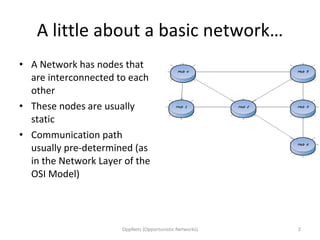
A little about a basic network… A Network has nodes that are interconnected to each other These nodes are usually static Communication path usually pre-determined (as in the Network Layer of the OSI Model) OppNets (Opportunistic Networks)
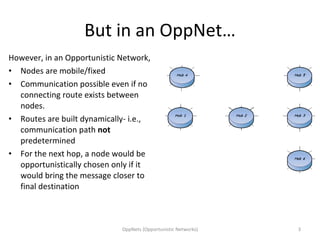
But in an OppNet… However, in an Opportunistic Network, Nodes are mobile/fixed Communication possible even if no connecting route exists between nodes. Routes are built dynamically- i.e., communication path  not  predetermined For the next hop, a node would be opportunistically chosen only if it would bring the message closer to final destination OppNets (Opportunistic Networks)
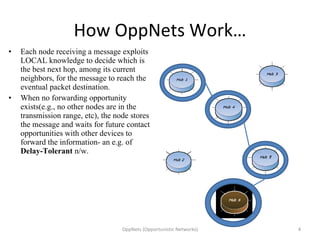
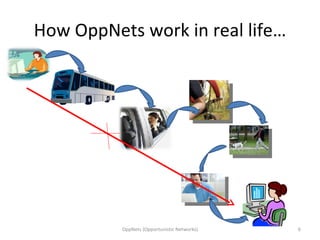
How OppNets Work… Each node receiving a message exploits LOCAL knowledge to decide which is the best next hop, among its current neighbors, for the message to reach the eventual packet destination. When no forwarding opportunity exists(e.g., no other nodes are in the transmission range, etc), the node stores the message and waits for future contact opportunities with other devices to forward the information- an e.g. of  Delay-Tolerant  n/w. OppNets (Opportunistic Networks)
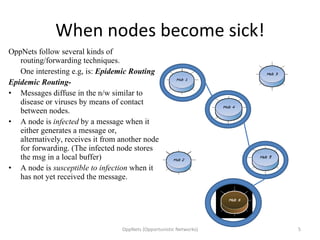
When nodes become sick! OppNets follow several kinds of routing/forwarding techniques.  One interesting e.g, is:  Epidemic Routing Epidemic Routing- Messages diffuse in the n/w similar to disease or viruses by means of contact between nodes. A node is  infected  by a message when it either generates a message or, alternatively, receives it from another node for forwarding. (The infected node stores the msg in a local buffer) A node is  susceptible to infection  when it has not yet received the message. OppNets (Opportunistic Networks)
How OppNets work in real life… OppNets (Opportunistic Networks)
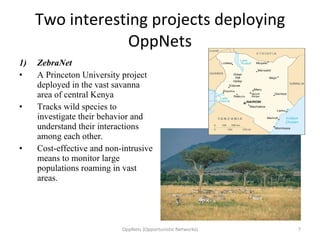
Two interesting projects deploying OppNets ZebraNet A Princeton University project deployed in the vast savanna area of central Kenya Tracks wild species to investigate their behavior and understand their interactions among each other. Cost-effective and non-intrusive means to monitor large populations roaming in vast areas.  OppNets (Opportunistic Networks)
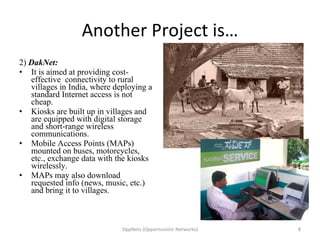
Another Project is… 2)  DakNet: It is aimed at providing cost-effective  connectivity to rural villages in India, where deploying a standard Internet access is not cheap. Kiosks are built up in villages and are equipped with digital storage and short-range wireless communications.  Mobile Access Points (MAPs) mounted on buses, motorcycles, etc., exchange data with the kiosks wirelessly. MAPs may also download requested info (news, music, etc.) and bring it to villages.  OppNets (Opportunistic Networks)
References Images from Google.com Lucia Pelusi, A. Passarella, Marco Conti, “Opportunistic Networking: Data Forwarding in Disconnected Mobile Ad Hoc Networks”, IEEE Communications Magazine, Nov, 2006, pp. 134-141. OppNets (Opportunistic Networks)
No Questions?!  OppNets (Opportunistic Networks)

Opportunistic Networking

  • 1.
  • 2.
    A little abouta basic network… A Network has nodes that are interconnected to each other These nodes are usually static Communication path usually pre-determined (as in the Network Layer of the OSI Model) OppNets (Opportunistic Networks)
  • 3.
    But in anOppNet… However, in an Opportunistic Network, Nodes are mobile/fixed Communication possible even if no connecting route exists between nodes. Routes are built dynamically- i.e., communication path not predetermined For the next hop, a node would be opportunistically chosen only if it would bring the message closer to final destination OppNets (Opportunistic Networks)
  • 4.
    How OppNets Work…Each node receiving a message exploits LOCAL knowledge to decide which is the best next hop, among its current neighbors, for the message to reach the eventual packet destination. When no forwarding opportunity exists(e.g., no other nodes are in the transmission range, etc), the node stores the message and waits for future contact opportunities with other devices to forward the information- an e.g. of Delay-Tolerant n/w. OppNets (Opportunistic Networks)
  • 5.
    When nodes becomesick! OppNets follow several kinds of routing/forwarding techniques. One interesting e.g, is: Epidemic Routing Epidemic Routing- Messages diffuse in the n/w similar to disease or viruses by means of contact between nodes. A node is infected by a message when it either generates a message or, alternatively, receives it from another node for forwarding. (The infected node stores the msg in a local buffer) A node is susceptible to infection when it has not yet received the message. OppNets (Opportunistic Networks)
  • 6.
    How OppNets workin real life… OppNets (Opportunistic Networks)
  • 7.
    Two interesting projectsdeploying OppNets ZebraNet A Princeton University project deployed in the vast savanna area of central Kenya Tracks wild species to investigate their behavior and understand their interactions among each other. Cost-effective and non-intrusive means to monitor large populations roaming in vast areas. OppNets (Opportunistic Networks)
  • 8.
    Another Project is…2) DakNet: It is aimed at providing cost-effective connectivity to rural villages in India, where deploying a standard Internet access is not cheap. Kiosks are built up in villages and are equipped with digital storage and short-range wireless communications. Mobile Access Points (MAPs) mounted on buses, motorcycles, etc., exchange data with the kiosks wirelessly. MAPs may also download requested info (news, music, etc.) and bring it to villages. OppNets (Opportunistic Networks)
  • 9.
    References Images fromGoogle.com Lucia Pelusi, A. Passarella, Marco Conti, “Opportunistic Networking: Data Forwarding in Disconnected Mobile Ad Hoc Networks”, IEEE Communications Magazine, Nov, 2006, pp. 134-141. OppNets (Opportunistic Networks)
  • 10.
    No Questions?! OppNets (Opportunistic Networks)