Multifocus Image Fusion Based on NSCT and Focused Area
Detection
ABSTRACT:
To overcome the difficulties of sub-band coefficients selection in multiscale
transform domain-based image fusion and solve the problem of block effects
suffered by spatial domain-based image fusion, this paper presents a novel hybrid
multifocus image fusion method. First, the source multifocus images are
decomposed using the nonsubsampled contourlet transform (NSCT). The low-
frequency sub-band coefficients are fused by the sum-modified-Laplacian-based
local visual contrast, whereas the high-frequency sub-band coefficients are fused
by the local Log-Gabor energy. The initial fused image is subsequently
reconstructed based on the inverse NSCT with the fused coefficients. Second, after
analyzing the similarity between the previous fused image and the source images,
the initial focus area detection map is obtained, which is used for achieving the
decision map obtained by employing a mathematical morphology postprocessing
technique. Finally, based on the decision map, the final fused image is obtained by
selecting the pixels in the focus areas and retaining the pixels in the focus region
boundary as their corresponding pixels in the initial fused image. Experimental
results demonstrate that the proposed method is better than various existing
transform-based fusion methods, including gradient pyramid transform, discrete
wavelet transform, NSCT, and a spatial-based method, in terms of both subjective
and objective evaluations.
EXISTING SYSTEM:
 The importance of image fusion in current image processing systems is
increasing, primarily because of the increased number and variety of image
acquisition techniques. The purpose of image fusion is to combine different
images from several sensors or the same sensor at different times to create a
new image that will be more accurate and comprehensive and, thus, more
suitable for a human operator or other image processing tasks.
 Currently, image fusion technology has been widely used in digital imaging,
remote sensing, biomedical imaging, computer vision, and so on. The MST-
based image fusion method can significantly enhance the visual effect, but in
the focus area of the source image, clarity of the fused image will have
different degrees of loss. That is because, in the process of Multi-scale
decomposition and reconstruction, improper selection of fusion rules often
causes the loss of useful information in the sourceimage.
DISADVANTAGES OF EXISTING SYSTEM:
 Loss of useful information.
PROPOSED SYSTEM:
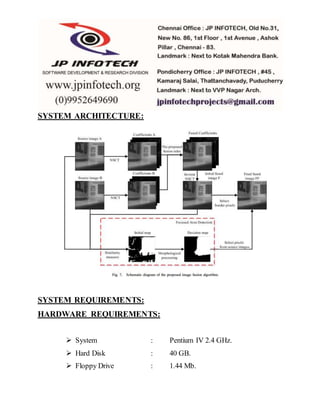
 This paper proposes a novel image fusion framework for multi-focus
images, which relies on the NSCT domain and focused area detection. The
process offusion is divided into two stages: initial fusion and final fusion.
 In the process of initial fusion, the SML based local visual contrast rule and
local Log-Gabor energy rule are selected as the fusion scheme for low- and
high-frequency coefficients of the NSCT domain, respectively. For fusing
the low-frequency coefficients, the model of the SML based local visual
contrast is used. Using this model, the contrast representation are selected
from low frequency coefficients and combined into the fused one. The Log-
Gabor Energy in NSCT domain is proposed and used to combine high-
frequency coefficients. The main benefit of Log-Gabor Energy is that it
selects and combines the most prominent edge and texture information
contained in the high frequency coefficients.
 Based on the result of initial fused image, morphological opening and
closing are employed for post-processing to generate a fusion decision
diagram. According to the fusion decision diagram, pixels of the source
image and the initial fusion image are selected to obtain the final fusion
image.
 Further, the proposed method can provide a better performance than the
current fusion methods whatever the source images are clean or noisy.
ADVANTAGES OF PROPOSED SYSTEM:
 This method, which synthesizes the advantages of both the transform-
based and spatial-based methods, not only overcomes the defects of MST-
based methods, but also eliminates “blockeffect”.
SYSTEM ARCHITECTURE:
SYSTEM REQUIREMENTS:
HARDWARE REQUIREMENTS:
 System : Pentium IV 2.4 GHz.
 Hard Disk : 40 GB.
 Floppy Drive : 1.44 Mb.
 Monitor : 15 VGA Colour.
 Mouse : Logitech.
 Ram : 512 Mb.
SOFTWARE REQUIREMENTS:
 Operating system : Windows XP/7.
 Coding Language : MATLAB
 Tool : MATLAB R2013A
REFERENCE:
Yong Yang, Member, IEEE, Song Tong, Shuying Huang, and Pan Lin,
“Multifocus Image Fusion Based on NSCT and Focused Area Detection”, IEEE
SENSORSJOURNAL, VOL. 15, NO. 5, MAY 2015.

Multifocus image fusion based on nsct

  • 1.
    Multifocus Image FusionBased on NSCT and Focused Area Detection ABSTRACT: To overcome the difficulties of sub-band coefficients selection in multiscale transform domain-based image fusion and solve the problem of block effects suffered by spatial domain-based image fusion, this paper presents a novel hybrid multifocus image fusion method. First, the source multifocus images are decomposed using the nonsubsampled contourlet transform (NSCT). The low- frequency sub-band coefficients are fused by the sum-modified-Laplacian-based local visual contrast, whereas the high-frequency sub-band coefficients are fused by the local Log-Gabor energy. The initial fused image is subsequently reconstructed based on the inverse NSCT with the fused coefficients. Second, after analyzing the similarity between the previous fused image and the source images, the initial focus area detection map is obtained, which is used for achieving the decision map obtained by employing a mathematical morphology postprocessing technique. Finally, based on the decision map, the final fused image is obtained by selecting the pixels in the focus areas and retaining the pixels in the focus region boundary as their corresponding pixels in the initial fused image. Experimental results demonstrate that the proposed method is better than various existing transform-based fusion methods, including gradient pyramid transform, discrete
  • 2.
    wavelet transform, NSCT,and a spatial-based method, in terms of both subjective and objective evaluations. EXISTING SYSTEM:  The importance of image fusion in current image processing systems is increasing, primarily because of the increased number and variety of image acquisition techniques. The purpose of image fusion is to combine different images from several sensors or the same sensor at different times to create a new image that will be more accurate and comprehensive and, thus, more suitable for a human operator or other image processing tasks.  Currently, image fusion technology has been widely used in digital imaging, remote sensing, biomedical imaging, computer vision, and so on. The MST- based image fusion method can significantly enhance the visual effect, but in the focus area of the source image, clarity of the fused image will have different degrees of loss. That is because, in the process of Multi-scale decomposition and reconstruction, improper selection of fusion rules often causes the loss of useful information in the sourceimage.
  • 3.
    DISADVANTAGES OF EXISTINGSYSTEM:  Loss of useful information. PROPOSED SYSTEM:  This paper proposes a novel image fusion framework for multi-focus images, which relies on the NSCT domain and focused area detection. The process offusion is divided into two stages: initial fusion and final fusion.  In the process of initial fusion, the SML based local visual contrast rule and local Log-Gabor energy rule are selected as the fusion scheme for low- and high-frequency coefficients of the NSCT domain, respectively. For fusing the low-frequency coefficients, the model of the SML based local visual contrast is used. Using this model, the contrast representation are selected from low frequency coefficients and combined into the fused one. The Log- Gabor Energy in NSCT domain is proposed and used to combine high- frequency coefficients. The main benefit of Log-Gabor Energy is that it selects and combines the most prominent edge and texture information contained in the high frequency coefficients.  Based on the result of initial fused image, morphological opening and closing are employed for post-processing to generate a fusion decision
  • 4.
    diagram. According tothe fusion decision diagram, pixels of the source image and the initial fusion image are selected to obtain the final fusion image.  Further, the proposed method can provide a better performance than the current fusion methods whatever the source images are clean or noisy. ADVANTAGES OF PROPOSED SYSTEM:  This method, which synthesizes the advantages of both the transform- based and spatial-based methods, not only overcomes the defects of MST- based methods, but also eliminates “blockeffect”.
  • 5.
    SYSTEM ARCHITECTURE: SYSTEM REQUIREMENTS: HARDWAREREQUIREMENTS:  System : Pentium IV 2.4 GHz.  Hard Disk : 40 GB.  Floppy Drive : 1.44 Mb.
  • 6.
     Monitor :15 VGA Colour.  Mouse : Logitech.  Ram : 512 Mb. SOFTWARE REQUIREMENTS:  Operating system : Windows XP/7.  Coding Language : MATLAB  Tool : MATLAB R2013A REFERENCE: Yong Yang, Member, IEEE, Song Tong, Shuying Huang, and Pan Lin, “Multifocus Image Fusion Based on NSCT and Focused Area Detection”, IEEE SENSORSJOURNAL, VOL. 15, NO. 5, MAY 2015.