
Newer
Anti Diabetic Drugs
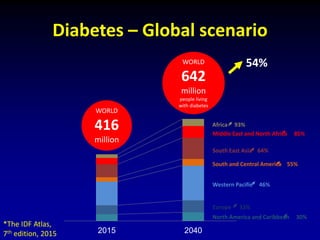
Diabetes – Global scenario
2015 2040
WORLD
416
million
WORLD
642
million
people living
with diabetes
Middle East and North Africa 85%
South East Asia 64%
South and Central America 55%
Western Pacific 46%
North America and Caribbean 30%
Europe 33%
Africa 93%
54%
*The IDF Atlas,
7th edition, 2015
Diabetes – Indian scenario
2014 2030
INDIA
67
million
INDIA
87
million
people living
with diabetes
*Diabetes Res Clin Pract
2010;87:4-14.
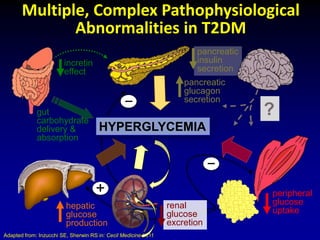
peripheral
glucose
uptake
hepatic
glucose
production
pancreatic
insulin
secretion
pancreatic
glucagon
secretion
gut
carbohydrate
delivery &
absorption
incretin
effect
HYPERGLYCEMIA
?
Adapted from: Inzucchi SE, Sherwin RS in: Cecil Medicine 2011
Multiple, Complex Pathophysiological
Abnormalities in T2DM
_
_
+
renal
glucose
excretion
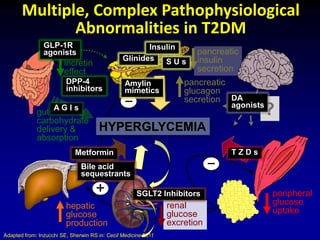
peripheral
glucose
uptake
hepatic
glucose
production
pancreatic
insulin
secretion
pancreatic
glucagon
secretion
gut
carbohydrate
delivery &
absorption
incretin
effect
HYPERGLYCEMIA
?
_
_
+
renal
glucose
excretion
DA
agonists
T Z D sMetformin
S U sGlinides
DPP-4
inhibitors
GLP-1R
agonists
A G I s
Amylin
mimetics
Insulin
Bile acid
sequestrants
SGLT2 Inhibitors
Multiple, Complex Pathophysiological
Abnormalities in T2DM
Adapted from: Inzucchi SE, Sherwin RS in: Cecil Medicine 2011
OADs
• Insulin Secretagogues
– Sulphonylureas – Glibenclamide, Glicliazide, Glipizide, Glimepiride
– Non SU secretagogues – Repaglinide, Nateglinide
• Insulin Sensitizers
– Biguanides – Metformin, Phenformin
– Thiazolidinediones– Pioglitazone, Rosiglitazone
• Alpha-Glucosidase Inhibitors: Acarbose, Voglibose, Miglitol
• DPP-4 Inhibitors: Sitagliptin, Vildagliptin, Saxagliptin, Linagliptin
• SGLT 2 Inhibitors: Empagliflozin, Canagliflozin, Dapagliflozin
• Others: Pramlintide, Bromocriptine, Colesevelam
• Insulins
– Ultrashort acting: Glulisine, Aspart, Lispro
– Short acting: Regular Insulin
– Intermediate acting: NPH
– Long acting: Glargine, Degludec, Detemer
• GLP-1 analogues: Exenatine, Lixisenatide, Liraglutide
Injectables
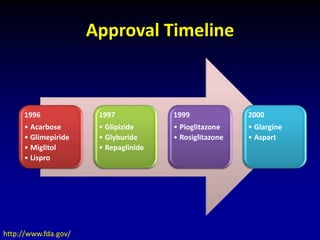
Approval Timeline
1996
• Acarbose
• Glimepiride
• Miglitol
• Lispro
1997
• Glipizide
• Glyburide
• Repaglinide
1999
• Pioglitazone
• Rosiglitazone
2000
• Glargine
• Aspart
http://www.fda.gov/
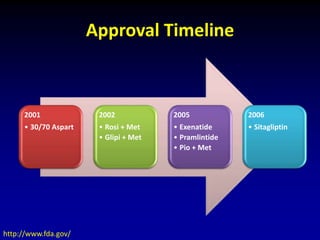
Approval Timeline
2001
• 30/70 Aspart
2002
• Rosi + Met
• Glipi + Met
2005
• Exenatide
• Pramlintide
• Pio + Met
2006
• Sitagliptin
http://www.fda.gov/
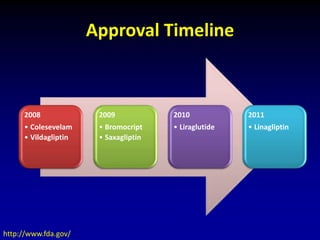
Approval Timeline
2008
• Colesevelam
• Vildagliptin
2009
• Bromocript
• Saxagliptin
2010
• Liraglutide
2011
• Linagliptin
http://www.fda.gov/
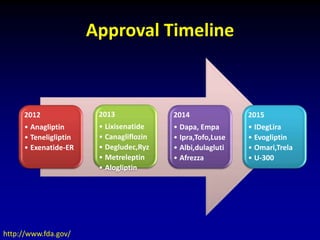
Approval Timeline
2012
• Anagliptin
• Teneligliptin
• Exenatide-ER
2013
• Lixisenatide
• Canagliflozin
• Degludec,Ryz
• Metreleptin
• Alogliptin
2014
• Dapa, Empa
• Ipra,Tofo,Luse
• Albi,dulagluti
• Afrezza
2015
• IDegLira
• Evogliptin
• Omari,Trela
• U-300
http://www.fda.gov/
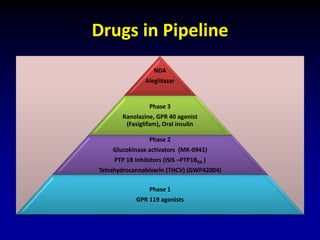
Drugs in Pipeline
NDA
Aleglitazar
Phase 3
Ranolazine, GPR 40 agonist
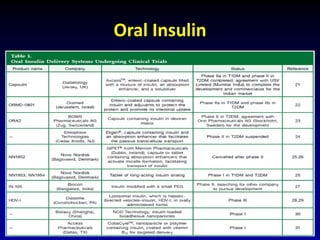
(Fasiglifam), Oral insulin
Phase 2
Glucokinase activators (MK-0941)
PTP 1B Inhibitors (ISIS –PTP1BRX )
Tetrahydrocannabivarin (THCV) (GWP42004)
Phase 1
GPR 119 agonists
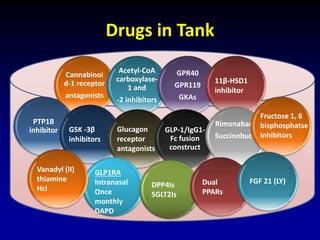
Drugs in Tank
Cannabinoi
d-1 receptor
antagonists
Acetyl-CoA
carboxylase-
1 and
-2 inhibitors
GPR40
GPR119
GKAs
11β-HSD1
inhibitor
PTP1B
inhibitor GSK -3β
inhibitors
Glucagon
receptor
antagonists
GLP-1/IgG1-
Fc fusion
construct
Rimonabant
Succinobuco
GLP1RA
Intranasal
Once
monthly
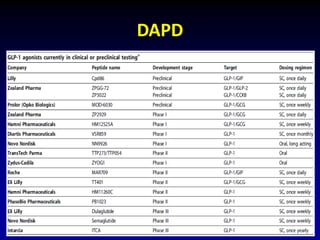
DAPD
DPP4Is
SGLT2Is
Dual
PPARs
FGF 21 (LY)
Vanadyl (II)
thiamine
Hcl
Fructose 1, 6
bisphosphatse
inhibitors
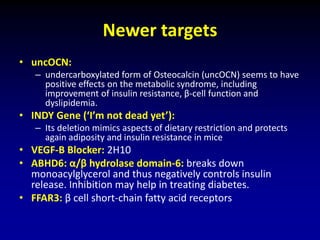
Newer targets
• uncOCN:
– undercarboxylated form of Osteocalcin (uncOCN) seems to have
positive effects on the metabolic syndrome, including
improvement of insulin resistance, β-cell function and
dyslipidemia.
• INDY Gene (ā€˜I’m not dead yet’):
– Its deletion mimics aspects of dietary restriction and protects
again adiposity and insulin resistance in mice
• VEGF-B Blocker: 2H10
• ABHD6: α/β hydrolase domain-6: breaks down
monoacylglycerol and thus negatively controls insulin
release. Inhibition may help in treating diabetes.
• FFAR3: β cell short-chain fatty acid receptors
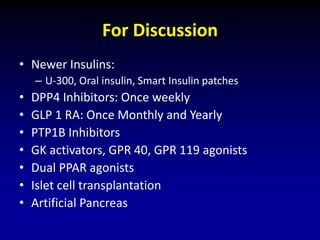
For Discussion
• Newer Insulins:
– U-300, Oral insulin, Smart Insulin patches
• DPP4 Inhibitors: Once weekly
• GLP 1 RA: Once Monthly and Yearly
• PTP1B Inhibitors
• GK activators, GPR 40, GPR 119 agonists
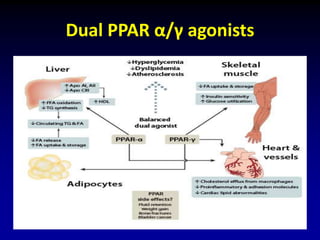
• Dual PPAR agonists
• Islet cell transplantation
• Artificial Pancreas
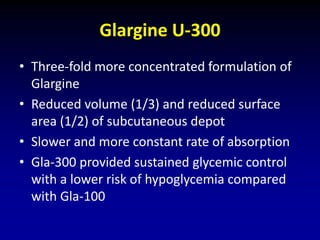
Glargine U-300
• Three-fold more concentrated formulation of
Glargine
• Reduced volume (1/3) and reduced surface
area (1/2) of subcutaneous depot
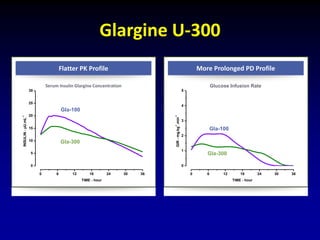
• Slower and more constant rate of absorption
• Gla-300 provided sustained glycemic control
with a lower risk of hypoglycemia compared
with Gla-100
Glargine U-300
Flatter PK Profile More Prolonged PD Profile
0 6 12 18 24 30 36
0
1
2
3
4
5
DOSE 0.4 U.kg
-1
U300
U100
GIR-mg.kg
-1
.min
-1
TIME - hour
Glucose Infusion Rate
0 6 12 18 24 30 36
0
5
10
15
20
25
30
LLOQ 5.02 µU.mL
-1
SC INJECTION
INSULIN-µU.mL
-1
TIME - hour
U100 0.4 U.kg
-1
U300 0.4 U.kg
-1
LOESS 0.15
Gla-300
Gla-100
Serum Insulin Glargine Concentration
Gla-300
Gla-100
Oral Insulin
DAPD
DAPD
PTP 1B Inhibitors
PTP 1B Inhibitors
PTP 1B Inhibitors
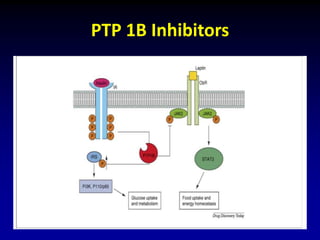
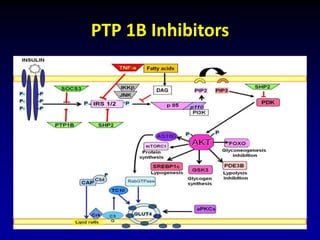
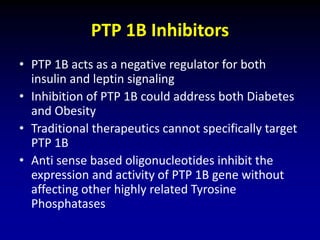
• PTP 1B acts as a negative regulator for both
insulin and leptin signaling
• Inhibition of PTP 1B could address both Diabetes
and Obesity
• Traditional therapeutics cannot specifically target
PTP 1B
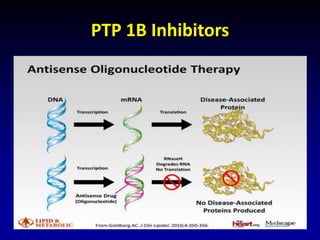
• Anti sense based oligonucleotides inhibit the
expression and activity of PTP 1B gene without
affecting other highly related Tyrosine
Phosphatases
PTP 1B Inhibitors
PTP 1B Inhibitors
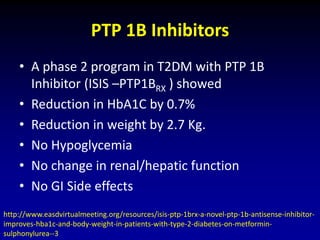
• A phase 2 program in T2DM with PTP 1B
Inhibitor (ISIS –PTP1BRX ) showed
• Reduction in HbA1C by 0.7%
• Reduction in weight by 2.7 Kg.
• No Hypoglycemia
• No change in renal/hepatic function
• No GI Side effects
http://www.easdvirtualmeeting.org/resources/isis-ptp-1brx-a-novel-ptp-1b-antisense-inhibitor-
improves-hba1c-and-body-weight-in-patients-with-type-2-diabetes-on-metformin-
sulphonylurea--3
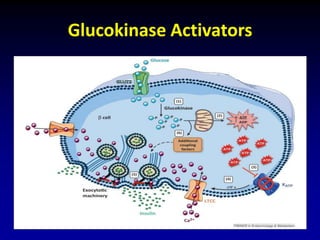
Glucokinase Activators
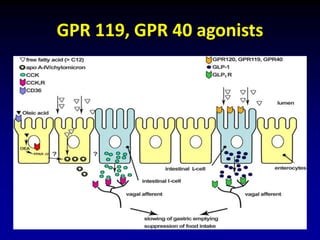
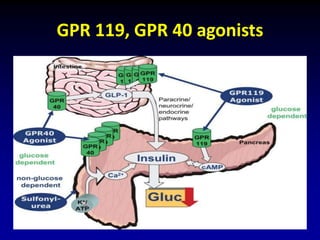
GPR 119, GPR 40 agonists
Dual PPAR α/γ agonists
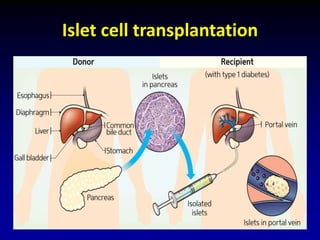
Islet cell transplantation
• The two types of pancreatic islet transplantation are
– auto-transplantation
– allo-transplantation
• Pancreatic islet auto-transplantation
– Performed following total pancreatectomy
– Patients with type 1 diabetes cannot receive pancreatic islet
auto-transplantation.
– The surgeon first removes the pancreas and then extracts and
purifies islets from the pancreas.
– Within hours, the islets are infused through a catheter into the
patient's liver.
– Goal is to give the body healthy islets to make insulin.
Islet cell transplantation
• Pancreatic islet allo-transplantation
– islets from the pancreas of a deceased organ donor are
purified, processed, and transferred into another person.
– Currently experimental (not approved for therapeutic
purpose).
– Transplant patients typically receive two infusions with an
average of 400,000 to 500,000 islets per infusion.
– In most cases, islet cells from several different donors are
needed.
– The islets are infused, into the portal vein.
– Pancreatic islet allo-transplantation is performed in type 1
diabetes.
Islet cell transplantation
• Islet transplantation is an efficient treatment for
type 1 diabetes
• Beta cells are removed from a donor's
pancreas and transferred into a person
with diabetes.
• As with all organ and tissue transplants, rejection
of the donor cells is the greatest challenge.
• Patients have to be on immuno-suppresssants life
long, which may increase chances of infection
and some cancers.
Islet cell transplantation
• Recent data of a 5-yr post transplant followup:
– Prevent severe hypoglycemia in nearly 90% of the
recipients at five years
– HbA1c levels were ≤ 7% in 84% of patients at 12
months, 70% of patients at 48 months, and 59% of
patients at 60 months after islet transplantation.
Diabetes Care. 2015 Sep;38(9):1714-22
Artificial Pancreas
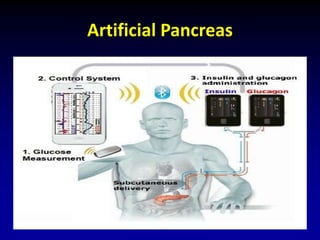
• Artificial/Bionic pancreas:
– Dual-chambered
– Two separate pumps for delivering both insulin and
glucagon,
– A continuous glucose monitor (CGM)
– A control algorithm built into an iPhone app.
• The bihormonal "bionic pancreas" continues to
perform well in clinical trials and could reach the
US market by 2018.
Artificial Pancreas
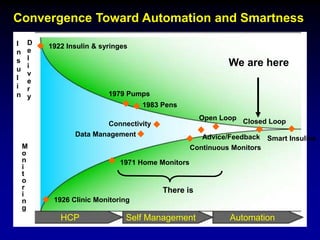
Convergence Toward Automation and Smartness
I
n
s
u
l
i
n
M
o
n
i
t
o
r
i
n
g
HCP Self Management Automation
1922 Insulin & syringes
1979 Pumps
1983 Pens
Connectivity
1926 Clinic Monitoring
1971 Home Monitors
Data Management Advice/Feedback
Open Loop
D
e
l
i
v
e
r
y
Closed Loop
We are here
Continuous Monitors
There is
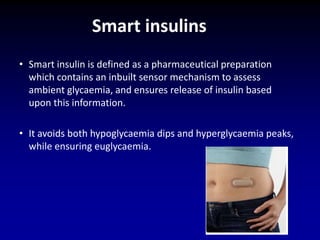
Smart Insulins
• Smart insulin is defined as a pharmaceutical preparation
which contains an inbuilt sensor mechanism to assess
ambient glycaemia, and ensures release of insulin based
upon this information.
• It avoids both hypoglycaemia dips and hyperglycaemia peaks,
while ensuring euglycaemia.
Smart insulins
• As long back as 1979, Brownlee and Cerami reported the
synthesis of a stable, biologically active glycosylated insulin
derivative, combined with a lectin called concavalin A.
• This synthetic ligand-bound insulin releases active insulin in a
quantity proportional to the amount of glucose present
• This approach, though currently far from perfection, has the
potential to revolutionize insulin therapy.
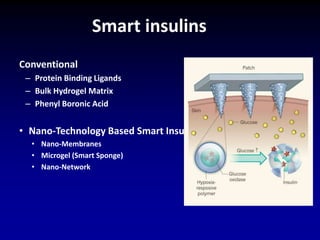
Smart insulins
Conventional
– Protein Binding Ligands
– Bulk Hydrogel Matrix
– Phenyl Boronic Acid
• Nano-Technology Based Smart Insulins
• Nano-Membranes
• Microgel (Smart Sponge)
• Nano-Network
Smart insulins
• Every smart insulin has to have two components:
• a glucose sensor, and
• an insulin delivery device.
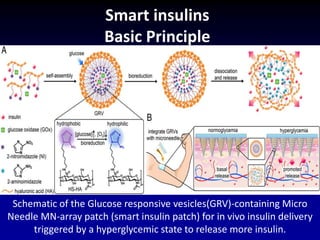
• In the recently developed nano — network, exposure to
hyperglycaemia leads to enzymatic catalysis of insulin
nanoparticles, and allows release of insulin.
• The duration of action of these nano-networks is 10 days in
type 1 mice, and has been noted to last up to 14 days in
some animal subjects.
Smart insulins
Basic Principle
Smart insulins
Basic Principle
Schematic of the Glucose responsive vesicles(GRV)-containing Micro
Needle MN-array patch (smart insulin patch) for in vivo insulin delivery
triggered by a hyperglycemic state to release more insulin.
• The field seems to be a promising area for innovation.
• Patents have been drawn for glucose-responsive insulin
formulations, including microgels, amphilic hydrogels, and thermo-
sensitive polymers.
• Patents are also filed for implantation insulin-producing devices
which contain porcine endocrine cells contained in immuno-
isolatory membranes.
• All these research paths have potential to reach fructification.
• Insulin secretion follows a nonlinear pattern.
• Any inorganic or non-living insulin secretory apparatus would not
be able to replicate the work of an organic, live islet of
Langerhans.
Smart insulins
Pros and cons
• Recently an autonomous drug release system, based upon
chemo-mechanical energy conversions, which works as an
Organic Engine, without using external energy source, has
been demonstrated to provide glycaemic control.
• This innovation has helped allay these fears. Smart insulins
are an exciting development in diabetes care.
• While it may take many years before they reach clinical use,
recent advances in the area suggest that smart insulins will
soon become a reality.
Smart insulins
THANK YOU