HEALTHCARE
INFORMATION
TECHNOLOGY
Dr.Vijay bhushanam MD
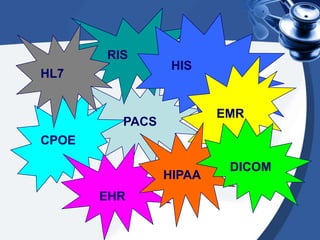
CPOE
HL7
EMR
HIS
EHR
RIS
HIPAA
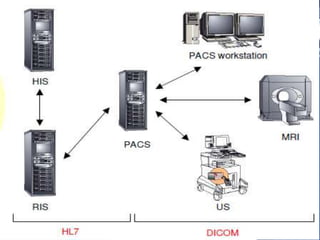
PACS
DICOM
Objectives
• Evolution of Healthcare IT and its
advantages
• Terminology
• Components of Hospital Information
System
• Standards Organizations
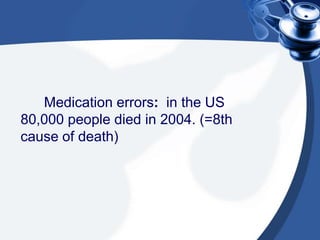
Medication errors: in the US
80,000 people died in 2004. (=8th
cause of death)
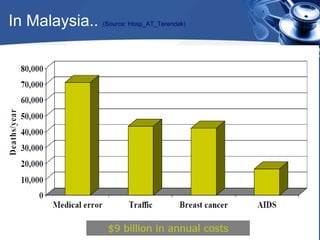
In Malaysia.. (Source: Hosp_AT_Terendak)
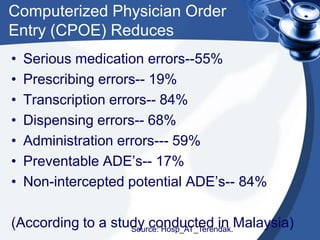
Computerized Physician Order
Entry (CPOE) Reduces
• Serious medication errors--55%
• Prescribing errors-- 19%
• Transcription errors-- 84%
• Dispensing errors-- 68%
• Administration errors--- 59%
• Preventable ADE’s-- 17%
• Non-intercepted potential ADE’s-- 84%
(According to a study conducted in Malaysia)Source: Hosp_AT_Terendak.
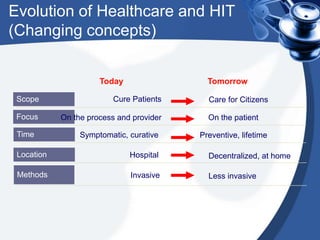
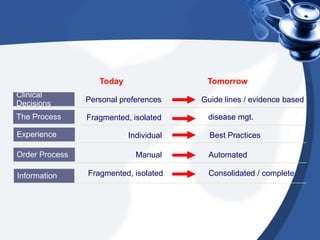
Evolution of Healthcare and HIT
(Changing concepts)
Today Tomorrow
Location Hospital Decentralized, at home
Time Symptomatic, curative Preventive, lifetime
Focus On the process and provider On the patient
Scope Cure Patients Care for Citizens
Methods Invasive Less invasive
Order Process Manual Automated
Experience Individual Best Practices
The Process Fragmented, isolated disease mgt.
Clinical
Decisions Personal preferences Guide lines / evidence based
Information Fragmented, isolated Consolidated / complete
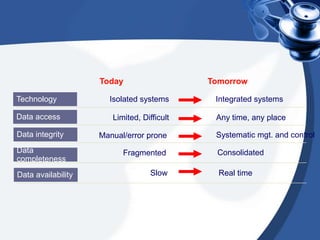
Today Tomorrow
Data
completeness
Fragmented Consolidated
Data integrity Manual/error prone Systematic mgt. and control
Data access Limited, Difficult Any time, any place
Technology Isolated systems Integrated systems
Data availability Slow Real time
Today Tomorrow
Ultimate objective
• Decrease cost
• Increase quality
• Easy to use
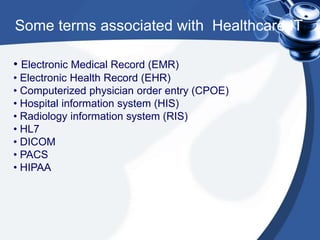
Some terms associated with Healthcare IT
• Electronic Medical Record (EMR)
• Electronic Health Record (EHR)
• Computerized physician order entry (CPOE)
• Hospital information system (HIS)
• Radiology information system (RIS)
• HL7
• DICOM
• PACS
• HIPAA
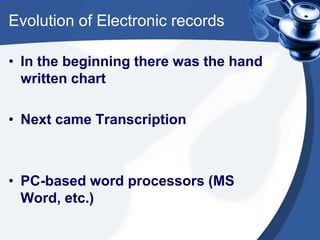
Evolution of Electronic records
• In the beginning there was the hand
written chart
• Next came Transcription
• PC-based word processors (MS
Word, etc.)
Ideal recording system should be
• Easy, legible chart generation
• Reduced burden
• “Real time" Chart generation
• Improved billing
• Expert computer & typing skills not required
• Consistent quality charts
• True database record keeping,
• The ability to automatically bring in past history, saving time &
reducing errors
• Storage of digital multimedia data
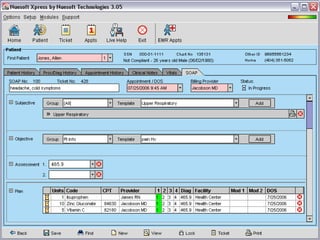
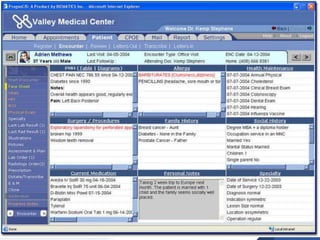
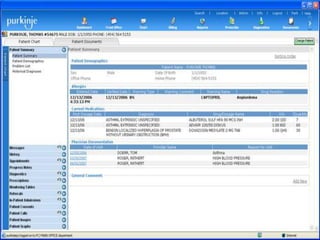
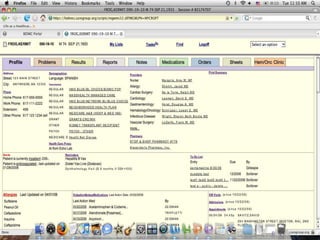
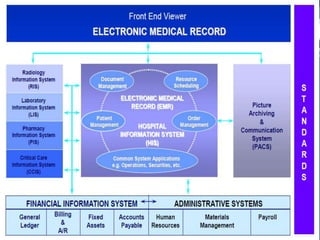
EMR
• EMR is the digital equivalent of the paper patient
chart within a specific provider organization. It is a
comprehensive record of tests, prescriptions,
diagnostic images and the entire patient history
• An EMR system manages patient medical
information created within an individual provider
organization
• It is an application environment composed of the
clinical data repository, clinical decision support,
controlled medical vocabulary, order entry,
computerized provider order entry, pharmacy, and
clinical documentation applications.
• This environment support the patient’s electronic
medical record across inpatient and outpatient
environments, and is used by healthcare
practitioners
• The data in the EMR is the legal record of what
happened to the patient during their encounter at the
CDO and is owned by the CDO.
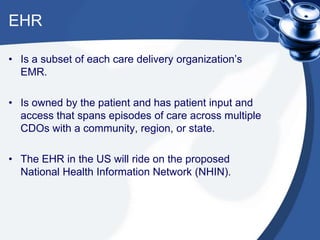
EHR
• Is a subset of each care delivery organization’s
EMR.
• Is owned by the patient and has patient input and
access that spans episodes of care across multiple
CDOs with a community, region, or state.
• The EHR in the US will ride on the proposed
National Health Information Network (NHIN).
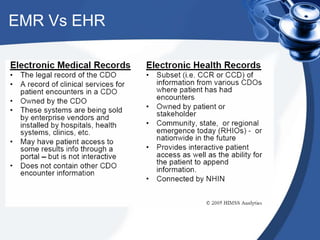
EMR Vs EHR
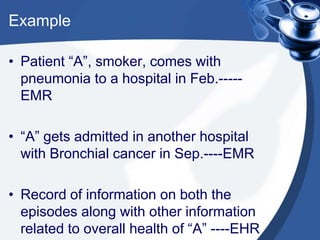
Example
• Patient “A”, smoker, comes with
pneumonia to a hospital in Feb.-----
EMR
• “A” gets admitted in another hospital
with Bronchial cancer in Sep.----EMR
• Record of information on both the
episodes along with other information
related to overall health of “A” ----EHR
Advantages of Electronic records
• Saves lives and reduces costs.
• Computer physician order entry (CPOE) systems
can effectively reduce preventable adverse drug
events.
• Computerized reminders and prompts on disease
management and preventive health guidelines are
very effective.
• Clinical IT tools can improve drug prescribing and
administration.
• Potential to transform care delivery, offering greater
quality, safety, and efficiency
• Many clinical IT benefits such as provider
convenience, patient satisfaction, and improved
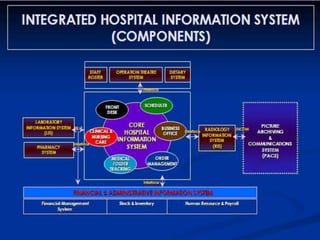
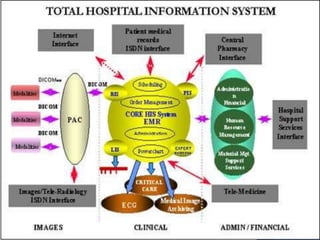
Hospital information system (HIS)
A hospital information system (HIS),
variously also called clinical information
system (CIS) is a comprehensive,
integrated information system designed to
manage the administrative, financial and
clinical aspects of a Hospital
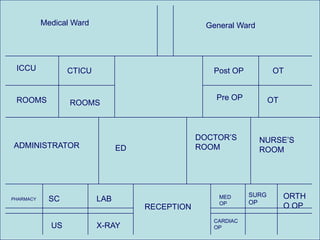
Medical Ward General Ward
ICCU CTICU
ROOMS ROOMS
Post OP
Pre OP
OT
OT
ADMINISTRATOR ED
DOCTOR’S
ROOM
NURSE’S
ROOM
PHARMACY SC
US
LAB
X-RAY
RECEPTION
MED
OP
SURG
OP
ORTH
O OP
CARDIAC
OP
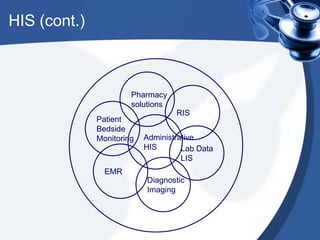
HIS (cont.)
EMR
Lab Data
LIS
RIS
Patient
Bedside
Monitoring
Pharmacy
solutions
Administrative
HIS
Diagnostic
Imaging
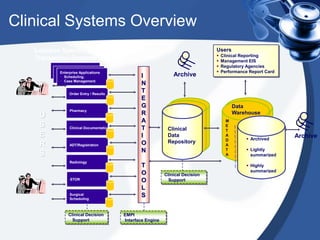
Clinical Systems Overview
Enterprise Applications
 Scheduling,
 Case Management
Users
 Clinical Reporting
 Management EIS
 Regulatory Agencies
 Performance Report Card
Location Specific and Distributed
Transaction Systems
I
N
T
E
G
R
A
T
I
O
N
T
O
O
L
S
U
S
E
R
S
Order Entry / Results
Pharmacy
Clinical Documentation
ADT/Registration
Radiology
STOR
Surgical
Scheduling
Clinical
Data
Repository
M
E
T
A
D
A
T
A
Data
Warehouse
 Archived
 Lightly
summarized
 Highly
summarized
Archive
Archive
Clinical Decision
Support
Clinical Decision
Support
EMPI
Interface Engine
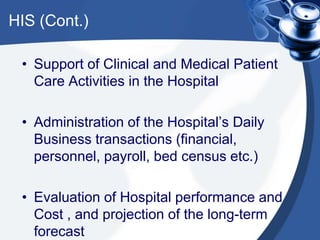
HIS (Cont.)
• Support of Clinical and Medical Patient
Care Activities in the Hospital
• Administration of the Hospital’s Daily
Business transactions (financial,
personnel, payroll, bed census etc.)
• Evaluation of Hospital performance and
Cost , and projection of the long-term
forecast
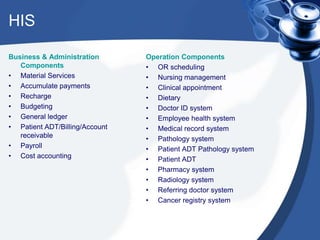
HIS
Business & Administration
Components
• Material Services
• Accumulate payments
• Recharge
• Budgeting
• General ledger
• Patient ADT/Billing/Account
receivable
• Payroll
• Cost accounting
Operation Components
• OR scheduling
• Nursing management
• Clinical appointment
• Dietary
• Doctor ID system
• Employee health system
• Medical record system
• Pathology system
• Patient ADT Pathology system
• Patient ADT
• Pharmacy system
• Radiology system
• Referring doctor system
• Cancer registry system
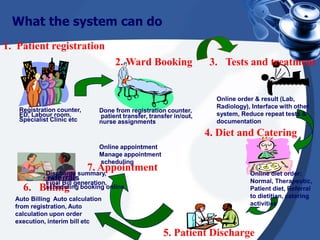
What the system can do
1. Patient registration
2. Ward Booking 3. Tests and treatment
4. Diet and Catering
5. Patient Discharge
6. Billing
Registration counter,
ED, Labour room,
Specialist Clinic etc
Done from registration counter,
patient transfer, transfer in/out,
nurse assignments
Online order & result (Lab,
Radiology), Interface with other
system, Reduce repeat tests &
documentation
Discharge summary,
referrals
Final Bill generation,
scheduling booking online
Auto Billing. Auto calculation
from registration, Auto
calculation upon order
execution, interim bill etc
7. Appointment Online diet order:
Normal, Therapeutic,
Patient diet, Referral
to dietitian, catering
activities
Online appointment
Manage appointment
scheduling
Advantages of Hospital Information
Systems
• Increased time nurses spend with patients
• Access to information
• Improved quality of documentation
• Improved quality of patient care
• Increased nursing productivity
• Improved communications Reduced medication errors
• Reduced hospital costs
• Increased nurse job satisfaction
• Development of a common clinical database
• Improved patient's perception of care
• Enhanced ability to track patient's record
• Enhanced ability to recruit and retain staff
• Improved hospital image
Standards Developing Organizations
(SDO’s) operating in the HIT
Several models of standardization for
electronic medical records and electronic
medical record exchange have been
proposed and multiple organizations formed
to help evaluate and implement them.
Standards and Reference models are
important for interoperability and help to
improve Information Quality (accuracy,
completeness, timeliness, relevancy,
accessibility,... )
Organizations
• CHI (Consolidated Health Informatics Initiative) - recommends
nationwide federal adoption of EHR standards in the US
• CCHIT (Certification Commission for Healthcare Information
Technology) - a private, not-for-profit organization that
evaluates and develops the certification for EHRs and
interoperable EHR networks (USA)
• IHE (Integrating the Healthcare Enterprise) - a consortium,
sponsored by the HIMSS, that recommends integration of EHR
data communicated using the HL7 and DICOM protocols
• ANSI (American National Standards Institute) - accredits
standards in the United States and co-ordinates US standards
with international standards
Organizations (cont.)
• HIMSS (Healthcare Information and Management
Systems Society)- an international trade organization
of health informatics technology providers
• American Society for Testing and Materials - a
consortium of scientists and engineers that
recommends international standards
• Open EHR - promotes open source EHR guidelines
• Canada Health Infoway - a private, not-for-profit
organization that promotes the development and
adoption of EHRs in Canada
• World Wide Web Consortium (W3C) - promotes
Internet-wide communications standards to prevent
market fragmentation
• Clinical Data Interchange Standards Consortium
(CDISC) - a non-profit organization that develops
platform-independent healthcare data standards
Standards
• HL7 - a standardized messaging and text communications
protocol between hospital and physician record systems,
and between practice management systems
• DICOM - an international communications protocol
standard for representing and transmitting radiology (and
other) image-based data, sponsored by NEMA (National
Electrical Manufacturers Association)
• ANSI X12 (EDI) - transaction protocols used for
transmitting patient data. Popular in the United States for
transmission of billing data.
Standards (cont.)
• CEN - CONTSYS (EN 13940), supports continuity
of care record standardization.
• CEN - HISA (EN 12967), a services standard for
inter-system communication in a clinical
information environment.
• ISO - ISO TC 215 provides international technical
specifications for EHRs.
ISO 18308 describes EHR architectures
• CEN's TC/251 provides EHR standards in Europe.
Focuses on EHR communication and distributed
access
• CEN - EHRcom (EN 13606), communication
standards for EHR information in Europe
HL7
• Health Level Seven (HL7), is an all-volunteer, not-
for-profit organization involved in development of
international healthcare standards. “HL7” is also
used to refer to some of the specific standards
created by the organization (i.e. HL7 v2.x, v3.0,
HL7 etc.).
• It is one of several American National Standards
Institute (ANSI) –accredited Standards Developing
Organizations (SDOs) operating in the healthcare
arena
• Domain is clinical and administrative data
• It provides a framework (and related standards) for
the exchange, integration, sharing and retrieval of
electronic health information
DICOM
• Digital Imaging and Communications in Medicine
• It is a standard for handling, storing, printing, and
transmitting information in medical imaging
• Developed by American College of Radiology
(ACR) and National Electrical Manufacturers
Association (NEMA).
• DICOM files can be exchanged between two
entities that are capable of receiving image and
patient data in DICOM format
• DICOM enables the integration of scanners,
servers, workstations, printers, and network
hardware from multiple manufacturers into a
picture archiving and communication system
(PACS).
PACS
• In medical imaging picture archiving and
communication systems (PACS) are computers
or networks dedicated to the storage, retrieval,
distribution and presentation of images. The
medical images are stored in an independent
format. The most common format for image
storage is DICOM
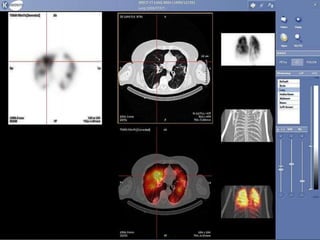
• Most PACSs handle images from various medical
imaging instruments, including ultrasound,
magnetic resonance, PET, computed tomography,
endoscopy, mammograms, etc
HIPAA
• The Health Insurance Portability and
Accountability Act (HIPAA)
• Title I of HIPAA protects health insurance coverage
• Title II of HIPAA, known as the Administrative
Simplification (AS) provisions, requires the
establishment of national standards for electronic
health care transactions
• It also address the security and privacy of health
data
• The standards are meant to improve the efficiency
and effectiveness of the nation's health care system
by encouraging the widespread use of electronic
data interchange in the US health care system.
Summary
• Healthcare transformation is to increase quality,
decrease cost.
• Common terms EMR, HER,HIS, HL7,
DICOM,PACS, HIPAA,, RIS etc.
• HIS is very effective
• Standards organizations develop the frame work
and integration guidelines for HIT tools
THANK YOU