Presented By
Ashish
M Pharm(Pharmacology)
Classification of antithyroid drugs
Preparation and doses of
antithyroid drugs
Therapeutic uses of antithyroid
drugs
 These are drugs used to lower the
functional capacity of the hyperactive
thyroid gland.
 Thyrotoxicosis is due to excessive
secretion of thyroid hormones.
Graves’ disease( Autoimmune disorder
) and toxic nodular goiter are two
main causes.
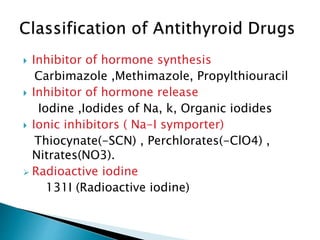
 Inhibitor of hormone synthesis
Carbimazole ,Methimazole, Propylthiouracil
 Inhibitor of hormone release
Iodine ,Iodides of Na, k, Organic iodides
 Ionic inhibitors ( Na-I symporter)
Thiocynate(-SCN) , Perchlorates(-ClO4) ,
Nitrates(NO3).
 Radioactive iodine
131I (Radioactive iodine)
 Methimazole (carbimazole)
 Propyl thiouracil (PTU)
These 2 are the major drugs used in the treatment of
thyrotoxicosis (Carbimazoles converted to
methimazole in vivo).
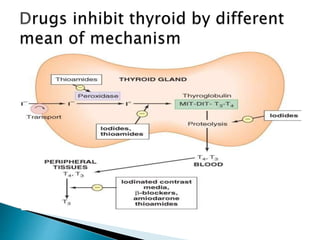
MOA:- These drug inhibit thyroid hormone production
by-
a) inhibiting thyroid peroxidase which is required in
intrathyroidal oxidation of Iodide.
b) by inhibiting the iodination of tyrosine
c) by inhibiting coupling of MIT and DIT to form
thyroid hormones
d) propylthiouracil also inhibits peripheral conversion
of T4 TO T3 by inhibiting DID -5 enzyme
- More potent given in a single daily dose
- Completely absorbed & readily accumulated
in thyroid gland
- Excreted in urine but slower than PTU.
- Has some immunosuppressive action leading
to decrease in serum TSH receptor
antibodies.
- Has little effect on conversion of T4 to T3 -
Crosses placenta.
- It is excreted in breast milk.
 Dose is 10 times that of Carbimazole given
every 6-8 hrs.
 Rapidly absorbed with a bioavailability of 50-
80 %
 Excreted in urine within 24 hrs
 Has no immunosuppressive effect
 It inhibits the peripheral conversion of T4 to
T3
 Crosses placenta less readily, Preferable in
pregnancy
 Not excreted in breast milk
 These drugs controls thyrotoxicosis in both
graves disease and toxic nodular goiter.
 Clinical improvement starts after 1-2 weeks
Propylthiouracil : 50-150mg followed by 25-
50 mg for maintenance
Carbimazole: 5-15 mg initially
Maintenance dose is 2.5-10mg daily in 1-2
divided doses
 Iodide salts inhibit organification (iodination
of tyrosine) and thyroid hormone release.
 These salts also decrease the size &
vascularity of the hyperplastic thyroid gland.
 Since iodide salts inhibit the release as well
as the synthesis of the hormone, their onset
of action occurs rapidly within 2-7 days.
 The usual forms of this drug are lugol's
solution(iodine & potassium iodide) and
saturated solution of potassium iodide.
 Lugols solution: 5% iodine in 10% KI solution :
5- 10drops/day
 It suppresses the conversion of T4 to
T3 via 5’ deiodinase in the liver,
kidney and other peripheral tissues.
 Ipodate has proved very useful in
rapidly reducing T3 concentration in
thyrotoxicosis (in thyroid storm)
 Radioactive iodine is administered as sodium
salt of 131I dissolved in water and taken orally.
 131I emits x ray as well as β particles
 131I is concentrated by thyroid, incorporated in
colloid- emits radiation from within the follicles.
 β particles penetrates around 0.5-2 mm of
tissue
 Thyroid follicular cells are affected within
undergoes pyknosis and necrosis followed by
fibrosis when a large dose is given.
 Most common indication is hyperthyroidism
due to Graves’ disease or Toxic nodular
goitre.
 Avg therapeutic dose is 3-6 milli curie
 Response is slow , it starts after 2 weeks and
gradually increases reaching peak at 3
month.
 Certain monovalent anions inhibit iodide
trapping by NIS into thyroid because of
similar hydrates ionic size.
 T4 ,T3 synthesized is inhibited.
 They are very toxic so they are not used.
 eg: Thiocyanates, Perchlorates
 Propranolol is used to rapidly alleviate
manifestations of thyrotoxicosis that are due
to sympathetic overactivity
eg: Palpitation, tremor, nervousness and
sweating.
 In addition they reduce peripheral conversion
of T4 to T3
A presentation on anti thyroid drugs

A presentation on anti thyroid drugs

  • 1.
  • 2.
    Classification of antithyroiddrugs Preparation and doses of antithyroid drugs Therapeutic uses of antithyroid drugs
  • 3.
     These aredrugs used to lower the functional capacity of the hyperactive thyroid gland.  Thyrotoxicosis is due to excessive secretion of thyroid hormones. Graves’ disease( Autoimmune disorder ) and toxic nodular goiter are two main causes.
  • 4.
     Inhibitor ofhormone synthesis Carbimazole ,Methimazole, Propylthiouracil  Inhibitor of hormone release Iodine ,Iodides of Na, k, Organic iodides  Ionic inhibitors ( Na-I symporter) Thiocynate(-SCN) , Perchlorates(-ClO4) , Nitrates(NO3).  Radioactive iodine 131I (Radioactive iodine)
  • 5.
     Methimazole (carbimazole) Propyl thiouracil (PTU) These 2 are the major drugs used in the treatment of thyrotoxicosis (Carbimazoles converted to methimazole in vivo). MOA:- These drug inhibit thyroid hormone production by- a) inhibiting thyroid peroxidase which is required in intrathyroidal oxidation of Iodide. b) by inhibiting the iodination of tyrosine c) by inhibiting coupling of MIT and DIT to form thyroid hormones d) propylthiouracil also inhibits peripheral conversion of T4 TO T3 by inhibiting DID -5 enzyme
  • 7.
    - More potentgiven in a single daily dose - Completely absorbed & readily accumulated in thyroid gland - Excreted in urine but slower than PTU. - Has some immunosuppressive action leading to decrease in serum TSH receptor antibodies. - Has little effect on conversion of T4 to T3 - Crosses placenta. - It is excreted in breast milk.
  • 8.
     Dose is10 times that of Carbimazole given every 6-8 hrs.  Rapidly absorbed with a bioavailability of 50- 80 %  Excreted in urine within 24 hrs  Has no immunosuppressive effect  It inhibits the peripheral conversion of T4 to T3  Crosses placenta less readily, Preferable in pregnancy  Not excreted in breast milk
  • 9.
     These drugscontrols thyrotoxicosis in both graves disease and toxic nodular goiter.  Clinical improvement starts after 1-2 weeks Propylthiouracil : 50-150mg followed by 25- 50 mg for maintenance Carbimazole: 5-15 mg initially Maintenance dose is 2.5-10mg daily in 1-2 divided doses
  • 10.
     Iodide saltsinhibit organification (iodination of tyrosine) and thyroid hormone release.  These salts also decrease the size & vascularity of the hyperplastic thyroid gland.  Since iodide salts inhibit the release as well as the synthesis of the hormone, their onset of action occurs rapidly within 2-7 days.  The usual forms of this drug are lugol's solution(iodine & potassium iodide) and saturated solution of potassium iodide.  Lugols solution: 5% iodine in 10% KI solution : 5- 10drops/day
  • 11.
     It suppressesthe conversion of T4 to T3 via 5’ deiodinase in the liver, kidney and other peripheral tissues.  Ipodate has proved very useful in rapidly reducing T3 concentration in thyrotoxicosis (in thyroid storm)
  • 12.
     Radioactive iodineis administered as sodium salt of 131I dissolved in water and taken orally.  131I emits x ray as well as β particles  131I is concentrated by thyroid, incorporated in colloid- emits radiation from within the follicles.  β particles penetrates around 0.5-2 mm of tissue  Thyroid follicular cells are affected within undergoes pyknosis and necrosis followed by fibrosis when a large dose is given.
  • 13.
     Most commonindication is hyperthyroidism due to Graves’ disease or Toxic nodular goitre.  Avg therapeutic dose is 3-6 milli curie  Response is slow , it starts after 2 weeks and gradually increases reaching peak at 3 month.
  • 14.
     Certain monovalentanions inhibit iodide trapping by NIS into thyroid because of similar hydrates ionic size.  T4 ,T3 synthesized is inhibited.  They are very toxic so they are not used.  eg: Thiocyanates, Perchlorates
  • 15.
     Propranolol isused to rapidly alleviate manifestations of thyrotoxicosis that are due to sympathetic overactivity eg: Palpitation, tremor, nervousness and sweating.  In addition they reduce peripheral conversion of T4 to T3