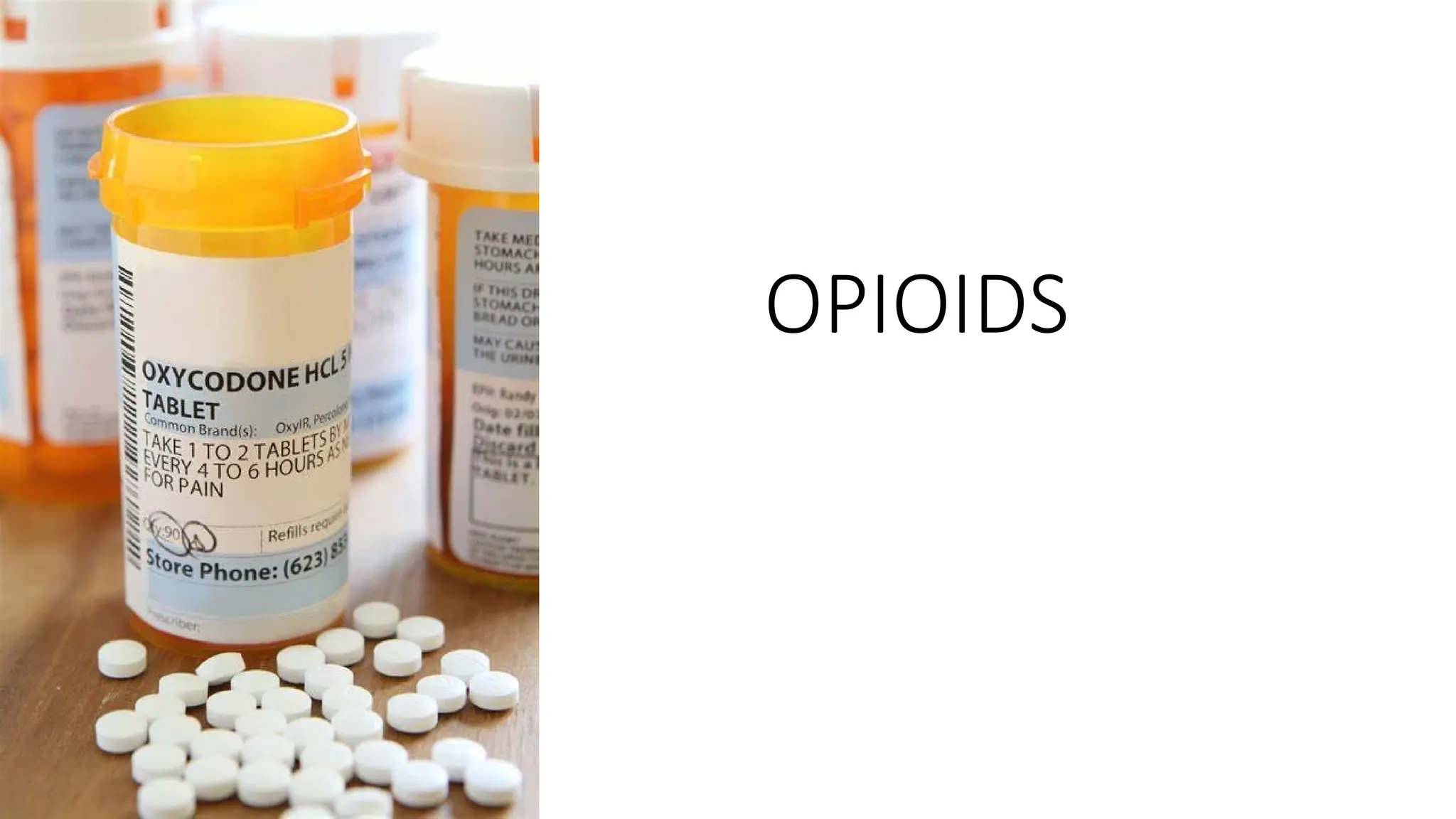
OPIOIDS
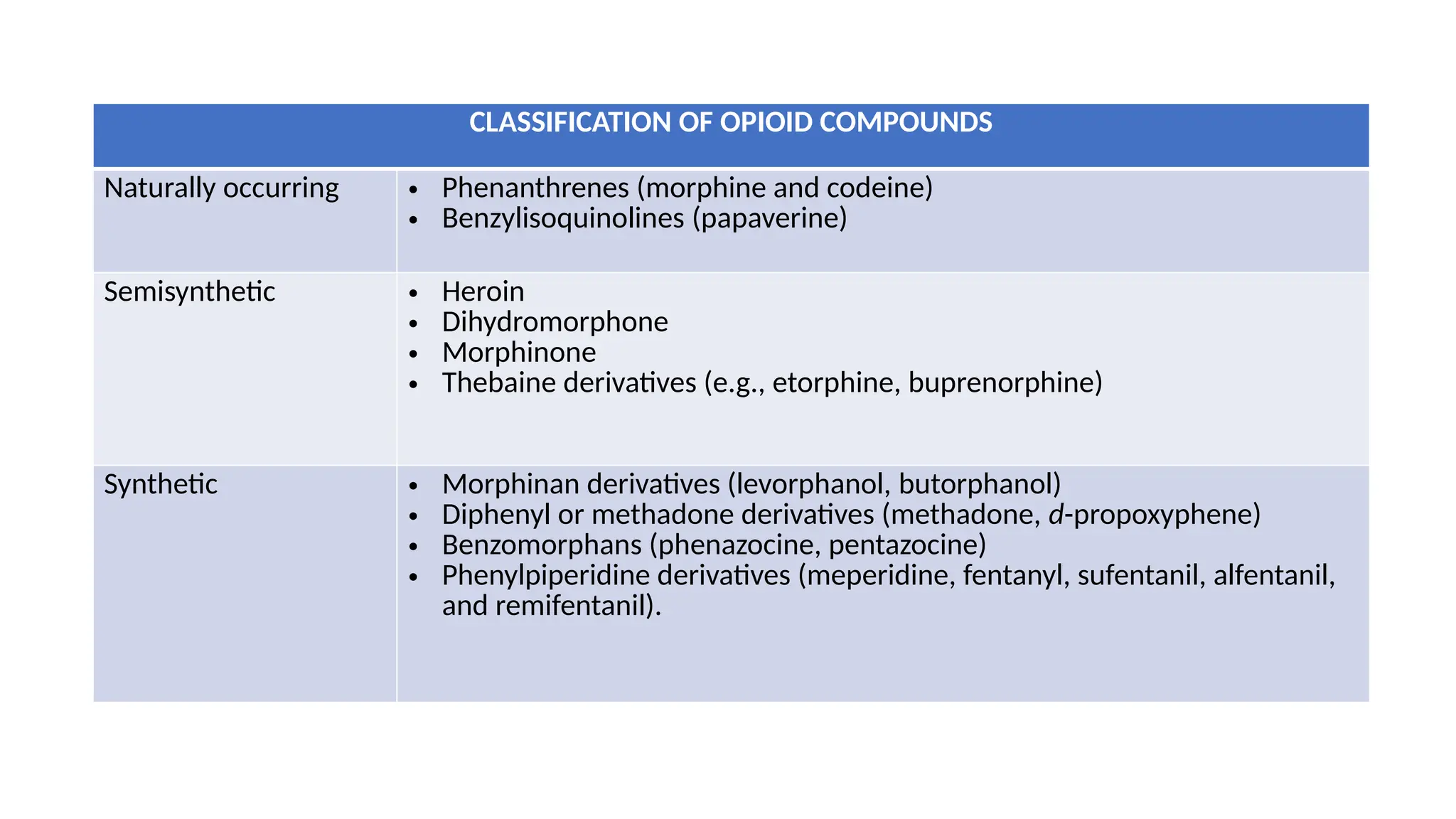
CLASSIFICATION OF OPIOID COMPOUNDS
Naturally occurring • Phenanthrenes (morphine and codeine)
• Benzylisoquinolines (papaverine)
Semisynthetic • Heroin
• Dihydromorphone
• Morphinone
• Thebaine derivatives (e.g., etorphine, buprenorphine)
Synthetic • Morphinan derivatives (levorphanol, butorphanol)
• Diphenyl or methadone derivatives (methadone, d-propoxyphene)
• Benzomorphans (phenazocine, pentazocine)
• Phenylpiperidine derivatives (meperidine, fentanyl, sufentanil, alfentanil,
and remifentanil).
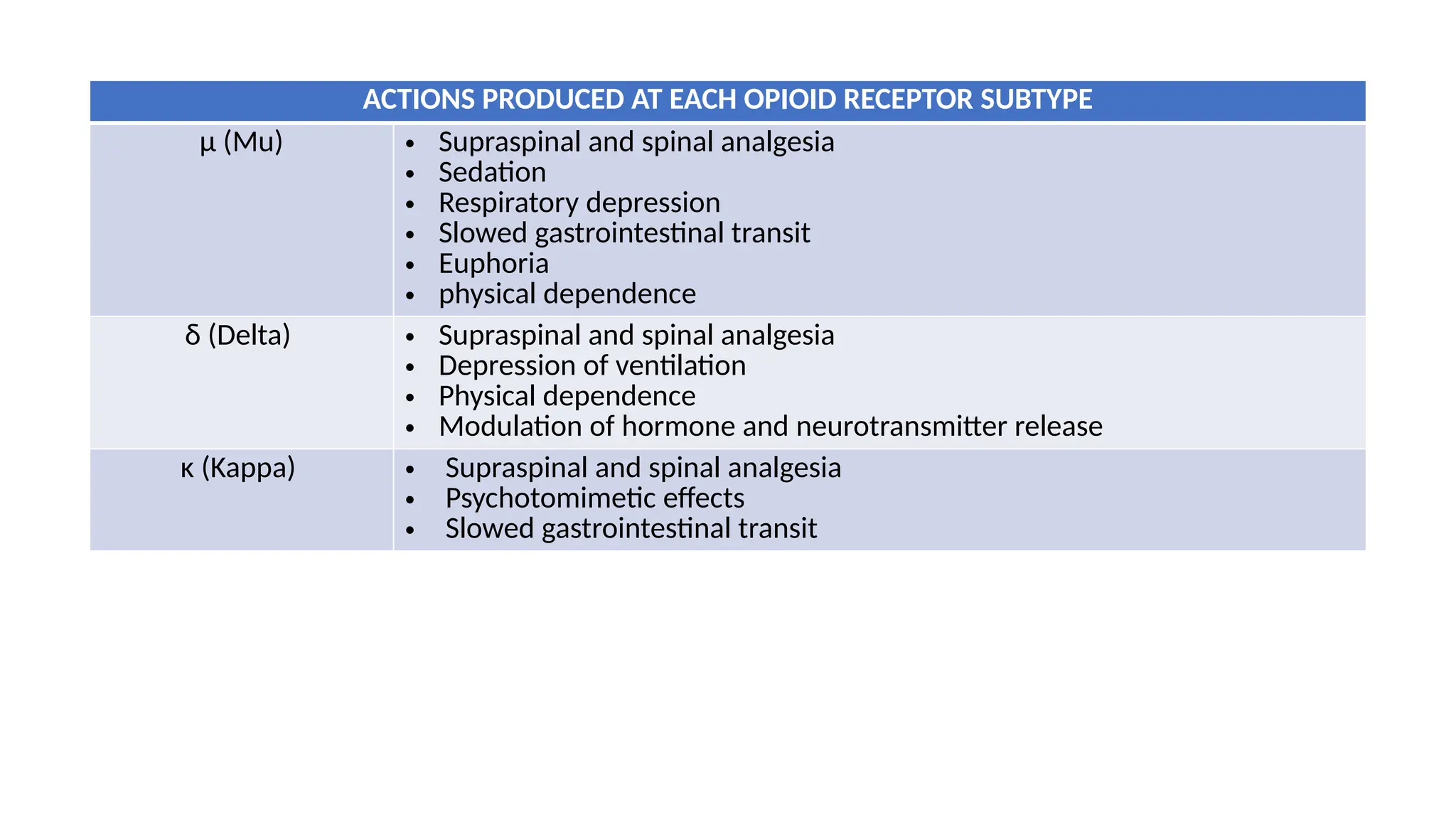
ACTIONS PRODUCED AT EACH OPIOID RECEPTOR SUBTYPE
µ (Mu) • Supraspinal and spinal analgesia
• Sedation
• Respiratory depression
• Slowed gastrointestinal transit
• Euphoria
• physical dependence
δ (Delta) • Supraspinal and spinal analgesia
• Depression of ventilation
• Physical dependence
• Modulation of hormone and neurotransmitter release
κ (Kappa) • Supraspinal and spinal analgesia
• Psychotomimetic effects
• Slowed gastrointestinal transit
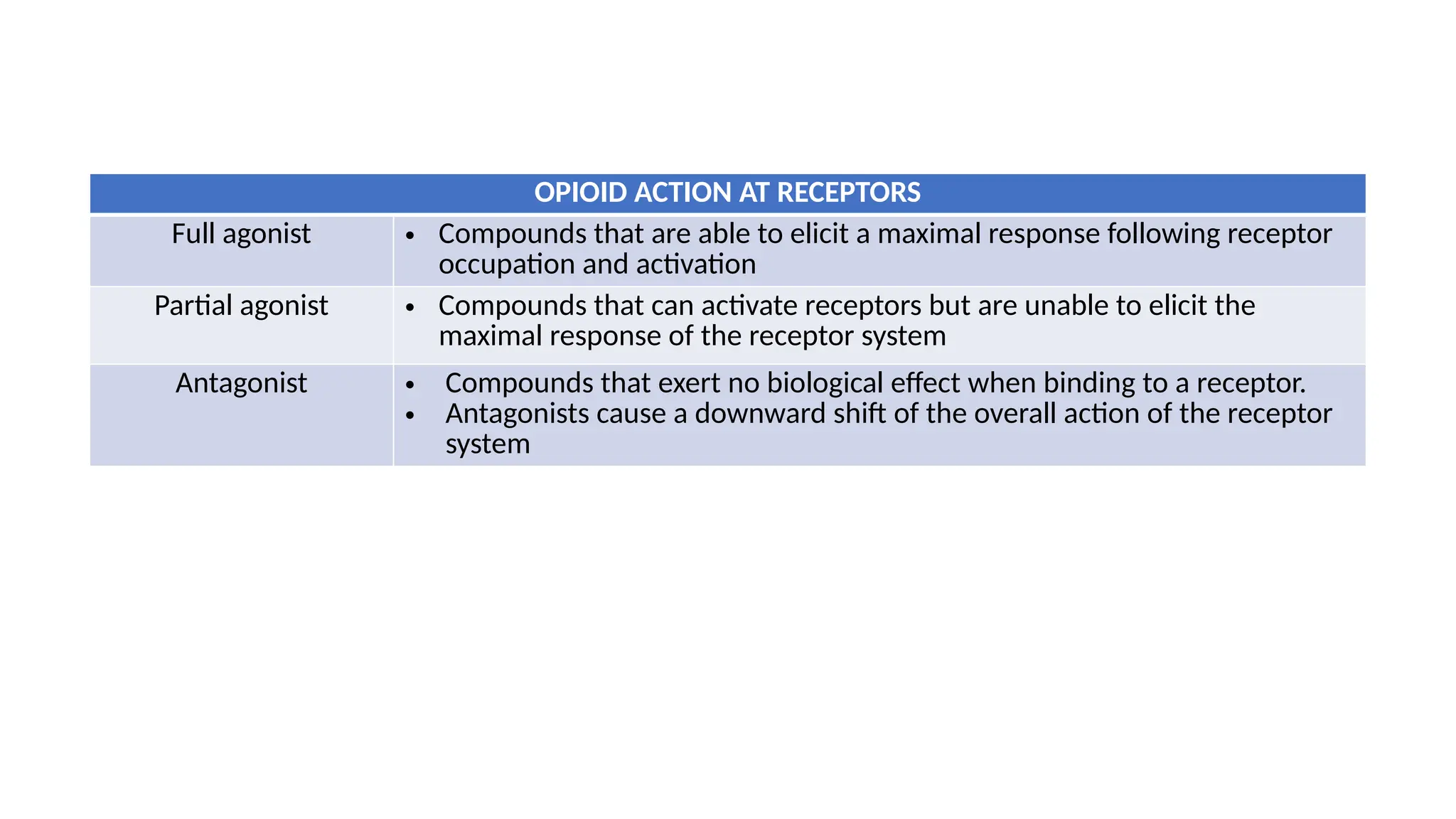
OPIOID ACTION AT RECEPTORS
Full agonist • Compounds that are able to elicit a maximal response following receptor
occupation and activation
Partial agonist • Compounds that can activate receptors but are unable to elicit the
maximal response of the receptor system
Antagonist • Compounds that exert no biological effect when binding to a receptor.
• Antagonists cause a downward shift of the overall action of the receptor
system
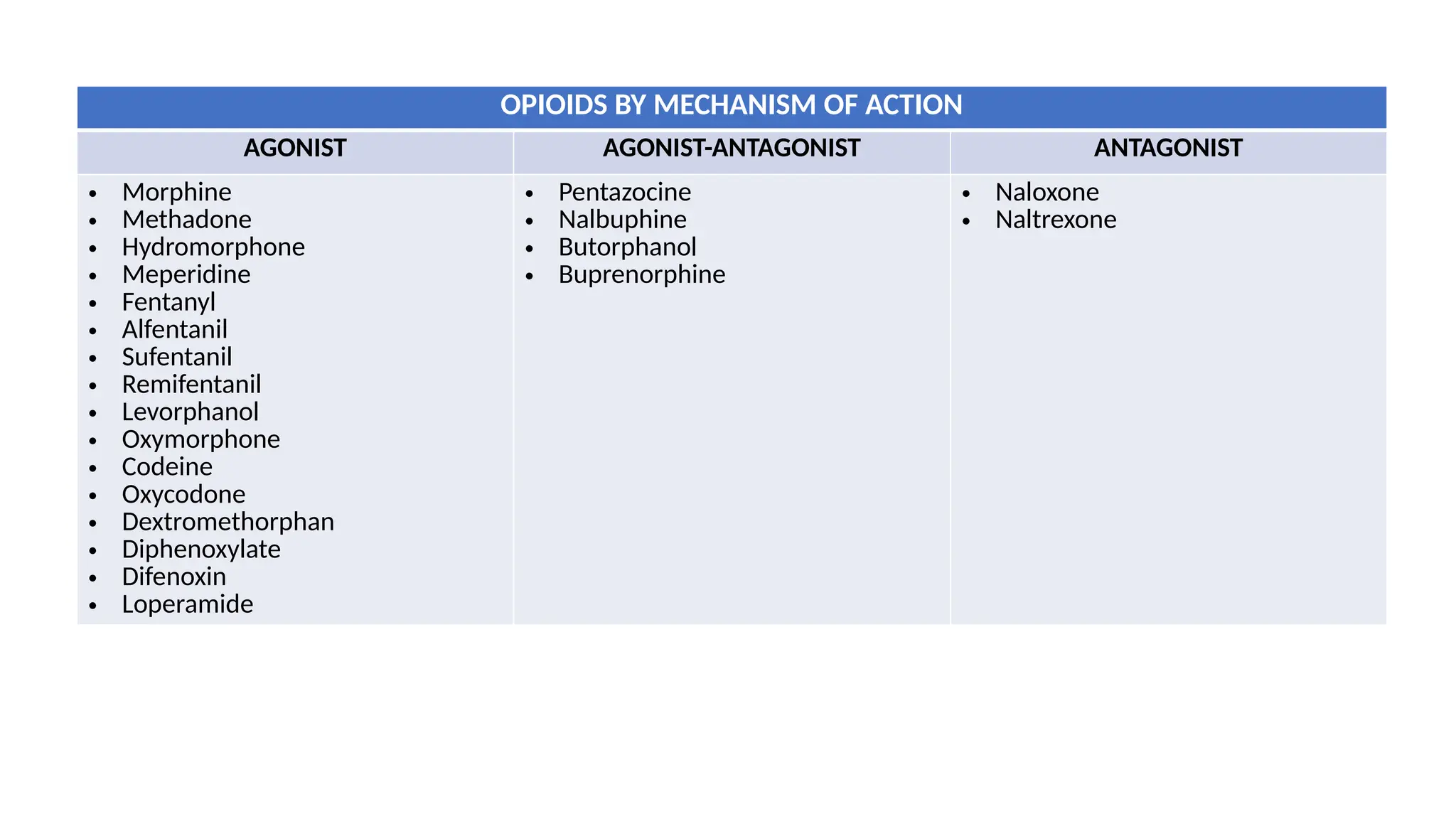
OPIOIDS BY MECHANISM OF ACTION
AGONIST AGONIST-ANTAGONIST ANTAGONIST
• Morphine
• Methadone
• Hydromorphone
• Meperidine
• Fentanyl
• Alfentanil
• Sufentanil
• Remifentanil
• Levorphanol
• Oxymorphone
• Codeine
• Oxycodone
• Dextromethorphan
• Diphenoxylate
• Difenoxin
• Loperamide
• Pentazocine
• Nalbuphine
• Butorphanol
• Buprenorphine
• Naloxone
• Naltrexone
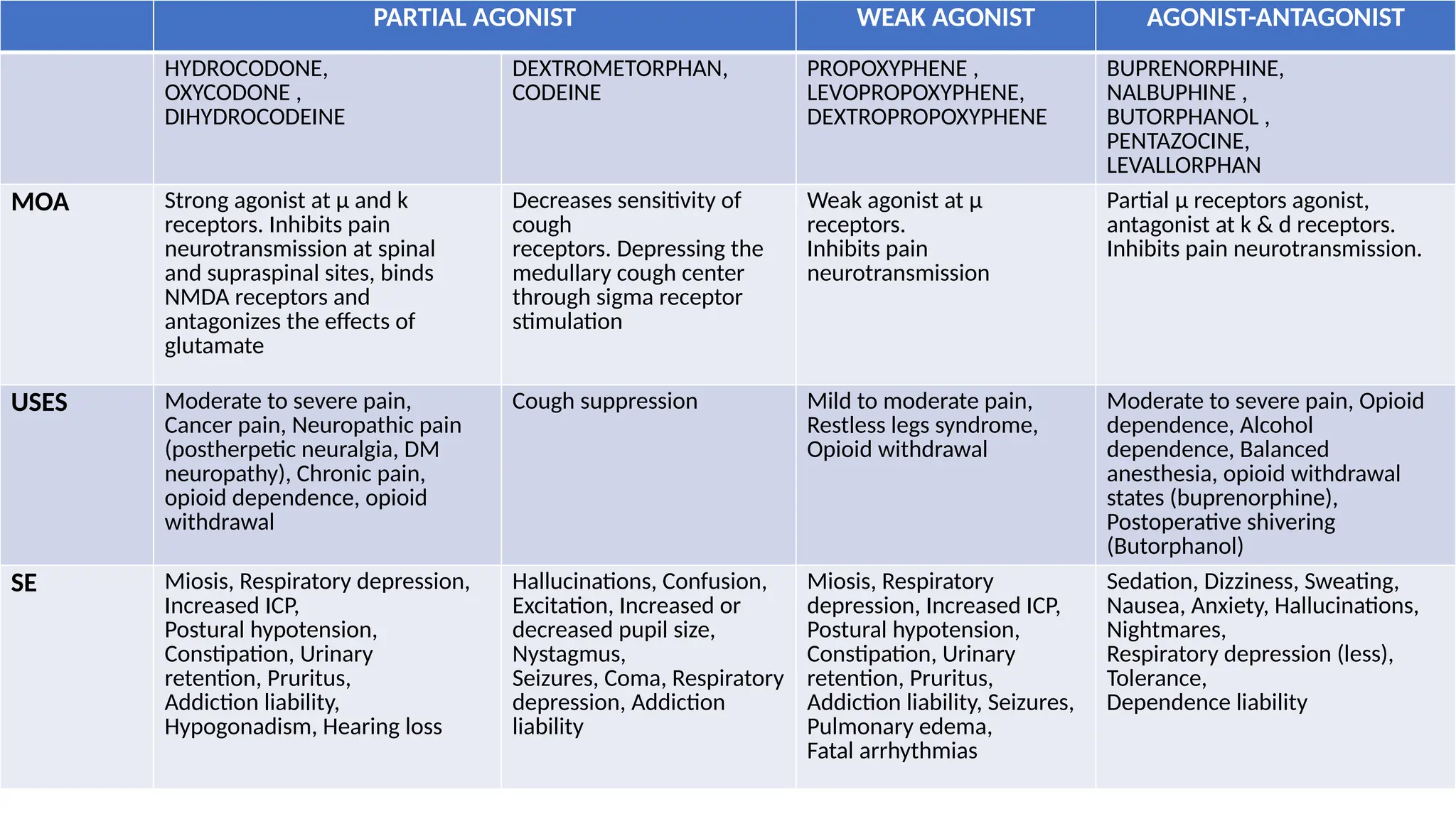
PARTIAL AGONIST WEAK AGONIST AGONIST-ANTAGONIST
HYDROCODONE,
OXYCODONE ,
DIHYDROCODEINE
DEXTROMETORPHAN,
CODEINE
PROPOXYPHENE ,
LEVOPROPOXYPHENE,
DEXTROPROPOXYPHENE
BUPRENORPHINE,
NALBUPHINE ,
BUTORPHANOL ,
PENTAZOCINE,
LEVALLORPHAN
MOA Strong agonist at μ and k
receptors. Inhibits pain
neurotransmission at spinal
and supraspinal sites, binds
NMDA receptors and
antagonizes the effects of
glutamate
Decreases sensitivity of
cough
receptors. Depressing the
medullary cough center
through sigma receptor
stimulation
Weak agonist at μ
receptors.
Inhibits pain
neurotransmission
Partial μ receptors agonist,
antagonist at k & d receptors.
Inhibits pain neurotransmission.
USES Moderate to severe pain,
Cancer pain, Neuropathic pain
(postherpetic neuralgia, DM
neuropathy), Chronic pain,
opioid dependence, opioid
withdrawal
Cough suppression Mild to moderate pain,
Restless legs syndrome,
Opioid withdrawal
Moderate to severe pain, Opioid
dependence, Alcohol
dependence, Balanced
anesthesia, opioid withdrawal
states (buprenorphine),
Postoperative shivering
(Butorphanol)
SE Miosis, Respiratory depression,
Increased ICP,
Postural hypotension,
Constipation, Urinary
retention, Pruritus,
Addiction liability,
Hypogonadism, Hearing loss
Hallucinations, Confusion,
Excitation, Increased or
decreased pupil size,
Nystagmus,
Seizures, Coma, Respiratory
depression, Addiction
liability
Miosis, Respiratory
depression, Increased ICP,
Postural hypotension,
Constipation, Urinary
retention, Pruritus,
Addiction liability, Seizures,
Pulmonary edema,
Fatal arrhythmias
Sedation, Dizziness, Sweating,
Nausea, Anxiety, Hallucinations,
Nightmares,
Respiratory depression (less),
Tolerance,
Dependence liability
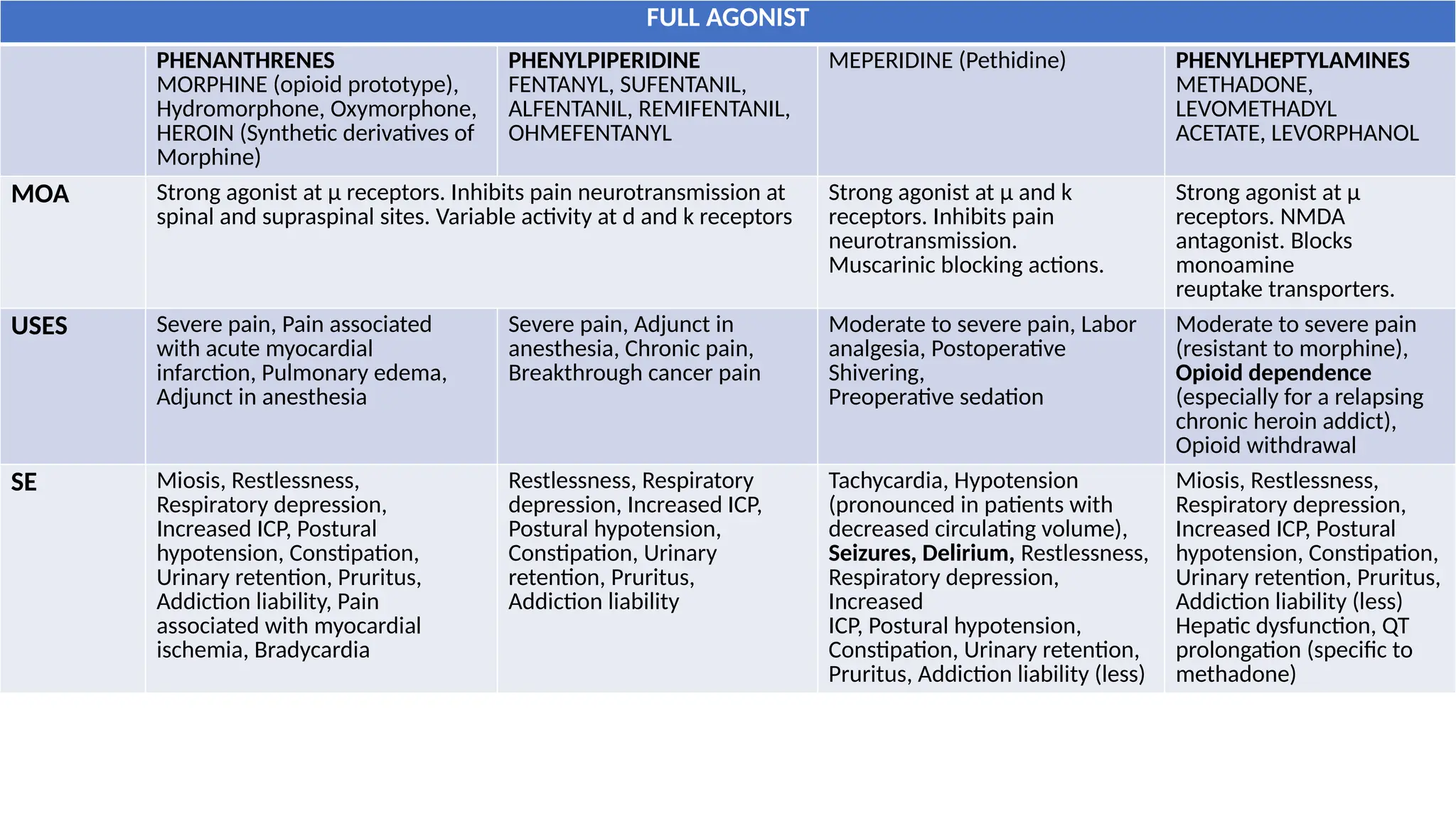
FULL AGONIST
PHENANTHRENES
MORPHINE (opioid prototype),
Hydromorphone, Oxymorphone,
HEROIN (Synthetic derivatives of
Morphine)
PHENYLPIPERIDINE
FENTANYL, SUFENTANIL,
ALFENTANIL, REMIFENTANIL,
OHMEFENTANYL
MEPERIDINE (Pethidine) PHENYLHEPTYLAMINES
METHADONE,
LEVOMETHADYL
ACETATE, LEVORPHANOL
MOA Strong agonist at μ receptors. Inhibits pain neurotransmission at
spinal and supraspinal sites. Variable activity at d and k receptors
Strong agonist at μ and k
receptors. Inhibits pain
neurotransmission.
Muscarinic blocking actions.
Strong agonist at μ
receptors. NMDA
antagonist. Blocks
monoamine
reuptake transporters.
USES Severe pain, Pain associated
with acute myocardial
infarction, Pulmonary edema,
Adjunct in anesthesia
Severe pain, Adjunct in
anesthesia, Chronic pain,
Breakthrough cancer pain
Moderate to severe pain, Labor
analgesia, Postoperative
Shivering,
Preoperative sedation
Moderate to severe pain
(resistant to morphine),
Opioid dependence
(especially for a relapsing
chronic heroin addict),
Opioid withdrawal
SE Miosis, Restlessness,
Respiratory depression,
Increased ICP, Postural
hypotension, Constipation,
Urinary retention, Pruritus,
Addiction liability, Pain
associated with myocardial
ischemia, Bradycardia
Restlessness, Respiratory
depression, Increased ICP,
Postural hypotension,
Constipation, Urinary
retention, Pruritus,
Addiction liability
Tachycardia, Hypotension
(pronounced in patients with
decreased circulating volume),
Seizures, Delirium, Restlessness,
Respiratory depression,
Increased
ICP, Postural hypotension,
Constipation, Urinary retention,
Pruritus, Addiction liability (less)
Miosis, Restlessness,
Respiratory depression,
Increased ICP, Postural
hypotension, Constipation,
Urinary retention, Pruritus,
Addiction liability (less)
Hepatic dysfunction, QT
prolongation (specific to
methadone)
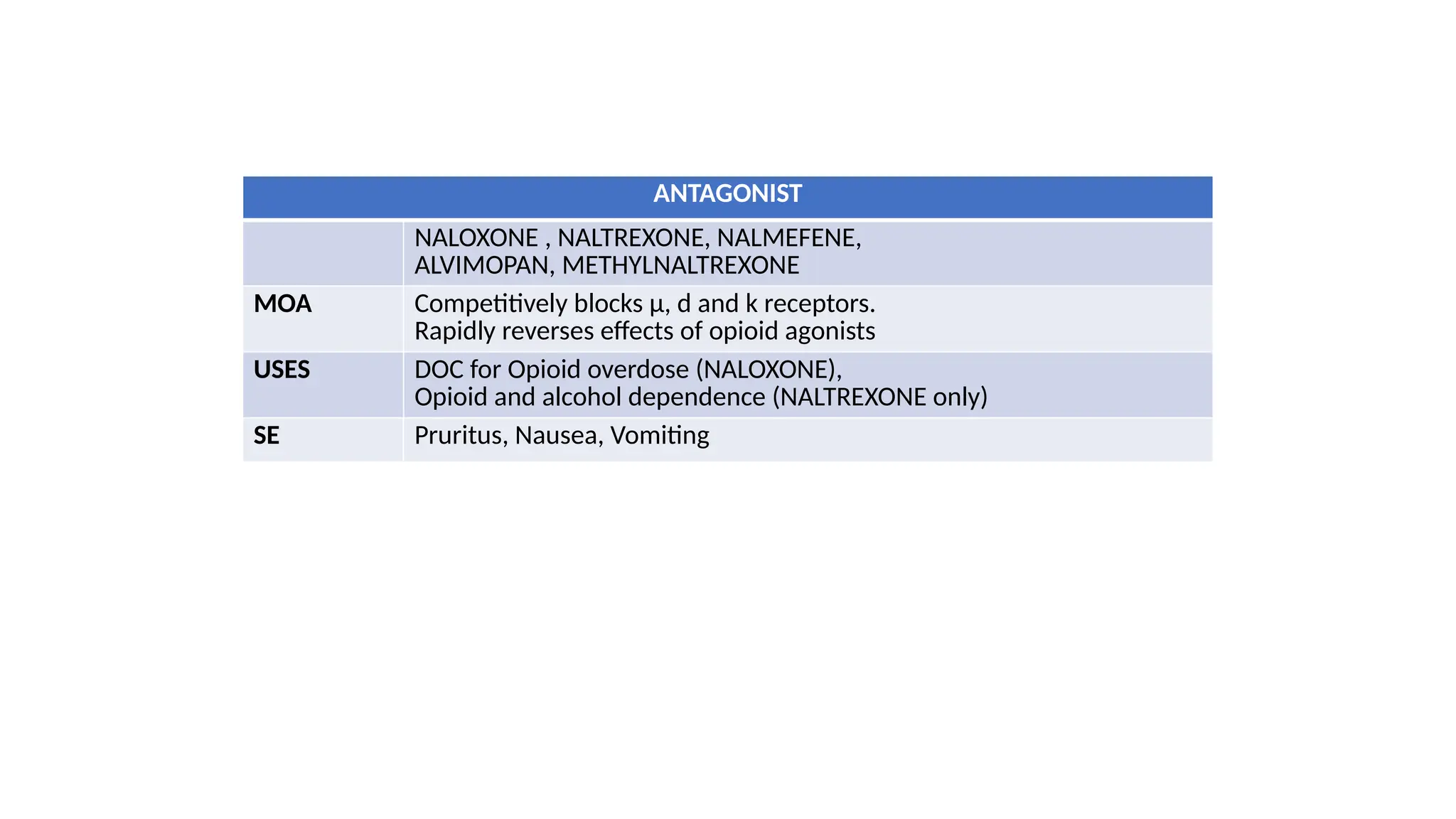
ANTAGONIST
NALOXONE , NALTREXONE, NALMEFENE,
ALVIMOPAN, METHYLNALTREXONE
MOA Competitively blocks μ, d and k receptors.
Rapidly reverses effects of opioid agonists
USES DOC for Opioid overdose (NALOXONE),
Opioid and alcohol dependence (NALTREXONE only)
SE Pruritus, Nausea, Vomiting

OPIOIDS, classification, drug class, mechanism iof action

  • 1.
  • 2.
    CLASSIFICATION OF OPIOIDCOMPOUNDS Naturally occurring • Phenanthrenes (morphine and codeine) • Benzylisoquinolines (papaverine) Semisynthetic • Heroin • Dihydromorphone • Morphinone • Thebaine derivatives (e.g., etorphine, buprenorphine) Synthetic • Morphinan derivatives (levorphanol, butorphanol) • Diphenyl or methadone derivatives (methadone, d-propoxyphene) • Benzomorphans (phenazocine, pentazocine) • Phenylpiperidine derivatives (meperidine, fentanyl, sufentanil, alfentanil, and remifentanil).
  • 3.
    ACTIONS PRODUCED ATEACH OPIOID RECEPTOR SUBTYPE µ (Mu) • Supraspinal and spinal analgesia • Sedation • Respiratory depression • Slowed gastrointestinal transit • Euphoria • physical dependence δ (Delta) • Supraspinal and spinal analgesia • Depression of ventilation • Physical dependence • Modulation of hormone and neurotransmitter release κ (Kappa) • Supraspinal and spinal analgesia • Psychotomimetic effects • Slowed gastrointestinal transit
  • 4.
    OPIOID ACTION ATRECEPTORS Full agonist • Compounds that are able to elicit a maximal response following receptor occupation and activation Partial agonist • Compounds that can activate receptors but are unable to elicit the maximal response of the receptor system Antagonist • Compounds that exert no biological effect when binding to a receptor. • Antagonists cause a downward shift of the overall action of the receptor system
  • 5.
    OPIOIDS BY MECHANISMOF ACTION AGONIST AGONIST-ANTAGONIST ANTAGONIST • Morphine • Methadone • Hydromorphone • Meperidine • Fentanyl • Alfentanil • Sufentanil • Remifentanil • Levorphanol • Oxymorphone • Codeine • Oxycodone • Dextromethorphan • Diphenoxylate • Difenoxin • Loperamide • Pentazocine • Nalbuphine • Butorphanol • Buprenorphine • Naloxone • Naltrexone
  • 6.
    PARTIAL AGONIST WEAKAGONIST AGONIST-ANTAGONIST HYDROCODONE, OXYCODONE , DIHYDROCODEINE DEXTROMETORPHAN, CODEINE PROPOXYPHENE , LEVOPROPOXYPHENE, DEXTROPROPOXYPHENE BUPRENORPHINE, NALBUPHINE , BUTORPHANOL , PENTAZOCINE, LEVALLORPHAN MOA Strong agonist at μ and k receptors. Inhibits pain neurotransmission at spinal and supraspinal sites, binds NMDA receptors and antagonizes the effects of glutamate Decreases sensitivity of cough receptors. Depressing the medullary cough center through sigma receptor stimulation Weak agonist at μ receptors. Inhibits pain neurotransmission Partial μ receptors agonist, antagonist at k & d receptors. Inhibits pain neurotransmission. USES Moderate to severe pain, Cancer pain, Neuropathic pain (postherpetic neuralgia, DM neuropathy), Chronic pain, opioid dependence, opioid withdrawal Cough suppression Mild to moderate pain, Restless legs syndrome, Opioid withdrawal Moderate to severe pain, Opioid dependence, Alcohol dependence, Balanced anesthesia, opioid withdrawal states (buprenorphine), Postoperative shivering (Butorphanol) SE Miosis, Respiratory depression, Increased ICP, Postural hypotension, Constipation, Urinary retention, Pruritus, Addiction liability, Hypogonadism, Hearing loss Hallucinations, Confusion, Excitation, Increased or decreased pupil size, Nystagmus, Seizures, Coma, Respiratory depression, Addiction liability Miosis, Respiratory depression, Increased ICP, Postural hypotension, Constipation, Urinary retention, Pruritus, Addiction liability, Seizures, Pulmonary edema, Fatal arrhythmias Sedation, Dizziness, Sweating, Nausea, Anxiety, Hallucinations, Nightmares, Respiratory depression (less), Tolerance, Dependence liability
  • 7.
    FULL AGONIST PHENANTHRENES MORPHINE (opioidprototype), Hydromorphone, Oxymorphone, HEROIN (Synthetic derivatives of Morphine) PHENYLPIPERIDINE FENTANYL, SUFENTANIL, ALFENTANIL, REMIFENTANIL, OHMEFENTANYL MEPERIDINE (Pethidine) PHENYLHEPTYLAMINES METHADONE, LEVOMETHADYL ACETATE, LEVORPHANOL MOA Strong agonist at μ receptors. Inhibits pain neurotransmission at spinal and supraspinal sites. Variable activity at d and k receptors Strong agonist at μ and k receptors. Inhibits pain neurotransmission. Muscarinic blocking actions. Strong agonist at μ receptors. NMDA antagonist. Blocks monoamine reuptake transporters. USES Severe pain, Pain associated with acute myocardial infarction, Pulmonary edema, Adjunct in anesthesia Severe pain, Adjunct in anesthesia, Chronic pain, Breakthrough cancer pain Moderate to severe pain, Labor analgesia, Postoperative Shivering, Preoperative sedation Moderate to severe pain (resistant to morphine), Opioid dependence (especially for a relapsing chronic heroin addict), Opioid withdrawal SE Miosis, Restlessness, Respiratory depression, Increased ICP, Postural hypotension, Constipation, Urinary retention, Pruritus, Addiction liability, Pain associated with myocardial ischemia, Bradycardia Restlessness, Respiratory depression, Increased ICP, Postural hypotension, Constipation, Urinary retention, Pruritus, Addiction liability Tachycardia, Hypotension (pronounced in patients with decreased circulating volume), Seizures, Delirium, Restlessness, Respiratory depression, Increased ICP, Postural hypotension, Constipation, Urinary retention, Pruritus, Addiction liability (less) Miosis, Restlessness, Respiratory depression, Increased ICP, Postural hypotension, Constipation, Urinary retention, Pruritus, Addiction liability (less) Hepatic dysfunction, QT prolongation (specific to methadone)
  • 8.
    ANTAGONIST NALOXONE , NALTREXONE,NALMEFENE, ALVIMOPAN, METHYLNALTREXONE MOA Competitively blocks μ, d and k receptors. Rapidly reverses effects of opioid agonists USES DOC for Opioid overdose (NALOXONE), Opioid and alcohol dependence (NALTREXONE only) SE Pruritus, Nausea, Vomiting

Editor's Notes

  • #2 Opioids can be classified as naturally occurring, semisynthetic, and synthetic