LINEAR PROGRAMMING PROBLEM
(LPP)
TOPIC: COST MINIMIZATION
INTRODUCTION
 Linear programming is a mathematical technique used to find the best possible solution in allocating
limited resources (constraints) to achieve maximum profit or minimum cost by modelling linear
relationships.
 Model formulation steps :
• Define the decision variables
• Construct the objective function
• Formulate the constraints
• Find the feasible solution
• Calculate the value of the objective function at each of the vertices of feasible solution area to
determine which of them has the maximum or minimum values
MODEL COMPONENTS
 Decision variables – mathematical symbols representing levels of activity of a firm.
 Objective function – a linear mathematical relationship describing an objective of the firm, in terms of
decision variables - this function is to be maximized or minimized.
 Constraints – requirements or restrictions placed on the firm by the operating environment, stated in
linear relationships of the decision variables.
 Parameters – numerical coefficients and constants used in the objective function and constraints.
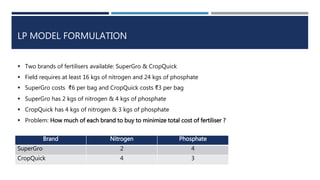
LP MODEL FORMULATION
 Two brands of fertilisers available: SuperGro & CropQuick
 Field requires at least 16 kgs of nitrogen and 24 kgs of phosphate
 SuperGro costs ₹6 per bag and CropQuick costs ₹3 per bag
 SuperGro has 2 kgs of nitrogen & 4 kgs of phosphate
 CropQuick has 4 kgs of nitrogen & 3 kgs of phosphate
 Problem: How much of each brand to buy to minimize total cost of fertiliser ?
Brand Nitrogen Phosphate
SuperGro 2 4
CropQuick 4 3
 Decision Variables
x = No. of bags of SuperGro
y = No. of bags of CropQuick
 Objective Function
Minimize, z = 6x + 3y
 Constraints
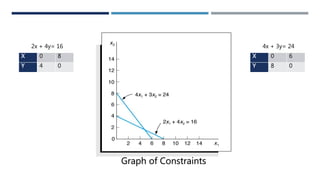
2x + 4y >= 16 (nitrogen)
4x + 3y >= 24 (phosphate)
x, y >= 0 (non-negativity constraint)
Graph of Constraints
X 0 6
Y 8 0
X 0 8
Y 4 0
4x + 3y= 242x + 4y= 16
Feasible Solution Area
Optimum Solution
Points Z
A (0,8) 24
B (4.8,1.6) 33.6
C (8,0) 48
z = 6x + 3y
So, 8 kgs of CropQuick should be bought to
minimise total cost of fertiliser.
Thank You

Linear programming Cost Minimization

  • 1.
  • 2.
    INTRODUCTION  Linear programmingis a mathematical technique used to find the best possible solution in allocating limited resources (constraints) to achieve maximum profit or minimum cost by modelling linear relationships.  Model formulation steps : • Define the decision variables • Construct the objective function • Formulate the constraints • Find the feasible solution • Calculate the value of the objective function at each of the vertices of feasible solution area to determine which of them has the maximum or minimum values
  • 3.
    MODEL COMPONENTS  Decisionvariables – mathematical symbols representing levels of activity of a firm.  Objective function – a linear mathematical relationship describing an objective of the firm, in terms of decision variables - this function is to be maximized or minimized.  Constraints – requirements or restrictions placed on the firm by the operating environment, stated in linear relationships of the decision variables.  Parameters – numerical coefficients and constants used in the objective function and constraints.
  • 4.
    LP MODEL FORMULATION Two brands of fertilisers available: SuperGro & CropQuick  Field requires at least 16 kgs of nitrogen and 24 kgs of phosphate  SuperGro costs ₹6 per bag and CropQuick costs ₹3 per bag  SuperGro has 2 kgs of nitrogen & 4 kgs of phosphate  CropQuick has 4 kgs of nitrogen & 3 kgs of phosphate  Problem: How much of each brand to buy to minimize total cost of fertiliser ? Brand Nitrogen Phosphate SuperGro 2 4 CropQuick 4 3
  • 5.
     Decision Variables x= No. of bags of SuperGro y = No. of bags of CropQuick  Objective Function Minimize, z = 6x + 3y  Constraints 2x + 4y >= 16 (nitrogen) 4x + 3y >= 24 (phosphate) x, y >= 0 (non-negativity constraint)
  • 6.
    Graph of Constraints X0 6 Y 8 0 X 0 8 Y 4 0 4x + 3y= 242x + 4y= 16
  • 7.
  • 8.
    Optimum Solution Points Z A(0,8) 24 B (4.8,1.6) 33.6 C (8,0) 48 z = 6x + 3y So, 8 kgs of CropQuick should be bought to minimise total cost of fertiliser.
  • 9.