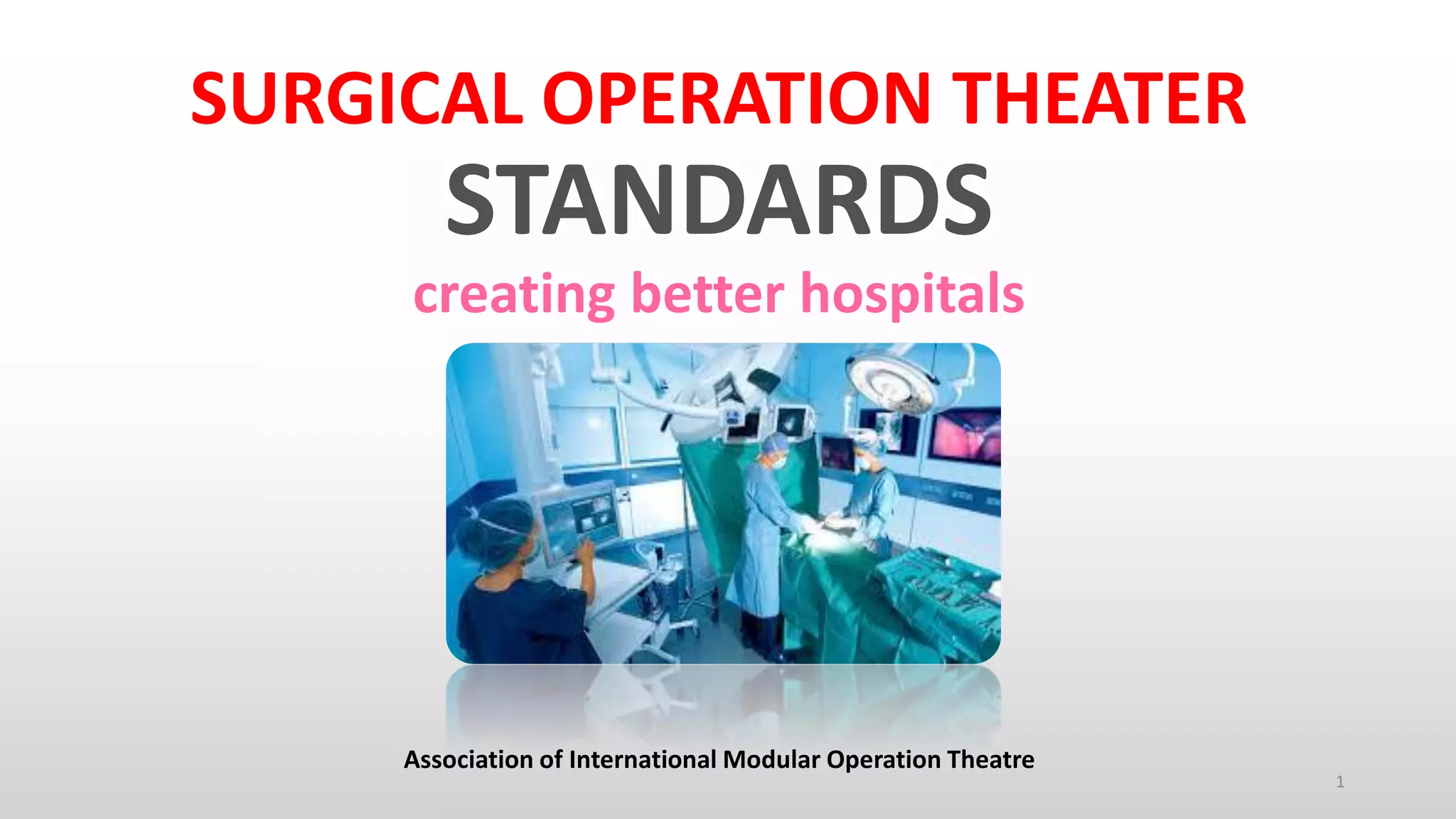
SURGICAL OPERATION THEATER
STANDARDS
creating better hospitals
1
Association of International Modular Operation Theatre
Need to Rethink on Safety and Standards
in our Operation theaters
• The Program file is created from various peer reviewed,
and world standard protocols in implantation of Safe
Operation theater standards for wider use in the world, In
India still we do not have any set standards and practices,
As good beginning is half done, I wish all my professional
friends go through the article, your opinions and comments
are highly appreciated for future developments,
2
Hospitals Continues to be a Great Risk to
many who avail the Services
3
Why Standards Infection Control a
Priority in Operation Theaters
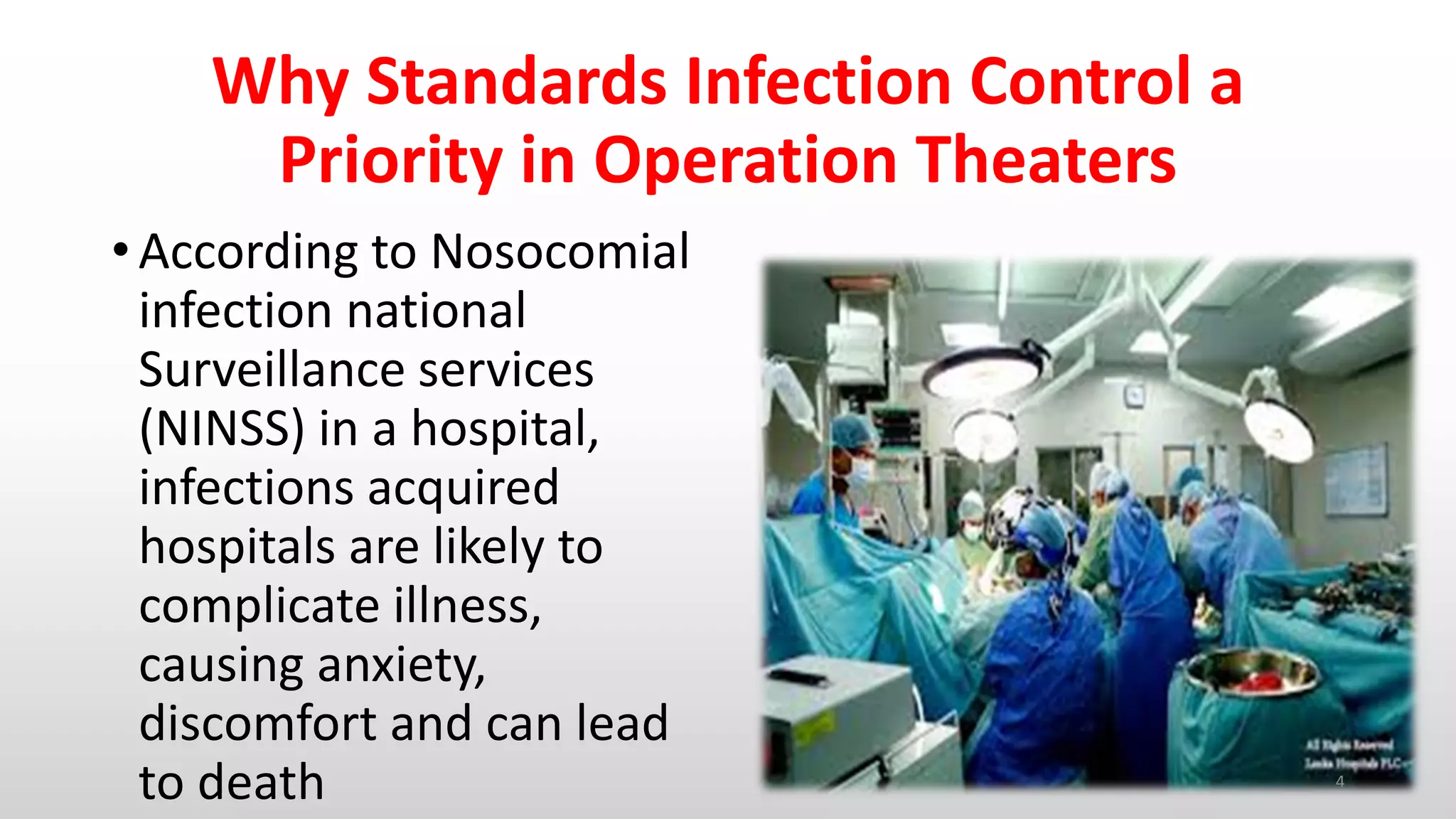
•According to Nosocomial
infection national
Surveillance services
(NINSS) in a hospital,
infections acquired
hospitals are likely to
complicate illness,
causing anxiety,
discomfort and can lead
to death 4
Public Confidence in Hospitals
•Patients and the wider
public should have
complete confidence
in the cleanliness and
hygiene of their
healthcare
environment
•So we Need Standards
5
What is everybody's Role in Safe
Operation theaters
• All healthcare professionals
have a duty to set a
standard by which to
practice. With a focus on
clinical effectiveness and
evidence based care theatre
staff must be able to
demonstrate the ability to
audit care and theatre
practice.
6
Plan a Operation Theater with following
objectives
• To control the concentration of Pathogens
• To prevent infiltration of non purified air into the operating theatre
• Air flow pattern that carries contaminated air away from the
operating table
• Comfortable environment for the patient and operating team
• Convenient & uninterrupted personal movements inside the OT
• Safe Zone creation in OT [ for the safe location of sterile instruments
& Disposables
7
Document the Operation Theater
Functioning
The theatre register will record:
• Procedures which were undertaken (both surgical and the type of
anaesthetic)
• The names of surgeon and anaesthetist and a list of support staff
• The name of the scrub and circulating practitioner
• The time each patient entered and left theatre
• The patient’s name, date of birth, sex, NHS number, scrub and circulating
practitioner, implanted materials and any untoward incidents
• Details of any implants
• Details of untoward events
8
Recording & Transmission of Surgical
Procedures
New international standards also include:
• Recording of Surgical procedures performed on patient as records for
medico legal purpose as well as HIPAA / NABH compliance
• Monitoring Pre-OP & Post-OP procedures performed by junior surgeons
• Live webcasting or IP transmission of surgical procedures to avoid chaos
inside operation theatre
• To maintain privacy of personal information of patient during any CME
activity
9
However we have to Implement Standard
protocols as associated with best practices
•The care that is
delivered and
improvements in
practice must be
based on evidence
and best practice
guidance.
10
The safe surgery saves lives approach
• The Safe Surgery Saves Lives
programme aims to improve
surgical safety and reduce the
number of surgical deaths and
complications in four ways
• Objective 1
• 1 by giving clinicians, hospital
administrators and public health
officials information on the role
and patterns of surgical safety in
public health
11
Objective 2
•by defining a minimum
set of uniform
measures or ‘surgical
vital statistics’, for
national and
international
surveillance of surgical
care;
12
Objective 3
•by identifying a simple
set of surgical safety
standards that can be
used in all countries
and settings and are
compiled in a ‘surgical
safety check-list’ for
use in operating rooms
13
Objective 4
•by testing the
checklist and
surveillance tools at
pilot sites in all WHO
regions and then
disseminating the
checklist to hospitals
worldwide18-10-2016 14
Surgical Site Infections – Increases
Morbidity and Mortality
•Infections of the
surgical wound are one
of the most common
HAI and are important
cause of morbidity and
mortality for patients
undergoing surgery
18-10-2016 15
Factors influencing the
Increased Rate of Infection
• There are several factors that
could affect such infection,
namely, patient factors (i.e.
susceptibility to infection).
Surgical field factors (i.e: the
thermal plume from the site),
room factors (i.e: cleanness of
the OR), and HVAC factors ( i.e:
High air change rate(ACH) and
direction of air flow).
16
Consequences of Infections in
Surgical Patients
•The delay in recovery and increased hospital
stay also has economic consequences. It is
estimated that each patient with a surgical
site infection requires an additional stay for
6.5 days and hospital cost are doubled. It is a
pre-requisite that Operating Theaters achieve
Ultra- Clean status, especially for deep wound
surgery. 17
We Lack basic guidelines to
Structure the Operation Theaters
• In developing countries like
India, where there is no
uniform guidelines, many
OTs are built and maintained
according to the individual’s
knowledge level, availability of
funds, technical staff, and
equipment's
• However we need to start
with scientific beginning
18
INTERNATIONAL FEDRATION OF
INFECTION CONTROL (IFIC)
“ States it is now accepted that ULTRA-
CLEAN air reduces the risk of infection
in implant surgeries
19
Surveillance of the Operation theater needs
better understanding as it is not absolute to
true Saftey
• Good hospital hygiene is an
integral part of infection
control programme.
“Microbiological
surveillance” provides data
about the factors
contributing to infection. In
developed countries, though
standard protocols and
guidelines are available
20
Do not do the Settle plates with Blind ideas,
Evaluate how good they suit to your situations
•Settle plates to
estimate the CFU
can help in few
matters, but may
not serve the
absolute purpose
18-10-2016 21
Doing settle plates Mandatory ?
The Results are Inconclusive ?
•Though settle plate method may be regarded as
a crude measure of airborne contamination, in
places without other facilities it can still
provide a simple and cost effective way of
enumerating the contamination rate of
horizontal surfaces at multiple points.
Although there is no need to routinely
perform surveillance cultures in operation
theatre 22
Settle plates help us to know the
Environment we work and risk to patients
•However there are
evidences which
suggest that there is a
need to monitor the
air quality which may
help in reduction of
post-operative
complications due to
infection. 23
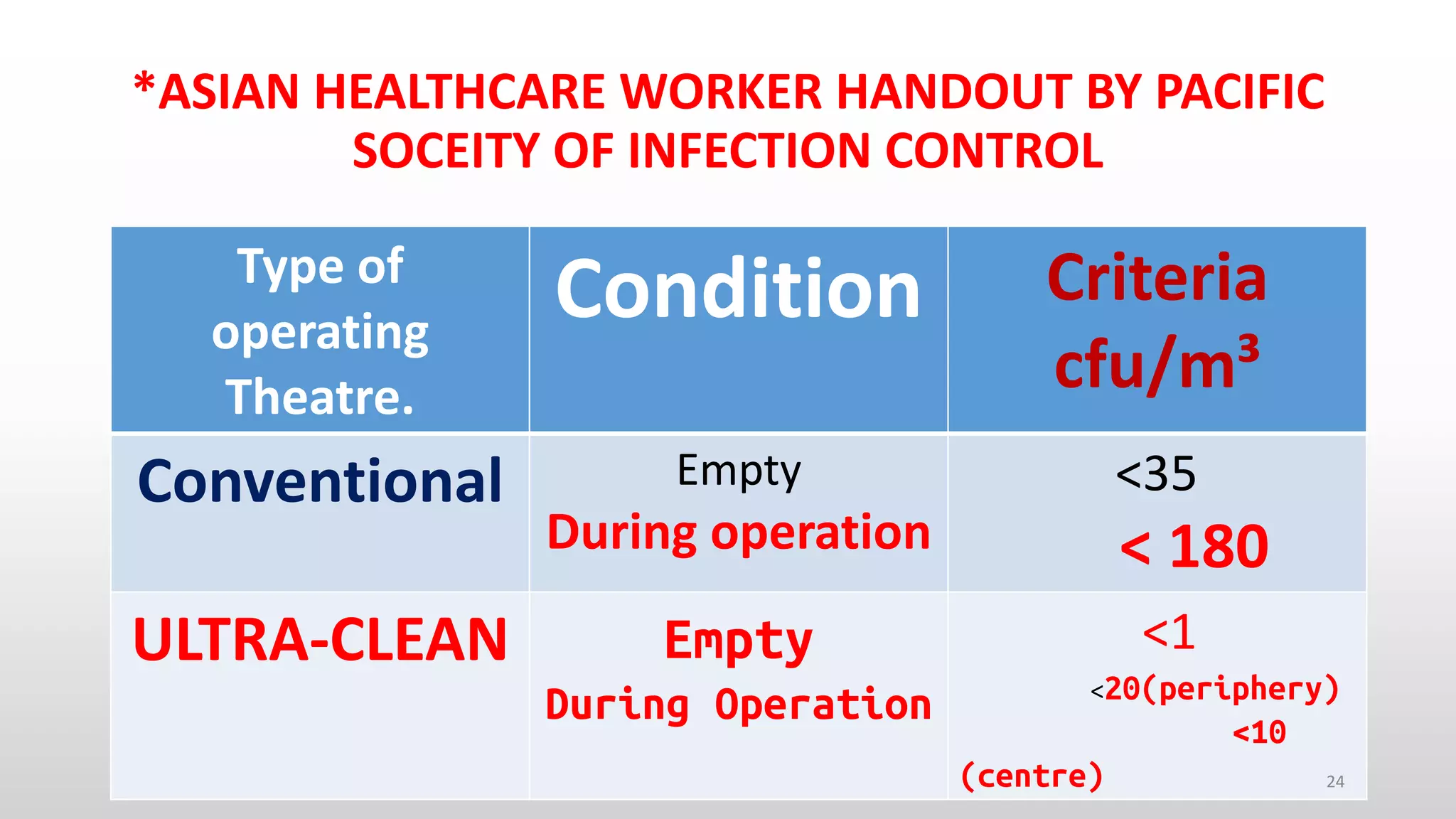
*ASIAN HEALTHCARE WORKER HANDOUT BY PACIFIC
SOCEITY OF INFECTION CONTROL
Type of
operating
Theatre.
Condition Criteria
cfu/m³
Conventional Empty
During operation
<35
< 180
ULTRA-CLEAN Empty
During Operation
<1
<20(periphery)
<10
(centre) 24
*STANDARD DESIGNIING OF OPERATING
THEATERS.
Factor HTM 2025 ASHRAE
Pressur
e
Positive pressure with
respect Pressure
differential should be
around 9 up to 30 Pa.
Positive pressure by
to corridor and
adjacent area
supplying 15% excess
air
Air Filter Primary and
secondary filter
Primary filter – 25%
Secondary filter -90%
HEPA filter – 99.97%18-10-2016 Dr.T.V.Rao MD @Infection control 25
*STANDARD DESIGNIING FOR OPERATING
THEATER.
Factor HTM 2025 ASHRAE
Humidity 55% ± 5% 45% - 55%
Temperature Range for
working
Range for
working
26
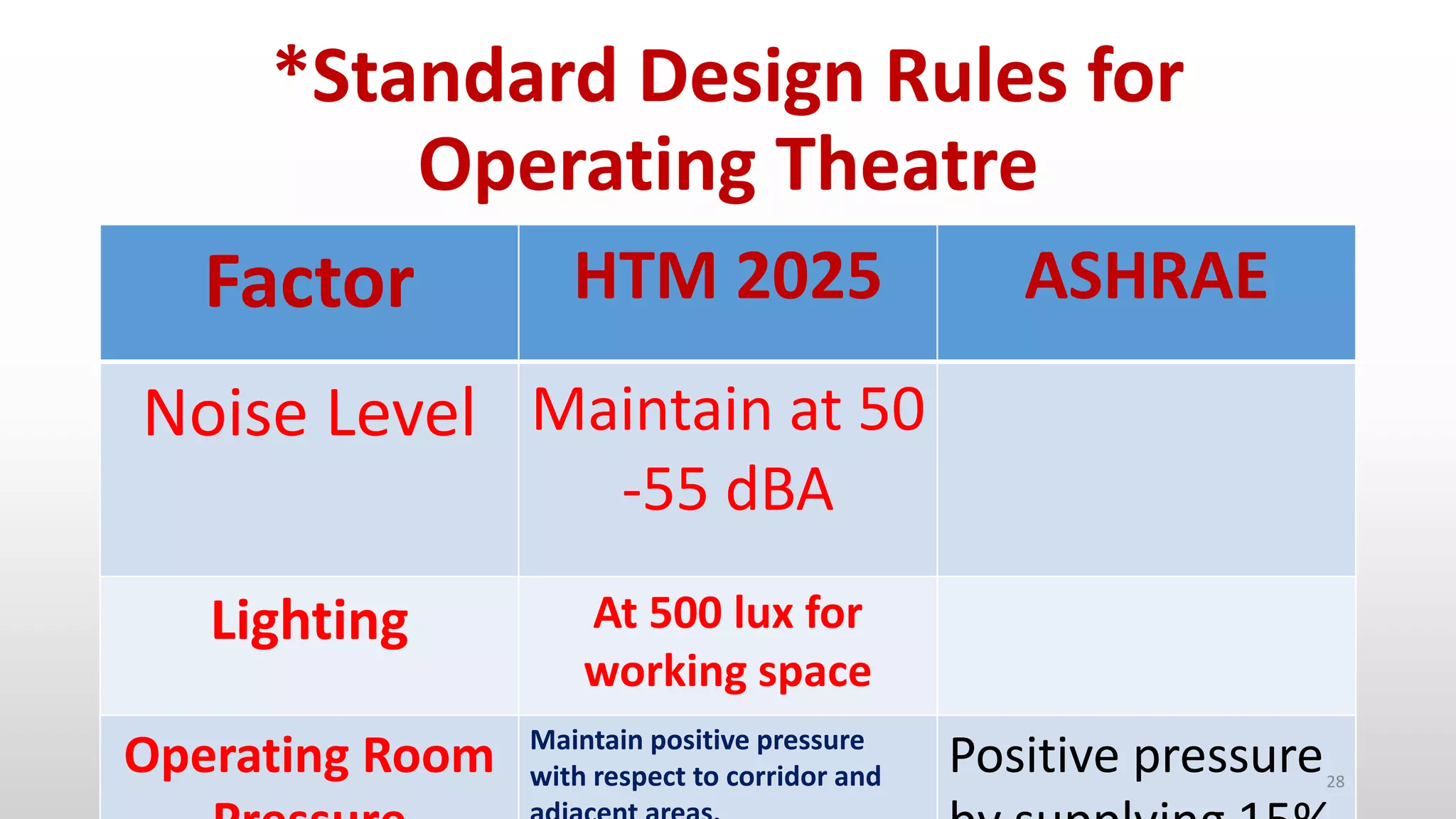
*Standard Design Rules for
Operating Theatre
Factor HTM 2025 ASHRAE
Air Exchanges
Rates
Required 20 ACH
for the system
15 ACH for outdoor air
system
- 25 ACH for recirculation
air systems
Air Velocity Working zone area should be
between 0.1m/s to 0.3 m/s
Operating Area Minimum sterile The experimental procedure is
defined by
DIN 4799 (1990), OR floor area
27
*Standard Design Rules for
Operating Theatre
Factor HTM 2025 ASHRAE
Noise Level Maintain at 50
-55 dBA
Lighting At 500 lux for
working space
Operating Room Maintain positive pressure
with respect to corridor and Positive pressure28
*Standard Design Rules for
Operating Theatre
Factor HTM 2025 ASHRAE
Air Filter
Primary and Secondary
filter- 80-90 %
HEPA filter-95% or more
efficiency based on EU
Primary filter –
25%
Secondary
filter – 90%
Temperature
Temperature range for working
condition
condition is 19°C to 23°C is
Temperature
range for working29
References
1. CLINICAL GUIDELINE FOR THEATRE PRACTICE STANDARDS –
GENERIC. Royal Cornwall Hospital NHS
2. WHO Guidelines for Safe Surgery 2009 Safe Surgery Saves Lives
30

Surgical operation theater standards

  • 1.
    SURGICAL OPERATION THEATER STANDARDS creatingbetter hospitals 1 Association of International Modular Operation Theatre
  • 2.
    Need to Rethinkon Safety and Standards in our Operation theaters • The Program file is created from various peer reviewed, and world standard protocols in implantation of Safe Operation theater standards for wider use in the world, In India still we do not have any set standards and practices, As good beginning is half done, I wish all my professional friends go through the article, your opinions and comments are highly appreciated for future developments, 2
  • 3.
    Hospitals Continues tobe a Great Risk to many who avail the Services 3
  • 4.
    Why Standards InfectionControl a Priority in Operation Theaters •According to Nosocomial infection national Surveillance services (NINSS) in a hospital, infections acquired hospitals are likely to complicate illness, causing anxiety, discomfort and can lead to death 4
  • 5.
    Public Confidence inHospitals •Patients and the wider public should have complete confidence in the cleanliness and hygiene of their healthcare environment •So we Need Standards 5
  • 6.
    What is everybody'sRole in Safe Operation theaters • All healthcare professionals have a duty to set a standard by which to practice. With a focus on clinical effectiveness and evidence based care theatre staff must be able to demonstrate the ability to audit care and theatre practice. 6
  • 7.
    Plan a OperationTheater with following objectives • To control the concentration of Pathogens • To prevent infiltration of non purified air into the operating theatre • Air flow pattern that carries contaminated air away from the operating table • Comfortable environment for the patient and operating team • Convenient & uninterrupted personal movements inside the OT • Safe Zone creation in OT [ for the safe location of sterile instruments & Disposables 7
  • 8.
    Document the OperationTheater Functioning The theatre register will record: • Procedures which were undertaken (both surgical and the type of anaesthetic) • The names of surgeon and anaesthetist and a list of support staff • The name of the scrub and circulating practitioner • The time each patient entered and left theatre • The patient’s name, date of birth, sex, NHS number, scrub and circulating practitioner, implanted materials and any untoward incidents • Details of any implants • Details of untoward events 8
  • 9.
    Recording & Transmissionof Surgical Procedures New international standards also include: • Recording of Surgical procedures performed on patient as records for medico legal purpose as well as HIPAA / NABH compliance • Monitoring Pre-OP & Post-OP procedures performed by junior surgeons • Live webcasting or IP transmission of surgical procedures to avoid chaos inside operation theatre • To maintain privacy of personal information of patient during any CME activity 9
  • 10.
    However we haveto Implement Standard protocols as associated with best practices •The care that is delivered and improvements in practice must be based on evidence and best practice guidance. 10
  • 11.
    The safe surgerysaves lives approach • The Safe Surgery Saves Lives programme aims to improve surgical safety and reduce the number of surgical deaths and complications in four ways • Objective 1 • 1 by giving clinicians, hospital administrators and public health officials information on the role and patterns of surgical safety in public health 11
  • 12.
    Objective 2 •by defininga minimum set of uniform measures or ‘surgical vital statistics’, for national and international surveillance of surgical care; 12
  • 13.
    Objective 3 •by identifyinga simple set of surgical safety standards that can be used in all countries and settings and are compiled in a ‘surgical safety check-list’ for use in operating rooms 13
  • 14.
    Objective 4 •by testingthe checklist and surveillance tools at pilot sites in all WHO regions and then disseminating the checklist to hospitals worldwide18-10-2016 14
  • 15.
    Surgical Site Infections– Increases Morbidity and Mortality •Infections of the surgical wound are one of the most common HAI and are important cause of morbidity and mortality for patients undergoing surgery 18-10-2016 15
  • 16.
    Factors influencing the IncreasedRate of Infection • There are several factors that could affect such infection, namely, patient factors (i.e. susceptibility to infection). Surgical field factors (i.e: the thermal plume from the site), room factors (i.e: cleanness of the OR), and HVAC factors ( i.e: High air change rate(ACH) and direction of air flow). 16
  • 17.
    Consequences of Infectionsin Surgical Patients •The delay in recovery and increased hospital stay also has economic consequences. It is estimated that each patient with a surgical site infection requires an additional stay for 6.5 days and hospital cost are doubled. It is a pre-requisite that Operating Theaters achieve Ultra- Clean status, especially for deep wound surgery. 17
  • 18.
    We Lack basicguidelines to Structure the Operation Theaters • In developing countries like India, where there is no uniform guidelines, many OTs are built and maintained according to the individual’s knowledge level, availability of funds, technical staff, and equipment's • However we need to start with scientific beginning 18
  • 19.
    INTERNATIONAL FEDRATION OF INFECTIONCONTROL (IFIC) “ States it is now accepted that ULTRA- CLEAN air reduces the risk of infection in implant surgeries 19
  • 20.
    Surveillance of theOperation theater needs better understanding as it is not absolute to true Saftey • Good hospital hygiene is an integral part of infection control programme. “Microbiological surveillance” provides data about the factors contributing to infection. In developed countries, though standard protocols and guidelines are available 20
  • 21.
    Do not dothe Settle plates with Blind ideas, Evaluate how good they suit to your situations •Settle plates to estimate the CFU can help in few matters, but may not serve the absolute purpose 18-10-2016 21
  • 22.
    Doing settle platesMandatory ? The Results are Inconclusive ? •Though settle plate method may be regarded as a crude measure of airborne contamination, in places without other facilities it can still provide a simple and cost effective way of enumerating the contamination rate of horizontal surfaces at multiple points. Although there is no need to routinely perform surveillance cultures in operation theatre 22
  • 23.
    Settle plates helpus to know the Environment we work and risk to patients •However there are evidences which suggest that there is a need to monitor the air quality which may help in reduction of post-operative complications due to infection. 23
  • 24.
    *ASIAN HEALTHCARE WORKERHANDOUT BY PACIFIC SOCEITY OF INFECTION CONTROL Type of operating Theatre. Condition Criteria cfu/m³ Conventional Empty During operation <35 < 180 ULTRA-CLEAN Empty During Operation <1 <20(periphery) <10 (centre) 24
  • 25.
    *STANDARD DESIGNIING OFOPERATING THEATERS. Factor HTM 2025 ASHRAE Pressur e Positive pressure with respect Pressure differential should be around 9 up to 30 Pa. Positive pressure by to corridor and adjacent area supplying 15% excess air Air Filter Primary and secondary filter Primary filter – 25% Secondary filter -90% HEPA filter – 99.97%18-10-2016 Dr.T.V.Rao MD @Infection control 25
  • 26.
    *STANDARD DESIGNIING FOROPERATING THEATER. Factor HTM 2025 ASHRAE Humidity 55% ± 5% 45% - 55% Temperature Range for working Range for working 26
  • 27.
    *Standard Design Rulesfor Operating Theatre Factor HTM 2025 ASHRAE Air Exchanges Rates Required 20 ACH for the system 15 ACH for outdoor air system - 25 ACH for recirculation air systems Air Velocity Working zone area should be between 0.1m/s to 0.3 m/s Operating Area Minimum sterile The experimental procedure is defined by DIN 4799 (1990), OR floor area 27
  • 28.
    *Standard Design Rulesfor Operating Theatre Factor HTM 2025 ASHRAE Noise Level Maintain at 50 -55 dBA Lighting At 500 lux for working space Operating Room Maintain positive pressure with respect to corridor and Positive pressure28
  • 29.
    *Standard Design Rulesfor Operating Theatre Factor HTM 2025 ASHRAE Air Filter Primary and Secondary filter- 80-90 % HEPA filter-95% or more efficiency based on EU Primary filter – 25% Secondary filter – 90% Temperature Temperature range for working condition condition is 19°C to 23°C is Temperature range for working29
  • 30.
    References 1. CLINICAL GUIDELINEFOR THEATRE PRACTICE STANDARDS – GENERIC. Royal Cornwall Hospital NHS 2. WHO Guidelines for Safe Surgery 2009 Safe Surgery Saves Lives 30