Operating Room (OR)
RLE
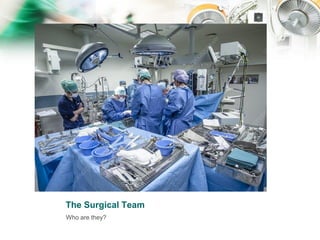
The Surgical Team
Who are they?
A team of highly trained professionals with a wide range of
specialties who is present to offer comprehensive patient
care.
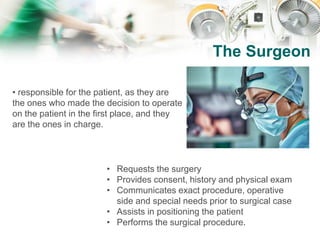
The Surgeon
• responsible for the patient, as they are
the ones who made the decision to operate
on the patient in the first place, and they
are the ones in charge.
• Requests the surgery
• Provides consent, history and physical exam
• Communicates exact procedure, operative
side and special needs prior to surgical case
• Assists in positioning the patient
• Performs the surgical procedure.
Anesthesiologist
• other attending physician in the room, and can
generally be thought of as second in command.
• The anesthesiologist takes part in all 3 phases of
surgery: before, during, and after.
• Assesses patient’s risk for receiving anesthesia
• Assesses need for appropriate anesthetic during
the surgical procedure
• Communicates equipment needs to the circulating
nurse
The First Assist
• the person helping the surgeon perform the case,
also scrubbed into the sterile surgical field.
• a resident, physician assistant (PA), nurse
practitioner (NP), certified surgical assistant (CSA),
or medical student.
•It’s their responsibility to assist the surgeon
in performing the procedure, which includes
a lot of retracting, suctioning, and
performing other supportive measures for
the surgeon.
The Scrub Nurse
• The scrub nurse is also scrubbed in the surgical field,
and is the one rub preparing, organizing, and providing
the various surgical tools and instruments to the
surgeon and first assist during the case.
•gathers the necessary supplies, including the sets of
surgical instruments
•first one to scrub in and set up a sterile surgical field
•helping the surgeon and assistants with their sterile
gown and gloves.
The Circulating Nurse
• the point person in helping assist the surgical
team outside of the sterile surgical field.
• Along with the scrub nurse, they are also
responsible for gathering supplies, sterile
equipment, and toolsets needed for surgery and
anesthesia.
• manage the documentation at the computer
before and during the case,
• verifying the patient’s ID, who all is in the room,
• getting the patient comfortable with warming
blankets, and the like.
Medical device company
representative
Sometimes surgeons will have a
representative from a company that
makes medical equipment in the
operating room. Such equipment
might be artificial joints, spine
stabilizers, or pacemakers. The
representative can help the surgeon
with sizing and function of the
equipment.
Appropriate Operating
Room Attire
Learning Objectives
• Identify the components of appropriate OR
attire worn in specific areas of the surgical
suite
• Identify the components of personal
protective equipment (PPE) donned before
performing surgical hand cleansing
• Identify the sterile parameters of a surgical
gown
• Demonstrate the correct procedure in
performing surgical hand scrubbing
•
Purpose & Definition
• Effective barriers that both prevent the dissemination of
microorganisms to patients and protect personnel from
blood and body substances of patients
• 2-pc pantsuit, head cover, mask and shoe covers
• Sterile gown & gloves (sterile team members at the sterile
field)
• PPE(eyewear & other protective items for anticipated
exposure to blood and body fluids)
Considerations for Appropriate
Attire
• Only approved, freshly laundered attire intended for use in
the OR is worn within the semi-restricted and restricted
areas.
• OR attire should not be worn outside the OR suite or
outdoors.
• Personal hygiene is emphasized.
– Not permitted in the OR suite: person with acute infections,
cuts, burns, or lesion
– Fingernails should be kept short
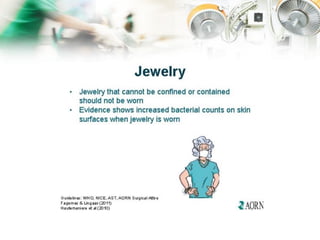
– Jewelry should be removed
– Facial make-up should be minimal
– Eyewear or spectacles should be wiped with a cleaning solution
– Identification badges should be secured
– Hand hygiene
– Comfortable, supportive, ski-proof shoes
TRUE or FALSE
• Briefcases, backpacks and other
personal items are allowed to be taken
into the semi-restricted or restricted
areas.
CORRECT or WRONG
• Mask maybe worn
dangling at any time
The photo is WRONG.
• The filter portion of a surgical
mask harbors bacteria collected
from the nasopharyngeal airways
• The contaminated mask may
cross contaminate the scrub attire
top when the mask is worn
hanging around the neck
CORRECT or WRONG
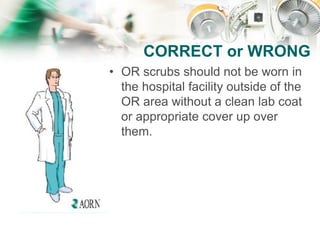
• OR scrubs should not be worn in
the hospital facility outside of the
OR area without a clean lab coat
or appropriate cover up over
them.
• Evidence shows that lab coats can
be contaminated with large numbers
of pathogenic microorganisms
• Lab coats are not always discarded
daily after use or laundered on a
frequent basis
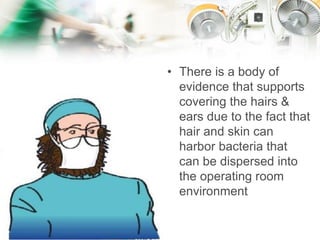
A YES or a NO?
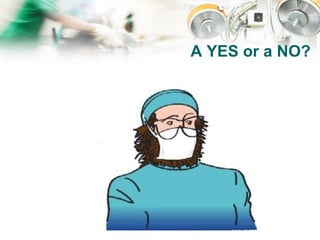
• There is a body of
evidence that supports
covering the hairs &
ears due to the fact that
hair and skin can
harbor bacteria that
can be dispersed into
the operating room
environment
Components of Appropriate
Attire
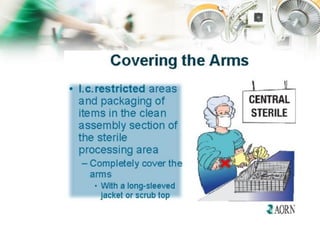
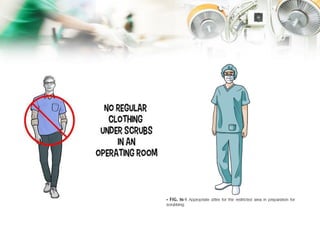
• Body cover: fit snugly; changed as soon as possible
whenever it becomes wet or visibly soiled
– Those who will not be sterile team members should wear
longsleeved jackets with front closures over a scrub suit
Components of Appropriate
Attire
• Head cover: cap first before the scrub suit
– Facial and head hair is completely covered
– Hair is long: bouffant-style hat
– Reusabe cloth cap: freshly laundered daily
Components of Appropriate
Attire
• Shoe covers: protect from blood and fluid
– Protective gloves to change shoe covers
– Removed before entering the dressing room area and must be
removed before leaving the OR suite
Components of Appropriate
Attire
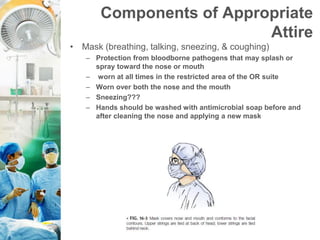
• Mask (breathing, talking, sneezing, & coughing)
– Protection from bloodborne pathogens that may splash or
spray toward the nose or mouth
– worn at all times in the restricted area of the OR suite
– Worn over both the nose and the mouth
– Sneezing???
– Hands should be washed with antimicrobial soap before and
after cleaning the nose and applying a new mask
• To prevent cross-infection, personnel should follow these
steps:
1. Handle the mask only by the strings, Hand hygiene
should be performed anytime the mask is handled.
2. Never lower the mask to hang loosely around the neck,
never place the mask on top of the head, and never place
the mask in a pocket.
3. Promptly discard the mask into the proper receptacle on
removal. Remask with a fresh mask between patients.
4. Change the mask frequently. Do not permit the mask to
become wet. Limit talking to a minimum.
Components of Appropriate
Attire
• Personal Protective Equipment (PPE)
– Aprons: full-front barrier; disposable plastic
• Against liquids & cleaning agents
• Lead aprons: against radiation exposure during procedures (full
body cover, vest, or skirt style
– Gloves: handle any materials or items contaminated by blood &
body substances
• Sterile gloves for sterile tea members & for all invasive
procedures
• Discarded after use
• Avoid opening doors, using a keyboard, or adjusting monitor
settings while wearing soiled gloves
• Double gloving: 1st pair is colored gloves (indicator glove)
• Wash hands after gloves are removed
– Eyewear: blood or body substances splash into the eyes
• Face shield: splash, spray, or splatter to the eyes or face
• Decontaminated or discarded promptly
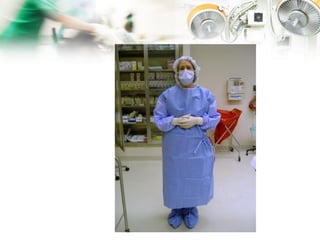
Surgical Gown
• Worn over the scrub suit ; enter the sterile field
• Prevents contamination between the bearer and the field and
differentiates sterile from non-sterile team members
• Resistant to penetration by fluids and blood & should be comfortable
without producing excessive heat buildup
• Reusable and disposable gowns
• Sterilized, but the back nor any area below the level of the sterile field is
unsterile
• Sterile gloves must cover the cuffs of the gown completely to prevent
contamination of the sterile field
Surgical Gloves
- Handle sterile supplies and tissues of the surgical site
- Inspected for damage or wetness
- Inner sterile paper wrap protects the sterility of the gloves when they
are removed from the peel-pack outer wrap
- Absorbable dry cornstarch: facilitate donning and prevent adhesion
of the glove surfaces
- If punctured or torn, changed immediately to prevent escape of
microorganisms from the wearer’s skin and seepage of blood & body
substances from the patient into the glove
Surgical Hand Hygiene
– Surgical scrub
– Removing as many microorganisms as possible from the skin
of the hands and arms before donning sterile surgical attire
– Automatic sensor/ foot or knee operated faucets
– Protective eyewear should be worn
– Purpose:
• Decrease the number of resident microorganisms on skin to an
irreducible minimum
• To keep the population of microorganisms minimal during the
surgical procedure by suppression of growth
• To reduced the hazard of microbial contamination of the surgical
wound by skin flora
Recommendations for surgical
hand preparation
• Remove ring, wrist-watch and bracelets.
Artificial nails are prohibited
• Sinks should be designed to reduce the risk
of splashes
• If hands are visibly soiled, wash hands with
plain soap before surgical preparation.
Remove debris from underneath fingernails
using a nail cleaner, preferably under
running water.
• Surgical hand antisepsis should be
performed (antimicrobial soap or alcohol-
based handrub) before donning sterile
gloves
• Scrub hands and forearms for 2-5 minutes
(using antimicrobial soap)
• Alcohol-based handrub
– Sufficient to keep hands and forearms wet
– Allow hands and forearms to dry thoroughly
before donning sterile gloves
Antimicrobial Skin-cleansing
Agents
– Clorhexidine gluconate (CHG)
– Idophors
– Triclosan
– Alcohol
– Hexachlorophene
– parachlorometaxylenol
Return demonstration
• Return demonstration on Surgical hand
hygiene
– August 18 PM
Gowning & Gloving
– Purpose:
• Exclude skin as a possible contaminant and to create a barrier
between the sterile and non-sterile areas
• The gown protects the patient and the wearer from cross
contamination
– General Considerations
• The scrub person gowns and gloves from a surface separate
from the main sterile field using the closed-gloving method and
then gowns and gloves the surgeon and the rest of the sterile
team using the open-assisted or closed-assisted gloving
method.
• Gown packages preferably are opened on a separate table from
other packages to avoid any chance of contamination from
dripping water.
• Splashing water on scrub attire during the surgical scrub should
be avoided because moisture may contaminate the sterile gown.
Gowning & Gloving
– Drying the hands and arms with a sterile towel
Gowning & Gloving Techniques
– Don the gown before the gloves (closed-gloving or open
gloving technique
– Assisted-open gloving technique
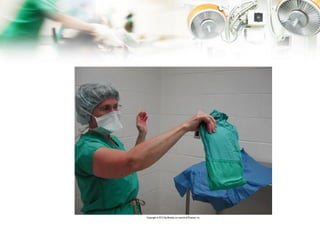
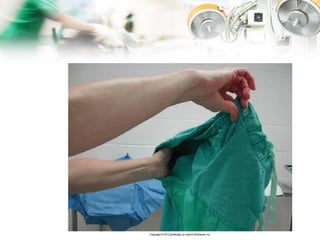
– Gowning Self
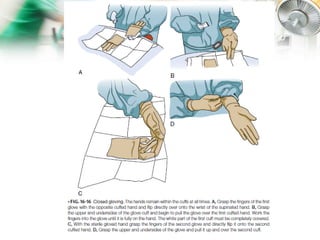
Closed
gloving
Cuff of glove completely covers cuff of
gown
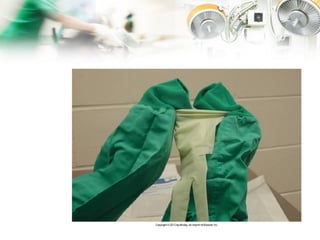
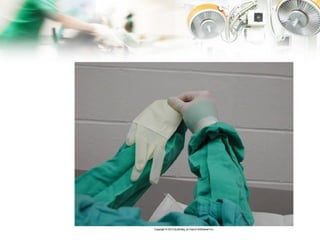
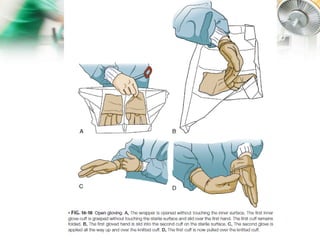
Open gloving technique
• the scrubbed person extends the hands all the way through the
cuffs and sleeves.
• The hands are totally exposed outside the cuffs
Assisted-gloving technique
Assisted-gowning
Removing a contaminated gown
Removing contaminated gloves
Assignment:
• Create a pocket card of the surgical
instruments.
• Briefly define or describe the different
classifications of instruments.
• For each classification, provide a photo of
the instruments.
• Submit: August 24, 2022
Classification of Instruments
– Dissecting and cutting instruments
• Scalpels
• Knives
• Scissors: tissue scissors, suture scissors, wire suture scissors,
Joseph nasal scissors, Potts angled scissors, Lister bandage
scissors, tenotomy scissors
• Blunt dissectors
– Grasping and Holding instruments
• Delicate forceps- bishop eye or forceps
• Adson forceps - Lahey forceps
• Bayonet forcep - Tenaculum
• Smooth tissue forceps - Bone holders- Lambotte bone
• Toothed tissue forceps or forceps with teeth
• Allis forcep
• Babcock forceps
– Debulking instruments
• Biopsy forceps
• Curettes
• Snares
• Clamping & occluding instruments
– Hemostatic clamps
– Hemostats
– Crushing clamps: Haeney clamp, hysterectomy clamp, Ochsner &
Kocher clamps
• Retracting & exposing instruments
– Manual retractors: appendiceal retractor, Volkmann rake retractors,
double-ended Army-navy retractor, Eastmann retractor, Mayo
retractor
– Hooks
– Self-retaining retractors: Weitlaners, Gelpi, Balfour, O’Sullivan-
O’Connor
• Viewing instruments
– Speculums: Auvard & Graves vaginal speculum
• Closure & approximation instruments
– Needle holders: Crile, Haeney, Mayo Hegar needle holder
• Small needle holders: Webster smooth jaw needle holder, Derf snub-
jaw needle holder, Ryder narrow tip needle holder
– Tungsten carbide jaws
– Staplers
Passing of Instruments
Scalpels and Handling
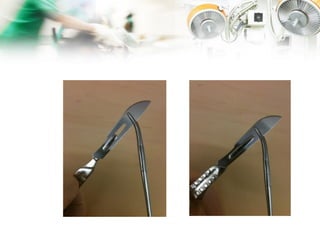
Technique on how to put the
surgical blade:
How to remove the blade:
Scissors & Handling
Forceps & Handling
Retractors & Handling
Needle Holders & Handling
Principles of Asepsis
• Scrubbed persons function within a sterile
field.
• Sterile drapes are used to create a sterile
field.
• All items used within a sterile field must be
sterile
• All items introduced onto a sterile field
should be opened, dispensed, and
transferred by methods that maintain sterility
and integrity
• A sterile field should be maintained and
monitored constantly
• All personnel moving within or around a
sterile field should do so in a manner to
maintain the sterile field
• The edge of anything that encloses sterile
contents is not considered sterile
• Sterile persons keep within the sterile area
• Non-sterile persons keep away from sterile
area
• Moisture may cause contamination
• Destruction of integrity of microbial barriers
result in contamination
Appropriate-Operating-Room-Attire (1).pdf

Appropriate-Operating-Room-Attire (1).pdf

  • 1.
  • 2.
  • 3.
    A team ofhighly trained professionals with a wide range of specialties who is present to offer comprehensive patient care.
  • 4.
    The Surgeon • responsiblefor the patient, as they are the ones who made the decision to operate on the patient in the first place, and they are the ones in charge. • Requests the surgery • Provides consent, history and physical exam • Communicates exact procedure, operative side and special needs prior to surgical case • Assists in positioning the patient • Performs the surgical procedure.
  • 5.
    Anesthesiologist • other attendingphysician in the room, and can generally be thought of as second in command. • The anesthesiologist takes part in all 3 phases of surgery: before, during, and after. • Assesses patient’s risk for receiving anesthesia • Assesses need for appropriate anesthetic during the surgical procedure • Communicates equipment needs to the circulating nurse
  • 6.
    The First Assist •the person helping the surgeon perform the case, also scrubbed into the sterile surgical field. • a resident, physician assistant (PA), nurse practitioner (NP), certified surgical assistant (CSA), or medical student. •It’s their responsibility to assist the surgeon in performing the procedure, which includes a lot of retracting, suctioning, and performing other supportive measures for the surgeon.
  • 7.
    The Scrub Nurse •The scrub nurse is also scrubbed in the surgical field, and is the one rub preparing, organizing, and providing the various surgical tools and instruments to the surgeon and first assist during the case. •gathers the necessary supplies, including the sets of surgical instruments •first one to scrub in and set up a sterile surgical field •helping the surgeon and assistants with their sterile gown and gloves.
  • 8.
    The Circulating Nurse •the point person in helping assist the surgical team outside of the sterile surgical field. • Along with the scrub nurse, they are also responsible for gathering supplies, sterile equipment, and toolsets needed for surgery and anesthesia. • manage the documentation at the computer before and during the case, • verifying the patient’s ID, who all is in the room, • getting the patient comfortable with warming blankets, and the like.
  • 9.
    Medical device company representative Sometimessurgeons will have a representative from a company that makes medical equipment in the operating room. Such equipment might be artificial joints, spine stabilizers, or pacemakers. The representative can help the surgeon with sizing and function of the equipment.
  • 10.
  • 11.
    Learning Objectives • Identifythe components of appropriate OR attire worn in specific areas of the surgical suite • Identify the components of personal protective equipment (PPE) donned before performing surgical hand cleansing • Identify the sterile parameters of a surgical gown • Demonstrate the correct procedure in performing surgical hand scrubbing •
  • 14.
    Purpose & Definition •Effective barriers that both prevent the dissemination of microorganisms to patients and protect personnel from blood and body substances of patients • 2-pc pantsuit, head cover, mask and shoe covers • Sterile gown & gloves (sterile team members at the sterile field) • PPE(eyewear & other protective items for anticipated exposure to blood and body fluids)
  • 17.
    Considerations for Appropriate Attire •Only approved, freshly laundered attire intended for use in the OR is worn within the semi-restricted and restricted areas. • OR attire should not be worn outside the OR suite or outdoors. • Personal hygiene is emphasized. – Not permitted in the OR suite: person with acute infections, cuts, burns, or lesion – Fingernails should be kept short – Jewelry should be removed – Facial make-up should be minimal – Eyewear or spectacles should be wiped with a cleaning solution – Identification badges should be secured – Hand hygiene – Comfortable, supportive, ski-proof shoes
  • 21.
    TRUE or FALSE •Briefcases, backpacks and other personal items are allowed to be taken into the semi-restricted or restricted areas.
  • 22.
    CORRECT or WRONG •Mask maybe worn dangling at any time
  • 23.
    The photo isWRONG. • The filter portion of a surgical mask harbors bacteria collected from the nasopharyngeal airways • The contaminated mask may cross contaminate the scrub attire top when the mask is worn hanging around the neck
  • 24.
    CORRECT or WRONG •OR scrubs should not be worn in the hospital facility outside of the OR area without a clean lab coat or appropriate cover up over them.
  • 25.
    • Evidence showsthat lab coats can be contaminated with large numbers of pathogenic microorganisms • Lab coats are not always discarded daily after use or laundered on a frequent basis
  • 26.
    A YES ora NO?
  • 27.
    • There isa body of evidence that supports covering the hairs & ears due to the fact that hair and skin can harbor bacteria that can be dispersed into the operating room environment
  • 31.
    Components of Appropriate Attire •Body cover: fit snugly; changed as soon as possible whenever it becomes wet or visibly soiled – Those who will not be sterile team members should wear longsleeved jackets with front closures over a scrub suit
  • 32.
    Components of Appropriate Attire •Head cover: cap first before the scrub suit – Facial and head hair is completely covered – Hair is long: bouffant-style hat – Reusabe cloth cap: freshly laundered daily
  • 33.
    Components of Appropriate Attire •Shoe covers: protect from blood and fluid – Protective gloves to change shoe covers – Removed before entering the dressing room area and must be removed before leaving the OR suite
  • 34.
    Components of Appropriate Attire •Mask (breathing, talking, sneezing, & coughing) – Protection from bloodborne pathogens that may splash or spray toward the nose or mouth – worn at all times in the restricted area of the OR suite – Worn over both the nose and the mouth – Sneezing??? – Hands should be washed with antimicrobial soap before and after cleaning the nose and applying a new mask
  • 35.
    • To preventcross-infection, personnel should follow these steps: 1. Handle the mask only by the strings, Hand hygiene should be performed anytime the mask is handled. 2. Never lower the mask to hang loosely around the neck, never place the mask on top of the head, and never place the mask in a pocket. 3. Promptly discard the mask into the proper receptacle on removal. Remask with a fresh mask between patients. 4. Change the mask frequently. Do not permit the mask to become wet. Limit talking to a minimum.
  • 37.
    Components of Appropriate Attire •Personal Protective Equipment (PPE) – Aprons: full-front barrier; disposable plastic • Against liquids & cleaning agents • Lead aprons: against radiation exposure during procedures (full body cover, vest, or skirt style – Gloves: handle any materials or items contaminated by blood & body substances • Sterile gloves for sterile tea members & for all invasive procedures • Discarded after use • Avoid opening doors, using a keyboard, or adjusting monitor settings while wearing soiled gloves • Double gloving: 1st pair is colored gloves (indicator glove) • Wash hands after gloves are removed – Eyewear: blood or body substances splash into the eyes • Face shield: splash, spray, or splatter to the eyes or face • Decontaminated or discarded promptly
  • 39.
    Surgical Gown • Wornover the scrub suit ; enter the sterile field • Prevents contamination between the bearer and the field and differentiates sterile from non-sterile team members • Resistant to penetration by fluids and blood & should be comfortable without producing excessive heat buildup • Reusable and disposable gowns • Sterilized, but the back nor any area below the level of the sterile field is unsterile • Sterile gloves must cover the cuffs of the gown completely to prevent contamination of the sterile field
  • 40.
    Surgical Gloves - Handlesterile supplies and tissues of the surgical site - Inspected for damage or wetness - Inner sterile paper wrap protects the sterility of the gloves when they are removed from the peel-pack outer wrap - Absorbable dry cornstarch: facilitate donning and prevent adhesion of the glove surfaces - If punctured or torn, changed immediately to prevent escape of microorganisms from the wearer’s skin and seepage of blood & body substances from the patient into the glove
  • 42.
    Surgical Hand Hygiene –Surgical scrub – Removing as many microorganisms as possible from the skin of the hands and arms before donning sterile surgical attire – Automatic sensor/ foot or knee operated faucets – Protective eyewear should be worn
  • 43.
    – Purpose: • Decreasethe number of resident microorganisms on skin to an irreducible minimum • To keep the population of microorganisms minimal during the surgical procedure by suppression of growth • To reduced the hazard of microbial contamination of the surgical wound by skin flora
  • 44.
    Recommendations for surgical handpreparation • Remove ring, wrist-watch and bracelets. Artificial nails are prohibited • Sinks should be designed to reduce the risk of splashes • If hands are visibly soiled, wash hands with plain soap before surgical preparation. Remove debris from underneath fingernails using a nail cleaner, preferably under running water.
  • 45.
    • Surgical handantisepsis should be performed (antimicrobial soap or alcohol- based handrub) before donning sterile gloves • Scrub hands and forearms for 2-5 minutes (using antimicrobial soap) • Alcohol-based handrub – Sufficient to keep hands and forearms wet – Allow hands and forearms to dry thoroughly before donning sterile gloves
  • 46.
    Antimicrobial Skin-cleansing Agents – Clorhexidinegluconate (CHG) – Idophors – Triclosan – Alcohol – Hexachlorophene – parachlorometaxylenol
  • 51.
    Return demonstration • Returndemonstration on Surgical hand hygiene – August 18 PM
  • 52.
    Gowning & Gloving –Purpose: • Exclude skin as a possible contaminant and to create a barrier between the sterile and non-sterile areas • The gown protects the patient and the wearer from cross contamination – General Considerations • The scrub person gowns and gloves from a surface separate from the main sterile field using the closed-gloving method and then gowns and gloves the surgeon and the rest of the sterile team using the open-assisted or closed-assisted gloving method. • Gown packages preferably are opened on a separate table from other packages to avoid any chance of contamination from dripping water. • Splashing water on scrub attire during the surgical scrub should be avoided because moisture may contaminate the sterile gown.
  • 53.
    Gowning & Gloving –Drying the hands and arms with a sterile towel
  • 55.
    Gowning & GlovingTechniques – Don the gown before the gloves (closed-gloving or open gloving technique – Assisted-open gloving technique – Gowning Self
  • 60.
  • 65.
    Cuff of glovecompletely covers cuff of gown
  • 69.
    Open gloving technique •the scrubbed person extends the hands all the way through the cuffs and sleeves. • The hands are totally exposed outside the cuffs
  • 71.
  • 72.
  • 73.
  • 74.
  • 77.
    Assignment: • Create apocket card of the surgical instruments. • Briefly define or describe the different classifications of instruments. • For each classification, provide a photo of the instruments. • Submit: August 24, 2022
  • 78.
    Classification of Instruments –Dissecting and cutting instruments • Scalpels • Knives • Scissors: tissue scissors, suture scissors, wire suture scissors, Joseph nasal scissors, Potts angled scissors, Lister bandage scissors, tenotomy scissors • Blunt dissectors – Grasping and Holding instruments • Delicate forceps- bishop eye or forceps • Adson forceps - Lahey forceps • Bayonet forcep - Tenaculum • Smooth tissue forceps - Bone holders- Lambotte bone • Toothed tissue forceps or forceps with teeth • Allis forcep • Babcock forceps – Debulking instruments • Biopsy forceps • Curettes • Snares
  • 79.
    • Clamping &occluding instruments – Hemostatic clamps – Hemostats – Crushing clamps: Haeney clamp, hysterectomy clamp, Ochsner & Kocher clamps • Retracting & exposing instruments – Manual retractors: appendiceal retractor, Volkmann rake retractors, double-ended Army-navy retractor, Eastmann retractor, Mayo retractor – Hooks – Self-retaining retractors: Weitlaners, Gelpi, Balfour, O’Sullivan- O’Connor
  • 80.
    • Viewing instruments –Speculums: Auvard & Graves vaginal speculum • Closure & approximation instruments – Needle holders: Crile, Haeney, Mayo Hegar needle holder • Small needle holders: Webster smooth jaw needle holder, Derf snub- jaw needle holder, Ryder narrow tip needle holder – Tungsten carbide jaws – Staplers
  • 81.
  • 83.
  • 85.
    Technique on howto put the surgical blade:
  • 87.
    How to removethe blade:
  • 89.
  • 90.
  • 92.
  • 94.
  • 99.
    Principles of Asepsis •Scrubbed persons function within a sterile field. • Sterile drapes are used to create a sterile field. • All items used within a sterile field must be sterile • All items introduced onto a sterile field should be opened, dispensed, and transferred by methods that maintain sterility and integrity
  • 100.
    • A sterilefield should be maintained and monitored constantly • All personnel moving within or around a sterile field should do so in a manner to maintain the sterile field • The edge of anything that encloses sterile contents is not considered sterile • Sterile persons keep within the sterile area • Non-sterile persons keep away from sterile area
  • 101.
    • Moisture maycause contamination • Destruction of integrity of microbial barriers result in contamination