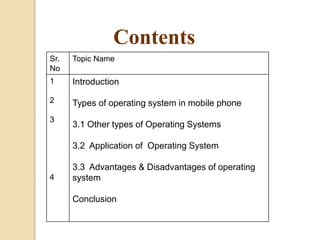
Contents
Sr.
No
Topic Name
1
2
3
4
Introduction
Types of operating system in mobile phone
3.1 Other types of Operating Systems
3.2 Application of Operating System
3.3 Advantages & Disadvantages of operating
system
Conclusion
Difference between a Mobile and a
Smartphone
. Shape and Size
. Design and Durability
. Battery Life
. Cameras
. Operating System
. Internet Connection
Design and capability of mobile OS is very
different than a general purpose OS running
on desktop machine.
 Mobile devices have constraint and
restriction on their physical characteristic
such as screen size, memory, power
 Scare availability of battery power.
 Limited amount of computing &
communication capability.
History
 .1993- The first smartphone ,the IBM Simon
had a touchscreen, email& PDA features.
 .1996-Personal Digital Assistant is
introduced with the palm OS mobile OS
 .2000- Symbian became the first modern
mobile OS on smartphone
 .2002- Microsoft’s first window CE
smartphone are introduced.
 . Blackberry releases its first
smartphone
 .2007- Apple iPhone with ios introduced as
an iPod
.2008-OHA release android 1.0 with the HTC
Dream as the first android phone.
.2009-Samsung announces the BADA OS.
.2012-The leno K800 will the first Intel
smartphone
.2013-canonical announced Ubuntu touch
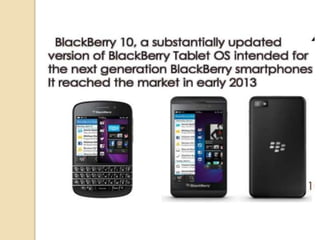
. Blackberry releases new OS
blackberry 10
. Google releases Android kitkat4.4.
.2014-blackberry releases Blackberry 10.3
Google releases Android 5.0 ‘’Lollipop’’
Apple releases ios8
Mobile Operating System Examples
.Google Android OS
.Apple iOS
.Windows 8 Mobile
.Ubuntu Mobile
.Blackberry
.Symbian OS
. Firebox OS
. Bada
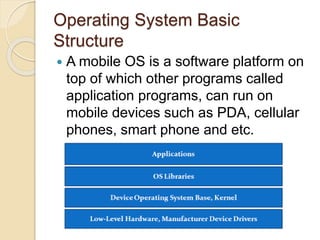
Operating System Basic
Structure
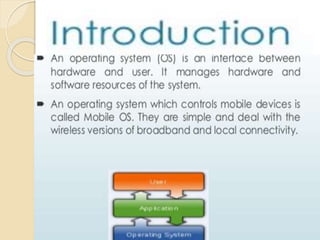
 A mobile OS is a software platform on
top of which other programs called
application programs, can run on
mobile devices such as PDA, cellular
phones, smart phone and etc.
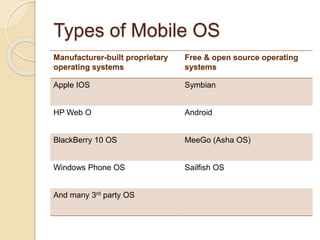
Types of Mobile OS
Manufacturer-built proprietary
operating systems
Free & open source operating
systems
Apple IOS Symbian
HP Web O Android
BlackBerry 10 OS MeeGo (Asha OS)
Windows Phone OS Sailfish OS
And many 3rd party OS
Java ME was formerly known as Java 2
Platform, Micro Edition (J2ME).
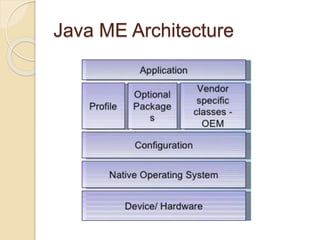
Java ME Architecture
Symbian
OS
The Symbian changed its logo on 2009.
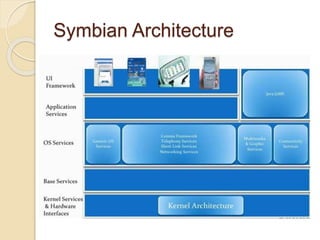
Symbian Architecture
Linux
OS
Tux the penguin is the mascot of Linux
Windows Mobile OS
It is a family of mobile operating
systems developed by Microsoft for smart
phones as the replacement successor
to Windows Mobile.
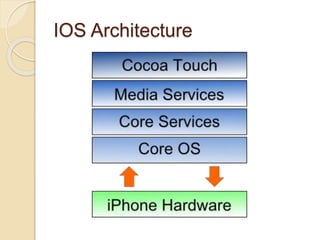
IOS
IOS is a mobile operating system created and
developed by apple.
IOS Architecture
Google Android
Platform OS
Android is a mobile operating system based
on the Linux kernel and currently developed
by Google.
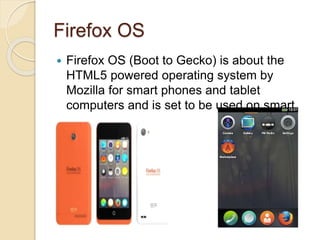
Firefox OS
 Firefox OS (Boot to Gecko) is about the
HTML5 powered operating system by
Mozilla for smart phones and tablet
computers and is set to be used on smart
TVs.
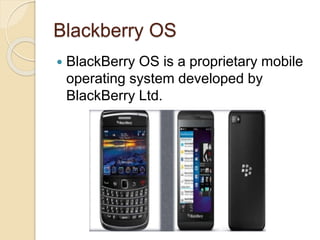
Blackberry OS
 BlackBerry OS is a proprietary mobile
operating system developed by
BlackBerry Ltd.
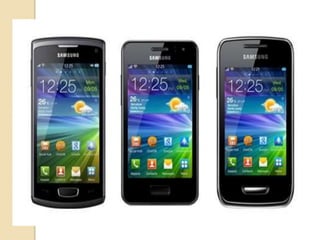
BADA
 Bada (stylized as bada; Korean: 바다)
is an operating system for mobile
devices such as smartphones and
tablet computers. It is developed by
Samsung Electronics. Its name is
derived from "바다 (bada)", meaning
"ocean" or "sea" in Korean. It ranges
from mid- to high-end smartphones.
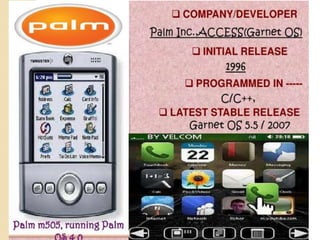
PALM OS
 Palm OS is an embedded operating
system designed for ease of use with a
touch screen-based graphical user
interface.
 It has been implemented on a wide
variety of mobile devices such as smart
phones, barcode readers, and GPS
devices.
 It is run on Arm architecture-based
processors.
 It is designed as a 32-bit architecture.
Applications of OS
 Modern mobile operating systems combine
the features of a personal computer
operating system with other features,
including a touch screen, cellular,
Bluetooth, Wi-Fi, GPS mobile navigation,
camera, video camera, speech recognition,
voice recorder, music player, Near field
communication and Infrared Blaster. It uses
processors like snapdragon, Qualcom ,
SRS processors etc.
Advantages of mobile operating
system
 Advantages of a mobile operating
system include convenience.
 It also includes open source platforms
being well supported.
 It also includes notification ease.
Disadvantages of mobile
operating system
 Disadvantages of mobile operating
system includes instability.
 It also includes a poor battery quality.
Future of Mobile OS
 Firefox OS
 Ubuntu Touch
 Tizen OS
Firefox OS
 Firefox OS is Mozilla’s attempt to create
their own smart phone OS.
 It is based on the Firefox browser and
Geeko rendering engine, with each using
web technologies like HTML 5.
 Mozilla sees the web as the future
application platform for every device.
Ubuntu Touch
 Ubuntu Touch OS developed
by Canonical Ltd.
 Ubuntu Touch aims to provide a similar
user experience as the Unity desktop.
 Canonical aims to release handsets
running the operating system by October
2013.
 Ubuntu Touch devices can be equipped
with a full Ubuntu session and may
change into a full desktop operating
system when plugged into a docking
station.
Tizen OS
 Tizen is an operating system for devices including
smart phones, tablets, in-vehicle infotainment (IVI)
devices, and smart TVs.
 It is an open source system that aims to offer a
consistent user experience across devices.
 The Tizen project resides within the Linux
Foundation and is governed by a Technical
Steering Group (TSG) composed of Intel and
Samsung.
 Tizen provides an environment for application
developers based on the JavaScript libraries
JQuery and JQuery Mobile.
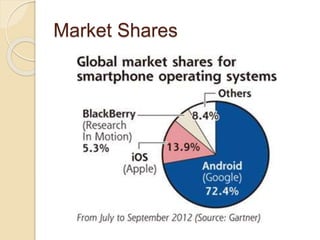
Market Shares
Conclusion
 For developers the operating system is an
ultimate platform to develop apps innovatively
and publish in market very easily. Not only in
mobile phones, the OS is diverging in various
fields like Tabs, Smart TVs and Cameras etc.
 A mobile OS should be a result of factors like
user experience, battery life, cloud readiness,
security and openness. A successful mobile OS
is a result of a design between software and
hardware together.
 Bottom Line – No Operating System is better
than the other. It’s up to you and you’re
requirements to decide which one suits you
better.
References
 http://en.wikipedia.org/wiki/Symbian
 http://www.developer.nokia.com/Community/Wiki/Categ
ory:Symbian
 http://eketab.files.wordpress.com/2007/09/thesymbiano
sarchitecturesourcebook.pdf
 http://www.developer.nokia.com/Resources/Library/
 http://developer.apple.com/library/ios/#releasenotes/Ge
neral/WhatsNewIniOS/Introduction/Introduction.html
 http://developer.apple.com/library/ios/#documentation/m
iscellaneous/conceptual/iphoneostechoverview/Introduc
tion/Introduction.html
 http://developer.apple.com/library/ios/documentation/mi
scellaneous/conceptual/iphoneostechoverview/iPhoneO
STechOverview.pdf
References (Contd.)
 http://www.mozilla.org/en-US/firefox/partners/#
 http://www.ubuntu.com/devices/phone
 https://www.tizen.org/about
Operating Systems in Mobile Phones

Operating Systems in Mobile Phones

  • 3.
    Contents Sr. No Topic Name 1 2 3 4 Introduction Types ofoperating system in mobile phone 3.1 Other types of Operating Systems 3.2 Application of Operating System 3.3 Advantages & Disadvantages of operating system Conclusion
  • 7.
    Difference between aMobile and a Smartphone . Shape and Size . Design and Durability . Battery Life . Cameras . Operating System . Internet Connection
  • 9.
    Design and capabilityof mobile OS is very different than a general purpose OS running on desktop machine.  Mobile devices have constraint and restriction on their physical characteristic such as screen size, memory, power  Scare availability of battery power.  Limited amount of computing & communication capability.
  • 10.
    History  .1993- Thefirst smartphone ,the IBM Simon had a touchscreen, email& PDA features.  .1996-Personal Digital Assistant is introduced with the palm OS mobile OS  .2000- Symbian became the first modern mobile OS on smartphone  .2002- Microsoft’s first window CE smartphone are introduced.  . Blackberry releases its first smartphone  .2007- Apple iPhone with ios introduced as an iPod
  • 11.
    .2008-OHA release android1.0 with the HTC Dream as the first android phone. .2009-Samsung announces the BADA OS. .2012-The leno K800 will the first Intel smartphone .2013-canonical announced Ubuntu touch . Blackberry releases new OS blackberry 10 . Google releases Android kitkat4.4. .2014-blackberry releases Blackberry 10.3 Google releases Android 5.0 ‘’Lollipop’’ Apple releases ios8
  • 13.
    Mobile Operating SystemExamples .Google Android OS .Apple iOS .Windows 8 Mobile .Ubuntu Mobile .Blackberry .Symbian OS . Firebox OS . Bada
  • 15.
    Operating System Basic Structure A mobile OS is a software platform on top of which other programs called application programs, can run on mobile devices such as PDA, cellular phones, smart phone and etc.
  • 16.
    Types of MobileOS Manufacturer-built proprietary operating systems Free & open source operating systems Apple IOS Symbian HP Web O Android BlackBerry 10 OS MeeGo (Asha OS) Windows Phone OS Sailfish OS And many 3rd party OS
  • 18.
    Java ME wasformerly known as Java 2 Platform, Micro Edition (J2ME).
  • 19.
  • 20.
  • 21.
  • 22.
    Linux OS Tux the penguinis the mascot of Linux
  • 23.
    Windows Mobile OS Itis a family of mobile operating systems developed by Microsoft for smart phones as the replacement successor to Windows Mobile.
  • 24.
    IOS IOS is amobile operating system created and developed by apple.
  • 25.
  • 26.
    Google Android Platform OS Androidis a mobile operating system based on the Linux kernel and currently developed by Google.
  • 27.
    Firefox OS  FirefoxOS (Boot to Gecko) is about the HTML5 powered operating system by Mozilla for smart phones and tablet computers and is set to be used on smart TVs.
  • 28.
    Blackberry OS  BlackBerryOS is a proprietary mobile operating system developed by BlackBerry Ltd.
  • 30.
    BADA  Bada (stylizedas bada; Korean: 바다) is an operating system for mobile devices such as smartphones and tablet computers. It is developed by Samsung Electronics. Its name is derived from "바다 (bada)", meaning "ocean" or "sea" in Korean. It ranges from mid- to high-end smartphones.
  • 32.
    PALM OS  PalmOS is an embedded operating system designed for ease of use with a touch screen-based graphical user interface.  It has been implemented on a wide variety of mobile devices such as smart phones, barcode readers, and GPS devices.  It is run on Arm architecture-based processors.  It is designed as a 32-bit architecture.
  • 34.
    Applications of OS Modern mobile operating systems combine the features of a personal computer operating system with other features, including a touch screen, cellular, Bluetooth, Wi-Fi, GPS mobile navigation, camera, video camera, speech recognition, voice recorder, music player, Near field communication and Infrared Blaster. It uses processors like snapdragon, Qualcom , SRS processors etc.
  • 35.
    Advantages of mobileoperating system  Advantages of a mobile operating system include convenience.  It also includes open source platforms being well supported.  It also includes notification ease.
  • 36.
    Disadvantages of mobile operatingsystem  Disadvantages of mobile operating system includes instability.  It also includes a poor battery quality.
  • 37.
    Future of MobileOS  Firefox OS  Ubuntu Touch  Tizen OS
  • 38.
    Firefox OS  FirefoxOS is Mozilla’s attempt to create their own smart phone OS.  It is based on the Firefox browser and Geeko rendering engine, with each using web technologies like HTML 5.  Mozilla sees the web as the future application platform for every device.
  • 39.
    Ubuntu Touch  UbuntuTouch OS developed by Canonical Ltd.  Ubuntu Touch aims to provide a similar user experience as the Unity desktop.  Canonical aims to release handsets running the operating system by October 2013.  Ubuntu Touch devices can be equipped with a full Ubuntu session and may change into a full desktop operating system when plugged into a docking station.
  • 40.
    Tizen OS  Tizenis an operating system for devices including smart phones, tablets, in-vehicle infotainment (IVI) devices, and smart TVs.  It is an open source system that aims to offer a consistent user experience across devices.  The Tizen project resides within the Linux Foundation and is governed by a Technical Steering Group (TSG) composed of Intel and Samsung.  Tizen provides an environment for application developers based on the JavaScript libraries JQuery and JQuery Mobile.
  • 41.
  • 42.
    Conclusion  For developersthe operating system is an ultimate platform to develop apps innovatively and publish in market very easily. Not only in mobile phones, the OS is diverging in various fields like Tabs, Smart TVs and Cameras etc.  A mobile OS should be a result of factors like user experience, battery life, cloud readiness, security and openness. A successful mobile OS is a result of a design between software and hardware together.  Bottom Line – No Operating System is better than the other. It’s up to you and you’re requirements to decide which one suits you better.
  • 43.
    References  http://en.wikipedia.org/wiki/Symbian  http://www.developer.nokia.com/Community/Wiki/Categ ory:Symbian http://eketab.files.wordpress.com/2007/09/thesymbiano sarchitecturesourcebook.pdf  http://www.developer.nokia.com/Resources/Library/  http://developer.apple.com/library/ios/#releasenotes/Ge neral/WhatsNewIniOS/Introduction/Introduction.html  http://developer.apple.com/library/ios/#documentation/m iscellaneous/conceptual/iphoneostechoverview/Introduc tion/Introduction.html  http://developer.apple.com/library/ios/documentation/mi scellaneous/conceptual/iphoneostechoverview/iPhoneO STechOverview.pdf
  • 44.
    References (Contd.)  http://www.mozilla.org/en-US/firefox/partners/# http://www.ubuntu.com/devices/phone  https://www.tizen.org/about