MOBILE OPERATING SYSTEM
 A mobile operating system is the operating system that
operates a Smartphone, tablet, PDA, or other digital mobile
devices.
 Modern mobile operating systems combine the features of a
personal computer operating system with touch screen, cellular,
Bluetooth, WiFi, GPS mobile navigation, camera, video camera,
speech recognition, voice recorder, music player, near field
communication, personal digital assistant (PDA) and other
FEATURES
 Multitasking
 Scheduling
 Memory Allocation
 File System Interface
 Keypad Interface
 I/O Interface
 Protection and Security
 Multimedia features
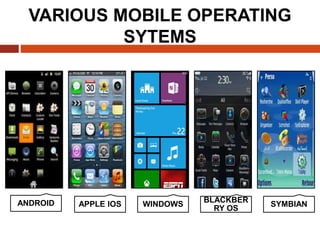
VARIOUS MOBILE OPERATING
SYTEMS
ANDROID APPLE IOS WINDOWS
BLACKBER
RY OS
SYMBIAN
REVENUE MODEL
Virtual Goods
Advertising Revenue
Subscription Revenue
Download Revenue
BUSINESS TO BUSINESS SCOPE
Mobile Network Operators
Mobile Handset Manufacturers
OS And Application Store Companies
Wireless/Mobile Application Developers
Wireless/Mobile Infrastructure Providers
Personal Computing Device Manufacturers
Services Infrastructure And Outsourcing Providers
WORLD MARKET
Android maintained its leadership position, with strong contributions from Samsung and its Galaxy
S4. Not to be overlooked were LG and Chinese vendors Huawei, Lenovo, and ZTE, which each
recorded double-digit shipment volumes in the millions. Combined, these vendors accounted for
62.5% of all Android-powered smartphone shipments during the quarter.
iOS finished the quarter as the clear number 2 operating system, showing that, even without new
product launches, demand remains strong. Moreover, Apple added new mobile operators to its
camp, boosting short-term volumes and cementing long-term end-user relationships.
Windows Phone posted the largest year-over-year increase among the top five smartphone
platforms, and in the process reinforced its position as the number 3 smartphone operating
system. Driving this result was Nokia, which released two new smartphones and grew its presence
at multiple mobile operators
BlackBerry saw its market share decline during the quarter, reaching levels not seen in the history
of IDC's Mobile Phone Tracker. However, BlackBerry has shown steady progress since the launch
of its BB 10 platform, which has grown to three models, additional mobile operators, and a greater
presence within its total volumes.
WORLD MARKET SHARE
YEAR RIM SYMBIAN IOS ANDROID BADA
WINDOWS
PHONE
OTHER
SMARTPHONE
S
2013 1.9% 15.6% 78.4% 3.2% 0.9%
2012 5.1% 4.2% 19.1% 66.2% 2.3% 2.5% 0.5%
2011 10.9% 18.7% 18.9% 46.5% 2.0% 1.7% 1.0%
2010 16.6% 37.3% 15.6% 22.5% 1.2% 0.0% 2.6%
2009 19.9% 46.9% 14.4% 3.9% 6.1%
INDIAN MARKET SHARE
YEAR RIM SYMBIAN IOS ANDROID BADA
WINDOWS
PHONE
2013 7.7% 12.9% 81% 3.8%
2012 9.9% 23.3% 2.4% 50.6% 10.2% 3.6%
2011 13.5% 46.6% 2.4% 28.2% 8.3% 1.2%
2010 1.7% 71.3% 0.72% 11.21% 1.35% 0.18%
STRATEGIES ADOPTED
iOS
• Focus on developed markets
• Unify hardware and software
• One platform user interface
• Providing large number of apps
• Elegant and classy look - Price
ANDROID
• Develop a family tree of Android.
• Build killer applications
• Be Free and Open
• Advertising through Google Web Search Engine
• Partnering with Carriers
WINDOWS
• Seamless integration with Microsoft platform
• Cloud Services
• Price cut
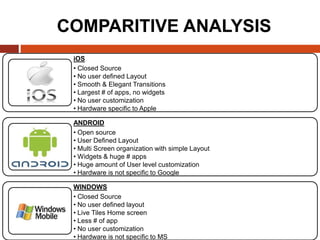
COMPARITIVE ANALYSIS
iOS
• Closed Source
• No user defined Layout
• Smooth & Elegant Transitions
• Largest # of apps, no widgets
• No user customization
• Hardware specific to Apple
ANDROID
• Open source
• User Defined Layout
• Multi Screen organization with simple Layout
• Widgets & huge # apps
• Huge amount of User level customization
• Hardware is not specific to Google
WINDOWS
• Closed Source
• No user defined layout
• Live Tiles Home screen
• Less # of app
• No user customization
• Hardware is not specific to MS
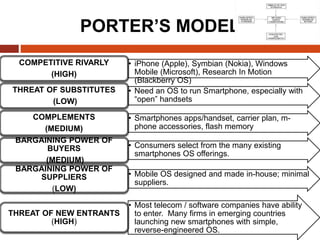
PORTER’S MODEL
• iPhone (Apple), Symbian (Nokia), Windows
Mobile (Microsoft), Research In Motion
(Blackberry OS)
COMPETITIVE RIVARLY
(HIGH)
• Need an OS to run Smartphone, especially with
“open” handsets
THREAT OF SUBSTITUTES
(LOW)
• Smartphones apps/handset, carrier plan, m-
phone accessories, flash memory
COMPLEMENTS
(MEDIUM)
• Consumers select from the many existing
smartphones OS offerings.
BARGAINING POWER OF
BUYERS
(MEDIUM)
• Mobile OS designed and made in-house; minimal
suppliers.
BARGAINING POWER OF
SUPPLIERS
(LOW)
• Most telecom / software companies have ability
to enter. Many firms in emerging countries
launching new smartphones with simple,
reverse-engineered OS.
THREAT OF NEW ENTRANTS
(HIGH)
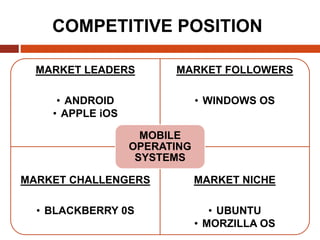
COMPETITIVE POSITION
MARKET LEADERS
• ANDROID
• APPLE iOS
MARKET FOLLOWERS
• WINDOWS OS
MARKET CHALLENGERS
• BLACKBERRY 0S
MARKET NICHE
• UBUNTU
• MORZILLA OS
MOBILE
OPERATING
SYSTEMS
EMERGING PLAYERS
MOZILLA'S
FIREFOX
OS
UBUNTU TIZEN
JOLLA
SAILFISH
ALIYUN
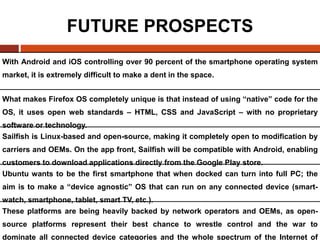
FUTURE PROSPECTS
With Android and iOS controlling over 90 percent of the smartphone operating system
market, it is extremely difficult to make a dent in the space.
What makes Firefox OS completely unique is that instead of using “native” code for the
OS, it uses open web standards – HTML, CSS and JavaScript – with no proprietary
software or technology.
Sailfish is Linux-based and open-source, making it completely open to modification by
carriers and OEMs. On the app front, Sailfish will be compatible with Android, enabling
customers to download applications directly from the Google Play store.
Ubuntu wants to be the first smartphone that when docked can turn into full PC; the
aim is to make a “device agnostic” OS that can run on any connected device (smart-
watch, smartphone, tablet, smart TV, etc.).
These platforms are being heavily backed by network operators and OEMs, as open-
source platforms represent their best chance to wrestle control and the war to
dominate all connected device categories and the whole spectrum of the Internet of
CONCLUSION
 Smartphone and Tablets powered by Mobile OS will continue
drawing focus in Global market and rule the IT and Telecom
Industry year ahead.
 Traditional mobile definition has been completely revamped in
past few years with faster processor, rich HD display with LED
technology. Cell phones are now capable of browsing over
internet wirelessly using Wi-Fi /, 3G or 4G technology.
 Apple iOS and Google Android – Rules the mobile operating
system followed by others.
REFERENCES
 Wikipedia
 Google Annual Report (2008)
 Gartner (2012), Market Share: Mobile Devices by Region
and Country
 OS News (2013), The second operating system hiding in
every mobile phone
 Renub Research (2012), India Smartphone Market &
Operating System Analysis Forecast”

Mobile Operating Systems

  • 2.
    MOBILE OPERATING SYSTEM A mobile operating system is the operating system that operates a Smartphone, tablet, PDA, or other digital mobile devices.  Modern mobile operating systems combine the features of a personal computer operating system with touch screen, cellular, Bluetooth, WiFi, GPS mobile navigation, camera, video camera, speech recognition, voice recorder, music player, near field communication, personal digital assistant (PDA) and other
  • 3.
    FEATURES  Multitasking  Scheduling Memory Allocation  File System Interface  Keypad Interface  I/O Interface  Protection and Security  Multimedia features
  • 4.
    VARIOUS MOBILE OPERATING SYTEMS ANDROIDAPPLE IOS WINDOWS BLACKBER RY OS SYMBIAN
  • 5.
    REVENUE MODEL Virtual Goods AdvertisingRevenue Subscription Revenue Download Revenue
  • 6.
    BUSINESS TO BUSINESSSCOPE Mobile Network Operators Mobile Handset Manufacturers OS And Application Store Companies Wireless/Mobile Application Developers Wireless/Mobile Infrastructure Providers Personal Computing Device Manufacturers Services Infrastructure And Outsourcing Providers
  • 7.
    WORLD MARKET Android maintainedits leadership position, with strong contributions from Samsung and its Galaxy S4. Not to be overlooked were LG and Chinese vendors Huawei, Lenovo, and ZTE, which each recorded double-digit shipment volumes in the millions. Combined, these vendors accounted for 62.5% of all Android-powered smartphone shipments during the quarter. iOS finished the quarter as the clear number 2 operating system, showing that, even without new product launches, demand remains strong. Moreover, Apple added new mobile operators to its camp, boosting short-term volumes and cementing long-term end-user relationships. Windows Phone posted the largest year-over-year increase among the top five smartphone platforms, and in the process reinforced its position as the number 3 smartphone operating system. Driving this result was Nokia, which released two new smartphones and grew its presence at multiple mobile operators BlackBerry saw its market share decline during the quarter, reaching levels not seen in the history of IDC's Mobile Phone Tracker. However, BlackBerry has shown steady progress since the launch of its BB 10 platform, which has grown to three models, additional mobile operators, and a greater presence within its total volumes.
  • 8.
    WORLD MARKET SHARE YEARRIM SYMBIAN IOS ANDROID BADA WINDOWS PHONE OTHER SMARTPHONE S 2013 1.9% 15.6% 78.4% 3.2% 0.9% 2012 5.1% 4.2% 19.1% 66.2% 2.3% 2.5% 0.5% 2011 10.9% 18.7% 18.9% 46.5% 2.0% 1.7% 1.0% 2010 16.6% 37.3% 15.6% 22.5% 1.2% 0.0% 2.6% 2009 19.9% 46.9% 14.4% 3.9% 6.1%
  • 9.
    INDIAN MARKET SHARE YEARRIM SYMBIAN IOS ANDROID BADA WINDOWS PHONE 2013 7.7% 12.9% 81% 3.8% 2012 9.9% 23.3% 2.4% 50.6% 10.2% 3.6% 2011 13.5% 46.6% 2.4% 28.2% 8.3% 1.2% 2010 1.7% 71.3% 0.72% 11.21% 1.35% 0.18%
  • 10.
    STRATEGIES ADOPTED iOS • Focuson developed markets • Unify hardware and software • One platform user interface • Providing large number of apps • Elegant and classy look - Price ANDROID • Develop a family tree of Android. • Build killer applications • Be Free and Open • Advertising through Google Web Search Engine • Partnering with Carriers WINDOWS • Seamless integration with Microsoft platform • Cloud Services • Price cut
  • 11.
    COMPARITIVE ANALYSIS iOS • ClosedSource • No user defined Layout • Smooth & Elegant Transitions • Largest # of apps, no widgets • No user customization • Hardware specific to Apple ANDROID • Open source • User Defined Layout • Multi Screen organization with simple Layout • Widgets & huge # apps • Huge amount of User level customization • Hardware is not specific to Google WINDOWS • Closed Source • No user defined layout • Live Tiles Home screen • Less # of app • No user customization • Hardware is not specific to MS
  • 12.
    PORTER’S MODEL • iPhone(Apple), Symbian (Nokia), Windows Mobile (Microsoft), Research In Motion (Blackberry OS) COMPETITIVE RIVARLY (HIGH) • Need an OS to run Smartphone, especially with “open” handsets THREAT OF SUBSTITUTES (LOW) • Smartphones apps/handset, carrier plan, m- phone accessories, flash memory COMPLEMENTS (MEDIUM) • Consumers select from the many existing smartphones OS offerings. BARGAINING POWER OF BUYERS (MEDIUM) • Mobile OS designed and made in-house; minimal suppliers. BARGAINING POWER OF SUPPLIERS (LOW) • Most telecom / software companies have ability to enter. Many firms in emerging countries launching new smartphones with simple, reverse-engineered OS. THREAT OF NEW ENTRANTS (HIGH)
  • 13.
    COMPETITIVE POSITION MARKET LEADERS •ANDROID • APPLE iOS MARKET FOLLOWERS • WINDOWS OS MARKET CHALLENGERS • BLACKBERRY 0S MARKET NICHE • UBUNTU • MORZILLA OS MOBILE OPERATING SYSTEMS
  • 14.
  • 15.
    FUTURE PROSPECTS With Androidand iOS controlling over 90 percent of the smartphone operating system market, it is extremely difficult to make a dent in the space. What makes Firefox OS completely unique is that instead of using “native” code for the OS, it uses open web standards – HTML, CSS and JavaScript – with no proprietary software or technology. Sailfish is Linux-based and open-source, making it completely open to modification by carriers and OEMs. On the app front, Sailfish will be compatible with Android, enabling customers to download applications directly from the Google Play store. Ubuntu wants to be the first smartphone that when docked can turn into full PC; the aim is to make a “device agnostic” OS that can run on any connected device (smart- watch, smartphone, tablet, smart TV, etc.). These platforms are being heavily backed by network operators and OEMs, as open- source platforms represent their best chance to wrestle control and the war to dominate all connected device categories and the whole spectrum of the Internet of
  • 16.
    CONCLUSION  Smartphone andTablets powered by Mobile OS will continue drawing focus in Global market and rule the IT and Telecom Industry year ahead.  Traditional mobile definition has been completely revamped in past few years with faster processor, rich HD display with LED technology. Cell phones are now capable of browsing over internet wirelessly using Wi-Fi /, 3G or 4G technology.  Apple iOS and Google Android – Rules the mobile operating system followed by others.
  • 17.
    REFERENCES  Wikipedia  GoogleAnnual Report (2008)  Gartner (2012), Market Share: Mobile Devices by Region and Country  OS News (2013), The second operating system hiding in every mobile phone  Renub Research (2012), India Smartphone Market & Operating System Analysis Forecast”