

i Operating Systems
(iOS)
OUTLINE
 Introduction
 History
 Working Process
 Technologies
 Advantages

 Disadvantages
 Conclusion
INTRODUCTION
 iOS (formerly iPhone OS) is a mobile operating

system originally developed for the iPhone later
extended to ipad and ipod.
 iOS is derived from Mac OS X, with which it
shares the Darwinfoundation, and is therefore
a Unix-like operating system.
 Apple licenses the trademark for "iOS" from Cisco
Systems (who own IOS).
HISTORY
 The operating system was unveiled with the

iPhone at the Macworld Conference & Expo,
January 9, 2007, and released in June of that
year.
 On March 6, 2008, Apple released the first beta,
along with a new name for the operating system:
"iPhone OS”.
 In June 2010, Apple rebranded iPhone OS as
"iOS".
 Apple licensed the "IOS" trademark from Cisco.
Version History
 iOS 1.x: initial OS release
 iOS 2.x: second major OS release
 iOS 3.x: third major OS release
 iOS 4.x: fourth major OS release
 iOS 5.x: fifth major OS release
WORKING PROCESS
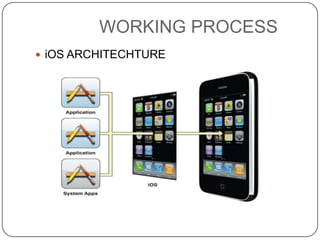
 iOS ARCHITECHTURE
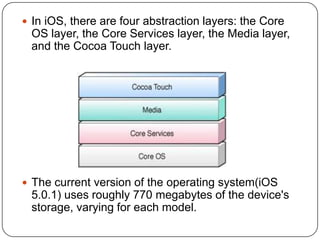
 In iOS, there are four abstraction layers: the Core

OS layer, the Core Services layer, the Media layer,
and the Cocoa Touch layer.

 The current version of the operating system(iOS

5.0.1) uses roughly 770 megabytes of the device's
storage, varying for each model.
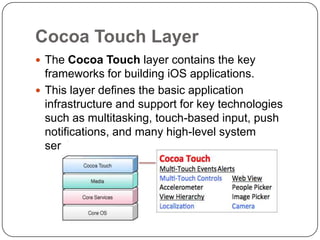
Cocoa Touch Layer
 The Cocoa Touch layer contains the key

frameworks for building iOS applications.
 This layer defines the basic application
infrastructure and support for key technologies
such as multitasking, touch-based input, push
notifications, and many high-level system
services.
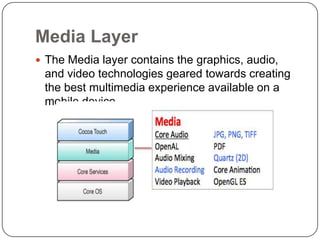
Media Layer
 The Media layer contains the graphics, audio,

and video technologies geared towards creating
the best multimedia experience available on a
mobile device.
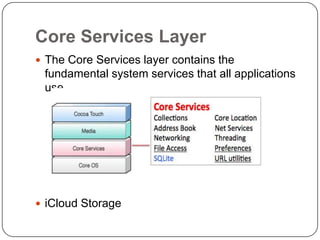
Core Services Layer
 The Core Services layer contains the

fundamental system services that all applications
use.

 iCloud Storage
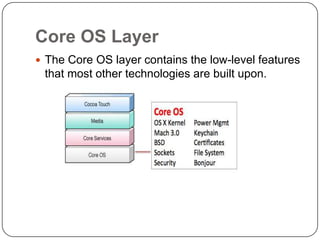
Core OS Layer
 The Core OS layer contains the low-level features

that most other technologies are built upon.
TECHNOLOGIES
 iPhone
 iPad
 iPod
 Apple Tv
iPhone
 At the Macworld Conference & Expo in January

2007, Steve Jobs revealed the long
anticipated iPhone, a convergence of an Internetenabled smartphone and iPod.
 . The iPhone features a 3.5-inch (89 mm) touch
screen display, 4, 8, or 16 GB of
memory, Bluetooth, and Wi-Fi (both "b" and
"g"). The iPhone first became available on June
29, 2007 for $499 (4 GB) and $599 (8 GB) with
an AT&T contract.
 On October 4, 2011, Apple unveiled the iPhone
4S.
iPad
 On January 27, 2010, Apple introduced their

much-anticipated media tablet, the iPad running a
modified version of iOS.
 Offers multi-touch interaction with multimedia
formats including newspapers, magazines,
ebooks, textbooks, photos, movies, TV shows
videos, music, word processing documents,
spreadsheets, video games, and most existing
iPhone apps.
 On March 2, 2011, Apple introduced an updated
iPad model which had a faster processor and two
cameras on the front and back respectively.
iPod
 On October 23, 2001, Apple introduced

the iPod digital music player.
 The iPod is the market leader in portable music
players by a significant margin, with more than
220 million units shipped as of September 2009.
 iPod Shuffle
 iPod Nano
 iPod Classic
Apple Tv
 Apple TV is a digital media receiver developed

and sold by Apple.
 Apple offered a preview of the device in
September 2006 and began shipping it the
following March.It initially shipped with a
40 GB hard disk; a 160 GB version was
introduced two months later and the earlier model
was ultimately discontinued.
 Apple TV allows consumers to use an HDTV set
to view photos, play music and watch video that
originates from limited Internet services or a local
network.
ADVANTAGES
 Connectivity
 Reliability
 Scalability
 Security
DISADVANTAGES
 Semi-thread message
 There is no real features upgrade for iPod
 Unlock way is complicated
 Mail does not support the attachment directly
CONCLUSION
 Thus, iOS is Apple's mobile operating system

developed originally for the iPhone later extended
to iPad and iPod as well.
 Apple licenses the trademark for "iOS" from Cisco
Systems (who own IOS), the same company with
which Apple had earlier settled a dispute over the
"iPhone" trademark.
 iOS 4 is the first version of the OS to be a free
upgrade on the iPod touch; Apple had charged
$9.99 for earlier upgrades.
Apple iOS - A modern way to mobile operating system

Apple iOS - A modern way to mobile operating system

  • 1.
  • 2.
    OUTLINE  Introduction  History Working Process  Technologies  Advantages  Disadvantages  Conclusion
  • 3.
    INTRODUCTION  iOS (formerlyiPhone OS) is a mobile operating system originally developed for the iPhone later extended to ipad and ipod.  iOS is derived from Mac OS X, with which it shares the Darwinfoundation, and is therefore a Unix-like operating system.  Apple licenses the trademark for "iOS" from Cisco Systems (who own IOS).
  • 4.
    HISTORY  The operatingsystem was unveiled with the iPhone at the Macworld Conference & Expo, January 9, 2007, and released in June of that year.  On March 6, 2008, Apple released the first beta, along with a new name for the operating system: "iPhone OS”.  In June 2010, Apple rebranded iPhone OS as "iOS".  Apple licensed the "IOS" trademark from Cisco.
  • 5.
    Version History  iOS1.x: initial OS release  iOS 2.x: second major OS release  iOS 3.x: third major OS release  iOS 4.x: fourth major OS release  iOS 5.x: fifth major OS release
  • 6.
  • 7.
     In iOS,there are four abstraction layers: the Core OS layer, the Core Services layer, the Media layer, and the Cocoa Touch layer.  The current version of the operating system(iOS 5.0.1) uses roughly 770 megabytes of the device's storage, varying for each model.
  • 8.
    Cocoa Touch Layer The Cocoa Touch layer contains the key frameworks for building iOS applications.  This layer defines the basic application infrastructure and support for key technologies such as multitasking, touch-based input, push notifications, and many high-level system services.
  • 9.
    Media Layer  TheMedia layer contains the graphics, audio, and video technologies geared towards creating the best multimedia experience available on a mobile device.
  • 10.
    Core Services Layer The Core Services layer contains the fundamental system services that all applications use.  iCloud Storage
  • 11.
    Core OS Layer The Core OS layer contains the low-level features that most other technologies are built upon.
  • 12.
  • 13.
    iPhone  At theMacworld Conference & Expo in January 2007, Steve Jobs revealed the long anticipated iPhone, a convergence of an Internetenabled smartphone and iPod.  . The iPhone features a 3.5-inch (89 mm) touch screen display, 4, 8, or 16 GB of memory, Bluetooth, and Wi-Fi (both "b" and "g"). The iPhone first became available on June 29, 2007 for $499 (4 GB) and $599 (8 GB) with an AT&T contract.  On October 4, 2011, Apple unveiled the iPhone 4S.
  • 14.
    iPad  On January27, 2010, Apple introduced their much-anticipated media tablet, the iPad running a modified version of iOS.  Offers multi-touch interaction with multimedia formats including newspapers, magazines, ebooks, textbooks, photos, movies, TV shows videos, music, word processing documents, spreadsheets, video games, and most existing iPhone apps.  On March 2, 2011, Apple introduced an updated iPad model which had a faster processor and two cameras on the front and back respectively.
  • 15.
    iPod  On October23, 2001, Apple introduced the iPod digital music player.  The iPod is the market leader in portable music players by a significant margin, with more than 220 million units shipped as of September 2009.  iPod Shuffle  iPod Nano  iPod Classic
  • 16.
    Apple Tv  AppleTV is a digital media receiver developed and sold by Apple.  Apple offered a preview of the device in September 2006 and began shipping it the following March.It initially shipped with a 40 GB hard disk; a 160 GB version was introduced two months later and the earlier model was ultimately discontinued.  Apple TV allows consumers to use an HDTV set to view photos, play music and watch video that originates from limited Internet services or a local network.
  • 17.
  • 18.
    DISADVANTAGES  Semi-thread message There is no real features upgrade for iPod  Unlock way is complicated  Mail does not support the attachment directly
  • 19.
    CONCLUSION  Thus, iOSis Apple's mobile operating system developed originally for the iPhone later extended to iPad and iPod as well.  Apple licenses the trademark for "iOS" from Cisco Systems (who own IOS), the same company with which Apple had earlier settled a dispute over the "iPhone" trademark.  iOS 4 is the first version of the OS to be a free upgrade on the iPod touch; Apple had charged $9.99 for earlier upgrades.