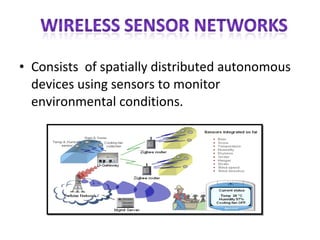
Consists  of spatially distributed autonomous devices using sensors to monitor environmental conditions.
Small physical size and low power consumption Concurrency-intensive operation Limited Physical Parallelism and Controller Hierarchy Diversity in Design and Usage Robust Operation
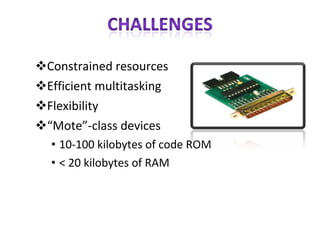
Constrained resources Efficient multitasking Flexibility “ Mote”-class devices 10-100 kilobytes of code ROM < 20 kilobytes of RAM
Portability Flexibility Efficient  Multitasking Networking (TCP/IP)‏ Size
 
Free and open source component-based operating system. Started as a collaboration between the University of California, Intel Research. Embedded operating system written in the nesC programming language. Event driven Operating System. Application and Libraries are written using nesC,a programming language.
Specifically  designed for WSN. Event-driven OS. Completely non-blocking. Programs are built out of software  components . Tasks are  non-preemptive  and run in  FIFO  order.  Tiny OS code is  statically linked.
Open source,  highly portable,   multitasking   operating system. Developed by  Adam Dunkels  at the  Swedish Institute of Computer Science. First OS for sensor networks to provide TCP/IP. Protothreads , a extremely lightweight, stackless threads.
Multitasking kernel Preemptive scheduling Managed Memory Allocator Protothreads TCP/IP networking, including IPv6
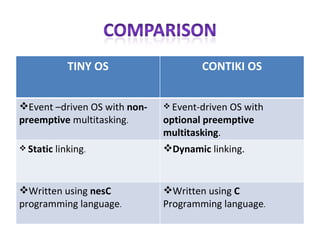
TINY OS CONTIKI OS Event –driven OS with  non-preemptive  multitasking . Event-driven OS with  optional preemptive multitasking . Static  linking . Dynamic  linking. Written using  nesC  programming language . Written using  C  Programming language .
 
N etwork  E mbedded  S ystems  C Event-driven programming language used to build applications for the TinyOS platform. An extension to the C programming language Designed to embody the structuring concepts and execution model of TinyOS.
Separation of construction and composition. Specification of component behaviour in terms of set of interfaces. Interfaces are bidirectional. Components are statically linked. Designed to run on embedded devices used in WSN .
 

Introduction to Tiny OS

  • 1.
  • 2.
  • 3.
    Consists ofspatially distributed autonomous devices using sensors to monitor environmental conditions.
  • 4.
    Small physical sizeand low power consumption Concurrency-intensive operation Limited Physical Parallelism and Controller Hierarchy Diversity in Design and Usage Robust Operation
  • 5.
    Constrained resources Efficientmultitasking Flexibility “ Mote”-class devices 10-100 kilobytes of code ROM < 20 kilobytes of RAM
  • 6.
    Portability Flexibility Efficient Multitasking Networking (TCP/IP)‏ Size
  • 7.
  • 8.
    Free and opensource component-based operating system. Started as a collaboration between the University of California, Intel Research. Embedded operating system written in the nesC programming language. Event driven Operating System. Application and Libraries are written using nesC,a programming language.
  • 9.
    Specifically designedfor WSN. Event-driven OS. Completely non-blocking. Programs are built out of software components . Tasks are non-preemptive and run in FIFO order. Tiny OS code is statically linked.
  • 10.
    Open source, highly portable, multitasking operating system. Developed by Adam Dunkels at the Swedish Institute of Computer Science. First OS for sensor networks to provide TCP/IP. Protothreads , a extremely lightweight, stackless threads.
  • 11.
    Multitasking kernel Preemptivescheduling Managed Memory Allocator Protothreads TCP/IP networking, including IPv6
  • 12.
    TINY OS CONTIKIOS Event –driven OS with non-preemptive multitasking . Event-driven OS with optional preemptive multitasking . Static linking . Dynamic linking. Written using nesC programming language . Written using C Programming language .
  • 13.
  • 14.
    N etwork E mbedded S ystems C Event-driven programming language used to build applications for the TinyOS platform. An extension to the C programming language Designed to embody the structuring concepts and execution model of TinyOS.
  • 15.
    Separation of constructionand composition. Specification of component behaviour in terms of set of interfaces. Interfaces are bidirectional. Components are statically linked. Designed to run on embedded devices used in WSN .
  • 16.