MOBILE APPLICATION
DEVELOPMENT
OVERVIEW1
OPERATING SYSTEM
 It is an interface between hardware and user.
 Collection of program that control recourses of computer system
 When computer is on, OS is loaded first in memory
 An operating system (OS) is a collection of software that manages
computer hardware resources and provides common services for
computer programs.
2
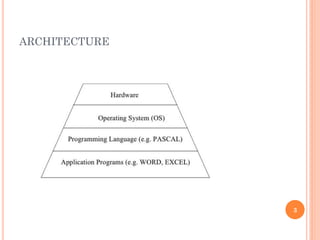
ARCHITECTURE
3
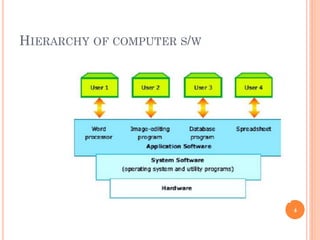
HIERARCHY OF COMPUTER S/W
4
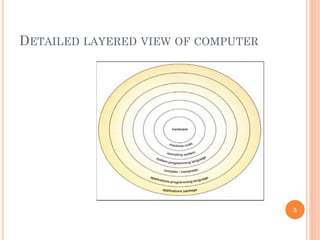
DETAILED LAYERED VIEW OF COMPUTER
5
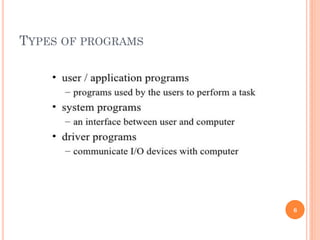
TYPES OF PROGRAMS
6
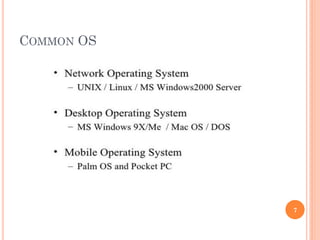
COMMON OS
7
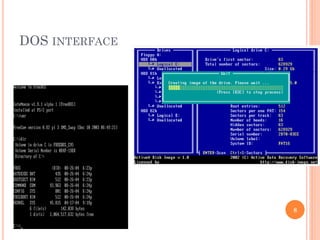
DOS INTERFACE
8
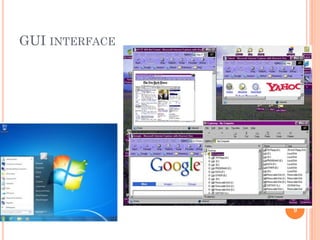
GUI INTERFACE
9
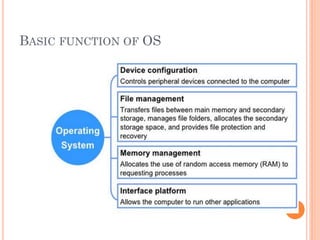
BASIC FUNCTION OF OS
10
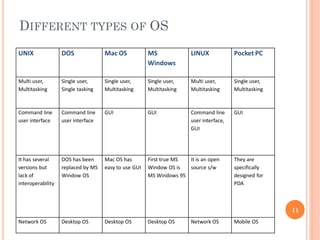
DIFFERENT TYPES OF OS
UNIX DOS Mac OS MS
Windows
LINUX Pocket PC
Multi user,
Multitasking
Single user,
Single tasking
Single user,
Multitasking
Single user,
Multitasking
Multi user,
Multitasking
Single user,
Multitasking
Command line
user interface
Command line
user interface
GUI GUI Command line
user interface,
GUI
GUI
It has several
versions but
lack of
interoperability
DOS has been
replaced by MS
Window OS
Mac OS has
easy to use GUI
First true MS
Window OS is
MS Windows 95
It is an open
source s/w
They are
specifically
designed for
PDA
Network OS Desktop OS Desktop OS Desktop OS Network OS Mobile OS
11
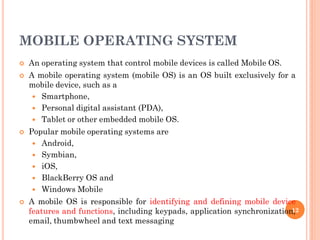
MOBILE OPERATING SYSTEM
 An operating system that control mobile devices is called Mobile OS.
 A mobile operating system (mobile OS) is an OS built exclusively for a
mobile device, such as a
 Smartphone,
 Personal digital assistant (PDA),
 Tablet or other embedded mobile OS.
 Popular mobile operating systems are
 Android,
 Symbian,
 iOS,
 BlackBerry OS and
 Windows Mobile
 A mobile OS is responsible for identifying and defining mobile device
features and functions, including keypads, application synchronization,
email, thumbwheel and text messaging
12
 A mobile OS is similar to a standard OS (like Windows, Linux,
and Mac) but is relatively simple and light.
 A mobile OS manages mobile multimedia functions, mobile and
Internet connectivity.
Smart Phones and OS are:
 Small and handy
 Multiple, frequent and continuous connectivity
 Product and diversity
 Open platform
 Limited memory
13
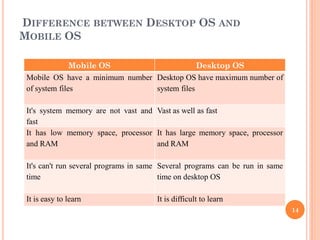
DIFFERENCE BETWEEN DESKTOP OS AND
MOBILE OS
Mobile OS Desktop OS
Mobile OS have a minimum number
of system files
Desktop OS have maximum number of
system files
It's system memory are not vast and
fast
Vast as well as fast
It has low memory space, processor
and RAM
It has large memory space, processor
and RAM
It's can't run several programs in same
time
Several programs can be run in same
time on desktop OS
It is easy to learn It is difficult to learn
14
15
HISTORY
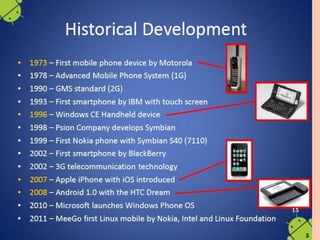
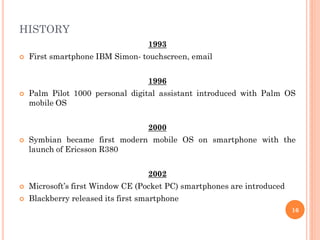
1993
 First smartphone IBM Simon- touchscreen, email
1996
 Palm Pilot 1000 personal digital assistant introduced with Palm OS
mobile OS
2000
 Symbian became first modern mobile OS on smartphone with the
launch of Ericsson R380
2002
 Microsoft’s first Window CE (Pocket PC) smartphones are introduced
 Blackberry released its first smartphone
16
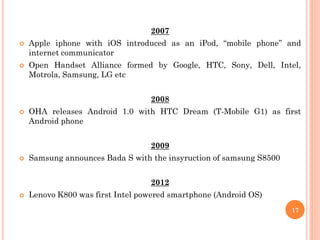
2007
 Apple iphone with iOS introduced as an iPod, “mobile phone” and
internet communicator
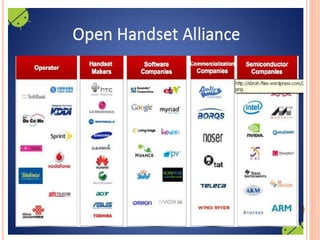
 Open Handset Alliance formed by Google, HTC, Sony, Dell, Intel,
Motrola, Samsung, LG etc
2008
 OHA releases Android 1.0 with HTC Dream (T-Mobile G1) as first
Android phone
2009
 Samsung announces Bada S with the insyruction of samsung S8500
2012
 Lenovo K800 was first Intel powered smartphone (Android OS)
17
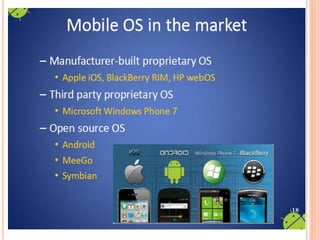
18
19
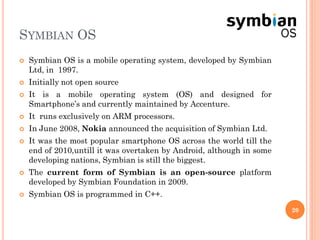
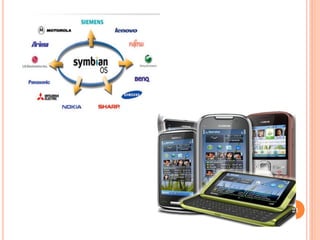
SYMBIAN OS
 Symbian OS is a mobile operating system, developed by Symbian
Ltd, in 1997.
 Initially not open source
 It is a mobile operating system (OS) and designed for
Smartphone’s and currently maintained by Accenture.
 It runs exclusively on ARM processors.
 In June 2008, Nokia announced the acquisition of Symbian Ltd.
 It was the most popular smartphone OS across the world till the
end of 2010,untill it was overtaken by Android, although in some
developing nations, Symbian is still the biggest.
 The current form of Symbian is an open-source platform
developed by Symbian Foundation in 2009.
 Symbian OS is programmed in C++.
20
21
WINDOW MOBILE
 Windows is developed by Microsoft
 The most dominant Operating system for
Smart Phones in earlier time.
 In 2011 Windows holds only 5% share of
the World Wide Smart Phone market
 Microsoft is open for third parties to
develop apps for its OS but the out comes
are very less
22
ANDROID
 Android initially founded in October 2003
 Acquired by Google in August 2005
 It was Google which developed and marketed the
platform to handset makers
 Android tested its beta version first and released the
first version 1.0 for HTC G1 phone in Sep 2008
 Android is an open source operating system which
allows developers to access unlocked hardware and
develop new programs as they wish.
 Android is currently the fastest growing smartphone
operating system in the market.
 The Android Market, which is the Android
equivalent of the Apple App Store is home to more
than 370,000 apps, many of which are completely
free
23
IOS
 It has been developed by Apple for its Smart Phone Brand IPHONE
 It has grown to be the most popular and powerful operating system
 Many apple devices such as iPhone, iPad and iPod are powered by this
OS.
 The Apple iOS is not allowed to be used in third party systems, so we will
only be able to use it on products made by Apple.
 It comes with the Safari web browser for internet use, an iPod application
for playing music and Apple's Mail for managing memos.
 According to apple according to some security
researchers iOS is packed with tons
OS security features.
 Apple holds a share of about 26% in the
Smart phone arena
24
BLACKBERRY OS
 Developed by Research In Motion(RIM) for
Black Berry Phones
 This OS is used only for the Black Berry mobiles
 It has got limited number of applications being
developed on its own platform
25
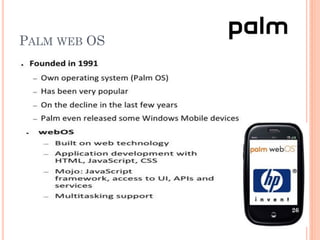
PALM WEB OS
26
 Palm OS[1] is an embedded operating system designed for ease of
use with a touchscreen-based graphical user interface.
 It has been implemented on a wide variety of mobile devices such
as smart phones, GPS devices.
 It is run on ARM architecture-based processors. It is designed as
a 32-bit architecture.
27
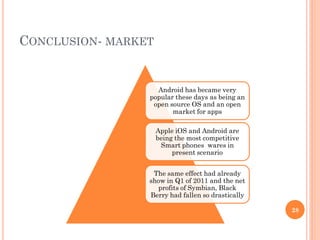
CONCLUSION- MARKET
Android has became very
popular these days as being an
open source OS and an open
market for apps
Apple iOS and Android are
being the most competitive
Smart phones wares in
present scenario
The same effect had already
show in Q1 of 2011 and the net
profits of Symbian, Black
Berry had fallen so drastically
28
FUTURE MOBILE OS
 Firefox OS
 Ubuntu Touch
 Tizen OS
29
FIREFOX OS
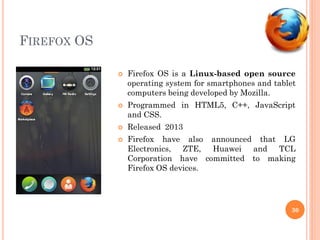
 Firefox OS is a Linux-based open source
operating system for smartphones and tablet
computers being developed by Mozilla.
 Programmed in HTML5, C++, JavaScript
and CSS.
 Released 2013
 Firefox have also announced that LG
Electronics, ZTE, Huawei and TCL
Corporation have committed to making
Firefox OS devices.
30
UBUNTU TOUCH
 Ubuntu Touch OS developed
by Canonical Ltd.
 release handsets
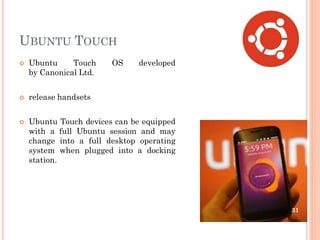
 Ubuntu Touch devices can be equipped
with a full Ubuntu session and may
change into a full desktop operating
system when plugged into a docking
station.
31
TIZEN OS
 Tizen is an operating system for devices
including smartphones, tablets, in-vehicle
infotainment (IVI) devices, and smart TVs.
 It is an open source system that aims to offer a
consistent user experience across devices.
 The Tizen project resides within the Linux
Foundation and is governed by a Technical
Steering Group (TSG) composed of Intel and
Samsung.
 Tizen provides an environment for application
developers based on the JavaScript libraries
JQuery and JQuery Mobile.
32

Mobile application development

  • 1.
  • 2.
    OPERATING SYSTEM  Itis an interface between hardware and user.  Collection of program that control recourses of computer system  When computer is on, OS is loaded first in memory  An operating system (OS) is a collection of software that manages computer hardware resources and provides common services for computer programs. 2
  • 3.
  • 4.
  • 5.
    DETAILED LAYERED VIEWOF COMPUTER 5
  • 6.
  • 7.
  • 8.
  • 9.
  • 10.
  • 11.
    DIFFERENT TYPES OFOS UNIX DOS Mac OS MS Windows LINUX Pocket PC Multi user, Multitasking Single user, Single tasking Single user, Multitasking Single user, Multitasking Multi user, Multitasking Single user, Multitasking Command line user interface Command line user interface GUI GUI Command line user interface, GUI GUI It has several versions but lack of interoperability DOS has been replaced by MS Window OS Mac OS has easy to use GUI First true MS Window OS is MS Windows 95 It is an open source s/w They are specifically designed for PDA Network OS Desktop OS Desktop OS Desktop OS Network OS Mobile OS 11
  • 12.
    MOBILE OPERATING SYSTEM An operating system that control mobile devices is called Mobile OS.  A mobile operating system (mobile OS) is an OS built exclusively for a mobile device, such as a  Smartphone,  Personal digital assistant (PDA),  Tablet or other embedded mobile OS.  Popular mobile operating systems are  Android,  Symbian,  iOS,  BlackBerry OS and  Windows Mobile  A mobile OS is responsible for identifying and defining mobile device features and functions, including keypads, application synchronization, email, thumbwheel and text messaging 12
  • 13.
     A mobileOS is similar to a standard OS (like Windows, Linux, and Mac) but is relatively simple and light.  A mobile OS manages mobile multimedia functions, mobile and Internet connectivity. Smart Phones and OS are:  Small and handy  Multiple, frequent and continuous connectivity  Product and diversity  Open platform  Limited memory 13
  • 14.
    DIFFERENCE BETWEEN DESKTOPOS AND MOBILE OS Mobile OS Desktop OS Mobile OS have a minimum number of system files Desktop OS have maximum number of system files It's system memory are not vast and fast Vast as well as fast It has low memory space, processor and RAM It has large memory space, processor and RAM It's can't run several programs in same time Several programs can be run in same time on desktop OS It is easy to learn It is difficult to learn 14
  • 15.
  • 16.
    HISTORY 1993  First smartphoneIBM Simon- touchscreen, email 1996  Palm Pilot 1000 personal digital assistant introduced with Palm OS mobile OS 2000  Symbian became first modern mobile OS on smartphone with the launch of Ericsson R380 2002  Microsoft’s first Window CE (Pocket PC) smartphones are introduced  Blackberry released its first smartphone 16
  • 17.
    2007  Apple iphonewith iOS introduced as an iPod, “mobile phone” and internet communicator  Open Handset Alliance formed by Google, HTC, Sony, Dell, Intel, Motrola, Samsung, LG etc 2008  OHA releases Android 1.0 with HTC Dream (T-Mobile G1) as first Android phone 2009  Samsung announces Bada S with the insyruction of samsung S8500 2012  Lenovo K800 was first Intel powered smartphone (Android OS) 17
  • 18.
  • 19.
  • 20.
    SYMBIAN OS  SymbianOS is a mobile operating system, developed by Symbian Ltd, in 1997.  Initially not open source  It is a mobile operating system (OS) and designed for Smartphone’s and currently maintained by Accenture.  It runs exclusively on ARM processors.  In June 2008, Nokia announced the acquisition of Symbian Ltd.  It was the most popular smartphone OS across the world till the end of 2010,untill it was overtaken by Android, although in some developing nations, Symbian is still the biggest.  The current form of Symbian is an open-source platform developed by Symbian Foundation in 2009.  Symbian OS is programmed in C++. 20
  • 21.
  • 22.
    WINDOW MOBILE  Windowsis developed by Microsoft  The most dominant Operating system for Smart Phones in earlier time.  In 2011 Windows holds only 5% share of the World Wide Smart Phone market  Microsoft is open for third parties to develop apps for its OS but the out comes are very less 22
  • 23.
    ANDROID  Android initiallyfounded in October 2003  Acquired by Google in August 2005  It was Google which developed and marketed the platform to handset makers  Android tested its beta version first and released the first version 1.0 for HTC G1 phone in Sep 2008  Android is an open source operating system which allows developers to access unlocked hardware and develop new programs as they wish.  Android is currently the fastest growing smartphone operating system in the market.  The Android Market, which is the Android equivalent of the Apple App Store is home to more than 370,000 apps, many of which are completely free 23
  • 24.
    IOS  It hasbeen developed by Apple for its Smart Phone Brand IPHONE  It has grown to be the most popular and powerful operating system  Many apple devices such as iPhone, iPad and iPod are powered by this OS.  The Apple iOS is not allowed to be used in third party systems, so we will only be able to use it on products made by Apple.  It comes with the Safari web browser for internet use, an iPod application for playing music and Apple's Mail for managing memos.  According to apple according to some security researchers iOS is packed with tons OS security features.  Apple holds a share of about 26% in the Smart phone arena 24
  • 25.
    BLACKBERRY OS  Developedby Research In Motion(RIM) for Black Berry Phones  This OS is used only for the Black Berry mobiles  It has got limited number of applications being developed on its own platform 25
  • 26.
  • 27.
     Palm OS[1]is an embedded operating system designed for ease of use with a touchscreen-based graphical user interface.  It has been implemented on a wide variety of mobile devices such as smart phones, GPS devices.  It is run on ARM architecture-based processors. It is designed as a 32-bit architecture. 27
  • 28.
    CONCLUSION- MARKET Android hasbecame very popular these days as being an open source OS and an open market for apps Apple iOS and Android are being the most competitive Smart phones wares in present scenario The same effect had already show in Q1 of 2011 and the net profits of Symbian, Black Berry had fallen so drastically 28
  • 29.
    FUTURE MOBILE OS Firefox OS  Ubuntu Touch  Tizen OS 29
  • 30.
    FIREFOX OS  FirefoxOS is a Linux-based open source operating system for smartphones and tablet computers being developed by Mozilla.  Programmed in HTML5, C++, JavaScript and CSS.  Released 2013  Firefox have also announced that LG Electronics, ZTE, Huawei and TCL Corporation have committed to making Firefox OS devices. 30
  • 31.
    UBUNTU TOUCH  UbuntuTouch OS developed by Canonical Ltd.  release handsets  Ubuntu Touch devices can be equipped with a full Ubuntu session and may change into a full desktop operating system when plugged into a docking station. 31
  • 32.
    TIZEN OS  Tizenis an operating system for devices including smartphones, tablets, in-vehicle infotainment (IVI) devices, and smart TVs.  It is an open source system that aims to offer a consistent user experience across devices.  The Tizen project resides within the Linux Foundation and is governed by a Technical Steering Group (TSG) composed of Intel and Samsung.  Tizen provides an environment for application developers based on the JavaScript libraries JQuery and JQuery Mobile. 32