Recent advances
in the Linux kernel
resource management
Kir Kolyshkin, OpenVZ
kir@openvz.org
Agenda

Resources to account and control

Some background on containers

Existing functionality, shortcomings

Control Groups a.k.a. cgroups

Memory Controller

Future work
Resources
Why?

All resources are finite

Multiple tasks and users

Need usage statistics / bookkeeping

Need Denial of Service protection

Need Quality of Service level
(not only limits but guarantees)
What?

CPU

Memory (RAM)

Swap

Disk space

Disk I/O

Network
Resources: CPU
CPU is given to tasks in time slices

CPU shares/weights

CPU limits

for SMP: CPU affinity
Resources: Memory & swap

User memory
− Virtual and physical (RSS) memory
− Dirty page cache

Kernel memory
− Various objects, different allocators
− Special case: network buffers

Swap space
Resources: disk

Disk space

Disk I/O bandwidth
− read/write
− mmap()
− swapin/swapout
− Problem: most of I/O is async
Resources: networking

Network bandwidth: solved by tc

Traffic Control:
− Shaping
− Scheduling
− Policies
− Dropping
Containers
What are containers?

Multiple isolated userspace
instances

Running on top of a single kernel

Like VMs but very lightweight,
native performance, low overhead
Containers Implementations

OpenVZ

Parallels Virtuozzo Containers

FreeBSD jails

Linux-VServer

Solaris 10 Containers/Zones

IBM AIX6 WPARs
(Workload Partitions)
Containers cont'd

Multiple containers should
peacefully co-exist, need DoS
protection

From the resource management
point of view, containers are just
groups of processes.
Existing mechanisms
Disk Quota

Per mount point disk quota
for users and groups

Soft limits, hard limits, grace periods

Can see the current usage

Can be inc'd/dec'd on-the-fly

Applications are expecting disk
space shortage (or at least should
be)
CPU

Per-process nice value which can be
changed on-the-fly (nice, renice)

Real-time priority queue

Hard CPU time limit (ulimit -c)
ulimit

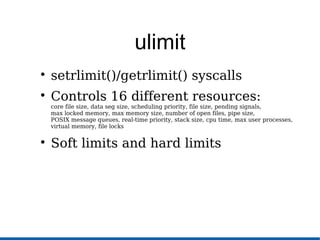
setrlimit()/getrlimit() syscalls

Controls 16 different resources:
core file size, data seg size, scheduling priority, file size, pending signals,
max locked memory, max memory size, number of open files, pipe size,
POSIX message queues, real-time priority, stack size, cpu time, max user processes,
virtual memory, file locks

Soft limits and hard limits
ulimit: problems

Not all resources are covered

Ulimits set in the current context
− the only good place to set is login
− some can only be decreased run-time

All limits are per-process
− only NPROC is per-UID

Current usage values are unknown

Memory limits are mostly ignored
Control Groups
Control Groups

A generic mechanism for grouping
tasks into hierarchical groups

Multiple resource controllers

Possible to have different groups for
different controllers

Managed via cgroup filesystem
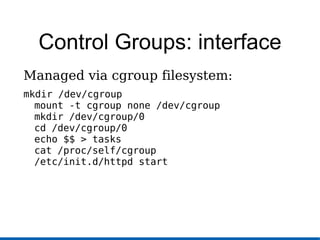
Control Groups: interface
Managed via cgroup filesystem:
mkdir /dev/cgroup
mount -t cgroup none /dev/cgroup
mkdir /dev/cgroup/0
cd /dev/cgroup/0
echo $$ > tasks
cat /proc/self/cgroup
/etc/init.d/httpd start
Control Groups: history

A feature known as cpusets was
developed by big iron Bull/SGI guys

Used to maintain process groups to
NUMA nodes affinity

Paul Menage generalized it

Now cpusets is just one of the
resource controllers
Memory Controller
Memory controller

User memory:
− RSS
− Page cache

Reclamation
− Same as try_to_free_pages()

OOM killer
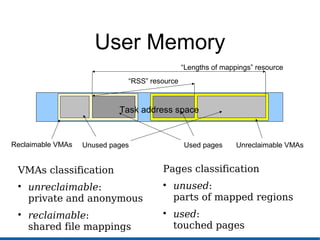
User Memory
VMAs classification

unreclaimable:
private and anonymous

reclaimable:
shared file mappings
Unused pages Used pages Unreclaimable VMAsReclaimable VMAs
“Lengths of mappings” resource
“RSS” resource
Pages classification

unused:
parts of mapped regions

used:
touched pages
Task address space
MemCtrl: interface
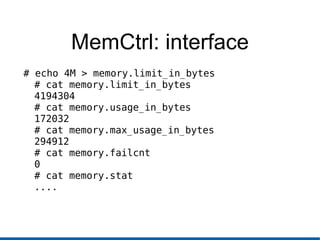
# echo 4M > memory.limit_in_bytes
# cat memory.limit_in_bytes
4194304
# cat memory.usage_in_bytes
172032
# cat memory.max_usage_in_bytes
294912
# cat memory.failcnt
0
# cat memory.stat
....
Shared Pages accounting

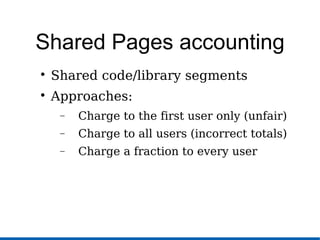
Shared code/library segments

Approaches:
− Charge to the first user only (unfair)
− Charge to all users (incorrect totals)
− Charge a fraction to every user
Page fractions accounting
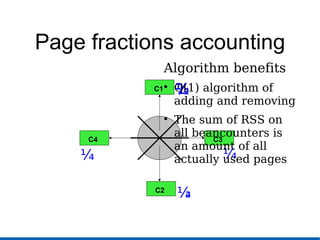
C1
C2
C3C4
1½
½¼
¼¼
¼
Algorithm benefits

O(1) algorithm of
adding and removing

The sum of RSS on
all beancounters is
an amount of all
actually used pages
Future
Future a.k.a. TODO

Shared pages accounting

VMA (user mappings) length ctrl

Kernel memory controller

cgroups checkpoint/restart

per-cgroup I/O priorities

All that is available in OpenVZ;
needs to be ported to mainstream
More Info
/usr/src/linux/Documentation/cgroups/*
/usr/src/linux/Documentation/controllers/*
containers@linux-foundation.org
Questions? Comments?
kir@openvz.org
Booth #63

Recent advances in the Linux kernel resource management

Editor's Notes

  • #26 OK, here's the first resource – the lenghts of mappings. It works with the task address space. All the vm areas it may have are splitted <click> into two classes: the unreclaimable areas <click> – those that are not backed by any disk file and thus will go to swap on memory shortage; and <click> the reclaimable ones – those that are backed by a disk file and its reclamation is almost always succeeds. Next, we distinguish two <click> pages types in the areas. The "unused" page <click> is the "hole" in the vm area – the page place is reserved, but the physical page is not yet created. This page becomes "used" <click> in the page fault. Used page is the synonym for a physical page. Using these terms the "lenghts of mapping" resource is <click> the sum of used pages and unused ones in the unreclaimable areas. The RSS resource is <click> merely the number of used pages
  • #29 The most interesting part of RSS accounting is how the shared page is accounted between the owning beancounters. Let's start with the single page. When the first beancounter touches it <click> it gets the whole page into its RSS resource. Then goes the second one <click>. We take one half of the page from the first beancounter and move this to the newbie. The third gay (sorry for my english – gUy) will <click> steal a quarter from the second one, without bothering the first. The forth <click> beancounter gets the quarter from the first one and doesn't mess with the rest owners. That is – we account the pages with the halves. Then we'll have one eigths and so on. This algorithm's benefits <click> are the follwong. The first is that we have a constant time algorithm of adding and removind the page owners – each touch we work with only one of the existing owners and do not bother the others. The second, is that when we sum-up the RSS values from all the beancounters we'll get the real physical memory consumption by the user space.