Live migrating a container:
pros, cons and gotchas
Pavel Emelyanov
Principal engineer @ Virtuozzo
AgendaAgenda
• Why you might want to live migrate a container
• Why (and how) to avoid live migration
• Why is container live migration so complex
2
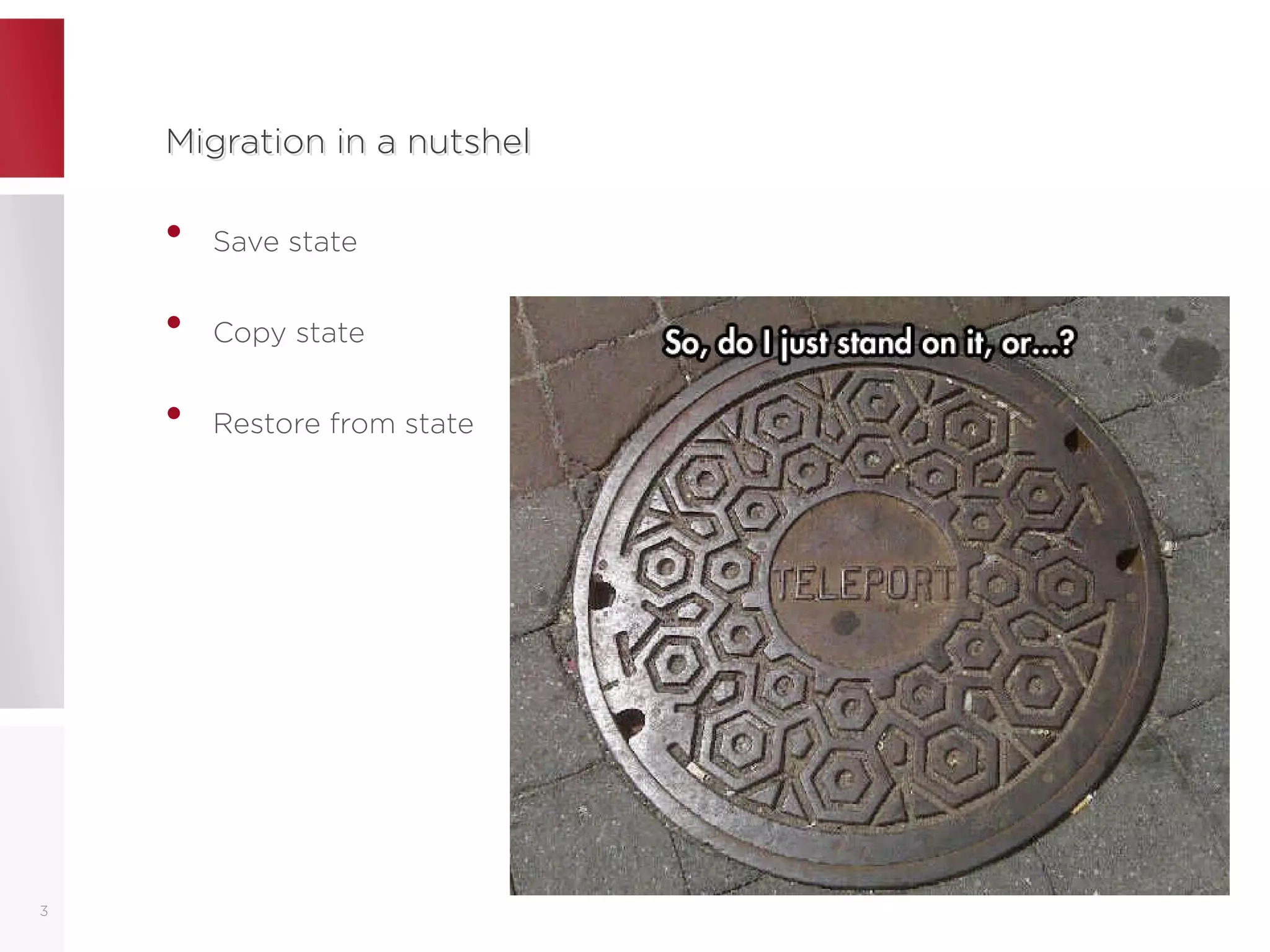
Migration in a nutshelMigration in a nutshel
• Save state
• Copy state
• Restore from state
3
Why you might want to live migrate a containerWhy you might want to live migrate a container
• Spectacular
• Load balancing
• Updating kernel
– Can avoid live migration, just C/R
• Updaring or replacing hardware
4
Why to avoid live migrationWhy to avoid live migration
5
How to avoid live migrationHow to avoid live migration
• Balance network traffic
• Microservices
• Crash-driven updates
• Planned downtime
6
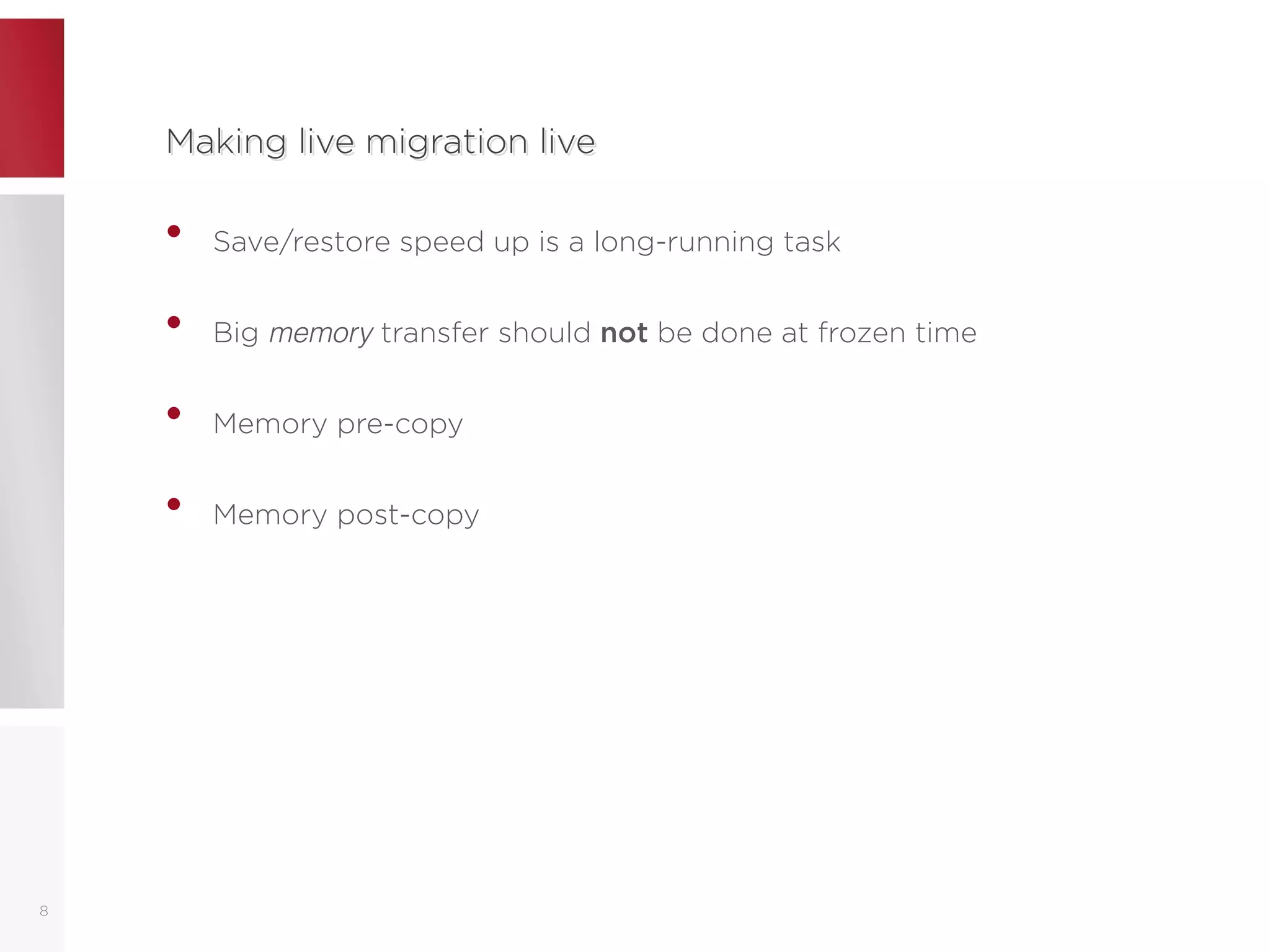
Making live migration liveMaking live migration live
• State saving, transfering and restoring happens with tasks frozen
– “Scatter” container is too complex
• Save state quickly
• Big transfer should not be done at that time
• Restore from state quickly
7
Making live migration liveMaking live migration live
• Save/restore speed up is a long-running task
• Big memory transfer should not be done at frozen time
• Memory pre-copy
• Memory post-copy
8
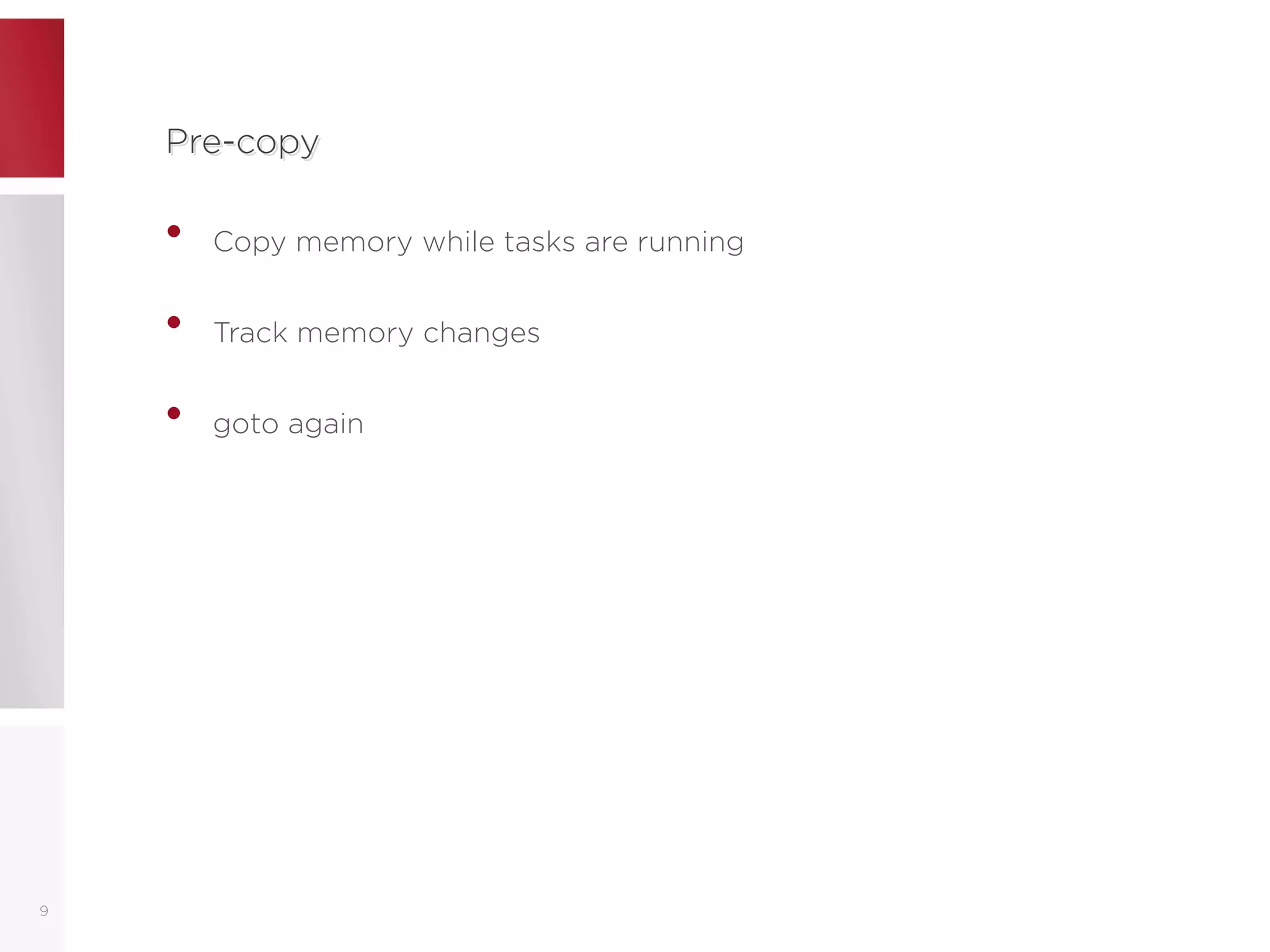
Pre-copyPre-copy
• Copy memory while tasks are running
• Track memory changes
• goto again
9
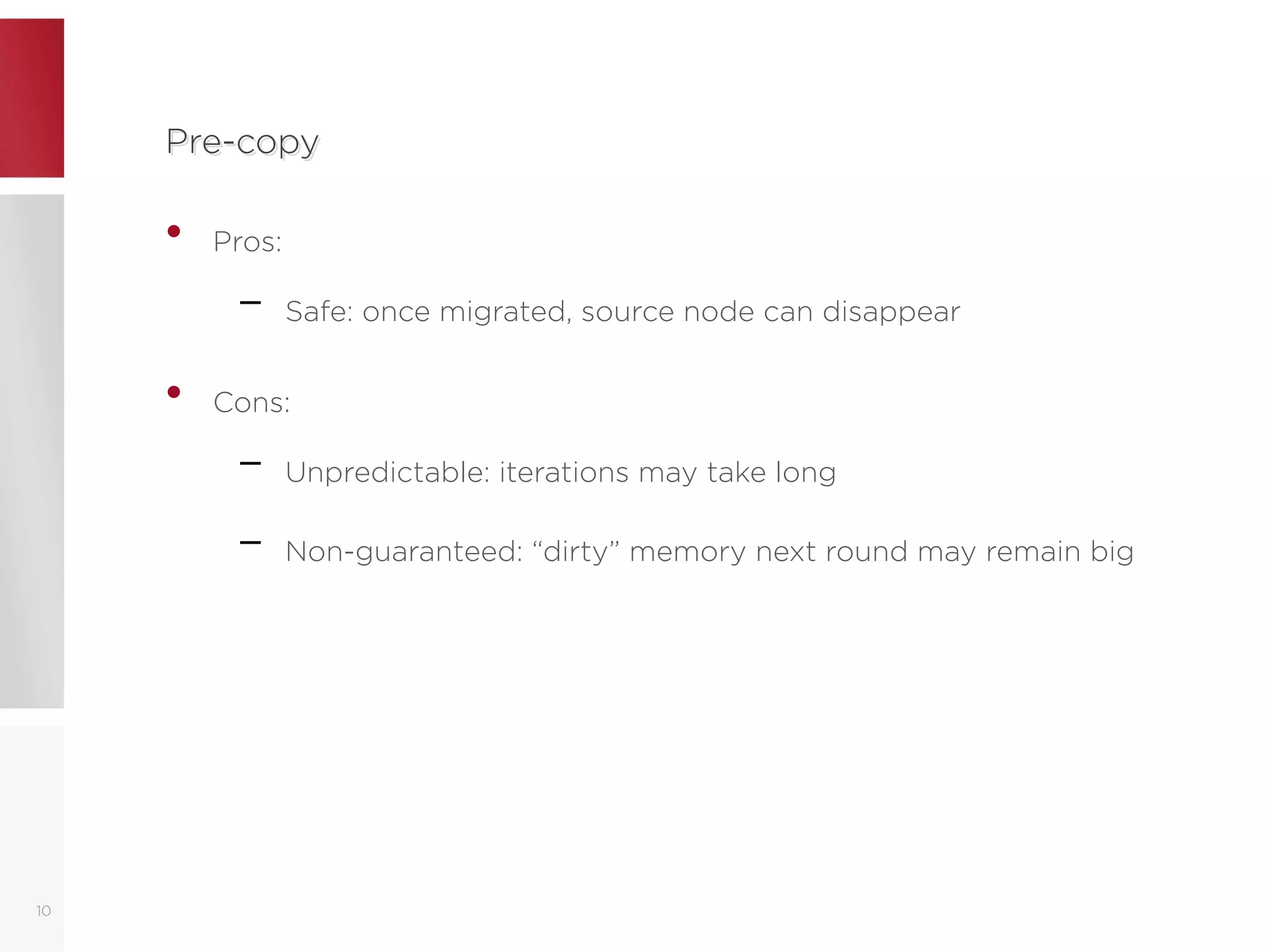
Pre-copyPre-copy
• Pros:
– Safe: once migrated, source node can disappear
• Cons:
– Unpredictable: iterations may take long
– Non-guaranteed: “dirty” memory next round may remain big
10
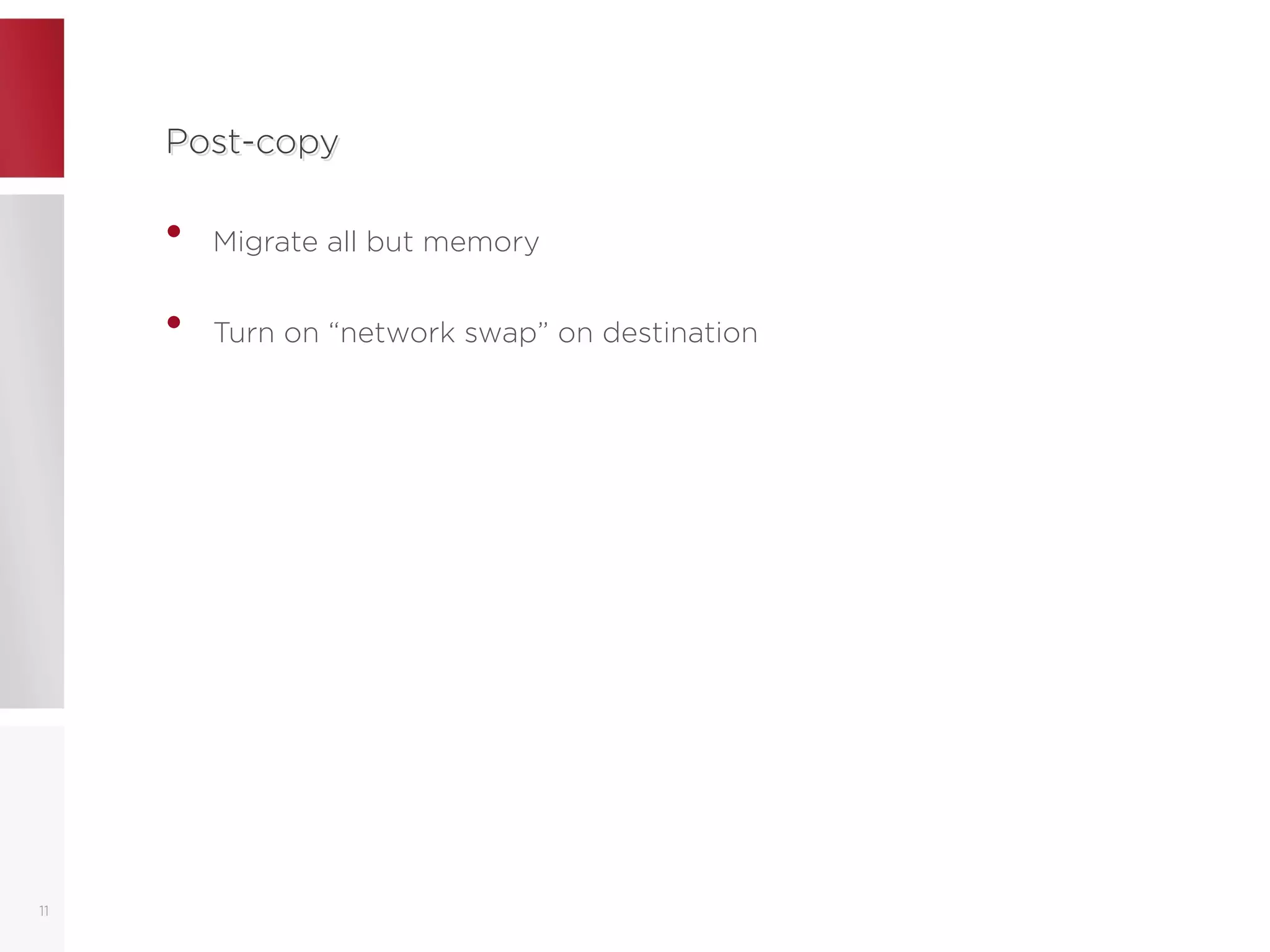
Post-copyPost-copy
• Migrate all but memory
• Turn on “network swap” on destination
11
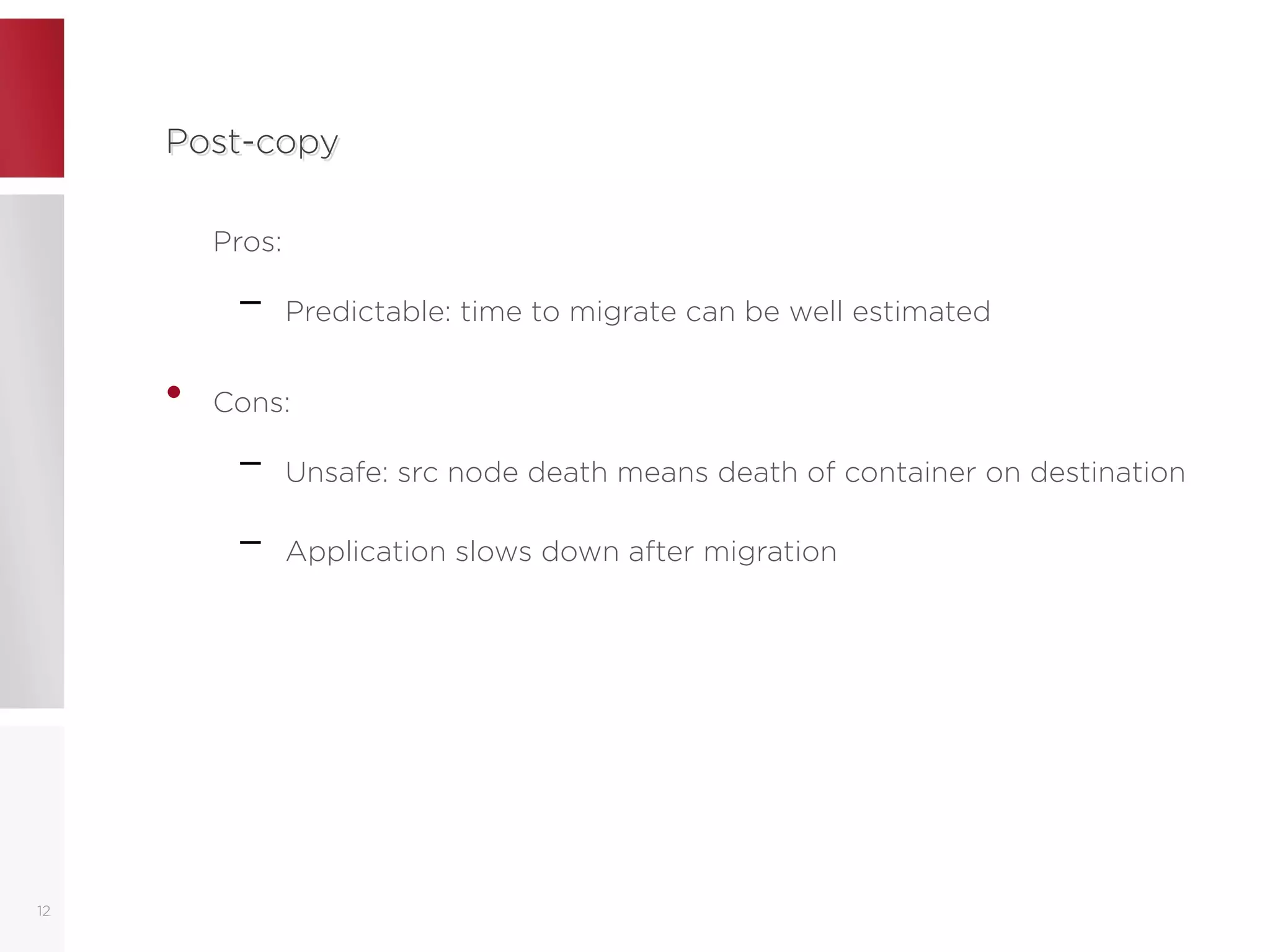
Post-copyPost-copy
Pros:
– Predictable: time to migrate can be well estimated
• Cons:
– Unsafe: src node death means death of container on destination
– Application slows down after migration
12
Live migration at lengthLive migration at length
• Memory pre-copy (iteratively, optional)
• Freeze + Save state
• Copy state
• Restore from state + Unfreeze and resume
• Memory post-copy (optional)
13
GotchasGotchas
14
VS
Things to deal withThings to deal with
• VM
– Environment: virtual hardware, paravirt
– CPU
– Memory
• Container
– Environment: cgroups, namespaces
– Processes and other animals
– Memory
15
Memory pre-copyMemory pre-copy
• VM
– All memory at hands
– Plain address space
• Container
– Memory
●
is scatered over the processes
●
can be (or can be not) shared
●
can be (or can be not) mapped to disk files
16
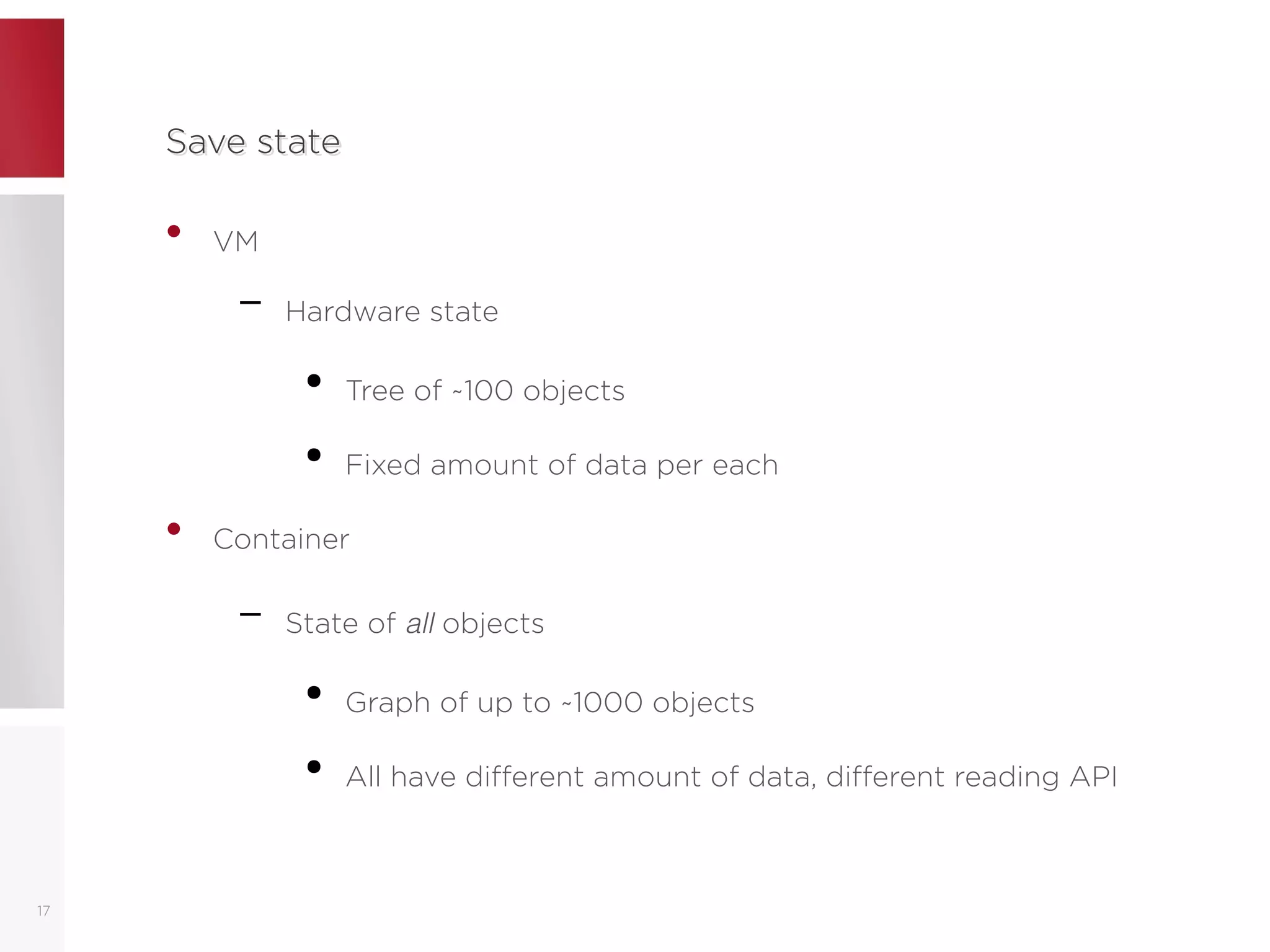
Save stateSave state
• VM
– Hardware state
●
Tree of ~100 objects
●
Fixed amount of data per each
• Container
– State of all objects
●
Graph of up to ~1000 objects
●
All have different amount of data, different reading API
17
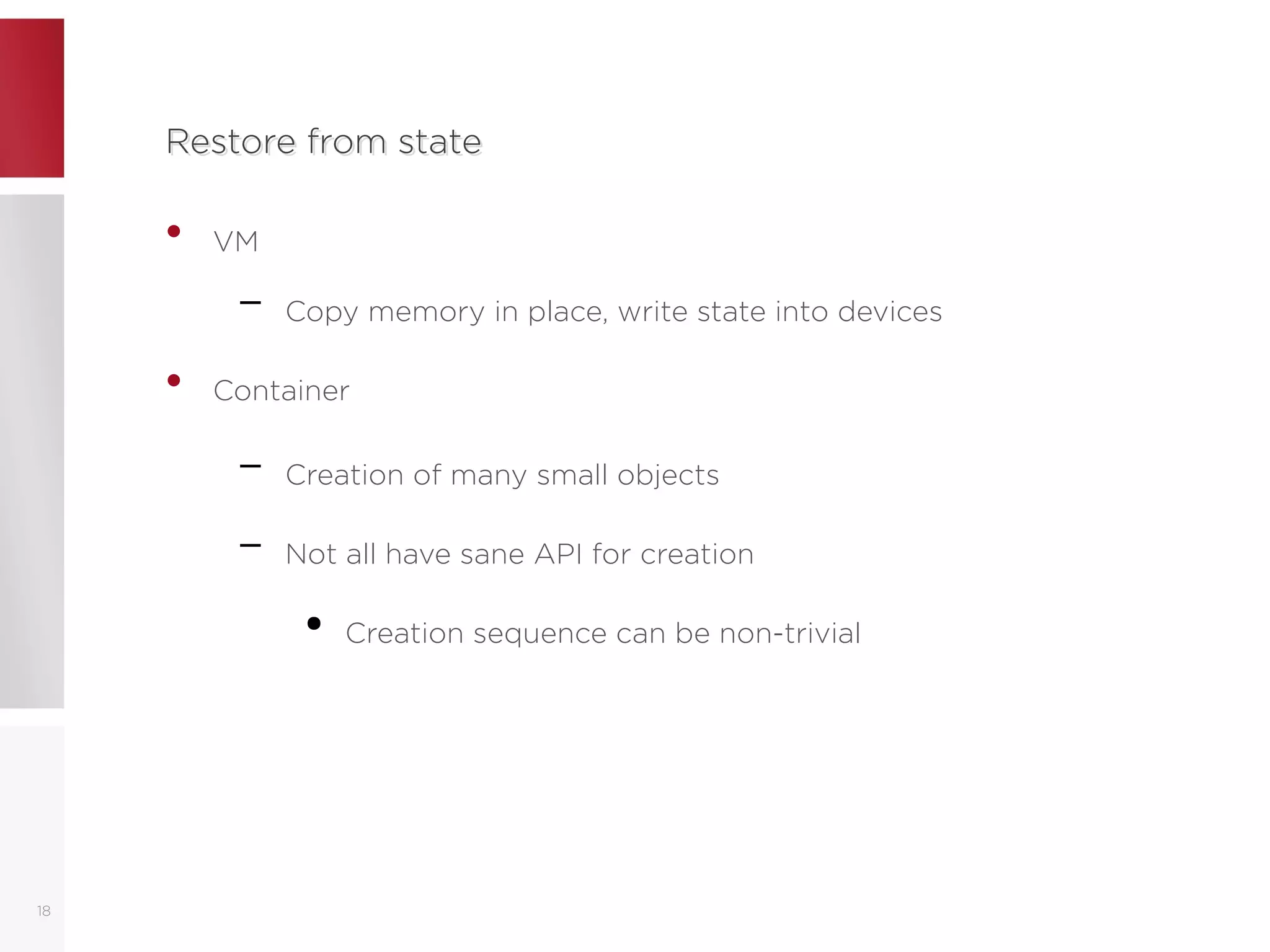
Restore from stateRestore from state
• VM
– Copy memory in place, write state into devices
• Container
– Creation of many small objects
– Not all have sane API for creation
●
Creation sequence can be non-trivial
18
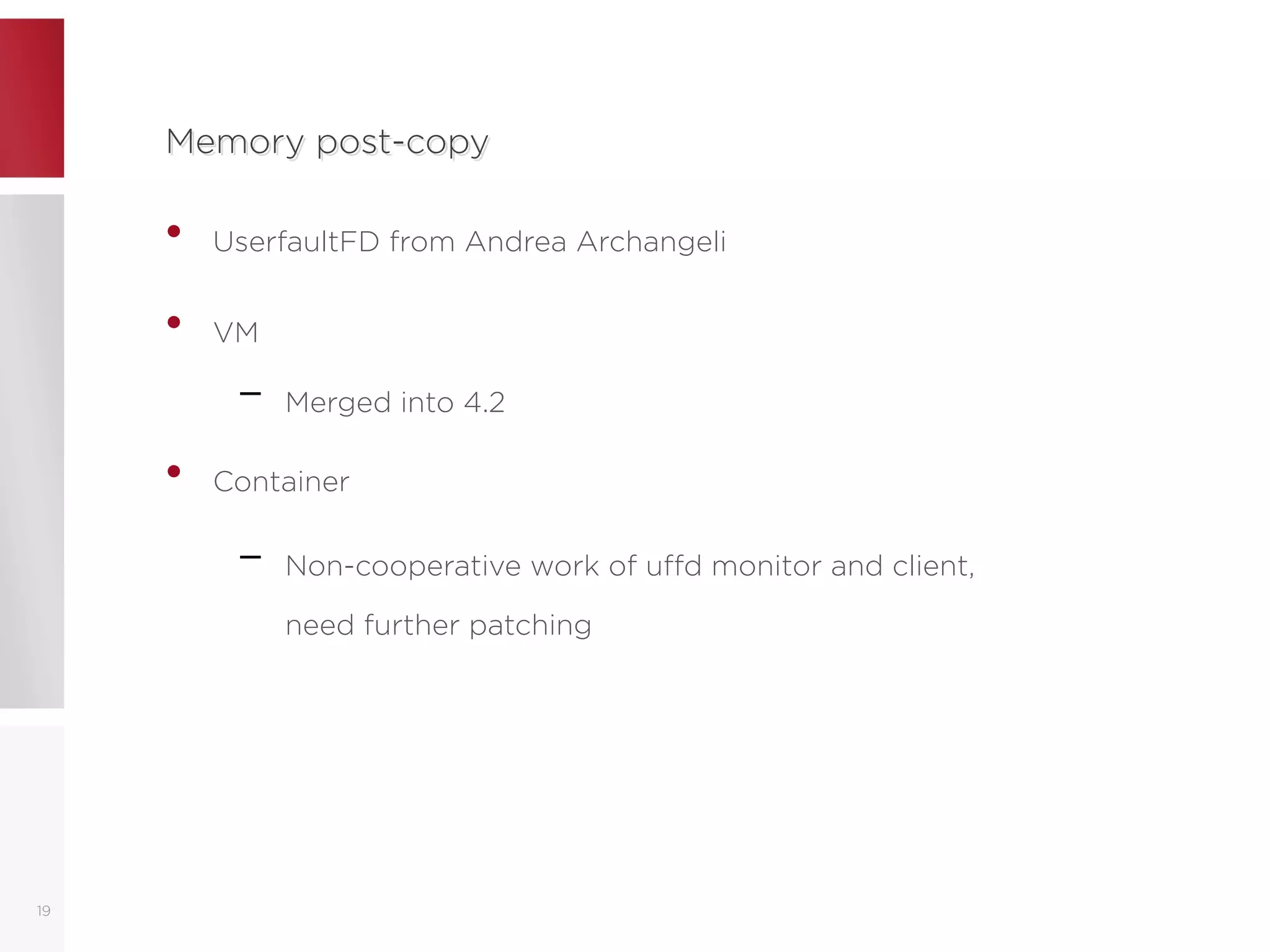
Memory post-copyMemory post-copy
• UserfaultFD from Andrea Archangeli
• VM
– Merged into 4.2
• Container
– Non-cooperative work of uffd monitor and client,
need further patching
19
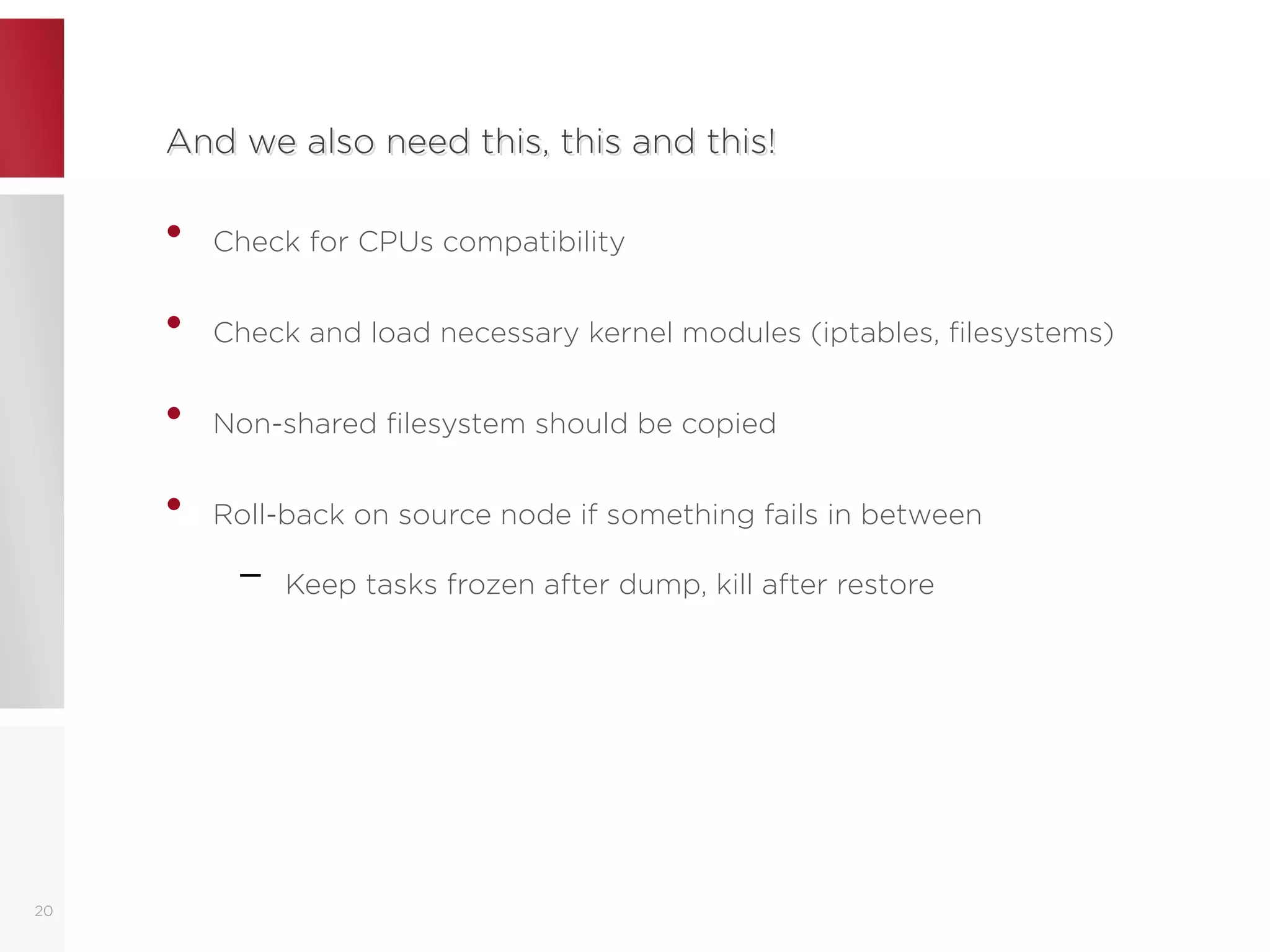
And we also need this, this and this!And we also need this, this and this!
• Check for CPUs compatibility
• Check and load necessary kernel modules (iptables, filesystems)
• Non-shared filesystem should be copied
• Roll-back on source node if something fails in between
– Keep tasks frozen after dump, kill after restore
20
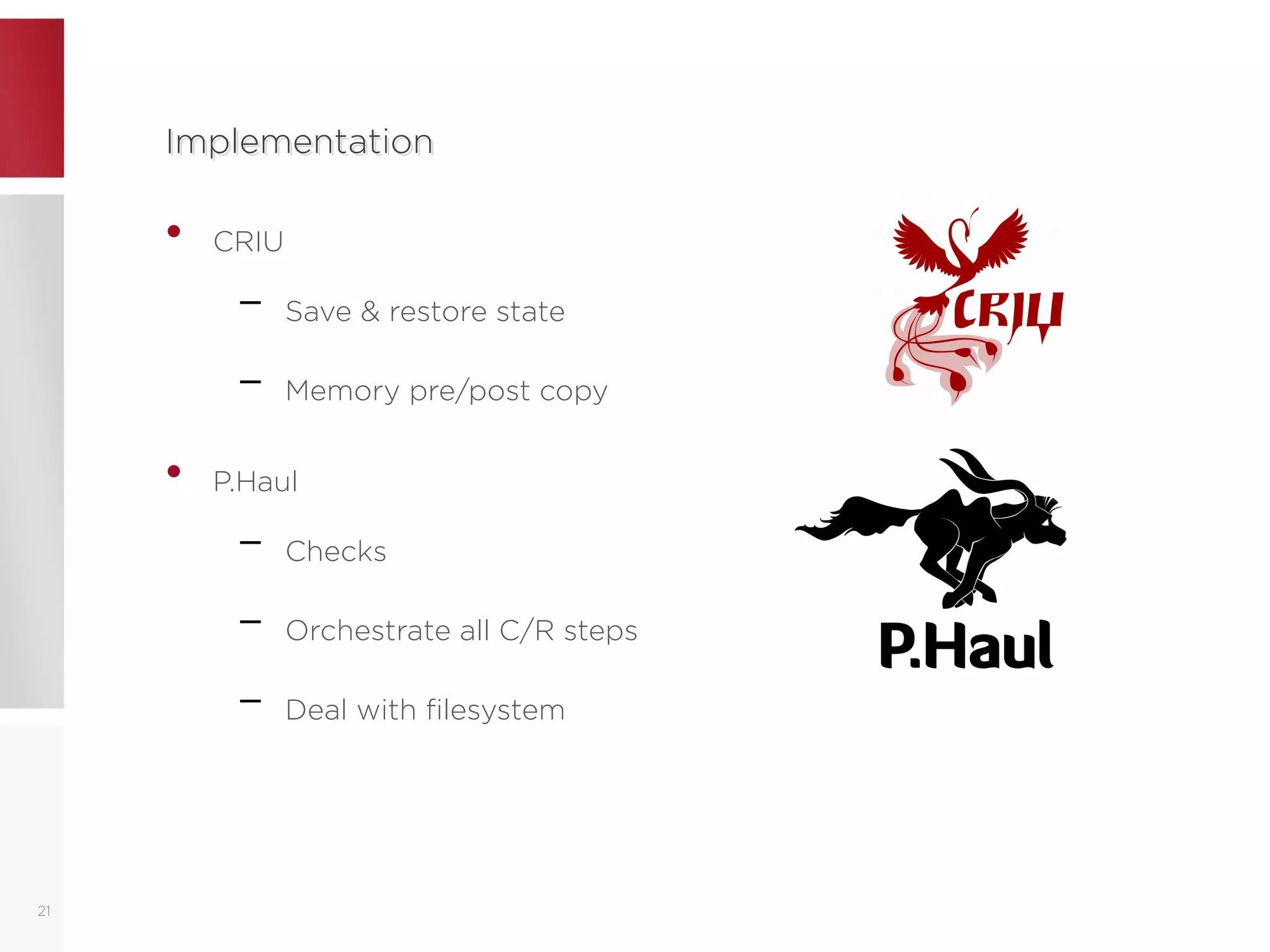
ImplementationImplementation
• CRIU
– Save & restore state
– Memory pre/post copy
• P.Haul
– Checks
– Orchestrate all C/R steps
– Deal with filesystem
21
P.Haul goalsP.Haul goals
• Provide engine for containers live miration using CRIU
• Perform necessary pre-checks (e.g. CPU compatibility)
• Organize memory pre-copy and/or post-copy
• Take care of file-system migration (if needed)
22
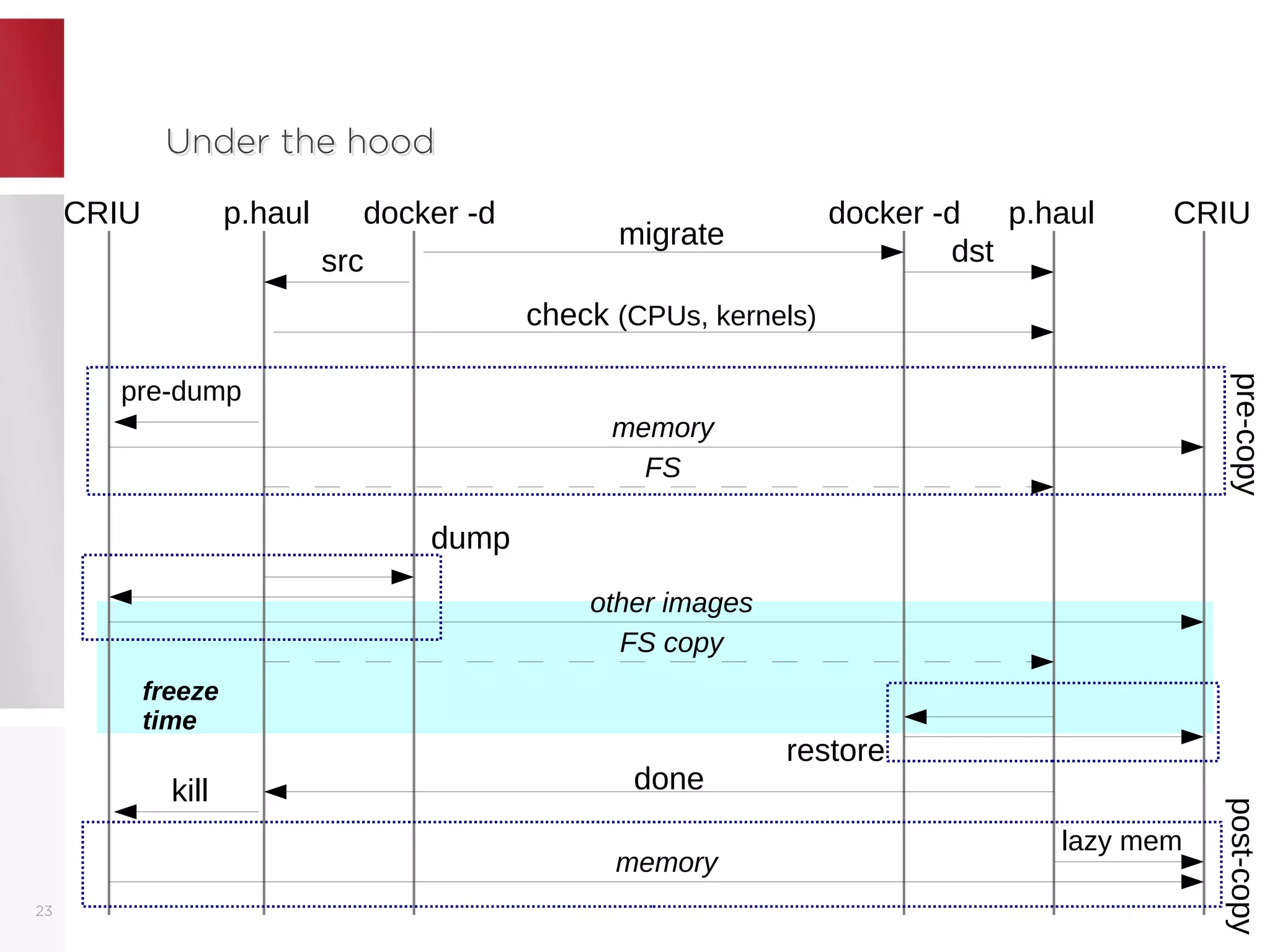
Under the hoodUnder the hood
23
CRIU CRIUp.haul p.hauldocker -d docker -d
migrate
src dst
check (CPUs, kernels)
pre-dump
memory
dump
other images
restore
memory
lazy mem
FS
FS copy
done
pre-copypost-copy
kill
freeze
time
More infoMore info
• http://criu.org
• http://criu.org/P.Haul
• criu@openvz.org
• +CriuOrg / @__criu__
• https://github.com/xemul/(criu|p.haul)
24
Thank you!
Pavel Emelyanov
@__criu__
xemul@openvz.org

Live migrating a container: pros, cons and gotchas -- Pavel Emelyanov

  • 1.
    Live migrating acontainer: pros, cons and gotchas Pavel Emelyanov Principal engineer @ Virtuozzo
  • 2.
    AgendaAgenda • Why youmight want to live migrate a container • Why (and how) to avoid live migration • Why is container live migration so complex 2
  • 3.
    Migration in anutshelMigration in a nutshel • Save state • Copy state • Restore from state 3
  • 4.
    Why you mightwant to live migrate a containerWhy you might want to live migrate a container • Spectacular • Load balancing • Updating kernel – Can avoid live migration, just C/R • Updaring or replacing hardware 4
  • 5.
    Why to avoidlive migrationWhy to avoid live migration 5
  • 6.
    How to avoidlive migrationHow to avoid live migration • Balance network traffic • Microservices • Crash-driven updates • Planned downtime 6
  • 7.
    Making live migrationliveMaking live migration live • State saving, transfering and restoring happens with tasks frozen – “Scatter” container is too complex • Save state quickly • Big transfer should not be done at that time • Restore from state quickly 7
  • 8.
    Making live migrationliveMaking live migration live • Save/restore speed up is a long-running task • Big memory transfer should not be done at frozen time • Memory pre-copy • Memory post-copy 8
  • 9.
    Pre-copyPre-copy • Copy memorywhile tasks are running • Track memory changes • goto again 9
  • 10.
    Pre-copyPre-copy • Pros: – Safe:once migrated, source node can disappear • Cons: – Unpredictable: iterations may take long – Non-guaranteed: “dirty” memory next round may remain big 10
  • 11.
    Post-copyPost-copy • Migrate allbut memory • Turn on “network swap” on destination 11
  • 12.
    Post-copyPost-copy Pros: – Predictable: timeto migrate can be well estimated • Cons: – Unsafe: src node death means death of container on destination – Application slows down after migration 12
  • 13.
    Live migration atlengthLive migration at length • Memory pre-copy (iteratively, optional) • Freeze + Save state • Copy state • Restore from state + Unfreeze and resume • Memory post-copy (optional) 13
  • 14.
  • 15.
    Things to dealwithThings to deal with • VM – Environment: virtual hardware, paravirt – CPU – Memory • Container – Environment: cgroups, namespaces – Processes and other animals – Memory 15
  • 16.
    Memory pre-copyMemory pre-copy •VM – All memory at hands – Plain address space • Container – Memory ● is scatered over the processes ● can be (or can be not) shared ● can be (or can be not) mapped to disk files 16
  • 17.
    Save stateSave state •VM – Hardware state ● Tree of ~100 objects ● Fixed amount of data per each • Container – State of all objects ● Graph of up to ~1000 objects ● All have different amount of data, different reading API 17
  • 18.
    Restore from stateRestorefrom state • VM – Copy memory in place, write state into devices • Container – Creation of many small objects – Not all have sane API for creation ● Creation sequence can be non-trivial 18
  • 19.
    Memory post-copyMemory post-copy •UserfaultFD from Andrea Archangeli • VM – Merged into 4.2 • Container – Non-cooperative work of uffd monitor and client, need further patching 19
  • 20.
    And we alsoneed this, this and this!And we also need this, this and this! • Check for CPUs compatibility • Check and load necessary kernel modules (iptables, filesystems) • Non-shared filesystem should be copied • Roll-back on source node if something fails in between – Keep tasks frozen after dump, kill after restore 20
  • 21.
    ImplementationImplementation • CRIU – Save& restore state – Memory pre/post copy • P.Haul – Checks – Orchestrate all C/R steps – Deal with filesystem 21
  • 22.
    P.Haul goalsP.Haul goals •Provide engine for containers live miration using CRIU • Perform necessary pre-checks (e.g. CPU compatibility) • Organize memory pre-copy and/or post-copy • Take care of file-system migration (if needed) 22
  • 23.
    Under the hoodUnderthe hood 23 CRIU CRIUp.haul p.hauldocker -d docker -d migrate src dst check (CPUs, kernels) pre-dump memory dump other images restore memory lazy mem FS FS copy done pre-copypost-copy kill freeze time
  • 24.
    More infoMore info •http://criu.org • http://criu.org/P.Haul • criu@openvz.org • +CriuOrg / @__criu__ • https://github.com/xemul/(criu|p.haul) 24
  • 25.

Editor's Notes

  • #3 To install a font: Open Fonts by clicking the Start button , clicking Control Panel, clicking Appearance and Personalization, and then clicking Fonts. Click File, and then click Install New Font. ... In the Add Fonts dialog box, under Drives, click the drive where the font that you want to install is located. http://windows.microsoft.com/en-us/windows-vista/install-or-uninstall-fonts <number>
  • #4 To install a font: Open Fonts by clicking the Start button , clicking Control Panel, clicking Appearance and Personalization, and then clicking Fonts. Click File, and then click Install New Font. ... In the Add Fonts dialog box, under Drives, click the drive where the font that you want to install is located. http://windows.microsoft.com/en-us/windows-vista/install-or-uninstall-fonts <number>
  • #5 To install a font: Open Fonts by clicking the Start button , clicking Control Panel, clicking Appearance and Personalization, and then clicking Fonts. Click File, and then click Install New Font. ... In the Add Fonts dialog box, under Drives, click the drive where the font that you want to install is located. http://windows.microsoft.com/en-us/windows-vista/install-or-uninstall-fonts <number>
  • #6 To install a font: Open Fonts by clicking the Start button , clicking Control Panel, clicking Appearance and Personalization, and then clicking Fonts. Click File, and then click Install New Font. ... In the Add Fonts dialog box, under Drives, click the drive where the font that you want to install is located. http://windows.microsoft.com/en-us/windows-vista/install-or-uninstall-fonts <number>
  • #7 To install a font: Open Fonts by clicking the Start button , clicking Control Panel, clicking Appearance and Personalization, and then clicking Fonts. Click File, and then click Install New Font. ... In the Add Fonts dialog box, under Drives, click the drive where the font that you want to install is located. http://windows.microsoft.com/en-us/windows-vista/install-or-uninstall-fonts <number>
  • #8 To install a font: Open Fonts by clicking the Start button , clicking Control Panel, clicking Appearance and Personalization, and then clicking Fonts. Click File, and then click Install New Font. ... In the Add Fonts dialog box, under Drives, click the drive where the font that you want to install is located. http://windows.microsoft.com/en-us/windows-vista/install-or-uninstall-fonts <number>
  • #9 To install a font: Open Fonts by clicking the Start button , clicking Control Panel, clicking Appearance and Personalization, and then clicking Fonts. Click File, and then click Install New Font. ... In the Add Fonts dialog box, under Drives, click the drive where the font that you want to install is located. http://windows.microsoft.com/en-us/windows-vista/install-or-uninstall-fonts <number>
  • #10 To install a font: Open Fonts by clicking the Start button , clicking Control Panel, clicking Appearance and Personalization, and then clicking Fonts. Click File, and then click Install New Font. ... In the Add Fonts dialog box, under Drives, click the drive where the font that you want to install is located. http://windows.microsoft.com/en-us/windows-vista/install-or-uninstall-fonts <number>
  • #11 To install a font: Open Fonts by clicking the Start button , clicking Control Panel, clicking Appearance and Personalization, and then clicking Fonts. Click File, and then click Install New Font. ... In the Add Fonts dialog box, under Drives, click the drive where the font that you want to install is located. http://windows.microsoft.com/en-us/windows-vista/install-or-uninstall-fonts <number>
  • #12 To install a font: Open Fonts by clicking the Start button , clicking Control Panel, clicking Appearance and Personalization, and then clicking Fonts. Click File, and then click Install New Font. ... In the Add Fonts dialog box, under Drives, click the drive where the font that you want to install is located. http://windows.microsoft.com/en-us/windows-vista/install-or-uninstall-fonts <number>
  • #13 To install a font: Open Fonts by clicking the Start button , clicking Control Panel, clicking Appearance and Personalization, and then clicking Fonts. Click File, and then click Install New Font. ... In the Add Fonts dialog box, under Drives, click the drive where the font that you want to install is located. http://windows.microsoft.com/en-us/windows-vista/install-or-uninstall-fonts <number>
  • #14 To install a font: Open Fonts by clicking the Start button , clicking Control Panel, clicking Appearance and Personalization, and then clicking Fonts. Click File, and then click Install New Font. ... In the Add Fonts dialog box, under Drives, click the drive where the font that you want to install is located. http://windows.microsoft.com/en-us/windows-vista/install-or-uninstall-fonts <number>
  • #15 To install a font: Open Fonts by clicking the Start button , clicking Control Panel, clicking Appearance and Personalization, and then clicking Fonts. Click File, and then click Install New Font. ... In the Add Fonts dialog box, under Drives, click the drive where the font that you want to install is located. http://windows.microsoft.com/en-us/windows-vista/install-or-uninstall-fonts <number>
  • #16 To install a font: Open Fonts by clicking the Start button , clicking Control Panel, clicking Appearance and Personalization, and then clicking Fonts. Click File, and then click Install New Font. ... In the Add Fonts dialog box, under Drives, click the drive where the font that you want to install is located. http://windows.microsoft.com/en-us/windows-vista/install-or-uninstall-fonts <number>
  • #17 To install a font: Open Fonts by clicking the Start button , clicking Control Panel, clicking Appearance and Personalization, and then clicking Fonts. Click File, and then click Install New Font. ... In the Add Fonts dialog box, under Drives, click the drive where the font that you want to install is located. http://windows.microsoft.com/en-us/windows-vista/install-or-uninstall-fonts <number>
  • #18 To install a font: Open Fonts by clicking the Start button , clicking Control Panel, clicking Appearance and Personalization, and then clicking Fonts. Click File, and then click Install New Font. ... In the Add Fonts dialog box, under Drives, click the drive where the font that you want to install is located. http://windows.microsoft.com/en-us/windows-vista/install-or-uninstall-fonts <number>
  • #19 To install a font: Open Fonts by clicking the Start button , clicking Control Panel, clicking Appearance and Personalization, and then clicking Fonts. Click File, and then click Install New Font. ... In the Add Fonts dialog box, under Drives, click the drive where the font that you want to install is located. http://windows.microsoft.com/en-us/windows-vista/install-or-uninstall-fonts <number>
  • #20 To install a font: Open Fonts by clicking the Start button , clicking Control Panel, clicking Appearance and Personalization, and then clicking Fonts. Click File, and then click Install New Font. ... In the Add Fonts dialog box, under Drives, click the drive where the font that you want to install is located. http://windows.microsoft.com/en-us/windows-vista/install-or-uninstall-fonts <number>
  • #21 To install a font: Open Fonts by clicking the Start button , clicking Control Panel, clicking Appearance and Personalization, and then clicking Fonts. Click File, and then click Install New Font. ... In the Add Fonts dialog box, under Drives, click the drive where the font that you want to install is located. http://windows.microsoft.com/en-us/windows-vista/install-or-uninstall-fonts <number>
  • #22 To install a font: Open Fonts by clicking the Start button , clicking Control Panel, clicking Appearance and Personalization, and then clicking Fonts. Click File, and then click Install New Font. ... In the Add Fonts dialog box, under Drives, click the drive where the font that you want to install is located. http://windows.microsoft.com/en-us/windows-vista/install-or-uninstall-fonts <number>
  • #23 To install a font: Open Fonts by clicking the Start button , clicking Control Panel, clicking Appearance and Personalization, and then clicking Fonts. Click File, and then click Install New Font. ... In the Add Fonts dialog box, under Drives, click the drive where the font that you want to install is located. http://windows.microsoft.com/en-us/windows-vista/install-or-uninstall-fonts <number>
  • #24 To install a font: Open Fonts by clicking the Start button , clicking Control Panel, clicking Appearance and Personalization, and then clicking Fonts. Click File, and then click Install New Font. ... In the Add Fonts dialog box, under Drives, click the drive where the font that you want to install is located. http://windows.microsoft.com/en-us/windows-vista/install-or-uninstall-fonts <number>
  • #25 To install a font: Open Fonts by clicking the Start button , clicking Control Panel, clicking Appearance and Personalization, and then clicking Fonts. Click File, and then click Install New Font. ... In the Add Fonts dialog box, under Drives, click the drive where the font that you want to install is located. http://windows.microsoft.com/en-us/windows-vista/install-or-uninstall-fonts <number>