Introduction to
OpenVPN/SSL VPN
Virtual Private Networks
VPNs provide a secure connection
over the internet between a user and
the resources they are accessing.
This technology is crucial for
protecting data as it travels across
potentially insecure networks like the
Internet, ensuring that sensitive
information remains confidential and
secure from unauthorized access.
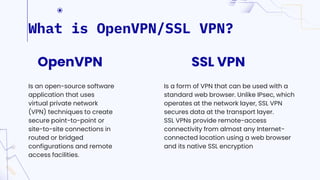
What is OpenVPN/SSL VPN?
Is an open-source software
application that uses
virtual private network
(VPN) techniques to create
secure point-to-point or
site-to-site connections in
routed or bridged
configurations and remote
access facilities.
Is a form of VPN that can be used with a
standard web browser. Unlike IPsec, which
operates at the network layer, SSL VPN
secures data at the transport layer.
SSL VPNs provide remote-access
connectivity from almost any Internet-
connected location using a web browser
and its native SSL encryption
OpenVPN SSL VPN
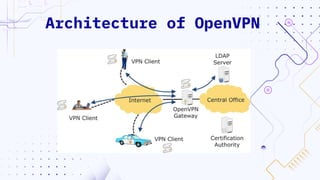
Architecture of OpenVPN
OpenVPN
The encryption capability of
OpenVPN is highly configurable,
supporting various ciphers such as
AES, Blowfish, and Camellia. Among
these, AES-256-bit encryption is often
recommended for environments
where high security is paramount.
OpenVPN flexibility in encryption and
cipher selection makes it adaptable
to different security needs.
Employs a robust security framework
that utilizes SSL/TLS for secure key
exchange between clients and
servers.
This architecture is designed to offer
strong authentication and encryption
capabilities
OpenVPN in more details, pt1
Network
Configuration
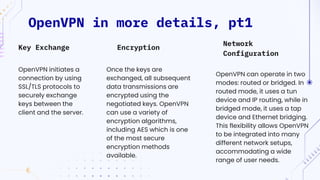
OpenVPN initiates a
connection by using
SSL/TLS protocols to
securely exchange
keys between the
client and the server.
Once the keys are
exchanged, all subsequent
data transmissions are
encrypted using the
negotiated keys. OpenVPN
can use a variety of
encryption algorithms,
including AES which is one
of the most secure
encryption methods
available.
OpenVPN can operate in two
modes: routed or bridged. In
routed mode, it uses a tun
device and IP routing, while in
bridged mode, it uses a tap
device and Ethernet bridging.
This flexibility allows OpenVPN
to be integrated into many
different network setups,
accommodating a wide
range of user needs.
Key Exchange Encryption
OpenVPN in more details, pt2
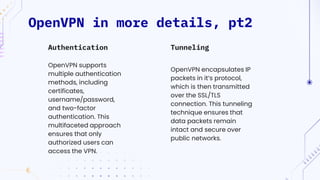
OpenVPN supports
multiple authentication
methods, including
certificates,
username/password,
and two-factor
authentication. This
multifaceted approach
ensures that only
authorized users can
access the VPN.
OpenVPN encapsulates IP
packets in it’s protocol,
which is then transmitted
over the SSL/TLS
connection. This tunneling
technique ensures that
data packets remain
intact and secure over
public networks.
Authentication Tunneling
Comparison with Other VPN Technologies, pt1
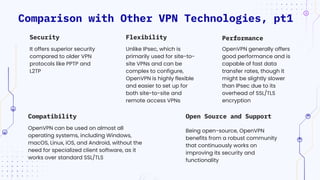
It offers superior security
compared to older VPN
protocols like PPTP and
L2TP
Unlike IPsec, which is
primarily used for site-to-
site VPNs and can be
complex to configure,
OpenVPN is highly flexible
and easier to set up for
both site-to-site and
remote access VPNs
Open Source and Support
Security Flexibility
OpenVPN can be used on almost all
operating systems, including Windows,
macOS, Linux, iOS, and Android, without the
need for specialized client software, as it
works over standard SSL/TLS
Being open-source, OpenVPN
benefits from a robust community
that continuously works on
improving its security and
functionality
OpenVPN generally offers
good performance and is
capable of fast data
transfer rates, though it
might be slightly slower
than IPsec due to its
overhead of SSL/TLS
encryption
Compatibility
Performance
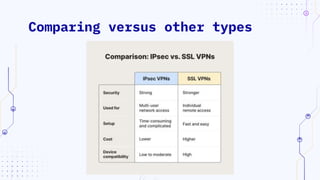
Comparing versus other types
Use Cases of
OpenVPN/SSL VPN
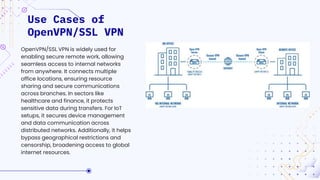
OpenVPN/SSL VPN is widely used for
enabling secure remote work, allowing
seamless access to internal networks
from anywhere. It connects multiple
office locations, ensuring resource
sharing and secure communications
across branches. In sectors like
healthcare and finance, it protects
sensitive data during transfers. For IoT
setups, it secures device management
and data communication across
distributed networks. Additionally, it helps
bypass geographical restrictions and
censorship, broadening access to global
internet resources.
Challenges and Limitations of OpenVPN
While OpenVPN is highly customizable, its configuration can be
complex and daunting for new users or administrators without
extensive networking experience.
The flexibility of settings and options, though beneficial, requires a
careful understanding to ensure optimal performance and security.
The strong encryption and comprehensive security features of
OpenVPN can introduce performance overhead, particularly on
networks with high traffic volumes or limited bandwidth.
The encryption and decryption processes consume CPU resources,
which might affect speed and latency, especially in resource-
constrained environments.
Summary
OpenVPN/SSL VPN offers a versatile and secure solution for
establishing virtual private networks. With robust encryption,
flexible authentication, and support for various configurations,
it meets diverse networking needs. While powerful, OpenVPN
can be complex to configure and may incur performance
overheads. Nevertheless, its reliability in protecting digital
communications makes it a preferred choice for businesses
and individuals alike, helping secure remote access, connect
multiple offices, and safely manage IoT operations. Its ongoing
development promises continued adaptation to evolving
security needs.
Thank You

OpenVPN_SSL VPN - David Targamadze - Presentation.pptx

  • 1.
  • 2.
    Virtual Private Networks VPNsprovide a secure connection over the internet between a user and the resources they are accessing. This technology is crucial for protecting data as it travels across potentially insecure networks like the Internet, ensuring that sensitive information remains confidential and secure from unauthorized access.
  • 3.
    What is OpenVPN/SSLVPN? Is an open-source software application that uses virtual private network (VPN) techniques to create secure point-to-point or site-to-site connections in routed or bridged configurations and remote access facilities. Is a form of VPN that can be used with a standard web browser. Unlike IPsec, which operates at the network layer, SSL VPN secures data at the transport layer. SSL VPNs provide remote-access connectivity from almost any Internet- connected location using a web browser and its native SSL encryption OpenVPN SSL VPN
  • 4.
  • 5.
    OpenVPN The encryption capabilityof OpenVPN is highly configurable, supporting various ciphers such as AES, Blowfish, and Camellia. Among these, AES-256-bit encryption is often recommended for environments where high security is paramount. OpenVPN flexibility in encryption and cipher selection makes it adaptable to different security needs. Employs a robust security framework that utilizes SSL/TLS for secure key exchange between clients and servers. This architecture is designed to offer strong authentication and encryption capabilities
  • 6.
    OpenVPN in moredetails, pt1 Network Configuration OpenVPN initiates a connection by using SSL/TLS protocols to securely exchange keys between the client and the server. Once the keys are exchanged, all subsequent data transmissions are encrypted using the negotiated keys. OpenVPN can use a variety of encryption algorithms, including AES which is one of the most secure encryption methods available. OpenVPN can operate in two modes: routed or bridged. In routed mode, it uses a tun device and IP routing, while in bridged mode, it uses a tap device and Ethernet bridging. This flexibility allows OpenVPN to be integrated into many different network setups, accommodating a wide range of user needs. Key Exchange Encryption
  • 7.
    OpenVPN in moredetails, pt2 OpenVPN supports multiple authentication methods, including certificates, username/password, and two-factor authentication. This multifaceted approach ensures that only authorized users can access the VPN. OpenVPN encapsulates IP packets in it’s protocol, which is then transmitted over the SSL/TLS connection. This tunneling technique ensures that data packets remain intact and secure over public networks. Authentication Tunneling
  • 8.
    Comparison with OtherVPN Technologies, pt1 It offers superior security compared to older VPN protocols like PPTP and L2TP Unlike IPsec, which is primarily used for site-to- site VPNs and can be complex to configure, OpenVPN is highly flexible and easier to set up for both site-to-site and remote access VPNs Open Source and Support Security Flexibility OpenVPN can be used on almost all operating systems, including Windows, macOS, Linux, iOS, and Android, without the need for specialized client software, as it works over standard SSL/TLS Being open-source, OpenVPN benefits from a robust community that continuously works on improving its security and functionality OpenVPN generally offers good performance and is capable of fast data transfer rates, though it might be slightly slower than IPsec due to its overhead of SSL/TLS encryption Compatibility Performance
  • 9.
  • 10.
    Use Cases of OpenVPN/SSLVPN OpenVPN/SSL VPN is widely used for enabling secure remote work, allowing seamless access to internal networks from anywhere. It connects multiple office locations, ensuring resource sharing and secure communications across branches. In sectors like healthcare and finance, it protects sensitive data during transfers. For IoT setups, it secures device management and data communication across distributed networks. Additionally, it helps bypass geographical restrictions and censorship, broadening access to global internet resources.
  • 11.
    Challenges and Limitationsof OpenVPN While OpenVPN is highly customizable, its configuration can be complex and daunting for new users or administrators without extensive networking experience. The flexibility of settings and options, though beneficial, requires a careful understanding to ensure optimal performance and security. The strong encryption and comprehensive security features of OpenVPN can introduce performance overhead, particularly on networks with high traffic volumes or limited bandwidth. The encryption and decryption processes consume CPU resources, which might affect speed and latency, especially in resource- constrained environments.
  • 12.
    Summary OpenVPN/SSL VPN offersa versatile and secure solution for establishing virtual private networks. With robust encryption, flexible authentication, and support for various configurations, it meets diverse networking needs. While powerful, OpenVPN can be complex to configure and may incur performance overheads. Nevertheless, its reliability in protecting digital communications makes it a preferred choice for businesses and individuals alike, helping secure remote access, connect multiple offices, and safely manage IoT operations. Its ongoing development promises continued adaptation to evolving security needs.
  • 13.