Secure Access Service Edge
Haris Chughtai
Mar 2021
SASE
HARIS CHUGHTAI
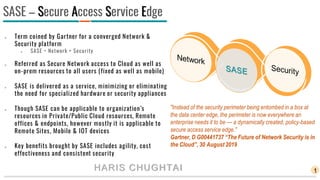
SASE – Secure Access Service Edge
 Term coined by Gartner for a converged Network &
Security platform
 SASE = Network + Security
 Referred as Secure Network access to Cloud as well as
on-prem resources to all users (fixed as well as mobile)
 SASE is delivered as a service, minimizing or eliminating
the need for specialized hardware or security appliances
 Though SASE can be applicable to organization’s
resources in Private/Public Cloud resources, Remote
offices & endpoints, however mostly it is applicable to
Remote Sites, Mobile & IOT devices
 Key benefits brought by SASE includes agility, cost
effectiveness and consistent security
1
"Instead of the security perimeter being entombed in a box at
the data center edge, the perimeter is now everywhere an
enterprise needs it to be — a dynamically created, policy-based
secure access service edge."
Gartner, D G00441737 “The Future of Network Security is in
the Cloud”, 30 August 2019
HARIS CHUGHTAI
SASE Driving Factors
 Cloud Adaptation
 Enterprise services & applications (including the one
carrying sensitive data) migration to public cloud is
inevitable
 SaaS e.g. Office365, Salesforce etc
 IaaS .e.g custom application running on VMs
 Decentralized Network Resources
 Traffic used to be 80/20 (80% internal + 20% internet)
 Now changing to 20/80 (20% internal + 80% internet)
 Mobility
 Users are no more bound to their office desk
 Need access to services from anywhere
 Convergence
 Network & Security functions are converging
2
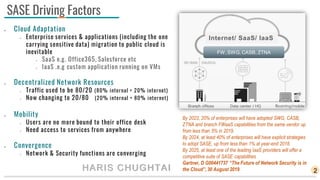
Internet/ SaaS/ IaaS
FW,SWG, CASB, ZTNA
By 2023, 20% of enterprises will have adopted SWG, CASB,
ZTNA and branch FWaaS capabilities from the same vendor up
from less than 5% in 2019.
By 2024, at least 40% of enterprises will have explicit strategies
to adopt SASE, up from less than 1% at year-end 2018.
By 2025, at least one of the leading IaaS providers will offer a
competitive suite of SASE capabilities
Gartner, D G00441737 “The Future of Network Security is in
the Cloud”, 30 August 2019.
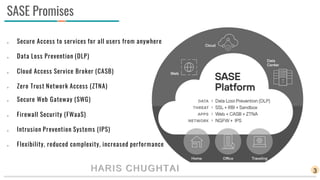
 Secure Access to services for all users from anywhere
 Data Loss Prevention (DLP)
 Cloud Access Service Broker (CASB)
 Zero Trust Network Access (ZTNA)
 Secure Web Gateway (SWG)
 Firewall Security (FWaaS)
 Intrusion Prevention Systems (IPS)
 Flexibility, reduced complexity, increased performance
3
SASE Promises
HARIS CHUGHTAI
HARIS CHUGHTAI
 SASE provides consistent, agile and holistic approach for a converged network enabled with security
 Helps avoiding traditional components based products and services
 Converged Networking & Security helps reducing number of devices and vendors that organization has to deal
with thus reduces Operational Overheads & bring cost optimizations
 When deployed with SDWAN, it enhances not only the security posture but also brings network efficiencies by
incorporating automated traffic optimization & continuity
 Improved Security by deploying a Zero Trust approach when users, devices and applications connect. A SASE
solution expected to provide complete session protection, regardless of whether a user is on or off the
corporate network
 Reduce dependency on enterprise Data Centers with gradual application migration to public Cloud
4
SASE Advantages to Enterprises
SASE & SDWAN
 SDWAN is an Access agnostic, agile WAN access (typically used for site-site connectivity to reduce
expensive MPLS cost). Moreover SDWAN is mainly intended for branch sites not for Mobile users
 Think of SASE as a platform to securely connect enterprise users to your Cloud as well as on-prem
resources irrespective of their location
 SDWAN vendors are strongly pitching their solutions as SASE which may not be entirely true
 SASE expected to offers more features than plain SDWAN
 SDWAN can be viewed as a SASE solution for branch sites if it can provide the expected security
features
5
HARIS CHUGHTAI
Key Take Aways
6
 SASE is a fairly newly evolved term, vendors are interpreting it in their own ways
Firewall vendors are positioning their edge FWs as branch SASE (Security + SDWAN)
SDWAN vendors adding limited security features to pitch it as SASE
 Be careful in mixing SASE with SDWAN
SDWAN is just a piece of broader solution SASE is expected to provide
Do your due diligence in selecting your SDWAN solution as SASE
 Not all Cloud firewalls offer capabilities anticipated from a SASE solution
 Don’t ignore the security of Mobile users which are major part of every organization now
 Avoid vendors that propose to deliver the broad set of services by linking a large number of products
(e.g. many purpose built VMs)
 If organization offices and users are dispersed globally, look for a SASE providers with worldwide POPs
for low-latency user access [providing a distributed edge computing capabilities]
 Shift security from boxes to a software based policy driven security service
HARIS CHUGHTAI

Understanding SASE

  • 1.
    Secure Access ServiceEdge Haris Chughtai Mar 2021 SASE
  • 2.
    HARIS CHUGHTAI SASE –Secure Access Service Edge  Term coined by Gartner for a converged Network & Security platform  SASE = Network + Security  Referred as Secure Network access to Cloud as well as on-prem resources to all users (fixed as well as mobile)  SASE is delivered as a service, minimizing or eliminating the need for specialized hardware or security appliances  Though SASE can be applicable to organization’s resources in Private/Public Cloud resources, Remote offices & endpoints, however mostly it is applicable to Remote Sites, Mobile & IOT devices  Key benefits brought by SASE includes agility, cost effectiveness and consistent security 1 "Instead of the security perimeter being entombed in a box at the data center edge, the perimeter is now everywhere an enterprise needs it to be — a dynamically created, policy-based secure access service edge." Gartner, D G00441737 “The Future of Network Security is in the Cloud”, 30 August 2019
  • 3.
    HARIS CHUGHTAI SASE DrivingFactors  Cloud Adaptation  Enterprise services & applications (including the one carrying sensitive data) migration to public cloud is inevitable  SaaS e.g. Office365, Salesforce etc  IaaS .e.g custom application running on VMs  Decentralized Network Resources  Traffic used to be 80/20 (80% internal + 20% internet)  Now changing to 20/80 (20% internal + 80% internet)  Mobility  Users are no more bound to their office desk  Need access to services from anywhere  Convergence  Network & Security functions are converging 2 Internet/ SaaS/ IaaS FW,SWG, CASB, ZTNA By 2023, 20% of enterprises will have adopted SWG, CASB, ZTNA and branch FWaaS capabilities from the same vendor up from less than 5% in 2019. By 2024, at least 40% of enterprises will have explicit strategies to adopt SASE, up from less than 1% at year-end 2018. By 2025, at least one of the leading IaaS providers will offer a competitive suite of SASE capabilities Gartner, D G00441737 “The Future of Network Security is in the Cloud”, 30 August 2019.
  • 4.
     Secure Accessto services for all users from anywhere  Data Loss Prevention (DLP)  Cloud Access Service Broker (CASB)  Zero Trust Network Access (ZTNA)  Secure Web Gateway (SWG)  Firewall Security (FWaaS)  Intrusion Prevention Systems (IPS)  Flexibility, reduced complexity, increased performance 3 SASE Promises HARIS CHUGHTAI
  • 5.
    HARIS CHUGHTAI  SASEprovides consistent, agile and holistic approach for a converged network enabled with security  Helps avoiding traditional components based products and services  Converged Networking & Security helps reducing number of devices and vendors that organization has to deal with thus reduces Operational Overheads & bring cost optimizations  When deployed with SDWAN, it enhances not only the security posture but also brings network efficiencies by incorporating automated traffic optimization & continuity  Improved Security by deploying a Zero Trust approach when users, devices and applications connect. A SASE solution expected to provide complete session protection, regardless of whether a user is on or off the corporate network  Reduce dependency on enterprise Data Centers with gradual application migration to public Cloud 4 SASE Advantages to Enterprises
  • 6.
    SASE & SDWAN SDWAN is an Access agnostic, agile WAN access (typically used for site-site connectivity to reduce expensive MPLS cost). Moreover SDWAN is mainly intended for branch sites not for Mobile users  Think of SASE as a platform to securely connect enterprise users to your Cloud as well as on-prem resources irrespective of their location  SDWAN vendors are strongly pitching their solutions as SASE which may not be entirely true  SASE expected to offers more features than plain SDWAN  SDWAN can be viewed as a SASE solution for branch sites if it can provide the expected security features 5 HARIS CHUGHTAI
  • 7.
    Key Take Aways 6 SASE is a fairly newly evolved term, vendors are interpreting it in their own ways Firewall vendors are positioning their edge FWs as branch SASE (Security + SDWAN) SDWAN vendors adding limited security features to pitch it as SASE  Be careful in mixing SASE with SDWAN SDWAN is just a piece of broader solution SASE is expected to provide Do your due diligence in selecting your SDWAN solution as SASE  Not all Cloud firewalls offer capabilities anticipated from a SASE solution  Don’t ignore the security of Mobile users which are major part of every organization now  Avoid vendors that propose to deliver the broad set of services by linking a large number of products (e.g. many purpose built VMs)  If organization offices and users are dispersed globally, look for a SASE providers with worldwide POPs for low-latency user access [providing a distributed edge computing capabilities]  Shift security from boxes to a software based policy driven security service HARIS CHUGHTAI