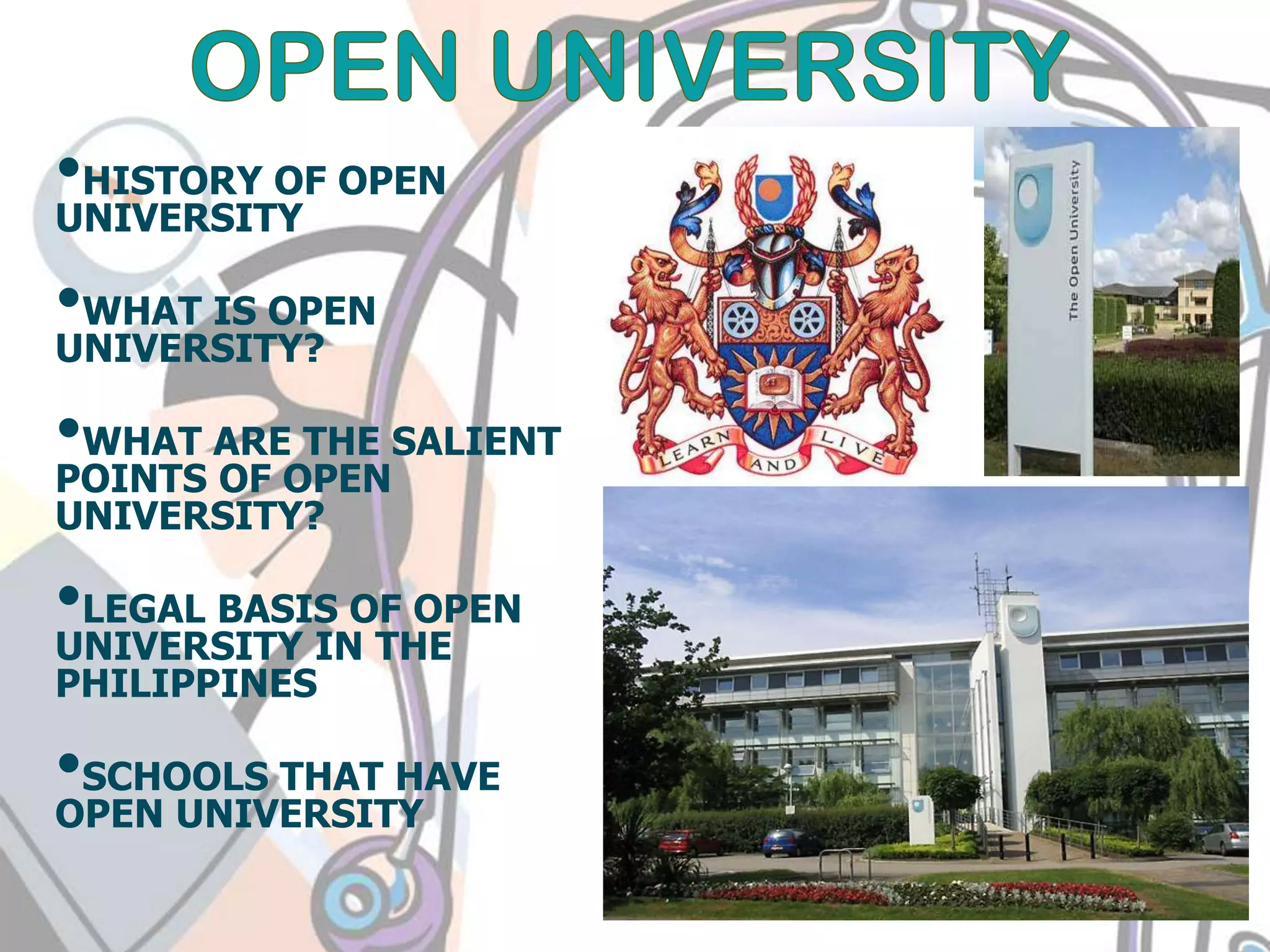
•HISTORY OF OPEN
UNIVERSITY
•WHAT IS OPEN
UNIVERSITY?
•WHAT ARE THE SALIENT
POINTS OF OPEN
UNIVERSITY?
•LEGAL BASIS OF OPEN
UNIVERSITY IN THE
PHILIPPINES
•SCHOOLS THAT HAVE
OPEN UNIVERSITY
History
•The OU was established in 1969 and the first students enrolled in
January 1971.
•The Open University (OU) is a distance learning
and research university founded by Royal Charter in the United
Kingdom.
•The university is funded by a combination of student fees,
contract income, and allocations for teaching and research by the
higher education funding bodies in each of the four countries of
the UK (England, Scotland, Wales and Northern Ireland).
•It is notable for having an open entry policy, i.e. students'
previous academic achievements are not taken into account for
entry to most undergraduate courses.
•The majority of the OU's undergraduate students are based in
the United Kingdom and principally study off-campus, but many
of its courses (both undergraduate and postgraduate) can be
studied off-campus anywhere in the world.
•The University administration is based at Walton Hall, Milton
Keynes in Buckinghamshire, but has regional centres in each of
its thirteen regions around the United Kingdom.
•It also has offices and regional examination centres in most
other European countries.
•The University awards undergraduate and postgraduate
degrees, as well as non-degree qualifications such as
diplomas and certificates, or continuing education units.
•Open universities are universities that have a less formal
structure than traditional universities.
•They are also known for open-door entry policies, where no
particular academic qualifications are needed for entry into
degree granting or other academic enrichment programs.
•Therefore, open universities attract and are ideal for students
who are older or who wish to achieve advanced degrees while
continuing their careers.
•They are ideal for continuing education that is either desired or
required to advance within a profession or specialty.
•Programs offered by open universities include distance or online
learning, correspondence courses, a combination of on-site
lectures and distance learning, as well as degree programs which
grant credit for life experience including work experience.
•Open universities are found throughout the world
programs offered range from technical training to advanced
degrees in commerce, finance and even law
•While open universities are usually private institutions, they
offer instruction at prices that tend to be far lower than those of
even some public institutions which offer similar courses.
•Degrees granted by open universities are often well respected in
the workplace because they show the graduate’s commitment to
obtaining further knowledge and training while remaining
committed to his or her career.
Section 1. The State shall protect
and promote the right of all citizens
to quality education at all levels,
and shall take appropriate steps to
make such education accessible to
all.
Section 2. The State shall:
(4) Encourage non-formal,
informal, and indigenous learning
systems, as well as self-learning,
independent, and out-of-school
study programs particularly those
that respond to community
needs; and
(5) Provide adult citizens, the
disabled, and out-of-school youth
with training in civics, vocational
efficiency, and other skills.
Open university programs in the Philippines
A great variety of degree, non-degree, certificate, and diploma
courses are offered through open universities in the Philippines,
most of which are divisions of state universities. The open
university programs in the Philippines include the following:
•The University of the Philippines, Open University (UPOU),
founded on 23 February 1995, offers degree and non-degree
programs, including courses at the undergraduate, graduate, and
doctoral level and certificate or diploma courses. It has been
named the National Center of Excellence in Open Learning and
Distance Education by CHED. Lessons are given via Internet,
learning modules, and occasional face-to-face sessions.
•The Polytechnic University of the Philippines, Open
University (PUP OU) has offered non-degree courses since the
1970s and degree courses since 1990.
•The Pamantasan ng Lungsod ng Maynila, Open University (PLM OU)
•The Pangasinan State University Open University Systems (PSU-OUS) were
founded in 1996 and began at PSU-Lingayen in March 1997 with diploma
courses. It now offers a wide range of courses to residents of Ilocos Norte,
and Ilocos Sur, as well as Pangasinan.
•The Western Mindanao University Open University System provides a non-
thesis master of public administration course, major in organization and
management. The students meet with their professors once a month at the
nodal centers in Ipil, Sibugay and Pagadian City.
•Bicol University’s Open University, established in 2005, allows students to
earn master’s degrees in public administration, local government
management, and management.
•The CLSU Open University, founded on August 29, 1997, offers graduate,
post-graduate, certificate, and diploma courses. The lessons are administered
through printed modules and occasional live tutorial sessions.
•Benguet State University has offered master’s and diploma programs for
certain courses since 1997.
•Asian Institute for Distance Education
•CAP College Foundation
HOME SCHOOLING
•HISTORY OF HOMESCHOOLING
•WHAT IS HOMESCHOOLING
•SALIENT POINTS IN
HOMESCHOOLING
•LEGAL BASIS OF HOME
SCHOOLING IN THE PHILIPPINES
History
Homeschooling or homeschool (also
called home education or home based
learning)
•is the education of children at home,
typically by parents or by tutors, rather
than in other formal settings
of public or private school
•Parents cite numerous reasons as
motivations to homeschool their children
The three reasons that are selected by the
majority of homeschooling parents in the
United States are:
1. concern about the school environment
2. to provide religious or moral instruction
3. dissatisfaction with academic
instruction at public and private schools
Raymond and Dorothy Moore
RAYMOND AND DOROTHY MOORE
Began to research the academic validity of the rapidly
growing early childhood education movement
They asserted that formal schooling before ages 8–12 not only
lacked the anticipated effectiveness, but was actually harmful to
children
They began to publish their view that formal schooling was
damaging young children academically, socially, mentally, and even
physiologically.
They presented evidence that childhood problems such as juvenile
delinquency, nearsightedness, increased enrollment of students in
special education classes, and behavioral problems were the result
of increasingly earlier enrollment of students.
They cited studies demonstrating that orphans who
were given surrogate mothers were measurably more
intelligent, with superior long term effects – even
though the mothers were "mentally retarded
teenagers" – and that illiterate tribal mothers in
Africa produced children who were socially and
emotionally more advanced than typical western
children, "by western standards of measurement."
Their primary assertion was that the bonds and
emotional development made at home with parents
during these years produced critical long term results
that were cut short by enrollment in schools, and
could neither be replaced nor afterward corrected in
an institutional setting.
Homeschooling is legal in the Philippines. In the 1987 Philippine
Constitution, Article XIV
•Section 1(2) states that the country will “Establish and maintain a system
of free public education in the elementary and high school levels. Without
limiting the natural right of parents to rear their children…” Under the last
phrase, “Without limiting the natural right of parents to rear their
children,” religious groups, mission boards, and families can branch off
from public education to create their own private education.
•However, the Constitution also provides under Section 4 (1) that “the
State recognizes the complementary roles of public and private
institutions in the education system and shall exercise reasonable
supervision and regulation of all education institutions.” Further, the
Department of Education (DepEd) Memo no. 216 s. 1997 entitled “Home
Education Program” states that if a homeschooled student wants to
transfer into a conventional school, he or she must first be accredited by
the DepEd.
Challenges in home schooling your child

Open university in the philippines

  • 1.
    •HISTORY OF OPEN UNIVERSITY •WHATIS OPEN UNIVERSITY? •WHAT ARE THE SALIENT POINTS OF OPEN UNIVERSITY? •LEGAL BASIS OF OPEN UNIVERSITY IN THE PHILIPPINES •SCHOOLS THAT HAVE OPEN UNIVERSITY
  • 2.
    History •The OU wasestablished in 1969 and the first students enrolled in January 1971. •The Open University (OU) is a distance learning and research university founded by Royal Charter in the United Kingdom. •The university is funded by a combination of student fees, contract income, and allocations for teaching and research by the higher education funding bodies in each of the four countries of the UK (England, Scotland, Wales and Northern Ireland). •It is notable for having an open entry policy, i.e. students' previous academic achievements are not taken into account for entry to most undergraduate courses.
  • 3.
    •The majority ofthe OU's undergraduate students are based in the United Kingdom and principally study off-campus, but many of its courses (both undergraduate and postgraduate) can be studied off-campus anywhere in the world. •The University administration is based at Walton Hall, Milton Keynes in Buckinghamshire, but has regional centres in each of its thirteen regions around the United Kingdom. •It also has offices and regional examination centres in most other European countries. •The University awards undergraduate and postgraduate degrees, as well as non-degree qualifications such as diplomas and certificates, or continuing education units.
  • 4.
    •Open universities areuniversities that have a less formal structure than traditional universities. •They are also known for open-door entry policies, where no particular academic qualifications are needed for entry into degree granting or other academic enrichment programs. •Therefore, open universities attract and are ideal for students who are older or who wish to achieve advanced degrees while continuing their careers. •They are ideal for continuing education that is either desired or required to advance within a profession or specialty.
  • 5.
    •Programs offered byopen universities include distance or online learning, correspondence courses, a combination of on-site lectures and distance learning, as well as degree programs which grant credit for life experience including work experience. •Open universities are found throughout the world programs offered range from technical training to advanced degrees in commerce, finance and even law •While open universities are usually private institutions, they offer instruction at prices that tend to be far lower than those of even some public institutions which offer similar courses. •Degrees granted by open universities are often well respected in the workplace because they show the graduate’s commitment to obtaining further knowledge and training while remaining committed to his or her career.
  • 6.
    Section 1. TheState shall protect and promote the right of all citizens to quality education at all levels, and shall take appropriate steps to make such education accessible to all. Section 2. The State shall: (4) Encourage non-formal, informal, and indigenous learning systems, as well as self-learning, independent, and out-of-school study programs particularly those that respond to community needs; and (5) Provide adult citizens, the disabled, and out-of-school youth with training in civics, vocational efficiency, and other skills.
  • 8.
    Open university programsin the Philippines A great variety of degree, non-degree, certificate, and diploma courses are offered through open universities in the Philippines, most of which are divisions of state universities. The open university programs in the Philippines include the following: •The University of the Philippines, Open University (UPOU), founded on 23 February 1995, offers degree and non-degree programs, including courses at the undergraduate, graduate, and doctoral level and certificate or diploma courses. It has been named the National Center of Excellence in Open Learning and Distance Education by CHED. Lessons are given via Internet, learning modules, and occasional face-to-face sessions. •The Polytechnic University of the Philippines, Open University (PUP OU) has offered non-degree courses since the 1970s and degree courses since 1990.
  • 9.
    •The Pamantasan ngLungsod ng Maynila, Open University (PLM OU) •The Pangasinan State University Open University Systems (PSU-OUS) were founded in 1996 and began at PSU-Lingayen in March 1997 with diploma courses. It now offers a wide range of courses to residents of Ilocos Norte, and Ilocos Sur, as well as Pangasinan. •The Western Mindanao University Open University System provides a non- thesis master of public administration course, major in organization and management. The students meet with their professors once a month at the nodal centers in Ipil, Sibugay and Pagadian City. •Bicol University’s Open University, established in 2005, allows students to earn master’s degrees in public administration, local government management, and management. •The CLSU Open University, founded on August 29, 1997, offers graduate, post-graduate, certificate, and diploma courses. The lessons are administered through printed modules and occasional live tutorial sessions. •Benguet State University has offered master’s and diploma programs for certain courses since 1997. •Asian Institute for Distance Education •CAP College Foundation
  • 10.
    HOME SCHOOLING •HISTORY OFHOMESCHOOLING •WHAT IS HOMESCHOOLING •SALIENT POINTS IN HOMESCHOOLING •LEGAL BASIS OF HOME SCHOOLING IN THE PHILIPPINES
  • 11.
    History Homeschooling or homeschool(also called home education or home based learning) •is the education of children at home, typically by parents or by tutors, rather than in other formal settings of public or private school •Parents cite numerous reasons as motivations to homeschool their children The three reasons that are selected by the majority of homeschooling parents in the United States are: 1. concern about the school environment 2. to provide religious or moral instruction 3. dissatisfaction with academic instruction at public and private schools Raymond and Dorothy Moore
  • 12.
    RAYMOND AND DOROTHYMOORE Began to research the academic validity of the rapidly growing early childhood education movement They asserted that formal schooling before ages 8–12 not only lacked the anticipated effectiveness, but was actually harmful to children They began to publish their view that formal schooling was damaging young children academically, socially, mentally, and even physiologically. They presented evidence that childhood problems such as juvenile delinquency, nearsightedness, increased enrollment of students in special education classes, and behavioral problems were the result of increasingly earlier enrollment of students.
  • 13.
    They cited studiesdemonstrating that orphans who were given surrogate mothers were measurably more intelligent, with superior long term effects – even though the mothers were "mentally retarded teenagers" – and that illiterate tribal mothers in Africa produced children who were socially and emotionally more advanced than typical western children, "by western standards of measurement." Their primary assertion was that the bonds and emotional development made at home with parents during these years produced critical long term results that were cut short by enrollment in schools, and could neither be replaced nor afterward corrected in an institutional setting.
  • 14.
    Homeschooling is legalin the Philippines. In the 1987 Philippine Constitution, Article XIV •Section 1(2) states that the country will “Establish and maintain a system of free public education in the elementary and high school levels. Without limiting the natural right of parents to rear their children…” Under the last phrase, “Without limiting the natural right of parents to rear their children,” religious groups, mission boards, and families can branch off from public education to create their own private education. •However, the Constitution also provides under Section 4 (1) that “the State recognizes the complementary roles of public and private institutions in the education system and shall exercise reasonable supervision and regulation of all education institutions.” Further, the Department of Education (DepEd) Memo no. 216 s. 1997 entitled “Home Education Program” states that if a homeschooled student wants to transfer into a conventional school, he or she must first be accredited by the DepEd.
  • 15.
    Challenges in homeschooling your child