
KUMI UNIVERSITYKUMI UNIVERSITY
P.O BOX 178, KUMI-UGANADA (East Africa)P.O BOX 178, KUMI-UGANADA (East Africa)
www.kumiuniversity.ac.orgwww.kumiuniversity.ac.org
RESEARCH PAPER ON OPEN SCHOOLING PROGRAMME: THE
ANSWER TO EDUCATION ACCESS AND QUALITY IN UGANDA
Robert Agwot Komakech*
Faculty of Social Sciences and Management Studies, Kumi University
P.O BOX 178, Kumi, Uganda (East Africa)
Tel: +256 774 181 052/+256 752 181 052; E-mail: kagwot@gmail.com
At
International Conference on Good Governance and Service
Delivery in Developing Economies held between 24th
-28th
August, 2015 at Imperial Hotel Kampala, Uganda
Background of the StudyBackground of the Study
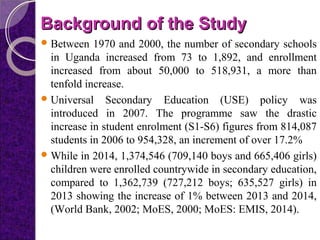
Between 1970 and 2000, the number of secondary schools
in Uganda increased from 73 to 1,892, and enrollment
increased from about 50,000 to 518,931, a more than
tenfold increase.
Universal Secondary Education (USE) policy was
introduced in 2007. The programme saw the drastic
increase in student enrolment (S1-S6) figures from 814,087
students in 2006 to 954,328, an increment of over 17.2%
While in 2014, 1,374,546 (709,140 boys and 665,406 girls)
children were enrolled countrywide in secondary education,
compared to 1,362,739 (727,212 boys; 635,527 girls) in
2013 showing the increase of 1% between 2013 and 2014,
(World Bank, 2002; MoES, 2000; MoES: EMIS, 2014).
Con’tCon’t
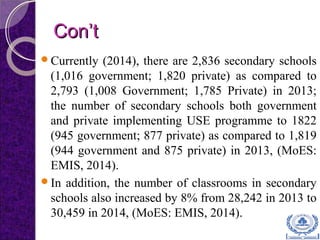
Currently (2014), there are 2,836 secondary schools
(1,016 government; 1,820 private) as compared to
2,793 (1,008 Government; 1,785 Private) in 2013;
the number of secondary schools both government
and private implementing USE programme to 1822
(945 government; 877 private) as compared to 1,819
(944 government and 875 private) in 2013, (MoES:
EMIS, 2014).
In addition, the number of classrooms in secondary
schools also increased by 8% from 28,242 in 2013 to
30,459 in 2014, (MoES: EMIS, 2014).
Con’tCon’t
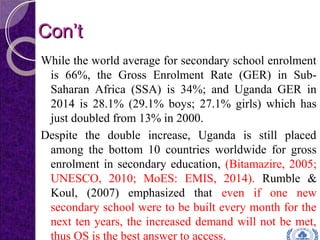
While the world average for secondary school enrolment
is 66%, the Gross Enrolment Rate (GER) in Sub-
Saharan Africa (SSA) is 34%; and Uganda GER in
2014 is 28.1% (29.1% boys; 27.1% girls) which has
just doubled from 13% in 2000.
Despite the double increase, Uganda is still placed
among the bottom 10 countries worldwide for gross
enrolment in secondary education, (Bitamazire, 2005;
UNESCO, 2010; MoES: EMIS, 2014). Rumble &
Koul, (2007) emphasized that even if one new
secondary school were to be built every month for the
next ten years, the increased demand will not be met,
thus OS is the best answer to access.
Con’tCon’t
In practice, countries implementing OS programmes
have better access and high enrollment in secondary
schools compared to the non-practicing countries.
For instance the widespread expansion of this
education level in all regions of the world between
1999 and 2009 increased the GER for lower
secondary education from 72% to 80% globally. The
most notable increase occurred in sub-Saharan
Africa, where the GER for lower secondary
education rose from 28% to 43%.
Con’tCon’t
OS implementing countries (South Africa, Botswana,
Seychelles, Mauritius and Namibia) in the sub-
Saharan countries are the only countries with the
ratios above 70% as compared to Uganda with 28%,
(Esi Sutherland-Addy, 2012; UNESCO, 2011).
Problem StatementProblem Statement
Therefore, although Uganda has experienced
remarkable achievements in secondary education,
the increasing demand for secondary education will
hardly be met by traditional face-to-face delivery
alone. It is against this background that, this paper
explore the new strategies the Government of
Uganda through the Ministry of Education and
Sports can employ to increase access while
improving quality education in the country.
Research MethodologyResearch Methodology
The paper is of exploratory nature and involves a conceptual analytical
approach. Conceptual analysis is a technique that treats concepts as
classes of objects, events, properties or relationships.
The techniques involves defining the meaning of a given concept precisely
by identifying and specifying the conditions under which any entity or
phenomenon is or could be classified under the concept in question.
Conceptual analysis is used in order to get a better understanding of Open
Schooling in the countries implementing the programme. Therefore, this
study is based on the reviewed relevant literature source on open
schooling programme. Also, pertinent Open Schooling (OS) and Open
and Distance Learning (ODL) documents from United Nations
Educational, Cultural and Scientific Organization (UNESCO), World
Bank (WB), and Organization for Economic Cooperation and
Development (OECD) website, specific countries reports such as India,
Zimbabwe, Botswana, Namibia, Mauritius, Seychelles, and South Africa
as well as research journals and conference proceedings relating to Open
Schooling were reviewed and analyzed
The Concept of Open SchoolingThe Concept of Open Schooling
Many children in developing countries do not receive
regular school education, Open Schooling (OS)
began as a way to provide education to children who
were without access to schools, and the rationale for its
provision has depended on the times and the context. In
Australia and Canada, parental concerns of those living
in isolated and remote rural areas who could not afford
to hire a personal tutor or send their children to
boarding schools led to the development of government
correspondence programmes.
The Concept…The Concept…
In 1979 an Open School was established in India, as a
project of the Central Board of Secondary Education,
Delhi. It was upgraded in 1989 and became the National
Institute of Open Schooling (NIOS) which is an
autonomous institution. Open Schools have now been
established and have developed rapidly in many
countries to cater for primary and secondary students.
Some of them have very high enrolments for example,
the National Institute of Open Schooling of India had a
cumulative enrolment of 354,811 between 1992 and
1997; while in 2010 NIOS had cumulative enrolment of
1.5 million students with more than 300,000 enrolling
every year, (Gaba, 1997; Mitra, 2009).
Concept …Concept …
In 2009, 28,942 out-of-school youths and adults
(10,033 male and 18,862 female students) enrolled
in Namibian College of Open Learning (NAMCOL)
programmes, and 42 of these learners enrolled in
more than one programme. In the same year, an
estimated 25,736 out-of school youths and adults
(8,919 males and 16,817 females) accessed
Botswana College of Distance and Open Learning
(BOCODOL) programmes.
What is Open Schooling?What is Open Schooling?
Open schooling is a flexible education system that allows
learners to learn where and when they want, physically
away from a school and a teacher. It uses several
teaching methods to support learning, and has no age
restrictions, content of courses to be taken or number of
courses in which students must enroll.
Abrioux, (2009) cited in Phillips, (2006) defines Open
Schooling as “the physical separation of the school level
learner from the teacher, and the use of unconventional
teaching methodologies, and Information and
Communication Technologies (ICTs) to bridge the
separation and provide the education and training.”
Open Schooling …Open Schooling …
According to Commonwealth of Learning, (2008),
Open Schooling is not called Open/Distance
Schooling for a reason; that is Open Schooling may
follow different patterns, but the most common
scenario is that the learners study specifically
designed open learning materials on their own at
home, in their workplace, wherever it is convenient
for them and then they meet together with a
facilitator on a regular basis.
The "Open" in Open Schooling refers to the openness
of the system for example:
Open Schooling …Open Schooling …
 Youth that missed out on schooling in their childhood
can enroll in courses which will provide them with the
equivalence of secondary education without
embarrassment of being in classrooms with children
much younger than themselves;
 Young mothers can take secondary level education
through studying at home, and attending tutorials only
when necessary and their responsibilities permit;
 Working adults can enroll in one or two courses at a
time, and study whenever their personal and work
commitments permit;
 Young adults can acquire skill training coupled with
academic subjects while self-employed or working as
non-skilled labour
Key Principles of Open SchoolingKey Principles of Open Schooling
The key principles of Open Schooling as include the
following:
Lifelong learning
Flexible learning
Learner support
Cost effectiveness
These principles give the distinction between Open
Schooling and Distance Education although there is
overlap between the two terms. In simple terms,
Distance Education refers to a set of practices to
plan and implement educational activities where
there is a separation between teaching and learning.
Advantages of Open Schooling inAdvantages of Open Schooling in
Uganda EducationUganda Education
UNESCO, (1996) in its report aimed to provide a
frame of reference to cope with the challenges and
demands of the new millennium. It proposed the
following four pillars of education, as essentials for
all, whether young or older, to function effectively in
the new millennium. These are: Learning to Do or
becoming competent; Learning to Learn or
remaining a life-long learner; Learning to live with
Others or learning to relate; and Learning to Be or
live by a set of principles or be a person of character.
The advantages for adoption of Open Schooling
include the following:
1. Reduce Costs of Education1. Reduce Costs of Education
Open Schooling is efficient and cost effective in a sense
that there is no need for the students to frequently
travel; offers opportunities for maximum number of
learners with no need for many buildings; and provide
economies of scale at the early stages of programme
expansion, as fixed costs are spread across more and
more students.
In 2007, Commonwealth of Learning study conducted by
Rumble & Koul revealed that the costs per student at
NIOS between 2002 and 2006 were on average 12.43
times lower than those of the two conventional
secondary school systems to which they were
compared.
2. Increase Access and Students2. Increase Access and Students
EnrollmentEnrollment
Open Schooling can meet the needs of remote
communities, those whose jobs prevent them
from attending regular classes, or those who
are tied to the home.
According to UNESCO, EFA Global Monitoring
report says, “Open schools are urgently needed to
provide access to education for millions of children
who currently have no access to any formal
schooling.
3.3. Improve on Quality EducationImprove on Quality Education
The system is efficient in delivering high quality
education to large numbers of students, and in
providing students with a breadth and depth of
choice in what and how they achieve their high
school certificate.
According to NIOS, (2013) echoed that, Open Schooling provides quality
education for all due to its flexibility in place and pace of learning,
flexible curriculum, self learning material, media and ICT support,
Personal Contact Programme (PCP), recognizing and accommodating
learner's preferred learning objectives and need for student support
services that will maximize the individual's chances of success.
4. Flexibility in Studying and4. Flexibility in Studying and
ExaminationExamination
The programme is flexible when issues of time and place
are taken into consideration. Every student has the
luxury of choosing the place and time that suits him/her.
In addition, OS does not only provide flexibility in
studying, but it also offers flexibility for examination for
instance, National Institute of Open Schooling offers
open examination pattern, called On Demand
examination.
Students can appear at one of the regional centers for the
examinations when they feel ready and comfortable.
The examination system is based on the random
questions method.
5. Solve the Problem of Teachers’5. Solve the Problem of Teachers’
Shortages and TurnoverShortages and Turnover
Open School Programme will engage all stakeholders such as
parents, learners and teachers and the role of teachers will
change to a mixture of facilitator or moderator. This will
enable creative thinking, competence and skill development,
as well as creation of new knowledge in the classroom, and
transforming the school into a truly creative learning
environment.
As a result, the system will address shortage of teachers since
students/ learners will develop a sense of independent
learning. It also provides opportunities for parents to be more
involved in the learning process of their children at the same
time; parents might even enroll for the courses themselves.
Policy ImplicationsPolicy Implications
Lewin, (2008) has shown that many developing countries will
never achieve Universal Secondary Education by
conventional schooling alone because that model is too
expensive. In the OECD countries the unit costs of secondary
education are generally less than double those at primary, but
in most of Africa ratios range from 1:3 to 1:5 or even higher.
In Uganda for instance, the government pays Ush. 8,100 per
annum for every child enrolled in primary four to seven in
UPE schools while Ush. 123,000 is paid annually for each
student under the USE programme in government aided
schools. This implies that the cost per child in secondary
school is 15.2 times more than in primary school. Therefore,
in order to have a very successful Open Schooling in the
country-the following need to be done.
1.1. Proper PlanningProper Planning
Since Open Schooling can play a major role in
providing access and quality to education; it is
important that policy-makers include OS in their
core planning for education.
However, the status of the programme should be
clearly defined in the national policy while ensuring
that funding is provided from government through a
well-designed funding formula.
2. Using Open Schooling for2. Using Open Schooling for
Political ExpediencyPolitical Expediency
The earliest government programmes such as UPE and
USE were implemented in the expedient way
without key stakeholders’ involvement which has
made the Ministry of Education and Sport failed to
balance the enrollment with quality across all levels
of education in the country.
Thus, to enable sustained development of this sub-
sector, a considered policy for OS is highly
desirable. Good policy ensures that the OS sub-
sector is less vulnerable to changes in government
and funding priorities.
3.3. Developing ICT InfrastructureDeveloping ICT Infrastructure
The successful inclusion of ICT in OS requires
having a basic secure infrastructure. Since ICT
policy issues are complex, they should not be
developed in isolation from larger government
reform initiatives in sectors besides education.
At the same time, ICT policy development in OS
must be coherent within the education sector so that
the underlying infrastructure is scalable and flexible.
4. Involve Development4. Involve Development
Partners in the ProgrammePartners in the Programme
Participation of non-state actors should be encouraged.
This can be achieved through promoting Public
Private Partnerships and the involvement of
international donors in development issues. This will
enable the state to tap into the resources of such
partners.
However, experience shows that projects that depend
too heavily on foreign aid often collapse when the
funding ends because alternate domestic resources
are not available to assume the burden, (World
Bank, 1998).
5.5. Employment TermsEmployment Terms
The government through the Ministry of Education
and Sports need to employ Teachers/ Facilitators/
Tutors on a part-time or contract basis for OS
programme.
This will promote commitment to the programme and
will lead to quality education. Furthermore, before
the renewal on the contract the performance of
individual(s) should be measured for instance using
Results Based Management (RBM) where
individual’s performance is linked to performance of
government departments and ministries.
66.. Continuous Monitoring andContinuous Monitoring and
EvaluationEvaluation
 Resources have to be accounted for and the progress of
projects has to be monitored continuously to ensure
compliance with the agreed objectives.
 Monitoring and evaluation should not be treated as an after-
thought, but as part and parcel of programme.
 In this, the media has a pivotal platform for monitoring and
explaining the crisis in the programme while harnessing the
power of technology to make education a global priority.
 Media outlets should track governments’ progress, highlight
effective initiatives, share stories that inspire commitment and
follow policy debates.
7. Government Commitment7. Government Commitment
Total government commitment is very crucial for the
success of OS programme. The commitment like in
the previous education programmes (Universal
Primary Education and Universal Secondary
Education) will encourage the public to embrace the
initiative.
These will clear the suspicion from intended
beneficiaries that OS programme is a “Second Class”
an afterthought education system to appease people
who have in fact been denied the right to equal
education
ConclusionConclusion
Open schooling’s flexibility makes it suitable for
Uganda to substantially reduce the opportunity costs
of schooling for learners from poor backgrounds.
Learners can study without neglecting their
household chores or having to sacrifice paid work,
practicing agriculture, selling at the market and
helping out with various domestic chores which have
been the main reasons why learners drop out and
absentee themselves from school.
Conclusion Con’tConclusion Con’t
When the programme is introduced the learners will
benefit greatly from the flexibility of choosing when,
where and how to learn; and these will change the
state of our education from good to great since it will
get our country out of the inherent challenges of
having teachers and principals who are less
experienced and motivated, governing bodies with
little capacity for supporting and managing schools,
widely varied performance between the schools,
limited human and financial resources, and low
levels of students literacy and numeracy.
ReferencesReferences
Abrioux, D.A.M.X. (2009). ‘Special Issues and Practices in Open Schooling’. In Abrioux,
D.A.M.X. & Ferreira, F. (eds), Perspectives on Education: Open Schooling in the 21st Century.
Vancouver: Commonwealth of Learning, PP. 3–34.
Bitamazire, G.M., (2005). STATUS OF EDUCATION FOR RURAL PEOPLE IN UGANDA: A Paper
Presented at the Ministerial Seminar on Education for Rural People in Africa, held between 7th 9th
September, 2005 in Addis Ababa, Ethiopia.
Butcher, N. & Roberts, N. (2004). “Costs, Effectiveness, Efficiency: A Guide for Sound Investment.”
In Perraton, H.D. & Lentell, H., (eds.). Policy for Open and Distance Learning. PP.
224–245.
Dodds, T., & John K. Mayo J.K., (1992). “The Promise and Performance of Distance Education in
Developing Nations: The IEC Experience 1971-1992.” Paper presented at the International
Extension College’s Anniversary Conference, “World Education Crisis: Roles for Distance
Education,” Robinson College, Cambridge, September 20-24, 1992.
Du Vivier E., & Ellis J., (2009). Enable the Development of Open Schooling. In Abrioux,
D.A.M.X. and Ferreira, F. (eds), Perspectives on Education: Open Schooling in the 21st Century.
Vancouver: Commonwealth of Learning, PP 21-34
Esi Sutherland-Addy, (2014). Gender Equity in Junior and Senior Secondary Education in Sub-Saharan
Africa. Africa Region Human Development Department: The World Bank Washington D.C.
Figueredo, V. & Anzalone, S., (2003). Alternative Models for Secondary Education in Developing
Countries: Rationale and Realities. American Institutes for Research. The University of
Pittsburgh, Available at http://www.ieq.org/pdf/Alternative_Models_sec_ed.pdf
Gaba, A.K., (1997). Is Open Schooling in India really Cost Effective? In Mukhopadyay, M. & Madha, P.,
References…References…
Ministry of Education and Sport: Education Management Information System, (2014). Government of the
Republic of Uganda
Mhlanga, E., (2009). The Theoretical Perspective of Open Schooling. In Ferreira. F, (ed). Quality
Assurance Toolkit for Open Schools: Commonwealth of Learning Vancouver, British Columbia
Mitra. S.,(2009). Student Support Services in Open Schooling: A Case Study of Students’ Needs and
Satisfaction in India. Open Learning. Available at www.tandfonline.com/doi/pdf/
Murphy, P., Anzalone, S., Bosch, A., & Moulton, J. (2002). Enhancing Learning Opportunities in Africa:
Distance Education and Information and Communication Technologies for Learning. Human
Development Department. Washington, DC.
NIOS, (2013). Education for All: Role of Open Schooling. International Conference; Ministry of Human
Resource Development, Government of India
OECD, (2006). Selected Statistics on Higher Education. Available at http://www.oecd.org/data.pdf
On-Demand Examination System, (2012). National Institute of Open Schooling. Available at
http://www.nios.ac.in/default.aspx.
Rumble.G, (1997). The Costs and Economics of Open and Distance Learning. London, Kogan Page, PP
134-160
Rumble, G. & Koul. B.N., (2007). Open Schooling for Secondary & Higher Secondary Education: Costs
and Effectiveness in India and Namibia. Commonwealth of Learning (COL): Vancouver, BC
Uganda Ministry of Education and Sports, (1999). The Ugandan Experience of Universal
Primary Education. Government of the Republic of Uganda.
References …References …
UNESCO, (1996), Learning: The Treasure Within. The International Commission on Education for the
Twenty-first Century. Jacques Delors. Available at www.unesco.org/education/pdf
UNESCO, (2010). EFA Global Monitoring report 2010: Reaching the Marginalized, PP.80-89,
UNESCO, (2011). Global Education Digest 2011Regional Profile: Sub-Saharan Africa. UNESCO Institute
for Statistics. Available at http://www.uis.unesco.org/Education/Documents/.pdf
Verspoor & Bregman, ,(2012). At the Crossroads: Challenges for Secondary Education in Africa. Africa
Human Development Department: World Bank. Available at: www.worldbank.org/
World Bank, (1998). “Latin America and the Caribbean: Education and Technology at the Crossroads.”
Washington, D.C.
World Bank, (2002). India: Secondary education and the New Agenda for Economic Growth.
Washington DC: Report No. 24208-IN. The World Bank.
Thank you for your aTTenTion
May god bless you!

Umi conference presentation on Open Schooling Programme

  • 1.
    KUMI UNIVERSITYKUMI UNIVERSITY P.OBOX 178, KUMI-UGANADA (East Africa)P.O BOX 178, KUMI-UGANADA (East Africa) www.kumiuniversity.ac.orgwww.kumiuniversity.ac.org RESEARCH PAPER ON OPEN SCHOOLING PROGRAMME: THE ANSWER TO EDUCATION ACCESS AND QUALITY IN UGANDA Robert Agwot Komakech* Faculty of Social Sciences and Management Studies, Kumi University P.O BOX 178, Kumi, Uganda (East Africa) Tel: +256 774 181 052/+256 752 181 052; E-mail: kagwot@gmail.com At International Conference on Good Governance and Service Delivery in Developing Economies held between 24th -28th August, 2015 at Imperial Hotel Kampala, Uganda
  • 2.
    Background of theStudyBackground of the Study Between 1970 and 2000, the number of secondary schools in Uganda increased from 73 to 1,892, and enrollment increased from about 50,000 to 518,931, a more than tenfold increase. Universal Secondary Education (USE) policy was introduced in 2007. The programme saw the drastic increase in student enrolment (S1-S6) figures from 814,087 students in 2006 to 954,328, an increment of over 17.2% While in 2014, 1,374,546 (709,140 boys and 665,406 girls) children were enrolled countrywide in secondary education, compared to 1,362,739 (727,212 boys; 635,527 girls) in 2013 showing the increase of 1% between 2013 and 2014, (World Bank, 2002; MoES, 2000; MoES: EMIS, 2014).
  • 3.
    Con’tCon’t Currently (2014), thereare 2,836 secondary schools (1,016 government; 1,820 private) as compared to 2,793 (1,008 Government; 1,785 Private) in 2013; the number of secondary schools both government and private implementing USE programme to 1822 (945 government; 877 private) as compared to 1,819 (944 government and 875 private) in 2013, (MoES: EMIS, 2014). In addition, the number of classrooms in secondary schools also increased by 8% from 28,242 in 2013 to 30,459 in 2014, (MoES: EMIS, 2014).
  • 4.
    Con’tCon’t While the worldaverage for secondary school enrolment is 66%, the Gross Enrolment Rate (GER) in Sub- Saharan Africa (SSA) is 34%; and Uganda GER in 2014 is 28.1% (29.1% boys; 27.1% girls) which has just doubled from 13% in 2000. Despite the double increase, Uganda is still placed among the bottom 10 countries worldwide for gross enrolment in secondary education, (Bitamazire, 2005; UNESCO, 2010; MoES: EMIS, 2014). Rumble & Koul, (2007) emphasized that even if one new secondary school were to be built every month for the next ten years, the increased demand will not be met, thus OS is the best answer to access.
  • 5.
    Con’tCon’t In practice, countriesimplementing OS programmes have better access and high enrollment in secondary schools compared to the non-practicing countries. For instance the widespread expansion of this education level in all regions of the world between 1999 and 2009 increased the GER for lower secondary education from 72% to 80% globally. The most notable increase occurred in sub-Saharan Africa, where the GER for lower secondary education rose from 28% to 43%.
  • 6.
    Con’tCon’t OS implementing countries(South Africa, Botswana, Seychelles, Mauritius and Namibia) in the sub- Saharan countries are the only countries with the ratios above 70% as compared to Uganda with 28%, (Esi Sutherland-Addy, 2012; UNESCO, 2011).
  • 7.
    Problem StatementProblem Statement Therefore,although Uganda has experienced remarkable achievements in secondary education, the increasing demand for secondary education will hardly be met by traditional face-to-face delivery alone. It is against this background that, this paper explore the new strategies the Government of Uganda through the Ministry of Education and Sports can employ to increase access while improving quality education in the country.
  • 8.
    Research MethodologyResearch Methodology Thepaper is of exploratory nature and involves a conceptual analytical approach. Conceptual analysis is a technique that treats concepts as classes of objects, events, properties or relationships. The techniques involves defining the meaning of a given concept precisely by identifying and specifying the conditions under which any entity or phenomenon is or could be classified under the concept in question. Conceptual analysis is used in order to get a better understanding of Open Schooling in the countries implementing the programme. Therefore, this study is based on the reviewed relevant literature source on open schooling programme. Also, pertinent Open Schooling (OS) and Open and Distance Learning (ODL) documents from United Nations Educational, Cultural and Scientific Organization (UNESCO), World Bank (WB), and Organization for Economic Cooperation and Development (OECD) website, specific countries reports such as India, Zimbabwe, Botswana, Namibia, Mauritius, Seychelles, and South Africa as well as research journals and conference proceedings relating to Open Schooling were reviewed and analyzed
  • 9.
    The Concept ofOpen SchoolingThe Concept of Open Schooling Many children in developing countries do not receive regular school education, Open Schooling (OS) began as a way to provide education to children who were without access to schools, and the rationale for its provision has depended on the times and the context. In Australia and Canada, parental concerns of those living in isolated and remote rural areas who could not afford to hire a personal tutor or send their children to boarding schools led to the development of government correspondence programmes.
  • 10.
    The Concept…The Concept… In1979 an Open School was established in India, as a project of the Central Board of Secondary Education, Delhi. It was upgraded in 1989 and became the National Institute of Open Schooling (NIOS) which is an autonomous institution. Open Schools have now been established and have developed rapidly in many countries to cater for primary and secondary students. Some of them have very high enrolments for example, the National Institute of Open Schooling of India had a cumulative enrolment of 354,811 between 1992 and 1997; while in 2010 NIOS had cumulative enrolment of 1.5 million students with more than 300,000 enrolling every year, (Gaba, 1997; Mitra, 2009).
  • 11.
    Concept …Concept … In2009, 28,942 out-of-school youths and adults (10,033 male and 18,862 female students) enrolled in Namibian College of Open Learning (NAMCOL) programmes, and 42 of these learners enrolled in more than one programme. In the same year, an estimated 25,736 out-of school youths and adults (8,919 males and 16,817 females) accessed Botswana College of Distance and Open Learning (BOCODOL) programmes.
  • 12.
    What is OpenSchooling?What is Open Schooling? Open schooling is a flexible education system that allows learners to learn where and when they want, physically away from a school and a teacher. It uses several teaching methods to support learning, and has no age restrictions, content of courses to be taken or number of courses in which students must enroll. Abrioux, (2009) cited in Phillips, (2006) defines Open Schooling as “the physical separation of the school level learner from the teacher, and the use of unconventional teaching methodologies, and Information and Communication Technologies (ICTs) to bridge the separation and provide the education and training.”
  • 13.
    Open Schooling …OpenSchooling … According to Commonwealth of Learning, (2008), Open Schooling is not called Open/Distance Schooling for a reason; that is Open Schooling may follow different patterns, but the most common scenario is that the learners study specifically designed open learning materials on their own at home, in their workplace, wherever it is convenient for them and then they meet together with a facilitator on a regular basis. The "Open" in Open Schooling refers to the openness of the system for example:
  • 14.
    Open Schooling …OpenSchooling …  Youth that missed out on schooling in their childhood can enroll in courses which will provide them with the equivalence of secondary education without embarrassment of being in classrooms with children much younger than themselves;  Young mothers can take secondary level education through studying at home, and attending tutorials only when necessary and their responsibilities permit;  Working adults can enroll in one or two courses at a time, and study whenever their personal and work commitments permit;  Young adults can acquire skill training coupled with academic subjects while self-employed or working as non-skilled labour
  • 15.
    Key Principles ofOpen SchoolingKey Principles of Open Schooling The key principles of Open Schooling as include the following: Lifelong learning Flexible learning Learner support Cost effectiveness These principles give the distinction between Open Schooling and Distance Education although there is overlap between the two terms. In simple terms, Distance Education refers to a set of practices to plan and implement educational activities where there is a separation between teaching and learning.
  • 16.
    Advantages of OpenSchooling inAdvantages of Open Schooling in Uganda EducationUganda Education UNESCO, (1996) in its report aimed to provide a frame of reference to cope with the challenges and demands of the new millennium. It proposed the following four pillars of education, as essentials for all, whether young or older, to function effectively in the new millennium. These are: Learning to Do or becoming competent; Learning to Learn or remaining a life-long learner; Learning to live with Others or learning to relate; and Learning to Be or live by a set of principles or be a person of character. The advantages for adoption of Open Schooling include the following:
  • 17.
    1. Reduce Costsof Education1. Reduce Costs of Education Open Schooling is efficient and cost effective in a sense that there is no need for the students to frequently travel; offers opportunities for maximum number of learners with no need for many buildings; and provide economies of scale at the early stages of programme expansion, as fixed costs are spread across more and more students. In 2007, Commonwealth of Learning study conducted by Rumble & Koul revealed that the costs per student at NIOS between 2002 and 2006 were on average 12.43 times lower than those of the two conventional secondary school systems to which they were compared.
  • 18.
    2. Increase Accessand Students2. Increase Access and Students EnrollmentEnrollment Open Schooling can meet the needs of remote communities, those whose jobs prevent them from attending regular classes, or those who are tied to the home. According to UNESCO, EFA Global Monitoring report says, “Open schools are urgently needed to provide access to education for millions of children who currently have no access to any formal schooling.
  • 19.
    3.3. Improve onQuality EducationImprove on Quality Education The system is efficient in delivering high quality education to large numbers of students, and in providing students with a breadth and depth of choice in what and how they achieve their high school certificate. According to NIOS, (2013) echoed that, Open Schooling provides quality education for all due to its flexibility in place and pace of learning, flexible curriculum, self learning material, media and ICT support, Personal Contact Programme (PCP), recognizing and accommodating learner's preferred learning objectives and need for student support services that will maximize the individual's chances of success.
  • 20.
    4. Flexibility inStudying and4. Flexibility in Studying and ExaminationExamination The programme is flexible when issues of time and place are taken into consideration. Every student has the luxury of choosing the place and time that suits him/her. In addition, OS does not only provide flexibility in studying, but it also offers flexibility for examination for instance, National Institute of Open Schooling offers open examination pattern, called On Demand examination. Students can appear at one of the regional centers for the examinations when they feel ready and comfortable. The examination system is based on the random questions method.
  • 21.
    5. Solve theProblem of Teachers’5. Solve the Problem of Teachers’ Shortages and TurnoverShortages and Turnover Open School Programme will engage all stakeholders such as parents, learners and teachers and the role of teachers will change to a mixture of facilitator or moderator. This will enable creative thinking, competence and skill development, as well as creation of new knowledge in the classroom, and transforming the school into a truly creative learning environment. As a result, the system will address shortage of teachers since students/ learners will develop a sense of independent learning. It also provides opportunities for parents to be more involved in the learning process of their children at the same time; parents might even enroll for the courses themselves.
  • 22.
    Policy ImplicationsPolicy Implications Lewin,(2008) has shown that many developing countries will never achieve Universal Secondary Education by conventional schooling alone because that model is too expensive. In the OECD countries the unit costs of secondary education are generally less than double those at primary, but in most of Africa ratios range from 1:3 to 1:5 or even higher. In Uganda for instance, the government pays Ush. 8,100 per annum for every child enrolled in primary four to seven in UPE schools while Ush. 123,000 is paid annually for each student under the USE programme in government aided schools. This implies that the cost per child in secondary school is 15.2 times more than in primary school. Therefore, in order to have a very successful Open Schooling in the country-the following need to be done.
  • 23.
    1.1. Proper PlanningProperPlanning Since Open Schooling can play a major role in providing access and quality to education; it is important that policy-makers include OS in their core planning for education. However, the status of the programme should be clearly defined in the national policy while ensuring that funding is provided from government through a well-designed funding formula.
  • 24.
    2. Using OpenSchooling for2. Using Open Schooling for Political ExpediencyPolitical Expediency The earliest government programmes such as UPE and USE were implemented in the expedient way without key stakeholders’ involvement which has made the Ministry of Education and Sport failed to balance the enrollment with quality across all levels of education in the country. Thus, to enable sustained development of this sub- sector, a considered policy for OS is highly desirable. Good policy ensures that the OS sub- sector is less vulnerable to changes in government and funding priorities.
  • 25.
    3.3. Developing ICTInfrastructureDeveloping ICT Infrastructure The successful inclusion of ICT in OS requires having a basic secure infrastructure. Since ICT policy issues are complex, they should not be developed in isolation from larger government reform initiatives in sectors besides education. At the same time, ICT policy development in OS must be coherent within the education sector so that the underlying infrastructure is scalable and flexible.
  • 26.
    4. Involve Development4.Involve Development Partners in the ProgrammePartners in the Programme Participation of non-state actors should be encouraged. This can be achieved through promoting Public Private Partnerships and the involvement of international donors in development issues. This will enable the state to tap into the resources of such partners. However, experience shows that projects that depend too heavily on foreign aid often collapse when the funding ends because alternate domestic resources are not available to assume the burden, (World Bank, 1998).
  • 27.
    5.5. Employment TermsEmploymentTerms The government through the Ministry of Education and Sports need to employ Teachers/ Facilitators/ Tutors on a part-time or contract basis for OS programme. This will promote commitment to the programme and will lead to quality education. Furthermore, before the renewal on the contract the performance of individual(s) should be measured for instance using Results Based Management (RBM) where individual’s performance is linked to performance of government departments and ministries.
  • 28.
    66.. Continuous MonitoringandContinuous Monitoring and EvaluationEvaluation  Resources have to be accounted for and the progress of projects has to be monitored continuously to ensure compliance with the agreed objectives.  Monitoring and evaluation should not be treated as an after- thought, but as part and parcel of programme.  In this, the media has a pivotal platform for monitoring and explaining the crisis in the programme while harnessing the power of technology to make education a global priority.  Media outlets should track governments’ progress, highlight effective initiatives, share stories that inspire commitment and follow policy debates.
  • 29.
    7. Government Commitment7.Government Commitment Total government commitment is very crucial for the success of OS programme. The commitment like in the previous education programmes (Universal Primary Education and Universal Secondary Education) will encourage the public to embrace the initiative. These will clear the suspicion from intended beneficiaries that OS programme is a “Second Class” an afterthought education system to appease people who have in fact been denied the right to equal education
  • 30.
    ConclusionConclusion Open schooling’s flexibilitymakes it suitable for Uganda to substantially reduce the opportunity costs of schooling for learners from poor backgrounds. Learners can study without neglecting their household chores or having to sacrifice paid work, practicing agriculture, selling at the market and helping out with various domestic chores which have been the main reasons why learners drop out and absentee themselves from school.
  • 31.
    Conclusion Con’tConclusion Con’t Whenthe programme is introduced the learners will benefit greatly from the flexibility of choosing when, where and how to learn; and these will change the state of our education from good to great since it will get our country out of the inherent challenges of having teachers and principals who are less experienced and motivated, governing bodies with little capacity for supporting and managing schools, widely varied performance between the schools, limited human and financial resources, and low levels of students literacy and numeracy.
  • 32.
    ReferencesReferences Abrioux, D.A.M.X. (2009).‘Special Issues and Practices in Open Schooling’. In Abrioux, D.A.M.X. & Ferreira, F. (eds), Perspectives on Education: Open Schooling in the 21st Century. Vancouver: Commonwealth of Learning, PP. 3–34. Bitamazire, G.M., (2005). STATUS OF EDUCATION FOR RURAL PEOPLE IN UGANDA: A Paper Presented at the Ministerial Seminar on Education for Rural People in Africa, held between 7th 9th September, 2005 in Addis Ababa, Ethiopia. Butcher, N. & Roberts, N. (2004). “Costs, Effectiveness, Efficiency: A Guide for Sound Investment.” In Perraton, H.D. & Lentell, H., (eds.). Policy for Open and Distance Learning. PP. 224–245. Dodds, T., & John K. Mayo J.K., (1992). “The Promise and Performance of Distance Education in Developing Nations: The IEC Experience 1971-1992.” Paper presented at the International Extension College’s Anniversary Conference, “World Education Crisis: Roles for Distance Education,” Robinson College, Cambridge, September 20-24, 1992. Du Vivier E., & Ellis J., (2009). Enable the Development of Open Schooling. In Abrioux, D.A.M.X. and Ferreira, F. (eds), Perspectives on Education: Open Schooling in the 21st Century. Vancouver: Commonwealth of Learning, PP 21-34 Esi Sutherland-Addy, (2014). Gender Equity in Junior and Senior Secondary Education in Sub-Saharan Africa. Africa Region Human Development Department: The World Bank Washington D.C. Figueredo, V. & Anzalone, S., (2003). Alternative Models for Secondary Education in Developing Countries: Rationale and Realities. American Institutes for Research. The University of Pittsburgh, Available at http://www.ieq.org/pdf/Alternative_Models_sec_ed.pdf Gaba, A.K., (1997). Is Open Schooling in India really Cost Effective? In Mukhopadyay, M. & Madha, P.,
  • 33.
    References…References… Ministry of Educationand Sport: Education Management Information System, (2014). Government of the Republic of Uganda Mhlanga, E., (2009). The Theoretical Perspective of Open Schooling. In Ferreira. F, (ed). Quality Assurance Toolkit for Open Schools: Commonwealth of Learning Vancouver, British Columbia Mitra. S.,(2009). Student Support Services in Open Schooling: A Case Study of Students’ Needs and Satisfaction in India. Open Learning. Available at www.tandfonline.com/doi/pdf/ Murphy, P., Anzalone, S., Bosch, A., & Moulton, J. (2002). Enhancing Learning Opportunities in Africa: Distance Education and Information and Communication Technologies for Learning. Human Development Department. Washington, DC. NIOS, (2013). Education for All: Role of Open Schooling. International Conference; Ministry of Human Resource Development, Government of India OECD, (2006). Selected Statistics on Higher Education. Available at http://www.oecd.org/data.pdf On-Demand Examination System, (2012). National Institute of Open Schooling. Available at http://www.nios.ac.in/default.aspx. Rumble.G, (1997). The Costs and Economics of Open and Distance Learning. London, Kogan Page, PP 134-160 Rumble, G. & Koul. B.N., (2007). Open Schooling for Secondary & Higher Secondary Education: Costs and Effectiveness in India and Namibia. Commonwealth of Learning (COL): Vancouver, BC Uganda Ministry of Education and Sports, (1999). The Ugandan Experience of Universal Primary Education. Government of the Republic of Uganda.
  • 34.
    References …References … UNESCO,(1996), Learning: The Treasure Within. The International Commission on Education for the Twenty-first Century. Jacques Delors. Available at www.unesco.org/education/pdf UNESCO, (2010). EFA Global Monitoring report 2010: Reaching the Marginalized, PP.80-89, UNESCO, (2011). Global Education Digest 2011Regional Profile: Sub-Saharan Africa. UNESCO Institute for Statistics. Available at http://www.uis.unesco.org/Education/Documents/.pdf Verspoor & Bregman, ,(2012). At the Crossroads: Challenges for Secondary Education in Africa. Africa Human Development Department: World Bank. Available at: www.worldbank.org/ World Bank, (1998). “Latin America and the Caribbean: Education and Technology at the Crossroads.” Washington, D.C. World Bank, (2002). India: Secondary education and the New Agenda for Economic Growth. Washington DC: Report No. 24208-IN. The World Bank.
  • 35.
    Thank you foryour aTTenTion May god bless you!