HISTORICAL DEVELOPMENT
OF EDUCATION IN THE
PHILIPPINES
SPANISH
COLONIZATION
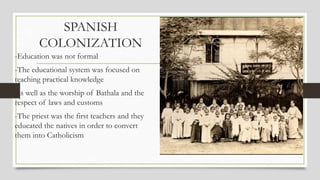
-Education was not formal
-The educational system was focused on
teaching practical knowledge
-as well as the worship of Bathala and the
respect of laws and customs
-The priest was the first teachers and they
educated the natives in order to convert
them into Catholicism
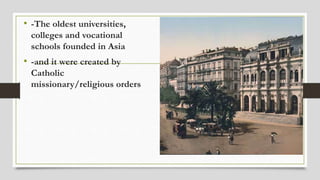
• -The oldest universities,
colleges and vocational
schools founded in Asia
• -and it were created by
Catholic
missionary/religious orders
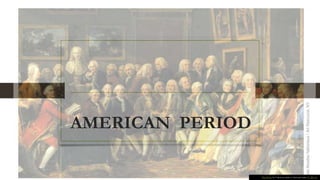
AMERICAN PERIOD
This Photo by Unknown author is licensed under CC BY-SA.
-Filipinos were among the most educated
people in all of Asia
-American soldiers built schools in conquered
areas, and the soldiers themselves were the
first teachers
 Volunteer American soldiers became the first teachers of the
Filipinos. Part of their mission was to build classrooms in
every place where they were assigned. The American soldiers
stopped teaching only when a group of teachers from the
U.S. came to the Philippines in June 1901. They came aboard
the ship "Sheridan." In August 1901, 600 teachers called
Thomasites arrived. Their name derived from the ship they
traveled on, the U.S. Army Transport Thomas.
 Education became a very important issue for the United
States colonial government, since it allowed it to spread
their cultural values, particularly the English language, to
the Filipino people.[5] Instruction in English language, and
American history, lead to forming of a national identity
and Filipino nationalism.
 Every child from age 7 was required to register in schools
located in their own town or province. The students were
given free school materials. There were three levels of
education during the American period. The "elementary"
level consisted of four primary years and 3 intermediate
years. The "secondary" or high school level consisted of
four years; and the third was the "college" or tertiary level.
Religion was not part of the curriculum of the schools as
it had been during the Spanish period.
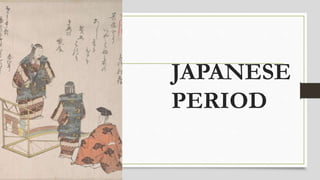
JAPANESE
PERIOD
JAPANESE PERIOD
SUMMARY
EDUCATIONAL AIMS
 Eradicate old idea of reliance on western nations
 Love of neighbor
 Military training
METHODS OF EDUCATION
Stress dignity of manual labor
Emphasis vocational Education
EDUCATION TYPES
Nihongo Language
Vocational training
Health Education Training
MEDIUM OF INSTRUCTION
 Nihongo Language
Educational System/ Curriculum
Six basic principles of Japanese education
1 .Realization of new order and promote friendly relations between
Japan and the Philippines to the farthest extent
2 .Foster a new Filipino culture based
3. Endeavor to elevate the morals of people, giving up over
emphasis of materialism
4. Diffusion of the Japanese language in the Philippines
5. Promotion of vocational course
6.To inspire people with the spirit to love neighbor
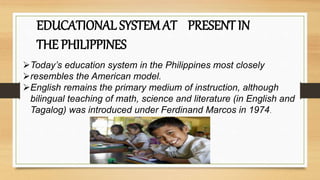
EDUCATIONAL SYSTEM AT PRESENT IN
THE PHILIPPINES
Today’s education system in the Philippines most closely
resembles the American model.
English remains the primary medium of instruction, although
bilingual teaching of math, science and literature (in English and
Tagalog) was introduced under Ferdinand Marcos in 1974.
 The pre-university education system in the Philippines is the
K to 12 Program (also known as K-12), which covers 13
years of education from kindergarten to Grade 12. It was
introduced over a six-year period from 2011 to 2017, to
bring the Philippines education system in line with the rest
of the world.
Kindergarten and Elementary School
 Central to the K-12 reforms was the provision of one year of
kindergarten schooling for every child in the Philippines, which
is done before elementary school. Elementary school in the
Philippines covers grades 1-6.
Primary Education
Similar to the curriculum, Primary Education starts
through Grade one to Six. However, it is now subdivided
into two cycles. For some private schools, the
Intermediate cycle extends to another year, thus getting
Grade 7 level before eventually moving to High School
Level.
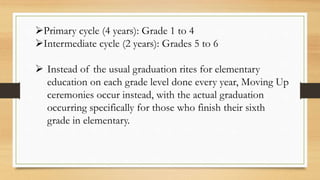
Primary cycle (4 years): Grade 1 to 4
Intermediate cycle (2 years): Grades 5 to 6
 Instead of the usual graduation rites for elementary
education on each grade level done every year, Moving Up
ceremonies occur instead, with the actual graduation
occurring specifically for those who finish their sixth
grade in elementary.
SECONDARY EDUCATION
With the K-12 program, the most affected by the restructuring is
the secondary education level. With the old basic education cycle,
Filipino students just spend four years in secondary schools.
However, an additional two more years is added to this level.
This is done to improve the quality of education of Filipino
students, but this serves as another preparatory level for students
who either wish to pursue higher education or as early as it is, enter
the Philippine workforce.
THE TWO CYCLES OF HIGH SCHOOL ARE:
Lower Secondary Education (Junior High School): Grade 7 to
10
Upper Secondary Education (Senior High School): Grade 11 to
12
In line with the new course curriculum, high schools have
been designed to have different academic and non-academic
tracks, with other accredited schools offering specialized
upper secondary education.
Students are free to choose which track they think would help
them build their future careers according to their strengths
and passion.
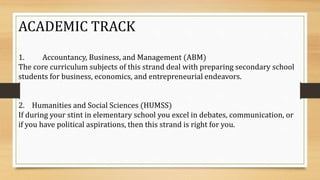
ACADEMIC TRACK
1. Accountancy, Business, and Management (ABM)
The core curriculum subjects of this strand deal with preparing secondary school
students for business, economics, and entrepreneurial endeavors.
2. Humanities and Social Sciences (HUMSS)
If during your stint in elementary school you excel in debates, communication, or
if you have political aspirations, then this strand is right for you.
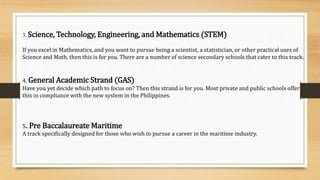
3. Science, Technology, Engineering, and Mathematics (STEM)
If you excel in Mathematics, and you want to pursue being a scientist, a statistician, or other practical uses of
Science and Math, then this is for you. There are a number of science secondary schools that cater to this track.
4. General Academic Strand (GAS)
Have you yet decide which path to focus on? Then this strand is for you. Most private and public schools offer
this in compliance with the new system in the Philippines.
5. Pre Baccalaureate Maritime
A track specifically designed for those who wish to pursue a career in the maritime industry.
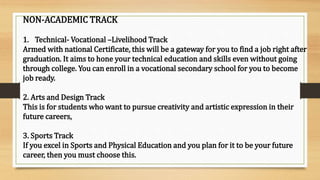
NON-ACADEMIC TRACK
1. Technical- Vocational –Livelihood Track
Armed with national Certificate, this will be a gateway for you to find a job right after
graduation. It aims to hone your technical education and skills even without going
through college. You can enroll in a vocational secondary school for you to become
job ready.
2. Arts and Design Track
This is for students who want to pursue creativity and artistic expression in their
future careers,
3. Sports Track
If you excel in Sports and Physical Education and you plan for it to be your future
career, then you must choose this.
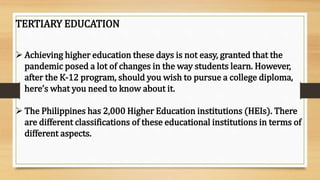
TERTIARY EDUCATION
 Achieving higher education these days is not easy, granted that the
pandemic posed a lot of changes in the way students learn. However,
after the K-12 program, should you wish to pursue a college diploma,
here’s what you need to know about it.
 The Philippines has 2,000 Higher Education institutions (HEIs). There
are different classifications of these educational institutions in terms of
different aspects.
COLLEGE OR UNIVERSITY
 When choosing a school that offers more courses, you could choose between a college or a university. A
university must meet stringent requirements from the commission on Higher Education (CHED) before
achieving the said status.
 A good quality institute bloom in an environment that fosters competitiveness, creative thinking,
innovation and so forth. It provides a learning environment that encourages working on innovative projects in
order to promote holistic personality development for nurturing future leaders.
PUBLIC OR PRIVATE
 In terms ownership, HEIs can be publicly funded, or owned by private institutions. Of course, tuition fees needed to study
differs from a public to a private one.
SECULAR OR RELIGIOUS
 A religious school is a school that either has a religious component in its operations or its curriculum, or exists
primarily for the purpose of teaching aspects of a particular religion.
EXPERTISE
 Some colleges and universities offer higher education programs after college. This courses can be specializing in a field of
studies such as Education, Nursing, or Education
Under graduate ( Bachelor’s Degree)
 Undergraduate degree programs are academic programs that are geared towards granting you a degree in
exchange for completing a specified number of courses or subjects. They typically take four to five years to
complete, depending on the field of study.
Post Graduate ( Master’s Degree)
 A postgraduate course is typically one year's duration full time or it can take two years to complete part-time. A
postgraduate diploma, postgraduate degree or Master's degree offers the student an advanced level of education in their
chosen area of study.
 In a taught masters, students are awarded a Masters of Arts (MA), Masters of Science (MSc) or a Master of Philosophy
(MPhil). MA and MSc are the two most common types of postgraduate degrees.
Doctoral (PhD)
Is a doctoral research degree and the highest level of
academic qualification you can achieve. A PhD degree
normally takes between three and four years of full-time work
to complete. You'll research and write a thesis offering an
original contribution to your subject.
ALTERNATIVE LEARNING SYSTEM IN THE
PHILIPPINES
 The Alternative Learning System (ALS) is a parallel learning system in the
Philippines that provides opportunities for out-of-school youth and adult
(OSYA) learners to develop basic and functional literacy skills, and to access
equivalent pathways to complete basic education.
There are two major programs on ALS that are being implemented by the
Department of Education, through the Bureau of Alternative Learning
System (BALS). One is the Basic Literacy Program and the other is the
Continuing Education Program - Accreditation and Equivalency (A&E).
Both programs are modular and flexible.
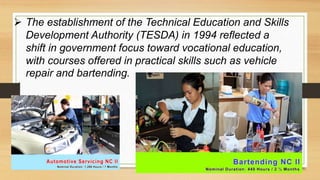
 The establishment of the Technical Education and Skills
Development Authority (TESDA) in 1994 reflected a
shift in government focus toward vocational education,
with courses offered in practical skills such as vehicle
repair and bartending.
SHIELA POWER POINT.pptx

SHIELA POWER POINT.pptx

  • 1.
  • 2.
    SPANISH COLONIZATION -Education was notformal -The educational system was focused on teaching practical knowledge -as well as the worship of Bathala and the respect of laws and customs -The priest was the first teachers and they educated the natives in order to convert them into Catholicism
  • 3.
    • -The oldestuniversities, colleges and vocational schools founded in Asia • -and it were created by Catholic missionary/religious orders
  • 4.
    AMERICAN PERIOD This Photoby Unknown author is licensed under CC BY-SA.
  • 5.
    -Filipinos were amongthe most educated people in all of Asia -American soldiers built schools in conquered areas, and the soldiers themselves were the first teachers
  • 6.
     Volunteer Americansoldiers became the first teachers of the Filipinos. Part of their mission was to build classrooms in every place where they were assigned. The American soldiers stopped teaching only when a group of teachers from the U.S. came to the Philippines in June 1901. They came aboard the ship "Sheridan." In August 1901, 600 teachers called Thomasites arrived. Their name derived from the ship they traveled on, the U.S. Army Transport Thomas.
  • 7.
     Education becamea very important issue for the United States colonial government, since it allowed it to spread their cultural values, particularly the English language, to the Filipino people.[5] Instruction in English language, and American history, lead to forming of a national identity and Filipino nationalism.
  • 8.
     Every childfrom age 7 was required to register in schools located in their own town or province. The students were given free school materials. There were three levels of education during the American period. The "elementary" level consisted of four primary years and 3 intermediate years. The "secondary" or high school level consisted of four years; and the third was the "college" or tertiary level. Religion was not part of the curriculum of the schools as it had been during the Spanish period.
  • 9.
  • 10.
    JAPANESE PERIOD SUMMARY EDUCATIONAL AIMS Eradicate old idea of reliance on western nations  Love of neighbor  Military training
  • 11.
    METHODS OF EDUCATION Stressdignity of manual labor Emphasis vocational Education
  • 12.
    EDUCATION TYPES Nihongo Language Vocationaltraining Health Education Training
  • 13.
    MEDIUM OF INSTRUCTION Nihongo Language
  • 14.
    Educational System/ Curriculum Sixbasic principles of Japanese education 1 .Realization of new order and promote friendly relations between Japan and the Philippines to the farthest extent 2 .Foster a new Filipino culture based 3. Endeavor to elevate the morals of people, giving up over emphasis of materialism 4. Diffusion of the Japanese language in the Philippines 5. Promotion of vocational course 6.To inspire people with the spirit to love neighbor
  • 15.
    EDUCATIONAL SYSTEM ATPRESENT IN THE PHILIPPINES Today’s education system in the Philippines most closely resembles the American model. English remains the primary medium of instruction, although bilingual teaching of math, science and literature (in English and Tagalog) was introduced under Ferdinand Marcos in 1974.
  • 16.
     The pre-universityeducation system in the Philippines is the K to 12 Program (also known as K-12), which covers 13 years of education from kindergarten to Grade 12. It was introduced over a six-year period from 2011 to 2017, to bring the Philippines education system in line with the rest of the world.
  • 17.
    Kindergarten and ElementarySchool  Central to the K-12 reforms was the provision of one year of kindergarten schooling for every child in the Philippines, which is done before elementary school. Elementary school in the Philippines covers grades 1-6.
  • 18.
    Primary Education Similar tothe curriculum, Primary Education starts through Grade one to Six. However, it is now subdivided into two cycles. For some private schools, the Intermediate cycle extends to another year, thus getting Grade 7 level before eventually moving to High School Level.
  • 19.
    Primary cycle (4years): Grade 1 to 4 Intermediate cycle (2 years): Grades 5 to 6  Instead of the usual graduation rites for elementary education on each grade level done every year, Moving Up ceremonies occur instead, with the actual graduation occurring specifically for those who finish their sixth grade in elementary.
  • 20.
    SECONDARY EDUCATION With theK-12 program, the most affected by the restructuring is the secondary education level. With the old basic education cycle, Filipino students just spend four years in secondary schools. However, an additional two more years is added to this level. This is done to improve the quality of education of Filipino students, but this serves as another preparatory level for students who either wish to pursue higher education or as early as it is, enter the Philippine workforce.
  • 21.
    THE TWO CYCLESOF HIGH SCHOOL ARE: Lower Secondary Education (Junior High School): Grade 7 to 10 Upper Secondary Education (Senior High School): Grade 11 to 12 In line with the new course curriculum, high schools have been designed to have different academic and non-academic tracks, with other accredited schools offering specialized upper secondary education. Students are free to choose which track they think would help them build their future careers according to their strengths and passion.
  • 22.
    ACADEMIC TRACK 1. Accountancy,Business, and Management (ABM) The core curriculum subjects of this strand deal with preparing secondary school students for business, economics, and entrepreneurial endeavors. 2. Humanities and Social Sciences (HUMSS) If during your stint in elementary school you excel in debates, communication, or if you have political aspirations, then this strand is right for you.
  • 23.
    3. Science, Technology,Engineering, and Mathematics (STEM) If you excel in Mathematics, and you want to pursue being a scientist, a statistician, or other practical uses of Science and Math, then this is for you. There are a number of science secondary schools that cater to this track. 4. General Academic Strand (GAS) Have you yet decide which path to focus on? Then this strand is for you. Most private and public schools offer this in compliance with the new system in the Philippines. 5. Pre Baccalaureate Maritime A track specifically designed for those who wish to pursue a career in the maritime industry.
  • 24.
    NON-ACADEMIC TRACK 1. Technical-Vocational –Livelihood Track Armed with national Certificate, this will be a gateway for you to find a job right after graduation. It aims to hone your technical education and skills even without going through college. You can enroll in a vocational secondary school for you to become job ready. 2. Arts and Design Track This is for students who want to pursue creativity and artistic expression in their future careers, 3. Sports Track If you excel in Sports and Physical Education and you plan for it to be your future career, then you must choose this.
  • 25.
    TERTIARY EDUCATION  Achievinghigher education these days is not easy, granted that the pandemic posed a lot of changes in the way students learn. However, after the K-12 program, should you wish to pursue a college diploma, here’s what you need to know about it.  The Philippines has 2,000 Higher Education institutions (HEIs). There are different classifications of these educational institutions in terms of different aspects.
  • 26.
    COLLEGE OR UNIVERSITY When choosing a school that offers more courses, you could choose between a college or a university. A university must meet stringent requirements from the commission on Higher Education (CHED) before achieving the said status.  A good quality institute bloom in an environment that fosters competitiveness, creative thinking, innovation and so forth. It provides a learning environment that encourages working on innovative projects in order to promote holistic personality development for nurturing future leaders. PUBLIC OR PRIVATE  In terms ownership, HEIs can be publicly funded, or owned by private institutions. Of course, tuition fees needed to study differs from a public to a private one. SECULAR OR RELIGIOUS  A religious school is a school that either has a religious component in its operations or its curriculum, or exists primarily for the purpose of teaching aspects of a particular religion.
  • 27.
    EXPERTISE  Some collegesand universities offer higher education programs after college. This courses can be specializing in a field of studies such as Education, Nursing, or Education Under graduate ( Bachelor’s Degree)  Undergraduate degree programs are academic programs that are geared towards granting you a degree in exchange for completing a specified number of courses or subjects. They typically take four to five years to complete, depending on the field of study. Post Graduate ( Master’s Degree)  A postgraduate course is typically one year's duration full time or it can take two years to complete part-time. A postgraduate diploma, postgraduate degree or Master's degree offers the student an advanced level of education in their chosen area of study.  In a taught masters, students are awarded a Masters of Arts (MA), Masters of Science (MSc) or a Master of Philosophy (MPhil). MA and MSc are the two most common types of postgraduate degrees.
  • 28.
    Doctoral (PhD) Is adoctoral research degree and the highest level of academic qualification you can achieve. A PhD degree normally takes between three and four years of full-time work to complete. You'll research and write a thesis offering an original contribution to your subject.
  • 29.
    ALTERNATIVE LEARNING SYSTEMIN THE PHILIPPINES  The Alternative Learning System (ALS) is a parallel learning system in the Philippines that provides opportunities for out-of-school youth and adult (OSYA) learners to develop basic and functional literacy skills, and to access equivalent pathways to complete basic education. There are two major programs on ALS that are being implemented by the Department of Education, through the Bureau of Alternative Learning System (BALS). One is the Basic Literacy Program and the other is the Continuing Education Program - Accreditation and Equivalency (A&E). Both programs are modular and flexible.
  • 30.
     The establishmentof the Technical Education and Skills Development Authority (TESDA) in 1994 reflected a shift in government focus toward vocational education, with courses offered in practical skills such as vehicle repair and bartending.