NEW GENERAL EDUCATION
CURRICULUM
The Commission on Higher Education (CHEd) has
approved the new set of mandatory general
education (GE) subjects that will be taught to college
students who have finished the added two years of
high school under the K to 12 (Kindergarten to Grade
12) program.
The new GE curriculum will be taken up for only one
year (or 18 units every semester) instead of two years
as currently practiced since most of the old GE
subjects will already be taken up in senior high school
(Grades 11 to 12).
The shortened GE curriculum has prompted all
collegiate disciplines, which take four to five years to
finish, to revise the content and length of their
respective curriculum before the K to 12 graduates
enter college in 2018.
The engineering technical panel has already
decided to shorten the course from five years to four
years because of the K to 12 program.
The technical panels of experts
formed by CHEd for every collegiate
discipline will decide whether to shorten
the course, or to keep the length but add
more major subjects.
“The decision is not across the
board. It will be discipline-based.
The technical panels would make their decisions
by the middle of the year since “2014 is when we
hope to implement a number of things, so that
means by this year we have those decisions
already made
At present, college students are
required to take up (GE) subjects
such as:
• Communication
• Math
• Science
• History
• Physical education (during their first two years before
they can take up subjects for their respective
disciplines.)
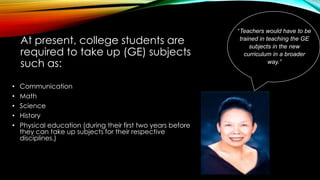
“Teachers would have to be
trained in teaching the GE
subjects in the new
curriculum in a broader
way.”
Sources involved in the drafting said the new GE curriculum
consisted of 12 subjects, including the mandatory subject on
the life and works of national hero Jose Rizal.
The eight GE subjects are:
• Understanding the Self
• Contemporary World
• Purposive Communication
• Art Appreciation
• Ethics
• Readings in Philippine History
• Mathematics in the Modern World
• Science and Technology (ST) and Society.
The students are allowed to
choose three elective subjects.
The K to 12 law crafted by Congress calls for a two-
year transition period where college teachers who
teach GE subjects can teach in Grade 11 and 12.
“They have not finalized any
arrangement with higher
education institutions on the fate
of displaced GE teachers..
There’s no solution yet. Obviously
we accept it as a problem. But K
to 12 was necessary and
therefore there will be some
sacrifices entailed. What we’re
trying to do now is to make sure
those sacrifices aren’t too big”
The shortened GE
curriculum and the
implementation of senior
high school in 2016 and
2017 have raised the
scenario where colleges
and GE teachers will
have no one in teach
during those two years.
DepEd already approved the curriculum for
grades 11 and 12 last December.
Senior high school will be implemented nationwide in 2016.
But the 30 high schools that piloted Grade 11 last year will see their
senior high school students’ graduate in March 2014.
The subjects taken up by these students should be credited
when they enter college.
OPEN UNIVERSITY; AN ALTERNATIVE SYSTEM OF
EDUCATION
The University of the
Philippines Open
University (U.P.O.U.) is
a public distance learning
institution and research
university.
Its mandate is to provide education opportunities to individuals aspiring
for higher education and improved qualifications but were unable to take
advantage of traditional modes of education because of personal and
professional obligations.
U.P.O.U. Provides quality higher and continuing education to Filipinos
through the distance education system. Its mission is to give its
students formal qualification, as well as to develop in them the
discipline and capability to become lifelong learners who are at
home in today's knowledge society.
The Commission on Higher
Education (CHED) has declared the
U.P.O.U. as the National Center of
Excellence in Open Learning and Distance
Education in recognition of its
achievements in this field and its vital role in
pushing the frontiers of learning in service
to the Filipino nation
a. Offer through open and distance learning degree and non-degree programs that are
responsive to the needs of learners and of the society of which they are a part;
b. Develop a system of continuing education to sustain professional growth and
promote lifelong learning;
c. Develop and adapt delivery systems appropriate to distance learners;
d. Provide leadership in the development of open learning and distance education
expertise in the country and in the appropriate use of information and communication
technologies of education; and
e. make instructional packages accessible to various publics through collaborative
arrangements, institutional agreements, and other appropriate mechanisms.
The U.P. Open University aims to:
MODE OF TEACHING &
LEARNING
U.P.O.U. delivers its programs and courses through distance
education (DE). In this mode, teachers and learners are separated
by time and space. Learners study in an independent self-learning
style using specially designed learning materials and resources.
Teaching and learning is mediated through the use of technology
like print, audio, video, and the internet. Students interact with their
instructors and each other through virtual classrooms, email,
and web conferencing. Almost all U.P.O.U. courses are offered
through online learning mode, making them accessible to learners
from different parts of the country and the world
FACULTIES OF STUDIES
U.P.O.U. has three faculties of studies (or colleges), each headed
by a dean:
• Faculty of Education
(FEd)
The Faculty of
Education (FEd) covers
the following range of
areas of study: general
education, alternative
education, language
and literacy education,
science and
mathematics teaching,
social studies
education, and
distance education.
• Faculty of Management and
Development Studies
(FMDS)
FMDS offers a range of
postgraduate programs in
R&D management,
environment and natural
resources management, land
valuation and management,
public management, social
work, nursing, hospital
administration, and public
health as well as non-formal
programs in entrepreneurship,
health, and land valuation.
• Faculty of
Information &
Communication
Studies (FICS)
FICS offers
degree programs in
communication,
information systems,
computer science,
and multimedia
studies.
ACADEMIC PROGRAMS
Undergraduate
Programs
• Associate in Arts
• Bachelor of Arts in
Multimedia Studies
• Bachelor of Education
Studies
The U.P. Open University offers the following degree
programs:
Graduate Certificate Program
• Graduate Certificate in Distance Education (within the
Master of Distance Education)
• Post-Baccalaureate Diploma Programs
• Diploma in Social Work
• Diploma in Computer Science
• Diploma in International Health
• Diploma in Research and Development Management
• Diploma in Environment and Natural Resources Management
• Diploma in Land Valuation and Management
• Diploma in Science Teaching
• Diploma in Math Teaching
• Diploma in Language and Literacy Education for Teachers
• Diploma in Social Studies Education
Graduate Programs
• Master in Social Work
• Master of Development Communication
• Master of Distance Education
• Master of International Health
• Master of Land Valuation and Management
• Master of Public Health
• Master in Hospital Administration
• Master of Arts in Nursing
• Master of Public Management
• Master of Environment and Natural Resources
Management
• Master of Arts in Education (Language and
Literacy Education)
• Master of Arts in Social Studies Education
• Master in Information Systems
• Doctor of Philosophy in Education (Biology
Education, Chemistry Education, Physics
Education, Mathematics Education)
• Doctor of Communication
Non-formal Courses/Certificates
• Caring for the Special Child
• Caring for the Elderly
• Community Mental Health
• Health Research Methods
• New Enterprise Planning
• Online Teaching and Learning
• Organic Agriculture
• Personal Entrepreneurial Development
• Introduction to E-Commerce
• Professional Teaching Certification
• Simplified Accounting for Entrepreneurs
• Continuing Professional Education Program on
Land Valuation
RESEARCH
U.P.O.U. conducts research in distance education (DE) and the disciplines it
currently offers.
The University has spearheaded research in open and distance learning in the
country. Its research in this area has delved into the following topics: DE learner profile,
learning styles, and learner performance; online teaching and learning; virtual learning
environments; computer-mediated collaborative learning; gender and distance
education; pedagogical approaches in distance education; DE program evaluation;
and management of DE.
I n addition, the University has also pursued research in the following discipline-
based areas: education, information and communication technology, multimedia,
communication, organization and management, public policy, environment, health,
and development studies. Many of these discipline-based studies have been externally
funded.
References:
http://newsinfo.inquirer.net/382497/ched-lays-out-new-ge-subjects-for-
colleges-universities-with-k12-program
http://en.wikipedia.org/wiki/University_of_the_Philippines_Open_University
http://www.google.com.ph/imgres?sa=X&hl=en&biw=1366&bih=600&tbm
=isch&tbnid=2FemM-
Xd9nFsyM:&imgrefurl=http://wvsu.edu.ph/ircgs/keynote-
speakers/&docid=BUu81r3GEhUXTM&imgurl=http://wvsu.edu.ph/ircgs/wp-
content/uploads/2012/03/patricia-licuanan-
ched.jpg&w=200&h=249&ei=Mt2JUc2ZD4L8rAfX6IHABg&zoom=1

GENERAL EDUCATION CURRICULUM

  • 1.
  • 2.
    The Commission onHigher Education (CHEd) has approved the new set of mandatory general education (GE) subjects that will be taught to college students who have finished the added two years of high school under the K to 12 (Kindergarten to Grade 12) program. The new GE curriculum will be taken up for only one year (or 18 units every semester) instead of two years as currently practiced since most of the old GE subjects will already be taken up in senior high school (Grades 11 to 12). The shortened GE curriculum has prompted all collegiate disciplines, which take four to five years to finish, to revise the content and length of their respective curriculum before the K to 12 graduates enter college in 2018.
  • 3.
    The engineering technicalpanel has already decided to shorten the course from five years to four years because of the K to 12 program. The technical panels of experts formed by CHEd for every collegiate discipline will decide whether to shorten the course, or to keep the length but add more major subjects. “The decision is not across the board. It will be discipline-based. The technical panels would make their decisions by the middle of the year since “2014 is when we hope to implement a number of things, so that means by this year we have those decisions already made
  • 4.
    At present, collegestudents are required to take up (GE) subjects such as: • Communication • Math • Science • History • Physical education (during their first two years before they can take up subjects for their respective disciplines.) “Teachers would have to be trained in teaching the GE subjects in the new curriculum in a broader way.”
  • 5.
    Sources involved inthe drafting said the new GE curriculum consisted of 12 subjects, including the mandatory subject on the life and works of national hero Jose Rizal. The eight GE subjects are: • Understanding the Self • Contemporary World • Purposive Communication • Art Appreciation • Ethics • Readings in Philippine History • Mathematics in the Modern World • Science and Technology (ST) and Society. The students are allowed to choose three elective subjects.
  • 6.
    The K to12 law crafted by Congress calls for a two- year transition period where college teachers who teach GE subjects can teach in Grade 11 and 12. “They have not finalized any arrangement with higher education institutions on the fate of displaced GE teachers.. There’s no solution yet. Obviously we accept it as a problem. But K to 12 was necessary and therefore there will be some sacrifices entailed. What we’re trying to do now is to make sure those sacrifices aren’t too big” The shortened GE curriculum and the implementation of senior high school in 2016 and 2017 have raised the scenario where colleges and GE teachers will have no one in teach during those two years.
  • 7.
    DepEd already approvedthe curriculum for grades 11 and 12 last December. Senior high school will be implemented nationwide in 2016. But the 30 high schools that piloted Grade 11 last year will see their senior high school students’ graduate in March 2014. The subjects taken up by these students should be credited when they enter college.
  • 8.
    OPEN UNIVERSITY; ANALTERNATIVE SYSTEM OF EDUCATION
  • 9.
    The University ofthe Philippines Open University (U.P.O.U.) is a public distance learning institution and research university. Its mandate is to provide education opportunities to individuals aspiring for higher education and improved qualifications but were unable to take advantage of traditional modes of education because of personal and professional obligations.
  • 10.
    U.P.O.U. Provides qualityhigher and continuing education to Filipinos through the distance education system. Its mission is to give its students formal qualification, as well as to develop in them the discipline and capability to become lifelong learners who are at home in today's knowledge society. The Commission on Higher Education (CHED) has declared the U.P.O.U. as the National Center of Excellence in Open Learning and Distance Education in recognition of its achievements in this field and its vital role in pushing the frontiers of learning in service to the Filipino nation
  • 11.
    a. Offer throughopen and distance learning degree and non-degree programs that are responsive to the needs of learners and of the society of which they are a part; b. Develop a system of continuing education to sustain professional growth and promote lifelong learning; c. Develop and adapt delivery systems appropriate to distance learners; d. Provide leadership in the development of open learning and distance education expertise in the country and in the appropriate use of information and communication technologies of education; and e. make instructional packages accessible to various publics through collaborative arrangements, institutional agreements, and other appropriate mechanisms. The U.P. Open University aims to:
  • 12.
    MODE OF TEACHING& LEARNING U.P.O.U. delivers its programs and courses through distance education (DE). In this mode, teachers and learners are separated by time and space. Learners study in an independent self-learning style using specially designed learning materials and resources. Teaching and learning is mediated through the use of technology like print, audio, video, and the internet. Students interact with their instructors and each other through virtual classrooms, email, and web conferencing. Almost all U.P.O.U. courses are offered through online learning mode, making them accessible to learners from different parts of the country and the world
  • 13.
    FACULTIES OF STUDIES U.P.O.U.has three faculties of studies (or colleges), each headed by a dean: • Faculty of Education (FEd) The Faculty of Education (FEd) covers the following range of areas of study: general education, alternative education, language and literacy education, science and mathematics teaching, social studies education, and distance education. • Faculty of Management and Development Studies (FMDS) FMDS offers a range of postgraduate programs in R&D management, environment and natural resources management, land valuation and management, public management, social work, nursing, hospital administration, and public health as well as non-formal programs in entrepreneurship, health, and land valuation. • Faculty of Information & Communication Studies (FICS) FICS offers degree programs in communication, information systems, computer science, and multimedia studies.
  • 14.
    ACADEMIC PROGRAMS Undergraduate Programs • Associatein Arts • Bachelor of Arts in Multimedia Studies • Bachelor of Education Studies The U.P. Open University offers the following degree programs: Graduate Certificate Program • Graduate Certificate in Distance Education (within the Master of Distance Education) • Post-Baccalaureate Diploma Programs • Diploma in Social Work • Diploma in Computer Science • Diploma in International Health • Diploma in Research and Development Management • Diploma in Environment and Natural Resources Management • Diploma in Land Valuation and Management • Diploma in Science Teaching • Diploma in Math Teaching • Diploma in Language and Literacy Education for Teachers • Diploma in Social Studies Education
  • 15.
    Graduate Programs • Masterin Social Work • Master of Development Communication • Master of Distance Education • Master of International Health • Master of Land Valuation and Management • Master of Public Health • Master in Hospital Administration • Master of Arts in Nursing • Master of Public Management • Master of Environment and Natural Resources Management • Master of Arts in Education (Language and Literacy Education) • Master of Arts in Social Studies Education • Master in Information Systems • Doctor of Philosophy in Education (Biology Education, Chemistry Education, Physics Education, Mathematics Education) • Doctor of Communication Non-formal Courses/Certificates • Caring for the Special Child • Caring for the Elderly • Community Mental Health • Health Research Methods • New Enterprise Planning • Online Teaching and Learning • Organic Agriculture • Personal Entrepreneurial Development • Introduction to E-Commerce • Professional Teaching Certification • Simplified Accounting for Entrepreneurs • Continuing Professional Education Program on Land Valuation
  • 16.
    RESEARCH U.P.O.U. conducts researchin distance education (DE) and the disciplines it currently offers. The University has spearheaded research in open and distance learning in the country. Its research in this area has delved into the following topics: DE learner profile, learning styles, and learner performance; online teaching and learning; virtual learning environments; computer-mediated collaborative learning; gender and distance education; pedagogical approaches in distance education; DE program evaluation; and management of DE. I n addition, the University has also pursued research in the following discipline- based areas: education, information and communication technology, multimedia, communication, organization and management, public policy, environment, health, and development studies. Many of these discipline-based studies have been externally funded.
  • 17.