




KU Leuven practices
Veerle Van Rompaey, PhD
Faculty of Economics and Business
2
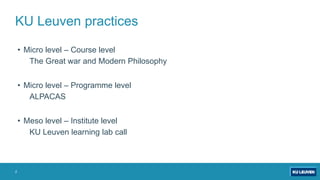
KU Leuven practices
• Micro level – Course level
The Great war and Modern Philosophy
• Micro level – Programme level
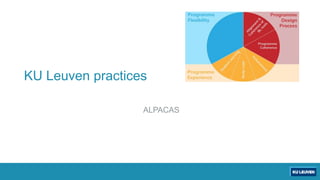
ALPACAS
• Meso level – Institute level
KU Leuven learning lab call
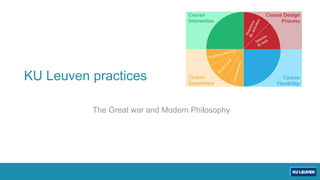
KU Leuven practices
The Great war and Modern Philosophy
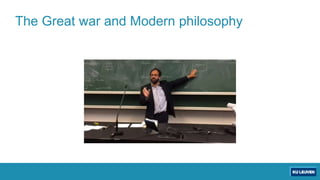
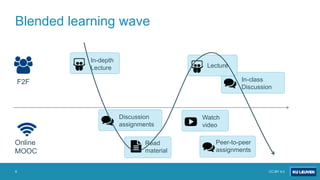
The Great war and Modern philosophy
“The idea is that the MOOC and the kind of learning experience in the MOOC
doesn't replace the offline it just enhances it. It wasn't one replaces the other
or makes the other redundant. It is just we can do things in the online which we
can't do in the offline. Likewise, we can do things in the offline that we can't do in
the online so let's bring them together.”
5
In-class
Discussion
Lecture
F2F
Online
MOOC
Watch
video
Peer-to-peer
assignments
Discussion
assignments
In-depth
Lecture
Read
material
CC-BY 4.06
Blended learning wave
KU Leuven practices
ALPACAS
8
9
10
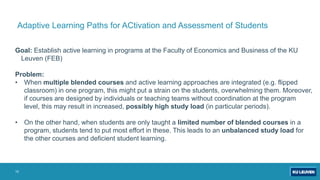
Adaptive Learning Paths for ACtivation and Assessment of Students
Goal: Establish active learning in programs at the Faculty of Economics and Business of the KU
Leuven (FEB)
Problem:
• When multiple blended courses and active learning approaches are integrated (e.g. flipped
classroom) in one program, this might put a strain on the students, overwhelming them. Moreover,
if courses are designed by individuals or teaching teams without coordination at the program
level, this may result in increased, possibly high study load (in particular periods).
• On the other hand, when students are only taught a limited number of blended courses in a
program, students tend to put most effort in these. This leads to an unbalanced study load for
the other courses and deficient student learning.
11
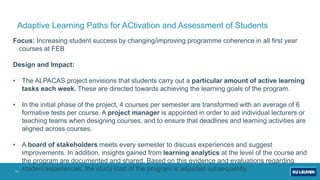
Adaptive Learning Paths for ACtivation and Assessment of Students
Focus: Increasing student success by changing/improving programme coherence in all first year
courses at FEB
Design and Impact:
• The ALPACAS project envisions that students carry out a particular amount of active learning
tasks each week. These are directed towards achieving the learning goals of the program.
• In the initial phase of the project, 4 courses per semester are transformed with an average of 6
formative tests per course. A project manager is appointed in order to aid individual lecturers or
teaching teams when designing courses, and to ensure that deadlines and learning activities are
aligned across courses.
• A board of stakeholders meets every semester to discuss experiences and suggest
improvements. In addition, insights gained from learning analytics at the level of the course and
the program are documented and shared. Based on this evidence and evaluations regarding
student experiences, the study load of the program is adjusted subsequently.
KU Leuven practices
KU Leuven Learning lab call
13

I-HE2020 KU Leuven Practices

  • 1.
    KU Leuven practices VeerleVan Rompaey, PhD Faculty of Economics and Business
  • 2.
    2 KU Leuven practices •Micro level – Course level The Great war and Modern Philosophy • Micro level – Programme level ALPACAS • Meso level – Institute level KU Leuven learning lab call
  • 3.
    KU Leuven practices TheGreat war and Modern Philosophy
  • 4.
    The Great warand Modern philosophy
  • 5.
    “The idea isthat the MOOC and the kind of learning experience in the MOOC doesn't replace the offline it just enhances it. It wasn't one replaces the other or makes the other redundant. It is just we can do things in the online which we can't do in the offline. Likewise, we can do things in the offline that we can't do in the online so let's bring them together.” 5
  • 6.
  • 7.
  • 8.
  • 9.
  • 10.
    10 Adaptive Learning Pathsfor ACtivation and Assessment of Students Goal: Establish active learning in programs at the Faculty of Economics and Business of the KU Leuven (FEB) Problem: • When multiple blended courses and active learning approaches are integrated (e.g. flipped classroom) in one program, this might put a strain on the students, overwhelming them. Moreover, if courses are designed by individuals or teaching teams without coordination at the program level, this may result in increased, possibly high study load (in particular periods). • On the other hand, when students are only taught a limited number of blended courses in a program, students tend to put most effort in these. This leads to an unbalanced study load for the other courses and deficient student learning.
  • 11.
    11 Adaptive Learning Pathsfor ACtivation and Assessment of Students Focus: Increasing student success by changing/improving programme coherence in all first year courses at FEB Design and Impact: • The ALPACAS project envisions that students carry out a particular amount of active learning tasks each week. These are directed towards achieving the learning goals of the program. • In the initial phase of the project, 4 courses per semester are transformed with an average of 6 formative tests per course. A project manager is appointed in order to aid individual lecturers or teaching teams when designing courses, and to ensure that deadlines and learning activities are aligned across courses. • A board of stakeholders meets every semester to discuss experiences and suggest improvements. In addition, insights gained from learning analytics at the level of the course and the program are documented and shared. Based on this evidence and evaluations regarding student experiences, the study load of the program is adjusted subsequently.
  • 12.
    KU Leuven practices KULeuven Learning lab call
  • 13.

Editor's Notes

  • #7 Model for blended learning & learning activities 1. Online components 2. Face 2 face components 3. Time 4. Activities. In this case online activities. Students need to Watch, Read and do a quiz 5. Offline activities. They did the preparation at home. In the lecture they're going to discuss the quiz. 6. Go home, online activities 7. Next lecture, discussion & indepth lecture 8. Wave --> Activities follow upon each other. What they do at home/online is the input for the f2f meeting This is called the wave,