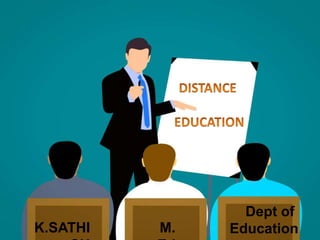
Dept of
EducationK.SATHI M.
INTRODUCTION
Distance learning is a way of learning remotely
without being in regular face-to-face contact
with a teacher in the classroom.
Instructional design is used to create learning
materials.
In distance education ,learning materials are
designed “situations in which a learner,with
others,or alone ,is working without the direct
control of a teacher.
Various Names for Distance Education
Correspondence Courses
Correspondence Education
Extension Courses
Distance Learning
Open Learning
Virtual Education
Online Education
Advantages
&
Disadvantages
Advantages
– Learner-paced
– Can be used anywhere
– Low cost
• Disadvantages
– Limited interactivity
– Motion cannot be shown
– Tarnished reputation
Need & Importance of
Distance Education in India
• Rapid growth of education: With the advancement of
education & technology, it is almost impossible to
incorporate new changes through formal education.
• Population: This unexpected growth rate of population
has reduced the chances for formal education to
educate each & every student.
• Geographical limitations: Many students who are
living in places which are geographically isolated finds
difficult to take education through regular classes.
• Qualification improvement: Distance education
provides opportunities to students who want to
improve their qualification while being in their present
jobs.
• Desire to work & study: Being capable of earning
while learning is the most attractive advantage of
distance education.
• Education for all ages: Distance education can
used by people of all ages.
• Financial Circumstances: Distance education is
important in India, due to financial & family
responsibilities of many of the India students.
• Faster Promotion: By getting educated through
distance, the present employees can improve
their qualification and increase their chances of
promotions.
• Flexibility factor: Education with flexibility is only
possible in the case of distance learning.
Growth and Development of Distance
Education in India
• India and China are two fast growing economies
of the world and need large skill based
manpower to sustain the economic growth.
• The existing formal higher educational system in
these countries will not be able to meet the
demand of the economy.
• The paper will try
• (i) to compare the development of economy and
distance education in India and China with
reference to policy perspectives;
(ii) to examine the course design, development and
delivery of distance education programmes in national
open universities of India and China i.e. Indira Gandhi
National Open University of India (IGNOU) and Open
University of China (OUC);
(iii) to analyze the trend of enrollment in IGNOU and
OUC; and
(iv) to compare the recognition /accreditation and quality
control process of distance learning in both these
countries. The paper highlights the policy strategies of
two countries towards quality control mechanism as
par with conventional system.
Distance Education in the Context of
Globalization
• It offers an inventory of questions, problems, and issues the authors
have selected; a description of the way they have studied them;
and a synthesis of conclusions they have reached.
• It also pinpoints what they have ignored, silenced, or left in the
shadows.
• The corpus includes twenty-four papers.
• After a short reflection on the background set up by the
globalization process, the outcomes presentation is structured by
distributing the different objects into three categories: the
international regulation of distance education, the e-learning
experiments, and information and communication technologies
(ICT) for development.
• A few comments highlight valuable contributions, as well as a few
omissions, in the researchers' works published in "D & S". (Contains
2 notes.)
Distance Education in the Future
• If the past or the present gives any indication of the
future, then the rapid pace at which distance
education has evolved will certainly continue into the
21st century.
• There has been tremendous growth in the number of
students participating in distance education.
• A significant contributing factor to this expected
growth is the “Millennials or Generation Y” children
born from 1982 - 2000 (Howe and Strauss).
• These learners are a diverse group of individuals
that are hyper communicators and multitaskers
(Pugh, 2009).
• These are serious technology users; they spend on
• Technological advancements will significantly chance the
distance education landscape.
• The future will see the rise of many web based
constructivist learning environments.
• Learners will be provided with a myriad of real world
environments to actively engage in the learning process,
through the use of web based technologies.
• Learning management systems will evolve to meet all the
needs of learners.
• Technologies such as digital paper, holographic keyboards,
organic computing, ubiquitous computing, data
warehousing, voice, video and data convergenceand etc..,

Distance education

  • 1.
  • 2.
    INTRODUCTION Distance learning isa way of learning remotely without being in regular face-to-face contact with a teacher in the classroom. Instructional design is used to create learning materials. In distance education ,learning materials are designed “situations in which a learner,with others,or alone ,is working without the direct control of a teacher.
  • 3.
    Various Names forDistance Education Correspondence Courses Correspondence Education Extension Courses Distance Learning Open Learning Virtual Education Online Education
  • 4.
    Advantages & Disadvantages Advantages – Learner-paced – Canbe used anywhere – Low cost • Disadvantages – Limited interactivity – Motion cannot be shown – Tarnished reputation
  • 5.
    Need & Importanceof Distance Education in India • Rapid growth of education: With the advancement of education & technology, it is almost impossible to incorporate new changes through formal education. • Population: This unexpected growth rate of population has reduced the chances for formal education to educate each & every student. • Geographical limitations: Many students who are living in places which are geographically isolated finds difficult to take education through regular classes. • Qualification improvement: Distance education provides opportunities to students who want to improve their qualification while being in their present jobs.
  • 6.
    • Desire towork & study: Being capable of earning while learning is the most attractive advantage of distance education. • Education for all ages: Distance education can used by people of all ages. • Financial Circumstances: Distance education is important in India, due to financial & family responsibilities of many of the India students. • Faster Promotion: By getting educated through distance, the present employees can improve their qualification and increase their chances of promotions. • Flexibility factor: Education with flexibility is only possible in the case of distance learning.
  • 7.
    Growth and Developmentof Distance Education in India • India and China are two fast growing economies of the world and need large skill based manpower to sustain the economic growth. • The existing formal higher educational system in these countries will not be able to meet the demand of the economy. • The paper will try • (i) to compare the development of economy and distance education in India and China with reference to policy perspectives;
  • 8.
    (ii) to examinethe course design, development and delivery of distance education programmes in national open universities of India and China i.e. Indira Gandhi National Open University of India (IGNOU) and Open University of China (OUC); (iii) to analyze the trend of enrollment in IGNOU and OUC; and (iv) to compare the recognition /accreditation and quality control process of distance learning in both these countries. The paper highlights the policy strategies of two countries towards quality control mechanism as par with conventional system.
  • 9.
    Distance Education inthe Context of Globalization • It offers an inventory of questions, problems, and issues the authors have selected; a description of the way they have studied them; and a synthesis of conclusions they have reached. • It also pinpoints what they have ignored, silenced, or left in the shadows. • The corpus includes twenty-four papers. • After a short reflection on the background set up by the globalization process, the outcomes presentation is structured by distributing the different objects into three categories: the international regulation of distance education, the e-learning experiments, and information and communication technologies (ICT) for development. • A few comments highlight valuable contributions, as well as a few omissions, in the researchers' works published in "D & S". (Contains 2 notes.)
  • 10.
    Distance Education inthe Future • If the past or the present gives any indication of the future, then the rapid pace at which distance education has evolved will certainly continue into the 21st century. • There has been tremendous growth in the number of students participating in distance education. • A significant contributing factor to this expected growth is the “Millennials or Generation Y” children born from 1982 - 2000 (Howe and Strauss). • These learners are a diverse group of individuals that are hyper communicators and multitaskers (Pugh, 2009). • These are serious technology users; they spend on
  • 11.
    • Technological advancementswill significantly chance the distance education landscape. • The future will see the rise of many web based constructivist learning environments. • Learners will be provided with a myriad of real world environments to actively engage in the learning process, through the use of web based technologies. • Learning management systems will evolve to meet all the needs of learners. • Technologies such as digital paper, holographic keyboards, organic computing, ubiquitous computing, data warehousing, voice, video and data convergenceand etc..,