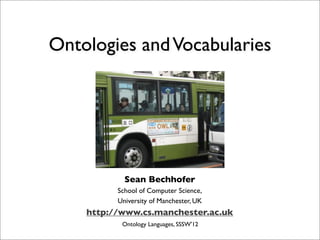
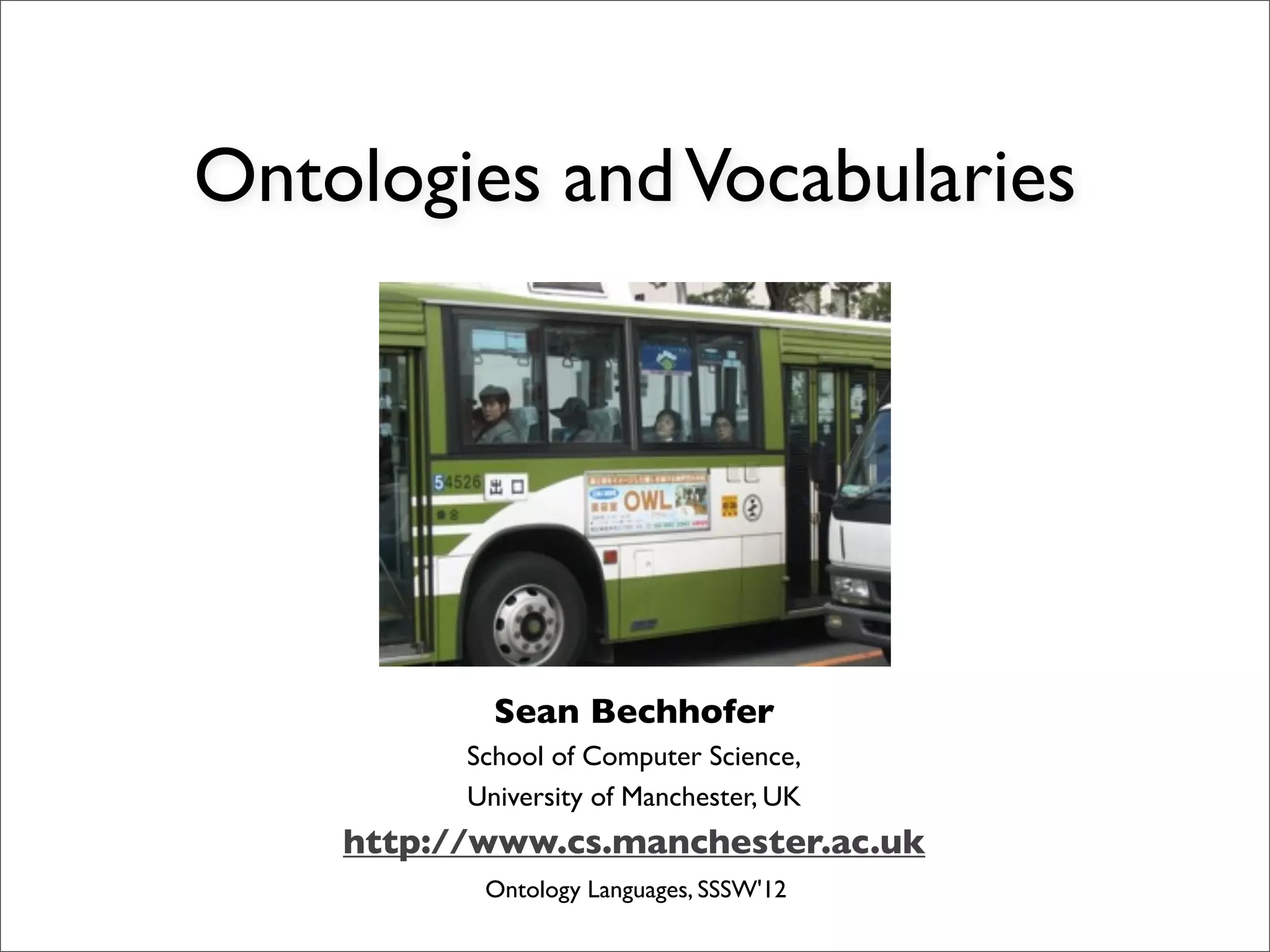
Ontologies and Vocabularies


            Sean Bechhofer
          School of Computer Science,
          University of Manchester, UK
    http://www.cs.manchester.ac.uk
           Ontology Languages, SSSW'12
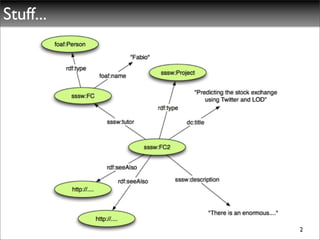
Stuff...


           2
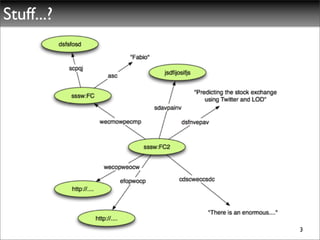
Stuff...?


            3
Semantic Web

  • Metadata
     – Describe resources
     – No good unless everyone speaks the same
       language;
  • Terminologies
     – provide shared and common vocabularies of a domain,
       so search engines, agents, authors and users can
       communicate.
     – No good unless everyone means the same thing;
  • Ontologies
     – provide a shared and common understanding of a
       domain that can be communicated across people and
       applications, and will play a major role in supporting   4
Classes/Properties/Individuals


   • Many representation languages use an “object oriented
     model” with
   • Objects/Instances/Individuals
      – Elements of the domain of discourse
   • Types/Classes/Concepts
      – Sets of objects sharing certain characteristics
   • Relations/Properties/Roles
      – Sets of pairs (tuples) of objects
   • Such languages are/can be:
      – Well understood
      – Formally specified
      – (Relatively) easy to use
      – Amenable to machine processing                       5
Structure of an Ontology

   Ontologies typically have two distinct components:
   • Names for important concepts in the domain
      – Elephant is a concept whose members are a kind of
        animal
      – Herbivore is a concept whose members are exactly
        those animals who eat only plants or parts of plants
      – AdultElephant is a concept whose members are exactly
        those elephants whose age is greater than 20 years
   • Background knowledge/constraints on the
     domain
      – An AdultElephant weighs at least 2,000 kg
      – All Elephants are either AfricanElephants or
        IndianElephants                                        6
Why Semantics?

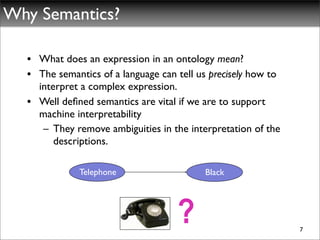
  • What does an expression in an ontology mean?
  • The semantics of a language can tell us precisely how to
    interpret a complex expression.
  • Well defined semantics are vital if we are to support
    machine interpretability
     – They remove ambiguities in the interpretation of the
        descriptions.

             Telephone                    Black


                                    ?                          7
What does RDF give us?

  •   A mechanism for publishing data.
  •   Single (simple) data model.
  •   Syntactic consistency between names (IRIs).
  •   Low level integration of data.
       – Mash the graphs together and we’re done.


                                                    8
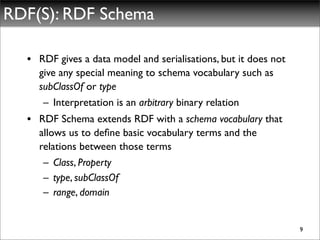
RDF(S): RDF Schema

  • RDF gives a data model and serialisations, but it does not
    give any special meaning to schema vocabulary such as
    subClassOf or type
     – Interpretation is an arbitrary binary relation
  • RDF Schema extends RDF with a schema vocabulary that
    allows us to define basic vocabulary terms and the
    relations between those terms
     – Class, Property
     – type, subClassOf
     – range, domain


                                                                 9
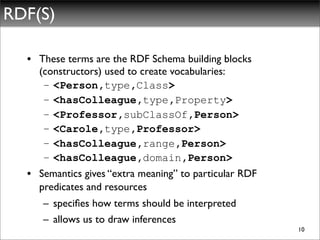
RDF(S)

  • These terms are the RDF Schema building blocks
    (constructors) used to create vocabularies:
     – <Person,type,Class>
     – <hasColleague,type,Property>
     – <Professor,subClassOf,Person>
     – <Carole,type,Professor>
     – <hasColleague,range,Person>
     – <hasColleague,domain,Person>
  • Semantics gives “extra meaning” to particular RDF
    predicates and resources
     – specifies how terms should be interpreted
     – allows us to draw inferences
                                                        10
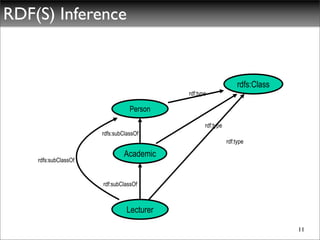
RDF(S) Inference


                                                                  rdfs:Class
                                           rdf:type

                                 Person
                                                  rdf:type
                      rdfs:subClassOf
                                                             rdf:type

                               Academic
    rdfs:subClassOf


                      rdf:subClassOf


                                Lecturer

                                                                               11
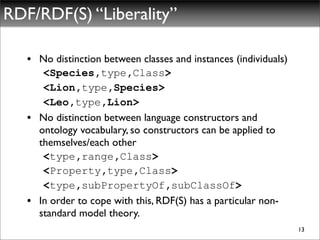
RDF(S) Inference


                                                          rdfs:Class
                                        rdf:type

                            Academic

                                               rdf:type
                   rdfs:subClassOf


                             Lecturer
       rdfs:type


                           rdf:type


                               Sean

                                                                       12
RDF/RDF(S) “Liberality”

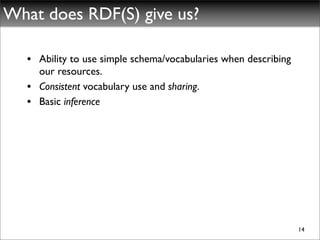
   • No distinction between classes and instances (individuals)
      <Species,type,Class>
      <Lion,type,Species>
      <Leo,type,Lion>
   • No distinction between language constructors and
     ontology vocabulary, so constructors can be applied to
     themselves/each other
      <type,range,Class>
      <Property,type,Class>
      <type,subPropertyOf,subClassOf>
   • In order to cope with this, RDF(S) has a particular non-
     standard model theory.
                                                                  13
What does RDF(S) give us?

   • Ability to use simple schema/vocabularies when describing
     our resources.
   • Consistent vocabulary use and sharing.
   • Basic inference


                                                                 14
Problems with RDF(S)

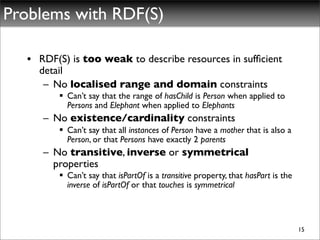
  • RDF(S) is too weak to describe resources in sufficient
    detail
     – No localised range and domain constraints
         Can’t say that the range of hasChild is Person when applied to
          Persons and Elephant when applied to Elephants
     – No existence/cardinality constraints
         Can’t say that all instances of Person have a mother that is also a
          Person, or that Persons have exactly 2 parents
     – No transitive, inverse or symmetrical
       properties
         Can’t say that isPartOf is a transitive property, that hasPart is the
          inverse of isPartOf or that touches is symmetrical


                                                                                  15
OWL

 • OWL: Web Ontology Language
 • Extends existing Web standards
    – Such as XML, RDF, RDFS
 • Is (hopefully) easy to understand and use
    – Based on familiar KR idioms
 • Of “adequate” expressive power
 • Formally specified
    – Possible to provide automated reasoning support


                                                        16
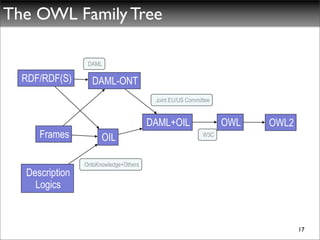
The OWL Family Tree

                 DAML

  RDF/RDF(S)      DAML-ONT
                                        Joint EU/US Committee


                                       DAML+OIL                 OWL   OWL2
     Frames           OIL                                 W3C


                OntoKnowledge+Others
  Description
    Logics


                                                                             17
Aside: Description Logics

   • A family of logic based Knowledge Representation
     formalisms
      – Descendants of semantic networks and KL-ONE
      – Describe domain in terms of concepts (classes), roles
        (relationships) and individuals
   • Distinguished by:
      – Formal semantics (typically model theoretic)
           Decidable fragments of FOL
           Closely related to Propositional Modal & Dynamic Logics
      – Provision of inference services
           Sound and complete decision procedures for key problems
           Implemented systems (highly optimised)


                                                                      18
OWL (Direct) Semantics

  • Model theoretic semantics. An interpretation consists of
    – A domain of discourse (a collection of objects)
    – Functions mapping
          classes to sets of objects
          properties to sets of pairs of objects
     – Rules describe how to interpret the constructors and
       tell us when an interpretation is a model.
  • Semantics described in terms of
     – Individuals in a domain of discourse
     – (Binary) Properties that relate individuals
     – Classes or collections of individuals
  • A class description is a characterisation of the individuals
    that are members of that class.                                19
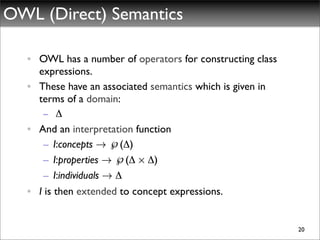
OWL (Direct) Semantics

  • OWL has a number of operators for constructing class
    expressions.
  • These have an associated semantics which is given in
    terms of a domain:
     – Δ
  • And an interpretation function
     – I:concepts ! ℘(Δ)
     – I:properties ! ℘(Δ £ Δ)
     – I:individuals ! Δ
  • I is then extended to concept expressions.


                                                           20
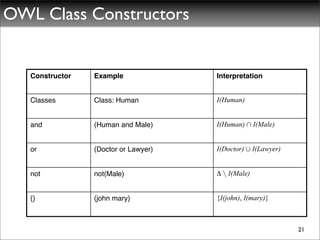
OWL Class Constructors


   Constructor   Example              Interpretation


   Classes       Class: Human         I(Human)


   and           (Human and Male)     I(Human) Å I(Male)


   or            (Doctor or Lawyer)   I(Doctor) [ I(Lawyer)


   not           not(Male)            Δ  I(Male)


   {}            {john mary}          {I(john), I(mary)}


                                                              21
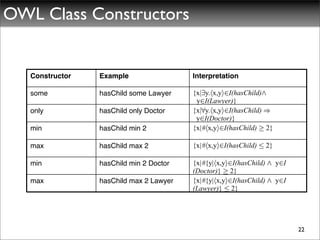
OWL Class Constructors


   Constructor   Example                 Interpretation

   some          hasChild some Lawyer    {x|9y.hx,yi2I(hasChild)^Æ
                                          y2I(Lawyer)}
   only          hasChild only Doctor    {x|8y.hx,yi2I(hasChild) )
                                          y2I(Doctor)}
   min           hasChild min 2          {x|#hx,yi2I(hasChild) ¸ 2}

   max           hasChild max 2          {x|#hx,yi2I(hasChild) · 2}

   min           hasChild min 2 Doctor   {x|#{y|hx,yi2I(hasChild) ^Æ y2I
                                         (Doctor)} ¸ 2}
   max           hasChild max 2 Lawyer   {x|#{y|hx,yi2I(hasChild) ^Æ y2I
                                         (Lawyer)} · 2}


                                                                           22
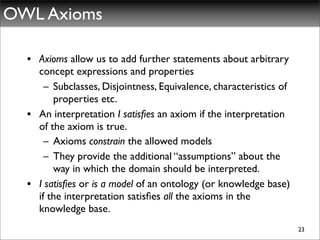
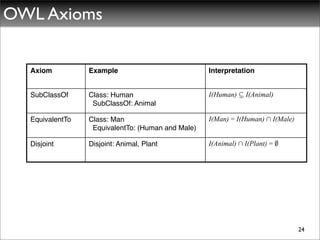
OWL Axioms

  • Axioms allow us to add further statements about arbitrary
    concept expressions and properties
      – Subclasses, Disjointness, Equivalence, characteristics of
        properties etc.
  • An interpretation I satisfies an axiom if the interpretation
    of the axiom is true.
      – Axioms constrain the allowed models
      – They provide the additional “assumptions” about the
        way in which the domain should be interpreted.
  • I satisfies or is a model of an ontology (or knowledge base)
    if the interpretation satisfies all the axioms in the
    knowledge base.
                                                                    23
OWL Axioms


  Axiom          Example                           Interpretation


  SubClassOf     Class: Human                      I(Human) µ I(Animal)
                  SubClassOf: Animal

  EquivalentTo   Class: Man                        I(Man) = I(Human) Å I(Male)
                  EquivalentTo: (Human and Male)

  Disjoint       Disjoint: Animal, Plant           I(Animal) Å I(Plant) = ;


                                                                                  24
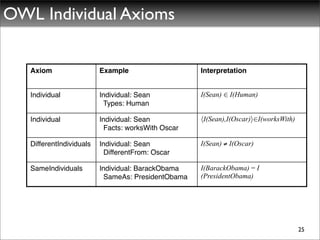
OWL Individual Axioms


   Axiom                  Example                   Interpretation


   Individual             Individual: Sean          I(Sean) 2 I(Human)
                           Types: Human

   Individual             Individual: Sean          hI(Sean),I(Oscar)i2I(worksWith)
                           Facts: worksWith Oscar

   DifferentIndividuals   Individual: Sean          I(Sean) ≠ I(Oscar)
                           DifferentFrom: Oscar

   SameIndividuals        Individual: BarackObama   I(BarackObama) = I
                           SameAs: PresidentObama   (PresidentObama)


                                                                                      25
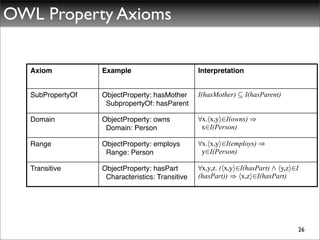
OWL Property Axioms


   Axiom           Example                        Interpretation


   SubPropertyOf   ObjectProperty: hasMother      I(hasMother) µ I(hasParent)
                    SubpropertyOf: hasParent

   Domain          ObjectProperty: owns           8x.hx,yi2I(owns) )
                    Domain: Person                 x2I(Person)

   Range           ObjectProperty: employs        8x.hx,yi2I(employs) )
                    Range: Person                  y2I(Person)

   Transitive      ObjectProperty: hasPart        8x,y,z. (hx,yi2I(hasPart) ^Æ hy,zi2I
                    Characteristics: Transitive   (hasPart)) ) hx,zi2I(hasPart)


                                                                                     26
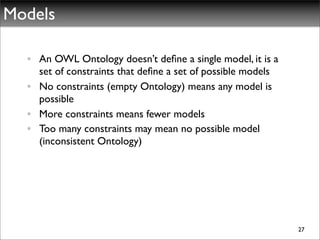
Models

  • An OWL Ontology doesn’t define a single model, it is a
    set of constraints that define a set of possible models
  • No constraints (empty Ontology) means any model is
    possible
  • More constraints means fewer models
  • Too many constraints may mean no possible model
    (inconsistent Ontology)


                                                             27
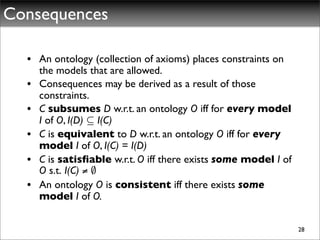
Consequences

  • An ontology (collection of axioms) places constraints on
    the models that are allowed.
  • Consequences may be derived as a result of those
    constraints.
  • C subsumes D w.r.t. an ontology O iff for every model
    I of O, I(D) µ I(C)
  • C is equivalent to D w.r.t. an ontology O iff for every
    model I of O, I(C) = I(D)
  • C is satisfiable w.r.t. O iff there exists some model I of
    O s.t. I(C) ≠ ;
  • An ontology O is consistent iff there exists some
    model I of O.


                                                                28
Reasoning

  • A reasoner makes use of the information asserted in the
    ontology.
  • Based on the semantics described, a reasoner can help us
    to discover inferences that are a consequence of the
    knowledge that we’ve presented that we weren’t aware of
    beforehand.
  • Is this new knowledge?
     – What’s actually in the ontology?


                                                               29
Reasoning

  • Subsumption reasoning
     – Allows us to infer when one class is a subclass of
        another
     – B is a subclass of A if it is necessarily the case that (in all
        models), all instances of B must be instances of A.
     – This can be either due to an explicit assertion, or
        through some inference process based on an intensional
        definition.
     – Can then build concept hierarchies representing the
        taxonomy.
     – This is classification of classes.
  • Satisfiability reasoning
     – Tells us when a concept is unsatisfiable
           i.e. when there is no model in which the interpretation of the
                                                                             30
            class is non-empty.
Instance Reasoning

   • Instance Retrieval
           What are the instances of a particular class C?
           Need not be a named class
   • Instantiation
           What are the classes that x is an instance of?


                                                              31
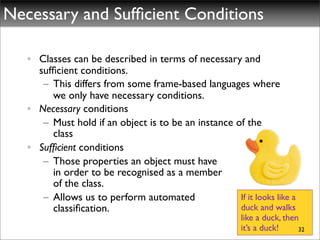
Necessary and Sufficient Conditions

   • Classes can be described in terms of necessary and
     sufficient conditions.
      – This differs from some frame-based languages where
        we only have necessary conditions.
   • Necessary conditions
      – Must hold if an object is to be an instance of the
        class
   • Sufficient conditions
      – Those properties an object must have
        in order to be recognised as a member
        of the class.
      – Allows us to perform automated               If it looks like a
        classification.                               duck and walks
                                                         like a duck, then
                                                         it’s a duck!     32
Misconceptions: Disjointness

   • By default, primitive classes are not disjoint.
   • Unless we explicitly say so, the description (Animal and
     Vegetable) is not unsatifiable.
   • Similarly with individuals. The so-called Unique Name
     Assumption (often present in DL languages) does not hold,
     and individuals are not considered to be distinct unless
     explicitly asserted to be so.


                                                                 33
Misconceptions: Domain and Range

   • OWL allows us to specify the domain and range of
     properties.
   • Note that this is not interpreted as a constraint.
   • Rather, the domain and range assertions allow us to make
     inferences about individuals.
   • Consider the following:
      • ObjectProperty: employs
           Domain: Company
           Range: Person
        Individual: IBM
           Facts: employs Jim
   • If we haven’t said anything else about IBM or Jim, this is
     not an error. However, we can now infer that IBM is a
     Company and Jim is a Person.
                                                                  34
Misconceptions: And/Or and Quantification

   • The logical connectives And and Or often cause confusion
      – Tea or Coffee?
      – Milk and Sugar?
   • Quantification can also be contrary to our intuition.
      – Universal quantification over an empty set is true.
      – Sean is a member of hasChild only Martian
      – Existential quantification may imply the existence of an
        individual that we don’t know the name of.


                                                                  35
Misconceptions: Closed and Open Worlds

   • The standard semantics of OWL makes an Open World
     Assumption (OWA).
      – We cannot assume that all information is known about
        all the individuals in a domain.
      – Facilitates reasoning about the intensional definitions of
        classes.
      – Sometimes strange side effects	

   • Closed World Assumption (CWA)
      – Named individuals are the only individuals in the
        domain
   • Negation as failure.
      – If we can’t deduce that x is an A, then we know it must
        be                                                          36
Annotations

  • OWL defines annotation properties.
  • These allow us to assert information about things
    (classes, properties, individuals) that don’t contribute to
    the logical knowledge.
     – No semantics (in the direct semantics)
  • Information not about the domain but about the modelling
    or description of the domain
     – e.g. DC style creation metadata
  • Annotations could also be used to support applications
     – e.g. labels (cf SKOS.....)


                                                                  37
Profiles

   • OWL Profiles describe subsets of the language that offer
     the potential for simpler/more efficient implementation
   • OWL EL
      – Roughly existential quantification of variables.
   • OWL QL
      – No class expressions in existential quantifications.
      – Query answering via rewrites into standard relational
        queries
   • OWL RL
      – Amenable to implementation using rule-based
        technologies.

                                                                38
Lightweight Vocabularies

   • For many applications, lightweight representations are
     more appropriate.
   • Thesauri, classification schemes, taxonomies and other
     controlled vocabularies
      – Many of these already exist and are in use in cultural
        heritage, library sciences, medicine etc.
      – Often have some taxonomic structure, but with a less
        precise semantics.


                                                                 39
Concept Schemes

  • A concept scheme is a set of concepts, potentially
    including statements about relationships between those
    concepts
     – Broader Terms
     – Narrower Terms
     – Related Terms
     – Synonyms, usage information etc.
  • Concept schemes aren’t formal ontologies in the way that
    OWL ontologies are formal ontologies
     – Concepts are not intended to me interpreted as sets
        of things in the same way

                                                               40
SKOS: Simple Knowledge Organisation

   •   SKOS provides an RDF vocabulary for the representation
       of such schemes.
   •   Designed with a focus on Retrieval Scenarios
       A. Single controlled vocabulary used to index and then
          retrieve objects
       B. Different controlled vocabularies used to index and
          retrieve objects
          • Mappings then required between the vocabularies
       – Initial use cases/requirements focus on these tasks
          • Not worrying about activities like Natural Language
            translation


                                                                  41
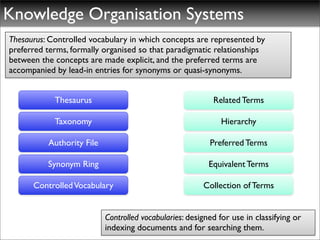
Knowledge Organisation Systems
Thesaurus: Controlled vocabulary in which concepts are represented by
preferred terms, formally organised so that paradigmatic relationships
between the concepts are made explicit, and the preferred terms are
accompanied by lead-in entries for synonyms or quasi-synonyms.


            Thesaurus                                      Related Terms

            Taxonomy                                         Hierarchy

          Authority File                                  Preferred Terms

          Synonym Ring                                    Equivalent Terms

      Controlled Vocabulary                             Collection of Terms


                           Controlled vocabularies: designed for use in classifying or
                           indexing documents and for searching them.
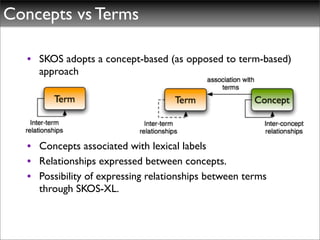
Concepts vs Terms

   • SKOS adopts a concept-based (as opposed to term-based)
     approach


   • Concepts associated with lexical labels
   • Relationships expressed between concepts.
   • Possibility of expressing relationships between terms
     through SKOS-XL.
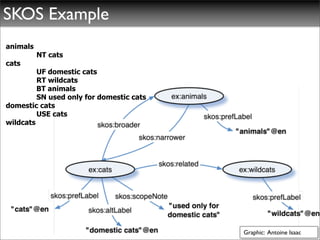
SKOS Example
animals
	
       NT cats
cats
	
       UF domestic cats
	
       RT wildcats
	
       BT animals
	
       SN used only for domestic cats
domestic cats
	
       USE cats
wildcats


                                          Graphic: Antoine Isaac
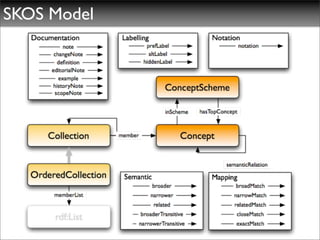
SKOS Model
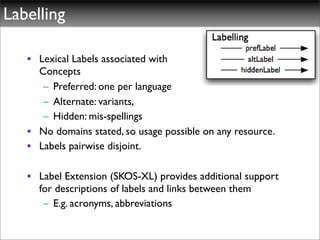
Labelling

   • Lexical Labels associated with
     Concepts	

      – Preferred: one per language
      – Alternate: variants,
      – Hidden: mis-spellings
   • No domains stated, so usage possible on any resource.
   • Labels pairwise disjoint.

   • Label Extension (SKOS-XL) provides additional support
     for descriptions of labels and links between them
      – E.g. acronyms, abbreviations
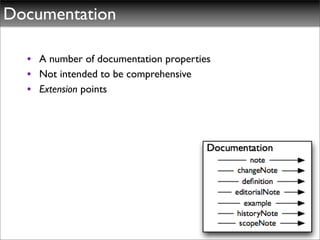
Documentation

  • A number of documentation properties
  • Not intended to be comprehensive
  • Extension points
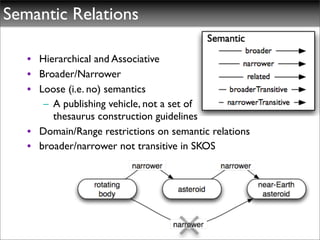
Semantic Relations

   • Hierarchical and Associative
   • Broader/Narrower
   • Loose (i.e. no) semantics
      – A publishing vehicle, not a set of
        thesaurus construction guidelines
   • Domain/Range restrictions on semantic relations
   • broader/narrower not transitive in SKOS
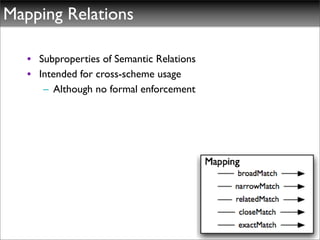
Mapping Relations

   • Subproperties of Semantic Relations
   • Intended for cross-scheme usage
      – Although no formal enforcement
SKOS and OWL

  • SKOS itself is defined as an OWL ontology.
  • A particular SKOS vocabulary is an instantiation of that
    ontology/schema
     – SKOS Concept is a Class, particular concepts are
       instances of that class
  • Allows use of OWL mechanisms to define properties of
    SKOS (e.g. the querying of the transitive closure of
    broader).
     –
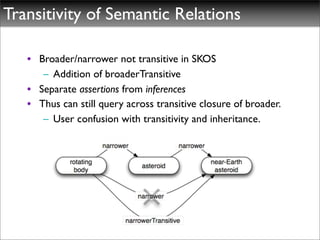
Transitivity of Semantic Relations

   • Broader/narrower not transitive in SKOS
      – Addition of broaderTransitive
   • Separate assertions from inferences
   • Thus can still query across transitive closure of broader.
      – User confusion with transitivity and inheritance.
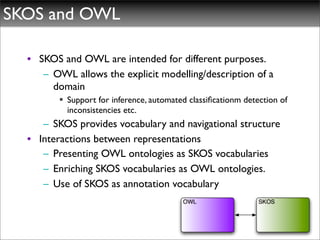
SKOS and OWL

  • SKOS and OWL are intended for different purposes.
     – OWL allows the explicit modelling/description of a
       domain
          Support for inference, automated classificationm detection of
           inconsistencies etc.
     – SKOS provides vocabulary and navigational structure
  • Interactions between representations
     – Presenting OWL ontologies as SKOS vocabularies
     – Enriching SKOS vocabularies as OWL ontologies.
     – Use of SKOS as annotation vocabulary
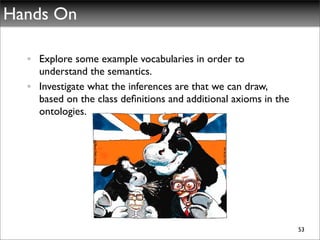
Hands On

  • Explore some example vocabularies in order to
    understand the semantics.
  • Investigate what the inferences are that we can draw,
    based on the class definitions and additional axioms in the
    ontologies.


                                                                 53

Ontologies and Vocabularies

  • 1.
    Ontologies and Vocabularies Sean Bechhofer School of Computer Science, University of Manchester, UK http://www.cs.manchester.ac.uk Ontology Languages, SSSW'12
  • 2.
  • 3.
  • 4.
    Semantic Web • Metadata – Describe resources – No good unless everyone speaks the same language; • Terminologies – provide shared and common vocabularies of a domain, so search engines, agents, authors and users can communicate. – No good unless everyone means the same thing; • Ontologies – provide a shared and common understanding of a domain that can be communicated across people and applications, and will play a major role in supporting 4
  • 5.
    Classes/Properties/Individuals • Many representation languages use an “object oriented model” with • Objects/Instances/Individuals – Elements of the domain of discourse • Types/Classes/Concepts – Sets of objects sharing certain characteristics • Relations/Properties/Roles – Sets of pairs (tuples) of objects • Such languages are/can be: – Well understood – Formally specified – (Relatively) easy to use – Amenable to machine processing 5
  • 6.
    Structure of anOntology Ontologies typically have two distinct components: • Names for important concepts in the domain – Elephant is a concept whose members are a kind of animal – Herbivore is a concept whose members are exactly those animals who eat only plants or parts of plants – AdultElephant is a concept whose members are exactly those elephants whose age is greater than 20 years • Background knowledge/constraints on the domain – An AdultElephant weighs at least 2,000 kg – All Elephants are either AfricanElephants or IndianElephants 6
  • 7.
    Why Semantics? • What does an expression in an ontology mean? • The semantics of a language can tell us precisely how to interpret a complex expression. • Well defined semantics are vital if we are to support machine interpretability – They remove ambiguities in the interpretation of the descriptions. Telephone Black ? 7
  • 8.
    What does RDFgive us? • A mechanism for publishing data. • Single (simple) data model. • Syntactic consistency between names (IRIs). • Low level integration of data. – Mash the graphs together and we’re done. 8
  • 9.
    RDF(S): RDF Schema • RDF gives a data model and serialisations, but it does not give any special meaning to schema vocabulary such as subClassOf or type – Interpretation is an arbitrary binary relation • RDF Schema extends RDF with a schema vocabulary that allows us to define basic vocabulary terms and the relations between those terms – Class, Property – type, subClassOf – range, domain 9
  • 10.
    RDF(S) •These terms are the RDF Schema building blocks (constructors) used to create vocabularies: – <Person,type,Class> – <hasColleague,type,Property> – <Professor,subClassOf,Person> – <Carole,type,Professor> – <hasColleague,range,Person> – <hasColleague,domain,Person> • Semantics gives “extra meaning” to particular RDF predicates and resources – specifies how terms should be interpreted – allows us to draw inferences 10
  • 11.
    RDF(S) Inference rdfs:Class rdf:type Person rdf:type rdfs:subClassOf rdf:type Academic rdfs:subClassOf rdf:subClassOf Lecturer 11
  • 12.
    RDF(S) Inference rdfs:Class rdf:type Academic rdf:type rdfs:subClassOf Lecturer rdfs:type rdf:type Sean 12
  • 13.
    RDF/RDF(S) “Liberality” • No distinction between classes and instances (individuals) <Species,type,Class> <Lion,type,Species> <Leo,type,Lion> • No distinction between language constructors and ontology vocabulary, so constructors can be applied to themselves/each other <type,range,Class> <Property,type,Class> <type,subPropertyOf,subClassOf> • In order to cope with this, RDF(S) has a particular non- standard model theory. 13
  • 14.
    What does RDF(S)give us? • Ability to use simple schema/vocabularies when describing our resources. • Consistent vocabulary use and sharing. • Basic inference 14
  • 15.
    Problems with RDF(S) • RDF(S) is too weak to describe resources in sufficient detail – No localised range and domain constraints  Can’t say that the range of hasChild is Person when applied to Persons and Elephant when applied to Elephants – No existence/cardinality constraints  Can’t say that all instances of Person have a mother that is also a Person, or that Persons have exactly 2 parents – No transitive, inverse or symmetrical properties  Can’t say that isPartOf is a transitive property, that hasPart is the inverse of isPartOf or that touches is symmetrical 15
  • 16.
    OWL • OWL:Web Ontology Language • Extends existing Web standards – Such as XML, RDF, RDFS • Is (hopefully) easy to understand and use – Based on familiar KR idioms • Of “adequate” expressive power • Formally specified – Possible to provide automated reasoning support 16
  • 17.
    The OWL FamilyTree DAML RDF/RDF(S) DAML-ONT Joint EU/US Committee DAML+OIL OWL OWL2 Frames OIL W3C OntoKnowledge+Others Description Logics 17
  • 18.
    Aside: Description Logics • A family of logic based Knowledge Representation formalisms – Descendants of semantic networks and KL-ONE – Describe domain in terms of concepts (classes), roles (relationships) and individuals • Distinguished by: – Formal semantics (typically model theoretic)  Decidable fragments of FOL  Closely related to Propositional Modal & Dynamic Logics – Provision of inference services  Sound and complete decision procedures for key problems  Implemented systems (highly optimised) 18
  • 19.
    OWL (Direct) Semantics • Model theoretic semantics. An interpretation consists of – A domain of discourse (a collection of objects) – Functions mapping  classes to sets of objects  properties to sets of pairs of objects – Rules describe how to interpret the constructors and tell us when an interpretation is a model. • Semantics described in terms of – Individuals in a domain of discourse – (Binary) Properties that relate individuals – Classes or collections of individuals • A class description is a characterisation of the individuals that are members of that class. 19
  • 20.
    OWL (Direct) Semantics • OWL has a number of operators for constructing class expressions. • These have an associated semantics which is given in terms of a domain: – Δ • And an interpretation function – I:concepts ! ℘(Δ) – I:properties ! ℘(Δ £ Δ) – I:individuals ! Δ • I is then extended to concept expressions. 20
  • 21.
    OWL Class Constructors Constructor Example Interpretation Classes Class: Human I(Human) and (Human and Male) I(Human) Å I(Male) or (Doctor or Lawyer) I(Doctor) [ I(Lawyer) not not(Male) Δ I(Male) {} {john mary} {I(john), I(mary)} 21
  • 22.
    OWL Class Constructors Constructor Example Interpretation some hasChild some Lawyer {x|9y.hx,yi2I(hasChild)^Æ y2I(Lawyer)} only hasChild only Doctor {x|8y.hx,yi2I(hasChild) ) y2I(Doctor)} min hasChild min 2 {x|#hx,yi2I(hasChild) ¸ 2} max hasChild max 2 {x|#hx,yi2I(hasChild) · 2} min hasChild min 2 Doctor {x|#{y|hx,yi2I(hasChild) ^Æ y2I (Doctor)} ¸ 2} max hasChild max 2 Lawyer {x|#{y|hx,yi2I(hasChild) ^Æ y2I (Lawyer)} · 2} 22
  • 23.
    OWL Axioms • Axioms allow us to add further statements about arbitrary concept expressions and properties – Subclasses, Disjointness, Equivalence, characteristics of properties etc. • An interpretation I satisfies an axiom if the interpretation of the axiom is true. – Axioms constrain the allowed models – They provide the additional “assumptions” about the way in which the domain should be interpreted. • I satisfies or is a model of an ontology (or knowledge base) if the interpretation satisfies all the axioms in the knowledge base. 23
  • 24.
    OWL Axioms Axiom Example Interpretation SubClassOf Class: Human I(Human) µ I(Animal) SubClassOf: Animal EquivalentTo Class: Man I(Man) = I(Human) Å I(Male) EquivalentTo: (Human and Male) Disjoint Disjoint: Animal, Plant I(Animal) Å I(Plant) = ; 24
  • 25.
    OWL Individual Axioms Axiom Example Interpretation Individual Individual: Sean I(Sean) 2 I(Human) Types: Human Individual Individual: Sean hI(Sean),I(Oscar)i2I(worksWith) Facts: worksWith Oscar DifferentIndividuals Individual: Sean I(Sean) ≠ I(Oscar) DifferentFrom: Oscar SameIndividuals Individual: BarackObama I(BarackObama) = I SameAs: PresidentObama (PresidentObama) 25
  • 26.
    OWL Property Axioms Axiom Example Interpretation SubPropertyOf ObjectProperty: hasMother I(hasMother) µ I(hasParent) SubpropertyOf: hasParent Domain ObjectProperty: owns 8x.hx,yi2I(owns) ) Domain: Person x2I(Person) Range ObjectProperty: employs 8x.hx,yi2I(employs) ) Range: Person y2I(Person) Transitive ObjectProperty: hasPart 8x,y,z. (hx,yi2I(hasPart) ^Æ hy,zi2I Characteristics: Transitive (hasPart)) ) hx,zi2I(hasPart) 26
  • 27.
    Models •An OWL Ontology doesn’t define a single model, it is a set of constraints that define a set of possible models • No constraints (empty Ontology) means any model is possible • More constraints means fewer models • Too many constraints may mean no possible model (inconsistent Ontology) 27
  • 28.
    Consequences •An ontology (collection of axioms) places constraints on the models that are allowed. • Consequences may be derived as a result of those constraints. • C subsumes D w.r.t. an ontology O iff for every model I of O, I(D) µ I(C) • C is equivalent to D w.r.t. an ontology O iff for every model I of O, I(C) = I(D) • C is satisfiable w.r.t. O iff there exists some model I of O s.t. I(C) ≠ ; • An ontology O is consistent iff there exists some model I of O. 28
  • 29.
    Reasoning •A reasoner makes use of the information asserted in the ontology. • Based on the semantics described, a reasoner can help us to discover inferences that are a consequence of the knowledge that we’ve presented that we weren’t aware of beforehand. • Is this new knowledge? – What’s actually in the ontology? 29
  • 30.
    Reasoning •Subsumption reasoning – Allows us to infer when one class is a subclass of another – B is a subclass of A if it is necessarily the case that (in all models), all instances of B must be instances of A. – This can be either due to an explicit assertion, or through some inference process based on an intensional definition. – Can then build concept hierarchies representing the taxonomy. – This is classification of classes. • Satisfiability reasoning – Tells us when a concept is unsatisfiable  i.e. when there is no model in which the interpretation of the 30 class is non-empty.
  • 31.
    Instance Reasoning • Instance Retrieval  What are the instances of a particular class C?  Need not be a named class • Instantiation  What are the classes that x is an instance of? 31
  • 32.
    Necessary and SufficientConditions • Classes can be described in terms of necessary and sufficient conditions. – This differs from some frame-based languages where we only have necessary conditions. • Necessary conditions – Must hold if an object is to be an instance of the class • Sufficient conditions – Those properties an object must have in order to be recognised as a member of the class. – Allows us to perform automated If it looks like a classification. duck and walks like a duck, then it’s a duck! 32
  • 33.
    Misconceptions: Disjointness • By default, primitive classes are not disjoint. • Unless we explicitly say so, the description (Animal and Vegetable) is not unsatifiable. • Similarly with individuals. The so-called Unique Name Assumption (often present in DL languages) does not hold, and individuals are not considered to be distinct unless explicitly asserted to be so. 33
  • 34.
    Misconceptions: Domain andRange • OWL allows us to specify the domain and range of properties. • Note that this is not interpreted as a constraint. • Rather, the domain and range assertions allow us to make inferences about individuals. • Consider the following: • ObjectProperty: employs Domain: Company Range: Person Individual: IBM Facts: employs Jim • If we haven’t said anything else about IBM or Jim, this is not an error. However, we can now infer that IBM is a Company and Jim is a Person. 34
  • 35.
    Misconceptions: And/Or andQuantification • The logical connectives And and Or often cause confusion – Tea or Coffee? – Milk and Sugar? • Quantification can also be contrary to our intuition. – Universal quantification over an empty set is true. – Sean is a member of hasChild only Martian – Existential quantification may imply the existence of an individual that we don’t know the name of. 35
  • 36.
    Misconceptions: Closed andOpen Worlds • The standard semantics of OWL makes an Open World Assumption (OWA). – We cannot assume that all information is known about all the individuals in a domain. – Facilitates reasoning about the intensional definitions of classes. – Sometimes strange side effects • Closed World Assumption (CWA) – Named individuals are the only individuals in the domain • Negation as failure. – If we can’t deduce that x is an A, then we know it must be 36
  • 37.
    Annotations •OWL defines annotation properties. • These allow us to assert information about things (classes, properties, individuals) that don’t contribute to the logical knowledge. – No semantics (in the direct semantics) • Information not about the domain but about the modelling or description of the domain – e.g. DC style creation metadata • Annotations could also be used to support applications – e.g. labels (cf SKOS.....) 37
  • 38.
    Profiles • OWL Profiles describe subsets of the language that offer the potential for simpler/more efficient implementation • OWL EL – Roughly existential quantification of variables. • OWL QL – No class expressions in existential quantifications. – Query answering via rewrites into standard relational queries • OWL RL – Amenable to implementation using rule-based technologies. 38
  • 39.
    Lightweight Vocabularies • For many applications, lightweight representations are more appropriate. • Thesauri, classification schemes, taxonomies and other controlled vocabularies – Many of these already exist and are in use in cultural heritage, library sciences, medicine etc. – Often have some taxonomic structure, but with a less precise semantics. 39
  • 40.
    Concept Schemes • A concept scheme is a set of concepts, potentially including statements about relationships between those concepts – Broader Terms – Narrower Terms – Related Terms – Synonyms, usage information etc. • Concept schemes aren’t formal ontologies in the way that OWL ontologies are formal ontologies – Concepts are not intended to me interpreted as sets of things in the same way 40
  • 41.
    SKOS: Simple KnowledgeOrganisation • SKOS provides an RDF vocabulary for the representation of such schemes. • Designed with a focus on Retrieval Scenarios A. Single controlled vocabulary used to index and then retrieve objects B. Different controlled vocabularies used to index and retrieve objects • Mappings then required between the vocabularies – Initial use cases/requirements focus on these tasks • Not worrying about activities like Natural Language translation 41
  • 42.
    Knowledge Organisation Systems Thesaurus:Controlled vocabulary in which concepts are represented by preferred terms, formally organised so that paradigmatic relationships between the concepts are made explicit, and the preferred terms are accompanied by lead-in entries for synonyms or quasi-synonyms. Thesaurus Related Terms Taxonomy Hierarchy Authority File Preferred Terms Synonym Ring Equivalent Terms Controlled Vocabulary Collection of Terms Controlled vocabularies: designed for use in classifying or indexing documents and for searching them.
  • 43.
    Concepts vs Terms • SKOS adopts a concept-based (as opposed to term-based) approach • Concepts associated with lexical labels • Relationships expressed between concepts. • Possibility of expressing relationships between terms through SKOS-XL.
  • 44.
    SKOS Example animals NT cats cats UF domestic cats RT wildcats BT animals SN used only for domestic cats domestic cats USE cats wildcats Graphic: Antoine Isaac
  • 45.
  • 46.
    Labelling • Lexical Labels associated with Concepts – Preferred: one per language – Alternate: variants, – Hidden: mis-spellings • No domains stated, so usage possible on any resource. • Labels pairwise disjoint. • Label Extension (SKOS-XL) provides additional support for descriptions of labels and links between them – E.g. acronyms, abbreviations
  • 47.
    Documentation •A number of documentation properties • Not intended to be comprehensive • Extension points
  • 48.
    Semantic Relations • Hierarchical and Associative • Broader/Narrower • Loose (i.e. no) semantics – A publishing vehicle, not a set of thesaurus construction guidelines • Domain/Range restrictions on semantic relations • broader/narrower not transitive in SKOS
  • 49.
    Mapping Relations • Subproperties of Semantic Relations • Intended for cross-scheme usage – Although no formal enforcement
  • 50.
    SKOS and OWL • SKOS itself is defined as an OWL ontology. • A particular SKOS vocabulary is an instantiation of that ontology/schema – SKOS Concept is a Class, particular concepts are instances of that class • Allows use of OWL mechanisms to define properties of SKOS (e.g. the querying of the transitive closure of broader). –
  • 51.
    Transitivity of SemanticRelations • Broader/narrower not transitive in SKOS – Addition of broaderTransitive • Separate assertions from inferences • Thus can still query across transitive closure of broader. – User confusion with transitivity and inheritance.
  • 52.
    SKOS and OWL • SKOS and OWL are intended for different purposes. – OWL allows the explicit modelling/description of a domain  Support for inference, automated classificationm detection of inconsistencies etc. – SKOS provides vocabulary and navigational structure • Interactions between representations – Presenting OWL ontologies as SKOS vocabularies – Enriching SKOS vocabularies as OWL ontologies. – Use of SKOS as annotation vocabulary
  • 53.
    Hands On • Explore some example vocabularies in order to understand the semantics. • Investigate what the inferences are that we can draw, based on the class definitions and additional axioms in the ontologies. 53