Welcome	
  to	
  
Ontology	
  Engineering	
  
      Guus	
  Schreiber	
  
Lecture	
  1	


                          Agenda	
  
•  Course	
  introduc:on:	
  what	
  is	
  an	
  ontology?	
  
•  Administra:on	
  
•  RDF/RDFS	
  
Literature	
  
•  James	
  Odell,	
  Ontology	
  White	
  Paper,	
  CSC	
  
   Catalyst,	
  2011,	
  V2011-­‐07-­‐15,	
  	
  
              hNp://www.jamesodell.com/
     Ontology_White_Paper_2011-­‐07-­‐15.pdf.	
                    	
  
•  For	
  this	
  lecture	
  Sec.s	
  1-­‐4	
  are	
  relevant	
  

•  Acknowledgement:	
  some	
  figures	
  in	
  this	
  
   lecture	
  come	
  from	
  the	
  paper	
  above.	
  	
  
What	
  is	
  an	
  Ontology?	
  
•  In	
  philosophy:	
  theory	
  of	
  what	
  exists	
  in	
  the	
  world	
  	
  
•  In	
  IT:	
  consensual	
  &	
  formal	
  descrip:on	
  of	
  shared	
  
   concepts	
  in	
  a	
  domain	
  
    •  Aid	
  to	
  human	
  communica:on	
  and	
  shared	
  
          understanding,	
  by	
  specifying	
  meaning	
  
    •  Machine-­‐processable	
  (e.g.,	
  agents	
  use	
  ontologies	
  in	
  	
  
          communica:on)	
  
    •  Key	
  technology	
  in	
  seman:c	
  informa:on	
  processing	
  
    •  Applica:ons:	
  knowledge	
  management,	
  e-­‐business,	
  
          seman:c	
  world-­‐wide	
  web.	
  	
  
What	
  is	
  an	
  Ontology?	
  II	
  
   “explicit	
  specifica-on	
  of	
  a	
  shared	
  
conceptualiza-on	
  that	
  holds	
  in	
  a	
  par-cular	
  
                    context”	
  	
  
             (several	
  authors)	
  
Knowledge	
  sharing	
  and	
  reuse	
  
•  Knowledge	
  engineering	
  is	
  costly	
  and	
  :me-­‐
   consuming	
  
•  Distributed	
  systems	
  
•  Increasing	
  need	
  for	
  defini:on	
  of	
  a	
  common	
  
   frame	
  of	
  reference	
  
   – Internet	
  search,	
  document	
  indexing,	
  ….	
  
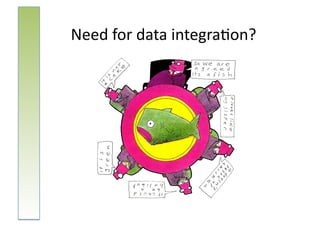
Need	
  for	
  data	
  integra:on?	
  
Seman:c	
  Web	
  
•  Data	
  integra:on	
  
•  AAA	
  slogan	
  
•  Non-­‐Unique	
  Naming	
  Assump:on	
  
•  Open	
  vs.	
  closed	
  World	
  
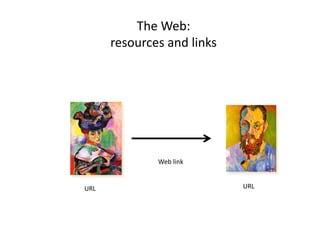
The	
  Web:	
  	
  
          resources	
  and	
  links	


                      Web	
  link	


URL	
                                     URL	
  
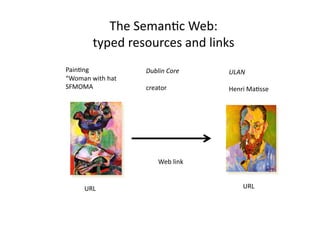
The	
  Seman:c	
  Web:	
  	
  
            typed	
  resources	
  and	
  links	
  
Pain:ng	
                   Dublin	
  Core	
        ULAN	
  
“Woman	
  with	
  hat	
  
SFMOMA	
                    creator	
               Henri	
  Ma:sse	


                                  Web	
  link	


        URL	
                                             URL	
  
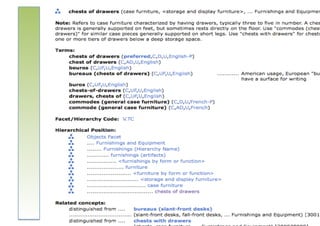
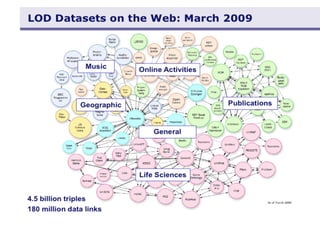
Seman:c	
  Web	
  
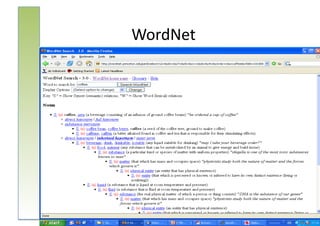
WordNet	
  
Domain	
  standards	
  and	
  vocabularies	
  as	
  
                ontologies	
  
•  Contain	
  ontological	
  informa:on	
  
•  Ontology	
  needs	
  to	
  be	
  “extracted”	
  
    –  Not	
  explicit	
  
•  Lists	
  of	
  domain	
  terms	
  are	
  some:mes	
  also	
  called	
  
   “ontologies”	
  
    –  Implies	
  a	
  weaker	
  no:on	
  of	
  ontology	
  
    –  Scope	
  typically	
  much	
  broader	
  than	
  a	
  specific	
  applica:on	
  
       domain	
  
    –  Contain	
  some	
  meta	
  informa:on:	
  hyponyms,	
  synonyms,	
  text	
  
•  Structured	
  knowledge	
  is	
  available	
  (on	
  the	
  web)	
  –	
  use	
  
   it!	
  
                                                                               14	
  
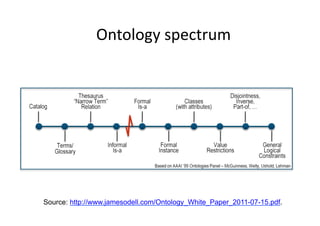
Ontology	
  spectrum	


Source: http://www.jamesodell.com/Ontology_White_Paper_2011-07-15.pdf.
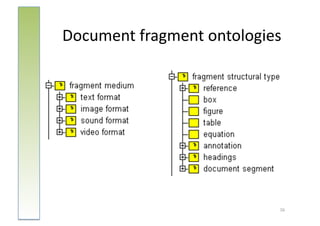
Document	
  fragment	
  ontologies	


                                     16	
  
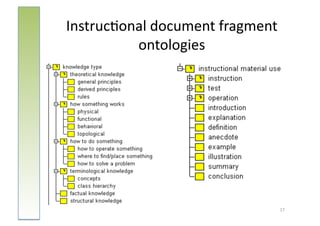
Instruc:onal	
  document	
  fragment	
  
          ontologies	


                                       17	
  
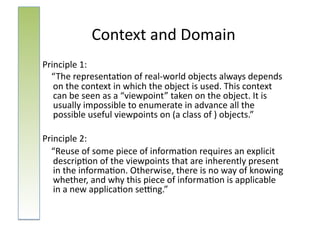
Context	
  and	
  Domain	
  
Principle	
  1:	


  “ The	
  representa:on	
  of	
  real-­‐world	
  objects	
  always	
  depends	
  
                on	
  the	
  context	
  in	
  which	
  the	
  object	
  is	
  used.	
  This	
  context	
  
                can	
  be	
  seen	
  as	
  a	
  “viewpoint”	
  taken	
  on	
  the	
  object.	
  It	
  is	
  
                usually	
  impossible	
  to	
  enumerate	
  in	
  advance	
  all	
  the	
  
                possible	
  useful	
  viewpoints	
  on	
  (a	
  class	
  of	
  )	
  objects.”	
  

Principle	
  2:	


  “Reuse	
  of	
  some	
  piece	
  of	
  informa:on	
  requires	
  an	
  explicit	
  
                descrip:on	
  of	
  the	
  viewpoints	
  that	
  are	
  inherently	
  present	
  
                in	
  the	
  informa:on.	
  Otherwise,	
  there	
  is	
  no	
  way	
  of	
  knowing	
  
                whether,	
  and	
  why	
  this	
  piece	
  of	
  informa:on	
  is	
  applicable	
  
                in	
  a	
  new	
  applica:on	
  seing.”	
  
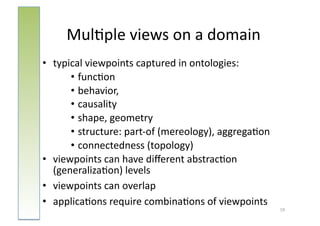
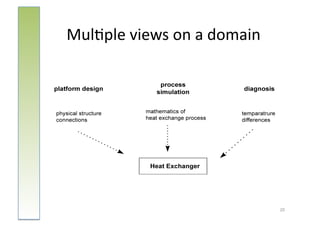
Mul:ple	
  views	
  on	
  a	
  domain	
  
•  typical	
  viewpoints	
  captured	
  in	
  ontologies:	
  	
  
       • func:on	
  
       • behavior,	
  	
  
       • causality	
  
       • shape,	
  geometry	
  
       • structure:	
  part-­‐of	
  (mereology),	
  aggrega:on	
  	
  
       • connectedness	
  (topology)	
  
•  viewpoints	
  can	
  have	
  different	
  abstrac:on	
  
   (generaliza:on)	
  levels	
  	
  
•  viewpoints	
  can	
  overlap	
  
•  applica:ons	
  require	
  combina:ons	
  of	
  viewpoints	
  
                                                                         19	
  
Mul:ple	
  views	
  on	
  a	
  domain	


                                            20	
  
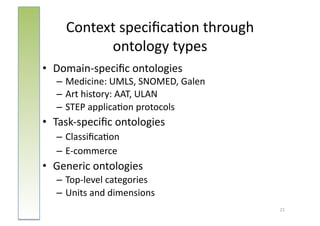
Context	
  specifica:on	
  through	
  	
  
             ontology	
  types                 	


•  Domain-­‐specific	
  ontologies	
  
    – Medicine:	
  UMLS,	
  SNOMED,	
  Galen	
  
    – Art	
  history:	
  AAT,	
  ULAN	
  
    – STEP	
  applica:on	
  protocols	
  
•  Task-­‐specific	
  ontologies	
  
    – Classifica:on	
  
    – E-­‐commerce	
  
•  Generic	
  ontologies	
  	
  
    – Top-­‐level	
  categories	
  
    – Units	
  and	
  dimensions	
  
                                                      21	
  
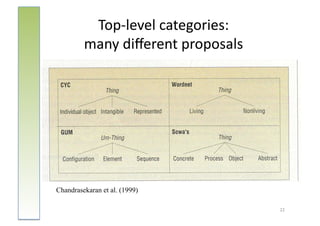
Top-­‐level	
  categories:	
  
         many	
  different	
  proposals	


Chandrasekaran et al. (1999)

                                             22	
  
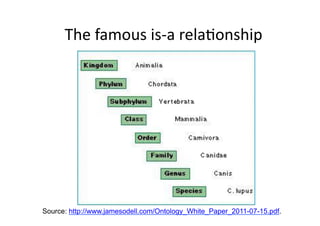
The	
  famous	
  is-­‐a	
  rela:onship	


Source: http://www.jamesodell.com/Ontology_White_Paper_2011-07-15.pdf.
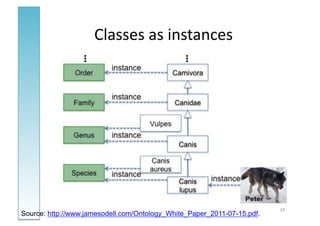
Classes	
  as	
  instances	


                                                                         24	
  
Source: http://www.jamesodell.com/Ontology_White_Paper_2011-07-15.pdf.
What	
  is	
  an	
  Ontology?	
  
   “explicit	
  specifica-on	
  of	
  a	
  shared	
  
conceptualiza-on	
  that	
  holds	
  in	
  a	
  par-cular	
  
                    context”	
  	
  
             (several	
  authors)	
  
Concepts
                                	
  
•  Help	
  us	
  organize	
  the	
  world	
  around	
  us	
  
•  Act	
  as	
  recogni:on	
  device	
  
•  Test	
  for	
  reality	
  
•  We	
  use	
  many	
  different	
  types	
  of	
  concepts	
  
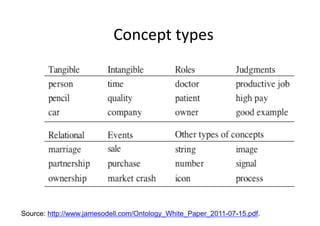
Concept	
  types


Source: http://www.jamesodell.com/Ontology_White_Paper_2011-07-15.pdf.
The	
  concept	
  triad	


Source: http://www.jamesodell.com/Ontology_White_Paper_2011-07-15.pdf.
Concept	
  specifica:on	
  
•  Symbol	
  
   – Name	
  used	
  for	
  the	
  concept	
  
   – Can	
  be	
  different	
  names,	
  different	
  languages	
  
   – E.g.,	
  “bike”,	
  fiets”	
  
•  Intension	
  (defini:on)	
  
   – Intended	
  meaning	
  of	
  the	
  concept	
  (seman:cs)	
  
   – E.g.	
  a	
  bike	
  has	
  at	
  least	
  one	
  wheel	
  and	
  a	
  human-­‐
     powered	
  movement	
  mechanism	
  
•  Extension	
  
   – Set	
  of	
  examples	
  of	
  the	
  concept	
  
   – E.g.	
  “my	
  bike”,	
  “your	
  bike”	
  
Incomplete	
  concept	
  specifica:ons
                                    	
  
•  Are	
  common	
  
•  Think	
  of	
  an	
  example:	
  	
  
    – Concept	
  with	
  no	
  instances	
  
    – Concept	
  with	
  no	
  symbol	
  
•  Primi:ve	
  vs.	
  defined	
  concepts	
  
Domain	
  =	
  area	
  of	
  interest
                                               	
  
•  Can	
  be	
  any	
  size	
  	
  
     – e.g.,	
  medicine	
  
•  Concepts	
  may	
  have	
  different	
  symbols	
  in	
  
   different	
  domains	
  
•  The	
  same	
  symbol	
  may	
  be	
  used	
  for	
  different	
  
   concepts	
  in	
  different	
  domains	
  (some:mes	
  
   also	
  in	
  the	
  same	
  domain)	
  	
  
Ontology	
  Specifica:on	
  
•  Class	
  (concept)	
                  •    Aggrega:on	
  
•  Subclass	
  with	
  inheritance	
     •    Rela:on-­‐aNribute	
  dis:nc:on	
  
                                         •    Trea:ng	
  rela:ons	
  as	
  classes	
  
•  Rela:on	
  (slot)	
  
                                         •    Sloppy	
  class/instance	
  
                                              dis:nc:on	
  
                                               –  Class-­‐level	
  aNributes/
                                                  rela:ons	
  
                                               –  Meta	
  classes	
  
                                         •    Constraints	
  
                                         •    Data	
  types	
  
                                         •    Modularity	
  
                                               –  Import/export	
  of	
  an	
  
                                                  ontology	
  
                                         •    Ontology	
  mapping	
  
Ontology	
  Languages	
  
   – UML	
  
   – RDF	
  Schema,	
  	
  OWL	
  
   – …..	


•  Common	
  basis	
  
   – Class	
  (concept)	
  
   – Subclass	
  with	
  inheritance	
  
   – Rela:on	
  (slot)	


                                           33	
  
Ontology	
  Tools	
  
Best	
  known	
  tool	
  
•  Protégé	
  (Stanford)	
  
•  We	
  will	
  use	
  this	
  tool	
  

Decision	
  points:	
  
     – Expressivity	
  
     – Graphical	
  representa:on	
  
     – DB	
  backend	
  
     – Modulariza:on	
  support	
  
     – Versioning	
  
Administra:on	
  
•  Course	
  website:	
  
           hNp://seman:cweb.cs.vu.nl/OE2012/	
  	
  
•  Use	
  blog	
  posts	
  for	
  content	
  ques:ons	
  
•  Use	
  oe-­‐list@few.vu.nl	
  for	
  admin	
  ques:ons	
  
Engineering	
  needs	
  prac:ce!	
  
	
   Lots	
  of	
  exercises	
  throughout	
  the	
  course:	
  
•  Two	
  mee:ngs	
  per	
  week	
  	
  
      •  Lectures	
  on	
  Monday	
  
      •  Work	
  sessions	
  on	
  Thursday	
  
•  You	
  are	
  encouraged	
  to	
  do	
  assignments	
  
     together	
  with	
  colleagues	
  
•  Individual	
  porsolio	
  
RDF(S)	
  Recap	
  
•  Which	
  RDF/RDF-­‐Schema	
  constructs	
  do	
  you	
  
   remember?	
  
URIs,	
  URLs	
  
•  URI:	
  global	
  iden:fier	
  for	
  a	
  web	
  resource	
  
         •  hNp://www.w3.org/2006/03/wn/wn20/instances/synset-­‐
            anniversary-­‐noun-­‐1	
  
•  URL:	
  dereferencable	
  URI,	
  used	
  to	
  locate	
  a	
  file	
  on	
  
   the	
  web.	
  
         •  hNp://www.w3.org/2006/03/wn/wn20/instances/synset-­‐
            anniversary-­‐noun-­‐1	
  
•  URI	
  abbrevia:ons:	
  
    – Qnames	
  
         •  Namespace:iden:fier	
  
         •  Wordnet:synset-­‐anniversary-­‐noun-­‐1	
  
Triples	
  
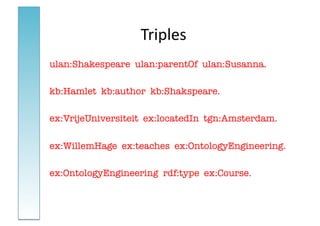
ulan:Shakespeare ulan:parentOf ulan:Susanna.

kb:Hamlet kb:author kb:Shakspeare.

ex:VrijeUniversiteit ex:locatedIn tgn:Amsterdam.

ex:WillemHage ex:teaches ex:OntologyEngineering.

ex:OntologyEngineering rdf:type ex:Course.
Syntax	
  
•  N3	
  Turtle	
  
    –  hNp://www.w3.org/TeamSubmission/turtle/	
  	
  
•  RDFXML	
  
    –  hNp://www.w3.org/TR/rdf-­‐syntax-­‐grammar/	
  
Blank	
  nodes	
  
How	
  would	
  you	
  model	
  
“Sonnet78	
  was	
  inspired	
  by	
  a	
  woman	
  who	
  lives	
  
  in	
  England”?	
  
           Lit:Sonnet78 lit:hasInspiration [ rdf:type bio:Woman;


   bio:livedIn geo:England ] .
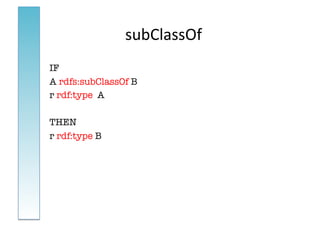
subClassOf	
  
IF
A rdfs:subClassOf B
r rdf:type A

THEN
r rdf:type B
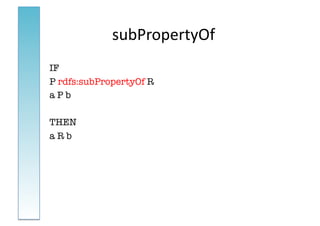
subPropertyOf	
  
IF
P rdfs:subPropertyOf R
a P b

THEN
a R b
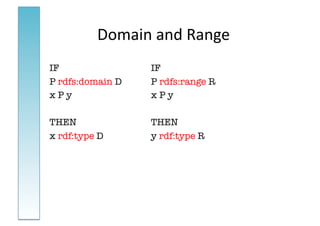
Domain	
  and	
  Range	
  
IF
                  IF
P rdfs:domain D
     P rdfs:range R
x P y
               x P y

THEN
                THEN
x rdf:type D
        y rdf:type R
More	
  RDF(S)	
  
•  rdfs:label	
  
•  rdfs:comment	
  
•  rdfs:seeAlso	
  
RDF-­‐Schema	
  
•  Provides	
  a	
  way	
  to	
  talk	
  about	
  the	
  vocabulary	
  
    – Define	
  classes,	
  proper:es	
  
         bb:author rdf:type rdfs:Property
•  Enables	
  inferencing	
  
    – Inferring	
  new	
  triples	
  from	
  asserted	
  triples.	
  
•  subClassOf,	
  subPropertyOf,	
  domain,	
  range.	
  
Guidelines	
  for	
  ontological	
  
                 engineering	
  (1)	
  
•  Do	
  not	
  develop	
  from	
  scratch	
  
•  Use	
  exis:ng	
  data	
  models	
  and	
  domain	
  standards	
  as	
  
   star:ng	
  point	
  
•  Start	
  with	
  construc:ng	
  an	
  ontology	
  of	
  common	
  
   concepts	
  
•  If	
  many	
  data	
  models,	
  start	
  with	
  two	
  typical	
  ones	
  
•  Make	
  the	
  purpose	
  and	
  context	
  of	
  the	
  ontology	
  
   explicit	
  
    –  E.g.	
  data	
  exchange	
  between	
  ship	
  designers	
  and	
  
       assessors	
  
    –  Opera:onally	
  purpose/context	
  with	
  use	
  cases	
  
•  Use	
  mul:ple	
  hierarchies	
  to	
  express	
  different	
  
   viewpoints	
  on	
  classes	
  
•  Consider	
  trea:ng	
  central	
  rela:onships	
  as	
  classes	
  
                                                                                  47	
  
Guidelines	
  for	
  ontological	
  
                   engineering	
  (2)	
  
•  Do	
  not	
  confuse	
  terms	
  and	
  concepts	
  
•  Small	
  ontologies	
  are	
  fine,	
  as	
  long	
  as	
  they	
  meet	
  their	
  goal	
  
•  Don’t	
  be	
  overly	
  ambi:ous:	
  complete	
  unified	
  models	
  are	
  
   difficult	
  
•  Ontologies	
  represent	
  sta:c	
  aspects	
  of	
  a	
  domain	
  
     –  Do	
  not	
  include	
  work	
  flow	
  
•  Use	
  a	
  standard	
  representa:on	
  format,	
  preferably	
  with	
  a	
  
   possibility	
  for	
  graphical	
  representa:on	
  
•  Decide	
  about	
  the	
  abstrac:on	
  level	
  of	
  the	
  ontology	
  early	
  
   on	
  in	
  the	
  process.	
  
     –  E.g.,	
  ontology	
  only	
  as	
  meta	
  model	


                                                                                             48	
  

Ontology Engineering: Introduction

  • 1.
    Welcome  to   Ontology  Engineering   Guus  Schreiber  
  • 2.
    Lecture  1   Agenda   •  Course  introduc:on:  what  is  an  ontology?   •  Administra:on   •  RDF/RDFS  
  • 3.
    Literature   •  James  Odell,  Ontology  White  Paper,  CSC   Catalyst,  2011,  V2011-­‐07-­‐15,     hNp://www.jamesodell.com/ Ontology_White_Paper_2011-­‐07-­‐15.pdf.     •  For  this  lecture  Sec.s  1-­‐4  are  relevant   •  Acknowledgement:  some  figures  in  this   lecture  come  from  the  paper  above.    
  • 4.
    What  is  an  Ontology?   •  In  philosophy:  theory  of  what  exists  in  the  world     •  In  IT:  consensual  &  formal  descrip:on  of  shared   concepts  in  a  domain   •  Aid  to  human  communica:on  and  shared   understanding,  by  specifying  meaning   •  Machine-­‐processable  (e.g.,  agents  use  ontologies  in     communica:on)   •  Key  technology  in  seman:c  informa:on  processing   •  Applica:ons:  knowledge  management,  e-­‐business,   seman:c  world-­‐wide  web.    
  • 5.
    What  is  an  Ontology?  II   “explicit  specifica-on  of  a  shared   conceptualiza-on  that  holds  in  a  par-cular   context”     (several  authors)  
  • 6.
    Knowledge  sharing  and  reuse   •  Knowledge  engineering  is  costly  and  :me-­‐ consuming   •  Distributed  systems   •  Increasing  need  for  defini:on  of  a  common   frame  of  reference   – Internet  search,  document  indexing,  ….  
  • 7.
    Need  for  data  integra:on?  
  • 8.
    Seman:c  Web   • Data  integra:on   •  AAA  slogan   •  Non-­‐Unique  Naming  Assump:on   •  Open  vs.  closed  World  
  • 9.
    The  Web:     resources  and  links   Web  link   URL   URL  
  • 10.
    The  Seman:c  Web:     typed  resources  and  links   Pain:ng   Dublin  Core   ULAN   “Woman  with  hat   SFMOMA   creator   Henri  Ma:sse   Web  link   URL   URL  
  • 11.
  • 12.
  • 14.
    Domain  standards  and  vocabularies  as   ontologies   •  Contain  ontological  informa:on   •  Ontology  needs  to  be  “extracted”   –  Not  explicit   •  Lists  of  domain  terms  are  some:mes  also  called   “ontologies”   –  Implies  a  weaker  no:on  of  ontology   –  Scope  typically  much  broader  than  a  specific  applica:on   domain   –  Contain  some  meta  informa:on:  hyponyms,  synonyms,  text   •  Structured  knowledge  is  available  (on  the  web)  –  use   it!   14  
  • 15.
    Ontology  spectrum   Source:http://www.jamesodell.com/Ontology_White_Paper_2011-07-15.pdf.
  • 16.
  • 17.
  • 18.
    Context  and  Domain   Principle  1:            “ The  representa:on  of  real-­‐world  objects  always  depends   on  the  context  in  which  the  object  is  used.  This  context   can  be  seen  as  a  “viewpoint”  taken  on  the  object.  It  is   usually  impossible  to  enumerate  in  advance  all  the   possible  useful  viewpoints  on  (a  class  of  )  objects.”   Principle  2:            “Reuse  of  some  piece  of  informa:on  requires  an  explicit   descrip:on  of  the  viewpoints  that  are  inherently  present   in  the  informa:on.  Otherwise,  there  is  no  way  of  knowing   whether,  and  why  this  piece  of  informa:on  is  applicable   in  a  new  applica:on  seing.”  
  • 19.
    Mul:ple  views  on  a  domain   •  typical  viewpoints  captured  in  ontologies:     • func:on   • behavior,     • causality   • shape,  geometry   • structure:  part-­‐of  (mereology),  aggrega:on     • connectedness  (topology)   •  viewpoints  can  have  different  abstrac:on   (generaliza:on)  levels     •  viewpoints  can  overlap   •  applica:ons  require  combina:ons  of  viewpoints   19  
  • 20.
    Mul:ple  views  on  a  domain   20  
  • 21.
    Context  specifica:on  through     ontology  types   •  Domain-­‐specific  ontologies   – Medicine:  UMLS,  SNOMED,  Galen   – Art  history:  AAT,  ULAN   – STEP  applica:on  protocols   •  Task-­‐specific  ontologies   – Classifica:on   – E-­‐commerce   •  Generic  ontologies     – Top-­‐level  categories   – Units  and  dimensions   21  
  • 22.
    Top-­‐level  categories:   many  different  proposals   Chandrasekaran et al. (1999) 22  
  • 23.
    The  famous  is-­‐a  rela:onship   Source: http://www.jamesodell.com/Ontology_White_Paper_2011-07-15.pdf.
  • 24.
    Classes  as  instances   24   Source: http://www.jamesodell.com/Ontology_White_Paper_2011-07-15.pdf.
  • 25.
    What  is  an  Ontology?   “explicit  specifica-on  of  a  shared   conceptualiza-on  that  holds  in  a  par-cular   context”     (several  authors)  
  • 26.
    Concepts   •  Help  us  organize  the  world  around  us   •  Act  as  recogni:on  device   •  Test  for  reality   •  We  use  many  different  types  of  concepts  
  • 27.
    Concept  types   Source: http://www.jamesodell.com/Ontology_White_Paper_2011-07-15.pdf.
  • 28.
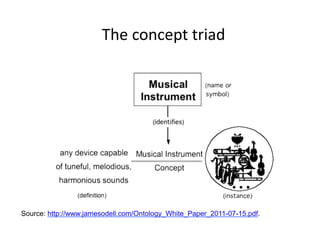
    The  concept  triad   Source: http://www.jamesodell.com/Ontology_White_Paper_2011-07-15.pdf.
  • 29.
    Concept  specifica:on   • Symbol   – Name  used  for  the  concept   – Can  be  different  names,  different  languages   – E.g.,  “bike”,  fiets”   •  Intension  (defini:on)   – Intended  meaning  of  the  concept  (seman:cs)   – E.g.  a  bike  has  at  least  one  wheel  and  a  human-­‐ powered  movement  mechanism   •  Extension   – Set  of  examples  of  the  concept   – E.g.  “my  bike”,  “your  bike”  
  • 30.
    Incomplete  concept  specifica:ons   •  Are  common   •  Think  of  an  example:     – Concept  with  no  instances   – Concept  with  no  symbol   •  Primi:ve  vs.  defined  concepts  
  • 31.
    Domain  =  area  of  interest   •  Can  be  any  size     – e.g.,  medicine   •  Concepts  may  have  different  symbols  in   different  domains   •  The  same  symbol  may  be  used  for  different   concepts  in  different  domains  (some:mes   also  in  the  same  domain)    
  • 32.
    Ontology  Specifica:on   • Class  (concept)   •  Aggrega:on   •  Subclass  with  inheritance   •  Rela:on-­‐aNribute  dis:nc:on   •  Trea:ng  rela:ons  as  classes   •  Rela:on  (slot)   •  Sloppy  class/instance   dis:nc:on   –  Class-­‐level  aNributes/ rela:ons   –  Meta  classes   •  Constraints   •  Data  types   •  Modularity   –  Import/export  of  an   ontology   •  Ontology  mapping  
  • 33.
    Ontology  Languages   – UML   – RDF  Schema,    OWL   – …..   •  Common  basis   – Class  (concept)   – Subclass  with  inheritance   – Rela:on  (slot)   33  
  • 34.
    Ontology  Tools   Best  known  tool   •  Protégé  (Stanford)   •  We  will  use  this  tool   Decision  points:   – Expressivity   – Graphical  representa:on   – DB  backend   – Modulariza:on  support   – Versioning  
  • 35.
    Administra:on   •  Course  website:   hNp://seman:cweb.cs.vu.nl/OE2012/     •  Use  blog  posts  for  content  ques:ons   •  Use  oe-­‐list@few.vu.nl  for  admin  ques:ons  
  • 36.
    Engineering  needs  prac:ce!     Lots  of  exercises  throughout  the  course:   •  Two  mee:ngs  per  week     •  Lectures  on  Monday   •  Work  sessions  on  Thursday   •  You  are  encouraged  to  do  assignments   together  with  colleagues   •  Individual  porsolio  
  • 37.
    RDF(S)  Recap   • Which  RDF/RDF-­‐Schema  constructs  do  you   remember?  
  • 38.
    URIs,  URLs   • URI:  global  iden:fier  for  a  web  resource   •  hNp://www.w3.org/2006/03/wn/wn20/instances/synset-­‐ anniversary-­‐noun-­‐1   •  URL:  dereferencable  URI,  used  to  locate  a  file  on   the  web.   •  hNp://www.w3.org/2006/03/wn/wn20/instances/synset-­‐ anniversary-­‐noun-­‐1   •  URI  abbrevia:ons:   – Qnames   •  Namespace:iden:fier   •  Wordnet:synset-­‐anniversary-­‐noun-­‐1  
  • 39.
    Triples   ulan:Shakespeare ulan:parentOfulan:Susanna. kb:Hamlet kb:author kb:Shakspeare. ex:VrijeUniversiteit ex:locatedIn tgn:Amsterdam. ex:WillemHage ex:teaches ex:OntologyEngineering. ex:OntologyEngineering rdf:type ex:Course.
  • 40.
    Syntax   •  N3  Turtle   –  hNp://www.w3.org/TeamSubmission/turtle/     •  RDFXML   –  hNp://www.w3.org/TR/rdf-­‐syntax-­‐grammar/  
  • 41.
    Blank  nodes   How  would  you  model   “Sonnet78  was  inspired  by  a  woman  who  lives   in  England”?   Lit:Sonnet78 lit:hasInspiration [ rdf:type bio:Woman; bio:livedIn geo:England ] .
  • 42.
    subClassOf   IF A rdfs:subClassOfB r rdf:type A THEN r rdf:type B
  • 43.
  • 44.
    Domain  and  Range   IF IF P rdfs:domain D P rdfs:range R x P y x P y THEN THEN x rdf:type D y rdf:type R
  • 45.
    More  RDF(S)   • rdfs:label   •  rdfs:comment   •  rdfs:seeAlso  
  • 46.
    RDF-­‐Schema   •  Provides  a  way  to  talk  about  the  vocabulary   – Define  classes,  proper:es   bb:author rdf:type rdfs:Property •  Enables  inferencing   – Inferring  new  triples  from  asserted  triples.   •  subClassOf,  subPropertyOf,  domain,  range.  
  • 47.
    Guidelines  for  ontological   engineering  (1)   •  Do  not  develop  from  scratch   •  Use  exis:ng  data  models  and  domain  standards  as   star:ng  point   •  Start  with  construc:ng  an  ontology  of  common   concepts   •  If  many  data  models,  start  with  two  typical  ones   •  Make  the  purpose  and  context  of  the  ontology   explicit   –  E.g.  data  exchange  between  ship  designers  and   assessors   –  Opera:onally  purpose/context  with  use  cases   •  Use  mul:ple  hierarchies  to  express  different   viewpoints  on  classes   •  Consider  trea:ng  central  rela:onships  as  classes   47  
  • 48.
    Guidelines  for  ontological   engineering  (2)   •  Do  not  confuse  terms  and  concepts   •  Small  ontologies  are  fine,  as  long  as  they  meet  their  goal   •  Don’t  be  overly  ambi:ous:  complete  unified  models  are   difficult   •  Ontologies  represent  sta:c  aspects  of  a  domain   –  Do  not  include  work  flow   •  Use  a  standard  representa:on  format,  preferably  with  a   possibility  for  graphical  representa:on   •  Decide  about  the  abstrac:on  level  of  the  ontology  early   on  in  the  process.   –  E.g.,  ontology  only  as  meta  model   48