Ontology representation

     Guus Schreiber, VU

 Ontology Engineering course
RDF/OWL
 Ontology language used in this course
 OWL = W3C Ontology Web Language
 RDF is basis of representation
  – Triples = binary relation format
  – Turtle is the triple syntax format most frequently
    used


                                                         2
Background reading
OWL Primer, W3C Recommendation, October
 2009, http://www.w3.org/TR/owl2-primer/.

 Section 4 contains the basic constructs
 Secs. 5-8 describe the advanced features (not all
  of these will be used in the course).
 The Turtle syntax is easiest to read. You can hide
  the other in the beginning of the document.


                                                       3
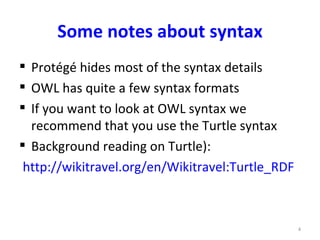
Some notes about syntax
 Protégé hides most of the syntax details
 OWL has quite a few syntax formats
 If you want to look at OWL syntax we
   recommend that you use the Turtle syntax
 Background reading on Turtle):
 h
 http://wikitravel.org/en/Wikitravel:Turtle_RDF


                                                  4
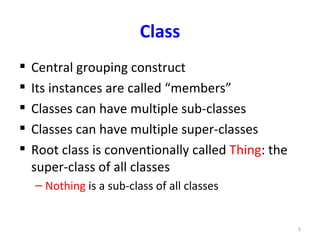
Class
   Central grouping construct
   Its instances are called “members”
   Classes can have multiple sub-classes
   Classes can have multiple super-classes
   Root class is conventionally called Thing: the
    super-class of all classes
    – Nothing is a sub-class of all classes


                                                     5
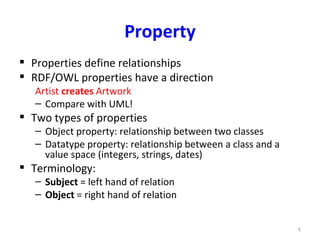
Property
 Properties define relationships
 RDF/OWL properties have a direction
   Artist creates Artwork
   – Compare with UML!
 Two types of properties
   – Object property: relationship between two classes
   – Datatype property: relationship between a class and a
     value space (integers, strings, dates)
 Terminology:
   – Subject = left hand of relation
   – Object = right hand of relation


                                                             6
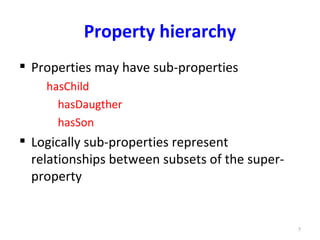
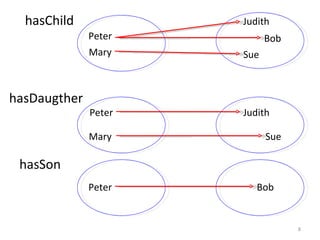
Property hierarchy
 Properties may have sub-properties
    hasChild
      hasDaugther
      hasSon
 Logically sub-properties represent
  relationships between subsets of the super-
  property


                                                7
hasChild            Judith
              Peter         Bob
              Mary    Sue


hasDaugther
              Peter   Judith

              Mary          Sue

 hasSon
              Peter      Bob


                                  8
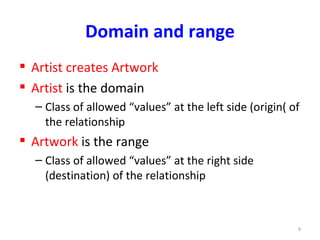
Domain and range
 Artist creates Artwork
 Artist is the domain
  – Class of allowed “values” at the left side (origin( of
    the relationship
 Artwork is the range
  – Class of allowed “values” at the right side
    (destination) of the relationship


                                                         9
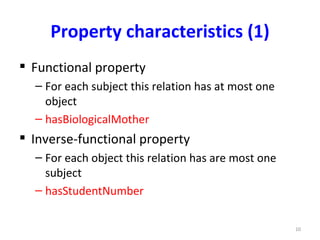
Property characteristics (1)
 Functional property
  – For each subject this relation has at most one
    object
  – hasBiologicalMother
 Inverse-functional property
  – For each object this relation has are most one
    subject
  – hasStudentNumber

                                                     10
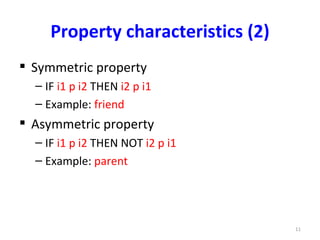
Property characteristics (2)
 Symmetric property
  – IF i1 p i2 THEN i2 p i1
  – Example: friend
 Asymmetric property
  – IF i1 p i2 THEN NOT i2 p i1
  – Example: parent


                                    11
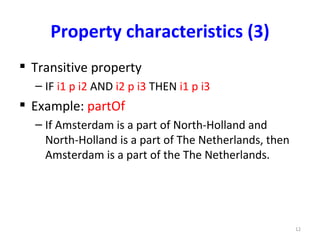
Property characteristics (3)
 Transitive property
  – IF i1 p i2 AND i2 p i3 THEN i1 p i3
 Example: partOf
  – If Amsterdam is a part of North-Holland and
    North-Holland is a part of The Netherlands, then
    Amsterdam is a part of the The Netherlands.


                                                       12
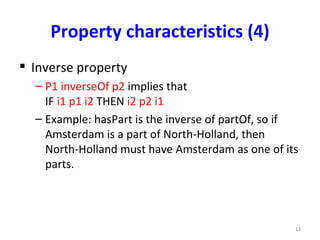
Property characteristics (4)
 Inverse property
  – P1 inverseOf p2 implies that
    IF i1 p1 i2 THEN i2 p2 i1
  – Example: hasPart is the inverse of partOf, so if
    Amsterdam is a part of North-Holland, then
    North-Holland must have Amsterdam as one of its
    parts.


                                                   13
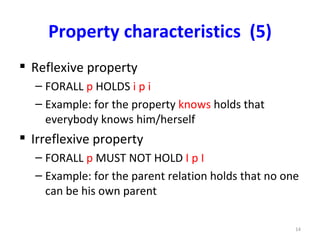
Property characteristics (5)
 Reflexive property
  – FORALL p HOLDS i p i
  – Example: for the property knows holds that
    everybody knows him/herself
 Irreflexive property
  – FORALL p MUST NOT HOLD I p I
  – Example: for the parent relation holds that no one
    can be his own parent

                                                     14
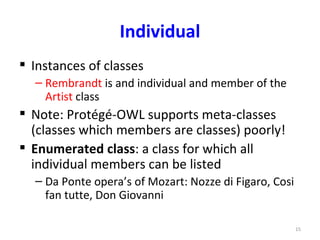
Individual
 Instances of classes
  – Rembrandt is and individual and member of the
    Artist class
 Note: Protégé-OWL supports meta-classes
  (classes which members are classes) poorly!
 Enumerated class: a class for which all
  individual members can be listed
  – Da Ponte opera’s of Mozart: Nozze di Figaro, Cosi
    fan tutte, Don Giovanni

                                                        15
Equality and inequality of individuals
 Equality example: two people (with different
  URLs) are actually the same:
            ex:Jim sameAs ex:James
 Inequality example: two people are different
         Ex1:Jim differentFrom ex2:Jim
 Important on the Web!
  – Difference between closed and open world


                                                 16
Cardinality restrictions of properties
 Defines how many relationships of a certain
  type there can be for a particular subject
 Examples:
  – Person marriedTo max 1
  – Course hasTutor min 1
  – Person hasParent exactly 2


                                                17
Value restrictions of properties
 Defines to what objects a subject can be related
  through a particular relation
 Examples
  – Wine producedBy only Vineyard
  Wine is only produced by vineyards
  – RedWine color value “Red”
  Red wines have a red color
  – Bicycle hasPart some Wheel
  Bicycles consist, amongst others, of at least one wheel

                                                            18
Equivalent classes & properties:
                 simple
 States that two classes are the same, for example
  two classes in different ontologies
                wn-en:Dog = wn-it:Cane

 You can do the same for properties
         ex1:hasPart = ex2:hasComponent

 Question: do you think equivalence occurs
  frequently?

                                                  19
Interlude:
      the notion of class extension
 OWL is derived from “description logic”
 Description logic takes an “extensional” view of
  classes:
  – Two classes are the same if - and only if- they have
    the same class extension
  – The class extension is the set of members of the class


 Question: does this correspond to your intuition?


                                                         20
Equivalent classes: complex (1)
 A class as the union of other classes
              Parent = Mother or Father
 In terms of class extensions:
  – The class extension of the class Parent is the union
    of the class extensions of the classes Mother and
    Father
  – OWL calls such formulas “class expressions” (term
    used in Protégé)

                                                      21
Equivalent classes: complex (2)
 A class as the intersection of other classes
           Mother =Woman and Parent
 In words: members of the Mother class must
  be members of both the Woman and the
  Parent class
 You can build even more complex
  expressions:
     Mother = Woman and some hasChild
                                                 22
Class expressions
 Statements such as Woman and Parent and
  Woman and some hasChild are called class
  expressions
 Description logic treats class expressions as
  anonymous classes
  – i.e. concepts with no symbol, cf. the concept triad


                                                      23
Equivalent classes: complex (3)
 Defining a class as the negation
  (“complement”) of other classes
    ChildlessPerson = Person and not Parent
 In words: a childless person is a member of
  the person class who does not belong to the
  extension of the parent class


                                                24
Necessary class definitions
 Description logic is used for classification
  reasoning
 A necessary definition state a constraint which
   must be true for class membership, but is not
  enough to classify it as a member of the class
 Example: red wine must have a red color
  – But: not all red things are red wines


                                                25
Necessary class definitions in
           description logic
 The red-wine constraint is expressed as follows:
   – Red wine is subclass of the class of all red things
 More formally: necessary conditions are stated
  as a constraint that the class in question (red
  wine) is a subclass of the anonymous class
  represented by the class expression (class of all
  red things)
 This explains how Protégé uses the
  “Superclasses”
   – Test this now; you’ll get the hang of it
                                                           26
Sufficient class definitions
 Sufficient definitions allow us to classify an
  individual as a member of a class
 Example: if we know someone belongs to the
  Woman and Parent class, we also know she
  belongs to the Mother class
 The equivalent-class expression represent
  sufficient definitions


                                                   27
Annotations
 Annotations are used to add metadata to
  classes and properties
 Annotations play no role in classification
 Example annotations:
  – Human-readable label (in multiple languages)
  – Time created
  – See also Dublin Core elements


                                                   28
Class exercise: comparison with UML
            class diagrams
 Make list of
  – Similarities
  – Differences


 Don’t forget that OWL is a Web language!


                                             29
Guidelines for naming concepts
 Keep original names, where possible
 Prefer more specific names over general ones
 Don’t be afraid of long names if you have to
  invent a name
 Use a consistent format
  – Here: ClassName propertyName
  – But alternatives are fine


                                             30
Class room exercise
 “Artefacts are created by humans. Art works
  are a kind of artefact. If a person has created
  an art work we call him/her an artist.”

 Exercise: create with the help of Protégé an
  OWL ontology for this domain description.


                                                    31

Ontology Engineering: representation in OWL

  • 1.
    Ontology representation Guus Schreiber, VU Ontology Engineering course
  • 2.
    RDF/OWL  Ontology languageused in this course  OWL = W3C Ontology Web Language  RDF is basis of representation – Triples = binary relation format – Turtle is the triple syntax format most frequently used 2
  • 3.
    Background reading OWL Primer,W3C Recommendation, October 2009, http://www.w3.org/TR/owl2-primer/.  Section 4 contains the basic constructs  Secs. 5-8 describe the advanced features (not all of these will be used in the course).  The Turtle syntax is easiest to read. You can hide the other in the beginning of the document. 3
  • 4.
    Some notes aboutsyntax  Protégé hides most of the syntax details  OWL has quite a few syntax formats  If you want to look at OWL syntax we recommend that you use the Turtle syntax  Background reading on Turtle): h http://wikitravel.org/en/Wikitravel:Turtle_RDF 4
  • 5.
    Class  Central grouping construct  Its instances are called “members”  Classes can have multiple sub-classes  Classes can have multiple super-classes  Root class is conventionally called Thing: the super-class of all classes – Nothing is a sub-class of all classes 5
  • 6.
    Property  Properties definerelationships  RDF/OWL properties have a direction Artist creates Artwork – Compare with UML!  Two types of properties – Object property: relationship between two classes – Datatype property: relationship between a class and a value space (integers, strings, dates)  Terminology: – Subject = left hand of relation – Object = right hand of relation 6
  • 7.
    Property hierarchy  Propertiesmay have sub-properties hasChild hasDaugther hasSon  Logically sub-properties represent relationships between subsets of the super- property 7
  • 8.
    hasChild Judith Peter Bob Mary Sue hasDaugther Peter Judith Mary Sue hasSon Peter Bob 8
  • 9.
    Domain and range Artist creates Artwork  Artist is the domain – Class of allowed “values” at the left side (origin( of the relationship  Artwork is the range – Class of allowed “values” at the right side (destination) of the relationship 9
  • 10.
    Property characteristics (1) Functional property – For each subject this relation has at most one object – hasBiologicalMother  Inverse-functional property – For each object this relation has are most one subject – hasStudentNumber 10
  • 11.
    Property characteristics (2) Symmetric property – IF i1 p i2 THEN i2 p i1 – Example: friend  Asymmetric property – IF i1 p i2 THEN NOT i2 p i1 – Example: parent 11
  • 12.
    Property characteristics (3) Transitive property – IF i1 p i2 AND i2 p i3 THEN i1 p i3  Example: partOf – If Amsterdam is a part of North-Holland and North-Holland is a part of The Netherlands, then Amsterdam is a part of the The Netherlands. 12
  • 13.
    Property characteristics (4) Inverse property – P1 inverseOf p2 implies that IF i1 p1 i2 THEN i2 p2 i1 – Example: hasPart is the inverse of partOf, so if Amsterdam is a part of North-Holland, then North-Holland must have Amsterdam as one of its parts. 13
  • 14.
    Property characteristics (5) Reflexive property – FORALL p HOLDS i p i – Example: for the property knows holds that everybody knows him/herself  Irreflexive property – FORALL p MUST NOT HOLD I p I – Example: for the parent relation holds that no one can be his own parent 14
  • 15.
    Individual  Instances ofclasses – Rembrandt is and individual and member of the Artist class  Note: Protégé-OWL supports meta-classes (classes which members are classes) poorly!  Enumerated class: a class for which all individual members can be listed – Da Ponte opera’s of Mozart: Nozze di Figaro, Cosi fan tutte, Don Giovanni 15
  • 16.
    Equality and inequalityof individuals  Equality example: two people (with different URLs) are actually the same: ex:Jim sameAs ex:James  Inequality example: two people are different Ex1:Jim differentFrom ex2:Jim  Important on the Web! – Difference between closed and open world 16
  • 17.
    Cardinality restrictions ofproperties  Defines how many relationships of a certain type there can be for a particular subject  Examples: – Person marriedTo max 1 – Course hasTutor min 1 – Person hasParent exactly 2 17
  • 18.
    Value restrictions ofproperties  Defines to what objects a subject can be related through a particular relation  Examples – Wine producedBy only Vineyard Wine is only produced by vineyards – RedWine color value “Red” Red wines have a red color – Bicycle hasPart some Wheel Bicycles consist, amongst others, of at least one wheel 18
  • 19.
    Equivalent classes &properties: simple  States that two classes are the same, for example two classes in different ontologies wn-en:Dog = wn-it:Cane  You can do the same for properties ex1:hasPart = ex2:hasComponent  Question: do you think equivalence occurs frequently? 19
  • 20.
    Interlude: the notion of class extension  OWL is derived from “description logic”  Description logic takes an “extensional” view of classes: – Two classes are the same if - and only if- they have the same class extension – The class extension is the set of members of the class  Question: does this correspond to your intuition? 20
  • 21.
    Equivalent classes: complex(1)  A class as the union of other classes Parent = Mother or Father  In terms of class extensions: – The class extension of the class Parent is the union of the class extensions of the classes Mother and Father – OWL calls such formulas “class expressions” (term used in Protégé) 21
  • 22.
    Equivalent classes: complex(2)  A class as the intersection of other classes Mother =Woman and Parent  In words: members of the Mother class must be members of both the Woman and the Parent class  You can build even more complex expressions: Mother = Woman and some hasChild 22
  • 23.
    Class expressions  Statementssuch as Woman and Parent and Woman and some hasChild are called class expressions  Description logic treats class expressions as anonymous classes – i.e. concepts with no symbol, cf. the concept triad 23
  • 24.
    Equivalent classes: complex(3)  Defining a class as the negation (“complement”) of other classes ChildlessPerson = Person and not Parent  In words: a childless person is a member of the person class who does not belong to the extension of the parent class 24
  • 25.
    Necessary class definitions Description logic is used for classification reasoning  A necessary definition state a constraint which must be true for class membership, but is not enough to classify it as a member of the class  Example: red wine must have a red color – But: not all red things are red wines 25
  • 26.
    Necessary class definitionsin description logic  The red-wine constraint is expressed as follows: – Red wine is subclass of the class of all red things  More formally: necessary conditions are stated as a constraint that the class in question (red wine) is a subclass of the anonymous class represented by the class expression (class of all red things)  This explains how Protégé uses the “Superclasses” – Test this now; you’ll get the hang of it 26
  • 27.
    Sufficient class definitions Sufficient definitions allow us to classify an individual as a member of a class  Example: if we know someone belongs to the Woman and Parent class, we also know she belongs to the Mother class  The equivalent-class expression represent sufficient definitions 27
  • 28.
    Annotations  Annotations areused to add metadata to classes and properties  Annotations play no role in classification  Example annotations: – Human-readable label (in multiple languages) – Time created – See also Dublin Core elements 28
  • 29.
    Class exercise: comparisonwith UML class diagrams  Make list of – Similarities – Differences  Don’t forget that OWL is a Web language! 29
  • 30.
    Guidelines for namingconcepts  Keep original names, where possible  Prefer more specific names over general ones  Don’t be afraid of long names if you have to invent a name  Use a consistent format – Here: ClassName propertyName – But alternatives are fine 30
  • 31.
    Class room exercise “Artefacts are created by humans. Art works are a kind of artefact. If a person has created an art work we call him/her an artist.”  Exercise: create with the help of Protégé an OWL ontology for this domain description. 31