Semantic web

   Tapas Kumar Mishra
       11CS60R32

                        1
Agenda
   Introduction
   What is semantic web
   Issues with traditional web search
   The Technology Stack
   Architecture of semantic web
   Meta Data
   Main Tasks
 Knowledge Representation
   ∙ XML
   ∙ RDF
 Ontology
  ∙ Taxonomy
   ∙ Inference Rules
   Conclusion
   And references

                                         2
Introduction

The Semantic Web is an extension of the
current web in which information is given
well-defined meaning, better enabling
computers and people to work in co-
operation.

                        [Tim Berners-Lee , 2001]


                                                   3
Introduction contd…
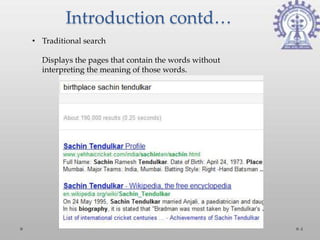
• Traditional search

  Displays the pages that contain the words without
  interpreting the meaning of those words.


                                                      4
Introduction contd…
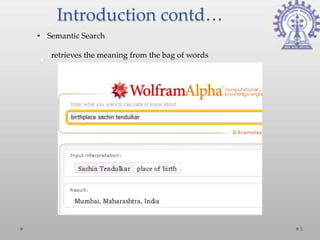
• Semantic Search

   retrieves the meaning from the bag of words


                                                 5
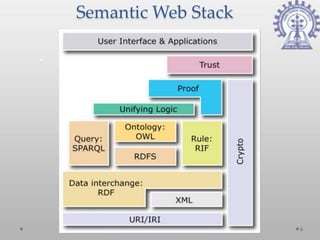
Semantic Web Stack


                     6
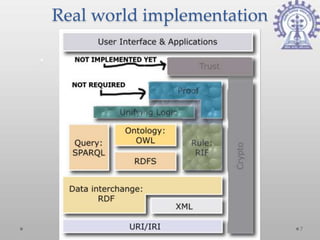
Real world implementation


                            7
Metadata

• The first form of semantic data on the Web was
  metadata :
                      information about information
• Basically include:

    1.   Means of creation of the data
    2.   Purpose of the data
    3.   Time and date of creation
    4.   Creator or author of data
    5.   Placement on a computer network where the data was created
    6.   Standards used


                                                                      8
Metadata Contd..
Example :

•   a meta element specifies name and associated
    content attributes describing aspects of the HTML
    page.
<meta name="keywords"content="wikipedia,encyclopedia">
•   default charset for plain text is simply set with meta:

<meta http-equiv="Content-Type" content="text/html charset=UTF-8" >


                                                                      9
Semantic Web main tasks
• Knowledge Representation:

   • Metadata annotation
   •   Description of resources using standard languages

• Search:

   • Retrieve relevant information according to user‟s query /
     interest / intention
   • Use metadata (and possibly content) in a “smart” way
     (i.e. “reasoning” about the meaning of annotations)


                                                                 10
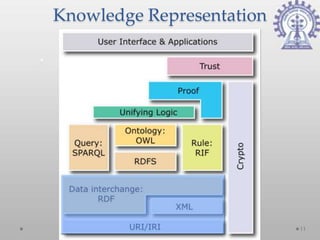
Knowledge Representation


                           11
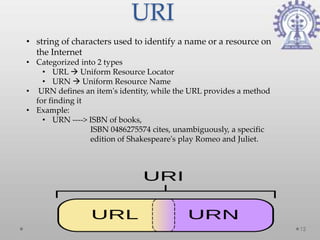
URI
• string of characters used to identify a name or a resource on
  the Internet
• Categorized into 2 types
    • URL  Uniform Resource Locator
    • URN  Uniform Resource Name
• URN defines an item's identity, while the URL provides a method
  for finding it
• Example:
    • URN ----> ISBN of books,
                 ISBN 0486275574 cites, unambiguously, a specific
                 edition of Shakespeare's play Romeo and Juliet.


                                                                    12
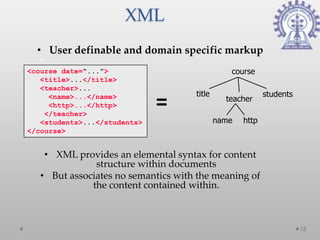
XML
  • User definable and domain specific markup
<course date=“...”>                             course
   <title>...</title>
   <teacher>...
                                     title                 students
     <name>...</name>
     <http>...</http>
    </teacher>
                              =                teacher

   <students>...</students>                  name   http
</course>


    • XML provides an elemental syntax for content
               structure within documents
   • But associates no semantics with the meaning of
              the content contained within.


                                                                      13
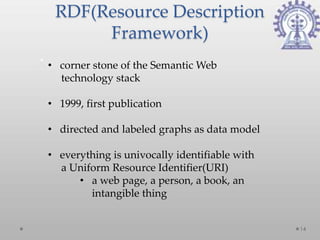
RDF(Resource Description
      Framework)
• corner stone of the Semantic Web
  technology stack

• 1999, first publication

• directed and labeled graphs as data model

• everything is univocally identifiable with
  a Uniform Resource Identifier(URI)
      • a web page, a person, a book, an
        intangible thing


                                               14
RDF CONTD…
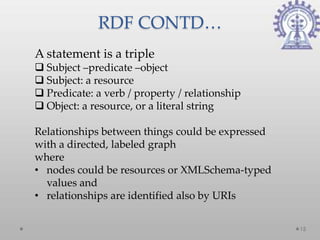
A statement is a triple
 Subject –predicate –object
 Subject: a resource
 Predicate: a verb / property / relationship
 Object: a resource, or a literal string

Relationships between things could be expressed
with a directed, labeled graph
where
• nodes could be resources or XMLSchema-typed
  values and
• relationships are identified also by URIs

                                                  15
RDF CONTD…
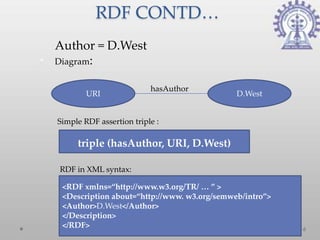
Author = D.West
Diagram:


                          hasAuthor
        URI                                  D.West


Simple RDF assertion triple :

     triple (hasAuthor, URI, D.West)

RDF in XML syntax:

 <RDF xmlns=“http://www.w3.org/TR/ … ” >
 <Description about=“http://www. w3.org/semweb/intro”>
 <Author>D.West</Author>
 </Description>
 </RDF>                                                  16
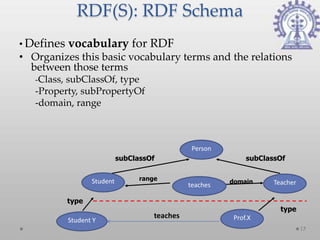
RDF(S): RDF Schema
• Defines   vocabulary for RDF
• Organizes this basic vocabulary terms and the relations
  between those terms
   -Class, subClassOf, type
   -Property, subPropertyOf
   -domain, range


                                                  Person
                             subClassOf                         subClassOf


                   Student         range                   domain
                                                 teaches               Teacher

            type
                                                                         type
                                       teaches              Prof.X
            Student Y
                                                                                 17
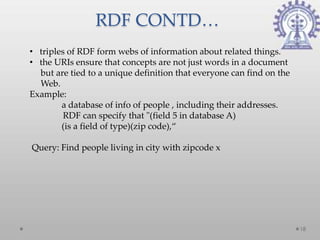
RDF CONTD…
• triples of RDF form webs of information about related things.
• the URIs ensure that concepts are not just words in a document
  but are tied to a unique definition that everyone can find on the
  Web.
Example:
        a database of info of people , including their addresses.
         RDF can specify that "(field 5 in database A)
        (is a field of type)(zip code),“

Query: Find people living in city with zipcode x


                                                                      18
RDF CONTD…

• Problem with RDF:
  o Synonym problem:


     • two databases may use different identifiers for what is in fact the
       same concept, such as zip code. A program that wants to compare or
       combine information across the two databases has to know that
       these two terms are being used to mean the same thing.


                                                                             19
Ontology
• Problems with RDF
   • two databases may use different identifiers for what
     is in fact the same concept, such as zip code
• Solution is Ontology….

An ontology is an explicit description of a domain
•   concepts
•   properties and attributes of concepts
•   constraints on properties and attributes
•   individuals (often, but not always)

Web ontology consists of
• Taxonomy
• Inference Rules


                                                            20
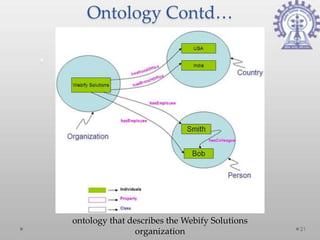
Ontology Contd…


ontology that describes the Webify Solutions
                                               21
                organization
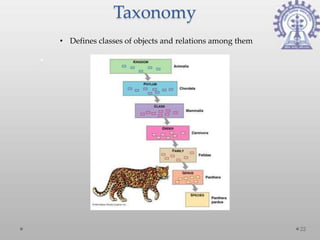
Taxonomy
• Defines classes of objects and relations among them


                                                        22
Taxonomy Contd…
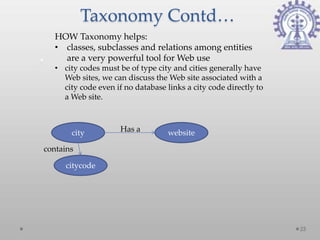
   HOW Taxonomy helps:
   • classes, subclasses and relations among entities
     are a very powerful tool for Web use
   • city codes must be of type city and cities generally have
     Web sites, we can discuss the Web site associated with a
     city code even if no database links a city code directly to
     a Web site.


       city           Has a         website

contains

      citycode


                                                                   23
Inference Rules
• Allows us to infer conclusions based on rules
  and facts available in the knowledge base
• Example:
   • An ontology may express the rule "If a city
     code is associated with a state code, and an
     address uses that city code, then that address
     has the associated state code."
   • A program could then readily deduce, for
     instance, that a IIT KGP address, being in
     Kharagpur, must be in West Bengal, which is
     in the India, and therefore should be
     formatted to indian standards.


                                                      24
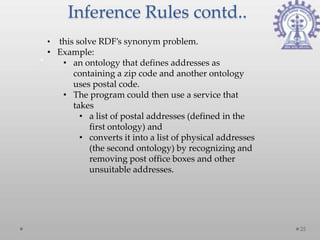
Inference Rules contd..
• this solve RDF’s synonym problem.
• Example:
   • an ontology that defines addresses as
      containing a zip code and another ontology
      uses postal code.
   • The program could then use a service that
      takes
        • a list of postal addresses (defined in the
          first ontology) and
        • converts it into a list of physical addresses
          (the second ontology) by recognizing and
          removing post office boxes and other
          unsuitable addresses.


                                                          25
PRO’s of Semantic web

  • Accuracy of web search
  • Tackle complicated questions
  • Inpage answer to query


                                   26
CONCLUSIONS AND
  FUTUREWORK
• Implementation of encryption layer
• Standard for retrieval
• Standard for metadata


                                       27
References

1. Berners-Lee, Tim; James Hendler and Ora Lassila
   (May 17, 2001). "The Semantic Web". Scientific
   American Magazine
2. www.en.wikipedia.org/wiki/Semantic_Web
3. Tim Berners-Lee, with Mark Fischetti. Harper San
   Francisco, 1999.”Weaving the Web”
4. http://www.w3.org/2001/sw/
5. www.SemanticWeb.org/
6. James Farrugia,University of Maine, Orono, ME.
   ” Model-theoretic semantics for the web”. ACM New
   York, NY, USA ©2003


                                                       28
Thank you


            29

Semantic web

  • 1.
    Semantic web Tapas Kumar Mishra 11CS60R32 1
  • 2.
    Agenda  Introduction  What is semantic web  Issues with traditional web search  The Technology Stack  Architecture of semantic web  Meta Data  Main Tasks  Knowledge Representation ∙ XML ∙ RDF  Ontology ∙ Taxonomy ∙ Inference Rules  Conclusion  And references 2
  • 3.
    Introduction The Semantic Webis an extension of the current web in which information is given well-defined meaning, better enabling computers and people to work in co- operation. [Tim Berners-Lee , 2001] 3
  • 4.
    Introduction contd… • Traditionalsearch Displays the pages that contain the words without interpreting the meaning of those words. 4
  • 5.
    Introduction contd… • SemanticSearch retrieves the meaning from the bag of words 5
  • 6.
  • 7.
  • 8.
    Metadata • The firstform of semantic data on the Web was metadata : information about information • Basically include: 1. Means of creation of the data 2. Purpose of the data 3. Time and date of creation 4. Creator or author of data 5. Placement on a computer network where the data was created 6. Standards used 8
  • 9.
    Metadata Contd.. Example : • a meta element specifies name and associated content attributes describing aspects of the HTML page. <meta name="keywords"content="wikipedia,encyclopedia"> • default charset for plain text is simply set with meta: <meta http-equiv="Content-Type" content="text/html charset=UTF-8" > 9
  • 10.
    Semantic Web maintasks • Knowledge Representation: • Metadata annotation • Description of resources using standard languages • Search: • Retrieve relevant information according to user‟s query / interest / intention • Use metadata (and possibly content) in a “smart” way (i.e. “reasoning” about the meaning of annotations) 10
  • 11.
  • 12.
    URI • string ofcharacters used to identify a name or a resource on the Internet • Categorized into 2 types • URL  Uniform Resource Locator • URN  Uniform Resource Name • URN defines an item's identity, while the URL provides a method for finding it • Example: • URN ----> ISBN of books, ISBN 0486275574 cites, unambiguously, a specific edition of Shakespeare's play Romeo and Juliet. 12
  • 13.
    XML •User definable and domain specific markup <course date=“...”> course <title>...</title> <teacher>... title students <name>...</name> <http>...</http> </teacher> = teacher <students>...</students> name http </course> • XML provides an elemental syntax for content structure within documents • But associates no semantics with the meaning of the content contained within. 13
  • 14.
    RDF(Resource Description Framework) • corner stone of the Semantic Web technology stack • 1999, first publication • directed and labeled graphs as data model • everything is univocally identifiable with a Uniform Resource Identifier(URI) • a web page, a person, a book, an intangible thing 14
  • 15.
    RDF CONTD… A statementis a triple  Subject –predicate –object  Subject: a resource  Predicate: a verb / property / relationship  Object: a resource, or a literal string Relationships between things could be expressed with a directed, labeled graph where • nodes could be resources or XMLSchema-typed values and • relationships are identified also by URIs 15
  • 16.
    RDF CONTD… Author =D.West Diagram: hasAuthor URI D.West Simple RDF assertion triple : triple (hasAuthor, URI, D.West) RDF in XML syntax: <RDF xmlns=“http://www.w3.org/TR/ … ” > <Description about=“http://www. w3.org/semweb/intro”> <Author>D.West</Author> </Description> </RDF> 16
  • 17.
    RDF(S): RDF Schema •Defines vocabulary for RDF • Organizes this basic vocabulary terms and the relations between those terms -Class, subClassOf, type -Property, subPropertyOf -domain, range Person subClassOf subClassOf Student range domain teaches Teacher type type teaches Prof.X Student Y 17
  • 18.
    RDF CONTD… • triplesof RDF form webs of information about related things. • the URIs ensure that concepts are not just words in a document but are tied to a unique definition that everyone can find on the Web. Example: a database of info of people , including their addresses. RDF can specify that "(field 5 in database A) (is a field of type)(zip code),“ Query: Find people living in city with zipcode x 18
  • 19.
    RDF CONTD… • Problemwith RDF: o Synonym problem: • two databases may use different identifiers for what is in fact the same concept, such as zip code. A program that wants to compare or combine information across the two databases has to know that these two terms are being used to mean the same thing. 19
  • 20.
    Ontology • Problems withRDF • two databases may use different identifiers for what is in fact the same concept, such as zip code • Solution is Ontology…. An ontology is an explicit description of a domain • concepts • properties and attributes of concepts • constraints on properties and attributes • individuals (often, but not always) Web ontology consists of • Taxonomy • Inference Rules 20
  • 21.
    Ontology Contd… ontology thatdescribes the Webify Solutions 21 organization
  • 22.
    Taxonomy • Defines classesof objects and relations among them 22
  • 23.
    Taxonomy Contd… HOW Taxonomy helps: • classes, subclasses and relations among entities are a very powerful tool for Web use • city codes must be of type city and cities generally have Web sites, we can discuss the Web site associated with a city code even if no database links a city code directly to a Web site. city Has a website contains citycode 23
  • 24.
    Inference Rules • Allowsus to infer conclusions based on rules and facts available in the knowledge base • Example: • An ontology may express the rule "If a city code is associated with a state code, and an address uses that city code, then that address has the associated state code." • A program could then readily deduce, for instance, that a IIT KGP address, being in Kharagpur, must be in West Bengal, which is in the India, and therefore should be formatted to indian standards. 24
  • 25.
    Inference Rules contd.. •this solve RDF’s synonym problem. • Example: • an ontology that defines addresses as containing a zip code and another ontology uses postal code. • The program could then use a service that takes • a list of postal addresses (defined in the first ontology) and • converts it into a list of physical addresses (the second ontology) by recognizing and removing post office boxes and other unsuitable addresses. 25
  • 26.
    PRO’s of Semanticweb • Accuracy of web search • Tackle complicated questions • Inpage answer to query 26
  • 27.
    CONCLUSIONS AND FUTUREWORK • Implementation of encryption layer • Standard for retrieval • Standard for metadata 27
  • 28.
    References 1. Berners-Lee, Tim;James Hendler and Ora Lassila (May 17, 2001). "The Semantic Web". Scientific American Magazine 2. www.en.wikipedia.org/wiki/Semantic_Web 3. Tim Berners-Lee, with Mark Fischetti. Harper San Francisco, 1999.”Weaving the Web” 4. http://www.w3.org/2001/sw/ 5. www.SemanticWeb.org/ 6. James Farrugia,University of Maine, Orono, ME. ” Model-theoretic semantics for the web”. ACM New York, NY, USA ©2003 28
  • 29.