+


    Grounding Ontologies
    with Social Processes and
    Natural Language
    2012-04-26
    IFIP WG 12.7 Workshop #2
+
    Definition of Ontology in
    Computer Science
    n    A conceptualization is a mathematical construct that contains
          abstract references to (1) objects, (2) relations, (3) functions,
          and (4) events as may be observed in a given real world.

    n    An ontology is a shared, [first order] logical, computer-
          stored, specification of such an agreed explicit
          conceptualization.

    n    [Tarski 1908, Gruber 1993, Studer 2000, et al.].
+
    Definition of Ontologies in
    Computer Science
    n    In summary: Semantics = Agreed Meaning
          n    Links symbols in autonomously developed systems to shared
                reality
          n    Agreed among humans as cognitive agents
          n    Stored in ontologies
                n    key technology for interoperability
                n    ontologies ≠ data models, but provide annotation for them
                n    support both human- and system-based reasoning
+
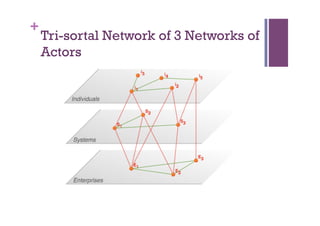
    Tri-sortal Network of 3 Networks of
    Actors
+
    Interoperation != Integration

    n    The autonomous nature of actors needs to be respected

    n    Interoperation stems from a need or wish to communicate,
          and collaborate

    n    à Motivates the need for agreements, contracts and the
          meaningful exchange of concepts
+
    The need for dual perspectives

    n    Human perspective: high level reasoning about “shared”
          concepts
          n    put humans “in the loop”
          n    natural language contexts

    n    System perspective : vocabulary agreements, lexons
          n    large volume data access
          n    low level reasoning
+
    Ontology Engineering Methods:
    Learning from Databases
    n    Technology matures: involve the less IT-gifted IT experts

    n    Natural language discourse analysis (NIAM, ORM) as used for
          databases

    n    Use legacy data / output reports / interviews, abstraction
          into fact types

    n    Lift data models into ontologies, remove application-specific
          context
+
    Developing Ontology-Grounded
    Methods and Applications
    n    Communities of users / domain experts own the ontology.
          Make use of discourse, social process and “legacy” resources

    n    Ontologies as approximations of perceived reality at type
          level! As ontologies evolve, they approximate the real world

    n    Users / domain experts rule at every step

    n    Facts holding in a certain context (the community, see later)
+
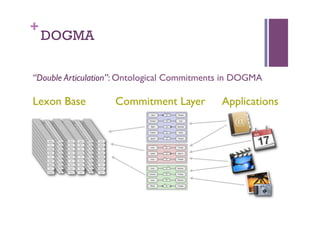
    DOGMA

“Double Articulation”: Ontological Commitments in DOGMA	


Lexon Base	

       Commitment Layer	

        Applications
+
    Commitments in DOGMA

    n    Commitment = < Selection, Encoding, Constraints >
          n    Where Selection = set of lexons with various Context-ids
          n    Encoding = reference mapping: Application symbols to lexon
                terms
          n    Constraints = set of Ω-RIDL* statements (expressed in lexon
                terms)
+
    Towards Hybrid Ontology
    Engineering
    n    Revisit discourse analysis, pragmatics, semiotics

    n    Model communities as 1st class citizens

    n    Formalize methodologies based on NL involvement of
          domain experts à Revisit discourse analysis, pragmatics,
          semiotics

    n    Upgrading role of legacy systems in enterprises

    n    Scalable semantic re-exploitation of RDF and LOD resources
+
    Grounding Ontologies with Social
    Processes and Natural Language
    n    Hybrid Ontology Description (HOD) HΩ=<Ω,G>
          n    Ω is a DOGMA Ontology Description (Lexon base, commitments
                and a mapping from terms to concepts)
          n    The contexts in hybrid ontology descriptions communities
          n    G is a glossary, a triple with components
          n    Gloss, a set of linguistic, human-interpretable glosses. Mappings
                from community-term
                pairs or lexons to glosses
+
    Method
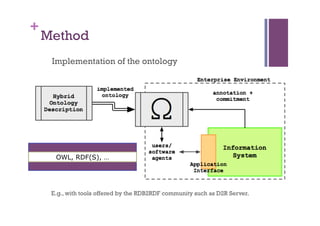
        Implementation of the ontology


         OWL, RDF(S), …


        E.g., with tools offered by the RDB2RDF community such as D2R Server.
Semantic Interoperation of IS through
Formalized Social Processes
03/21/12          15
+
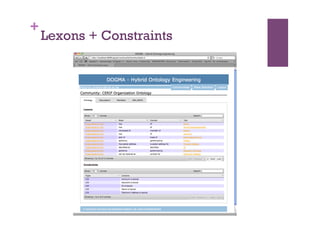
    Lexons + Constraints
+
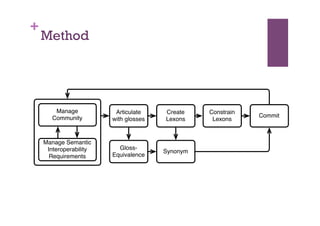
    Method


        Manage           Articulate    Create    Constrain
       Community                                             Commit
                        with glosses   Lexons     Lexons


    Manage Semantic
     Interoperability     Gloss-
                                       Synonym
      Requirements      Equivalence
+
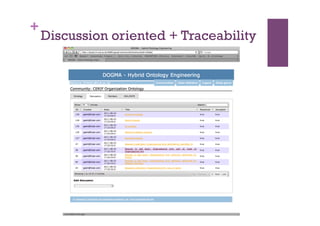
    Discussion oriented + Traceability
+
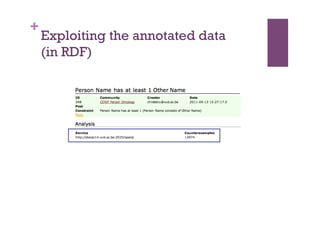
    Exploiting the annotated data
    (in RDF)
+
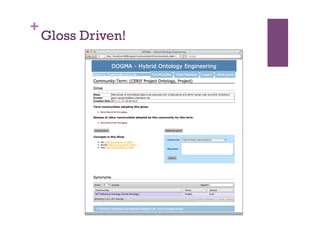
    Gloss Driven!
+
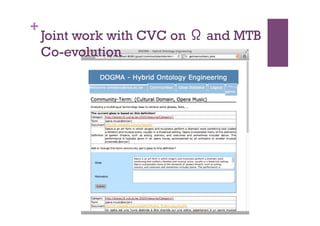
    Joint work with CVC on Ω and MTB
    Co-evolution
+
    Exploiting RDF thanks to Hybrid
    Ontology Implementations
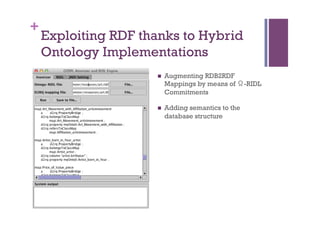
                     n    Augmenting RDB2RDF
                           Mappings by means of Ω-RIDL
                           Commitments

                     n    Adding semantics to the
                           database structure
+
    Exploiting RDF thanks to Hybrid
    Ontology Implementations
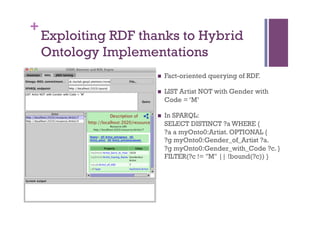
                     n    Fact-oriented querying of RDF.

                     n    LIST Artist NOT with Gender with
                           Code = ‘M’

                     n    In SPARQL:
                           SELECT DISTINCT ?a WHERE {
                           ?a a myOnto0:Artist. OPTIONAL {
                           ?g myOnto0:Gender_of_Artist ?a.
                           ?g myOnto0:Gender_with_Code ?c. }
                           FILTER(?c != "M" || !bound(?c)) }

2012 04-26-ifip-wg.pptx

  • 1.
    + Grounding Ontologies with Social Processes and Natural Language 2012-04-26 IFIP WG 12.7 Workshop #2
  • 2.
    + Definition of Ontology in Computer Science n  A conceptualization is a mathematical construct that contains abstract references to (1) objects, (2) relations, (3) functions, and (4) events as may be observed in a given real world. n  An ontology is a shared, [first order] logical, computer- stored, specification of such an agreed explicit conceptualization. n  [Tarski 1908, Gruber 1993, Studer 2000, et al.].
  • 3.
    + Definition of Ontologies in Computer Science n  In summary: Semantics = Agreed Meaning n  Links symbols in autonomously developed systems to shared reality n  Agreed among humans as cognitive agents n  Stored in ontologies n  key technology for interoperability n  ontologies ≠ data models, but provide annotation for them n  support both human- and system-based reasoning
  • 4.
    + Tri-sortal Network of 3 Networks of Actors
  • 5.
    + Interoperation != Integration n  The autonomous nature of actors needs to be respected n  Interoperation stems from a need or wish to communicate, and collaborate n  à Motivates the need for agreements, contracts and the meaningful exchange of concepts
  • 6.
    + The need for dual perspectives n  Human perspective: high level reasoning about “shared” concepts n  put humans “in the loop” n  natural language contexts n  System perspective : vocabulary agreements, lexons n  large volume data access n  low level reasoning
  • 7.
    + Ontology Engineering Methods: Learning from Databases n  Technology matures: involve the less IT-gifted IT experts n  Natural language discourse analysis (NIAM, ORM) as used for databases n  Use legacy data / output reports / interviews, abstraction into fact types n  Lift data models into ontologies, remove application-specific context
  • 8.
    + Developing Ontology-Grounded Methods and Applications n  Communities of users / domain experts own the ontology. Make use of discourse, social process and “legacy” resources n  Ontologies as approximations of perceived reality at type level! As ontologies evolve, they approximate the real world n  Users / domain experts rule at every step n  Facts holding in a certain context (the community, see later)
  • 9.
    + DOGMA “Double Articulation”: Ontological Commitments in DOGMA Lexon Base Commitment Layer Applications
  • 10.
    + Commitments in DOGMA n  Commitment = < Selection, Encoding, Constraints > n  Where Selection = set of lexons with various Context-ids n  Encoding = reference mapping: Application symbols to lexon terms n  Constraints = set of Ω-RIDL* statements (expressed in lexon terms)
  • 11.
    + Towards Hybrid Ontology Engineering n  Revisit discourse analysis, pragmatics, semiotics n  Model communities as 1st class citizens n  Formalize methodologies based on NL involvement of domain experts à Revisit discourse analysis, pragmatics, semiotics n  Upgrading role of legacy systems in enterprises n  Scalable semantic re-exploitation of RDF and LOD resources
  • 12.
    + Grounding Ontologies with Social Processes and Natural Language n  Hybrid Ontology Description (HOD) HΩ=<Ω,G> n  Ω is a DOGMA Ontology Description (Lexon base, commitments and a mapping from terms to concepts) n  The contexts in hybrid ontology descriptions communities n  G is a glossary, a triple with components n  Gloss, a set of linguistic, human-interpretable glosses. Mappings from community-term pairs or lexons to glosses
  • 13.
    + Method  Implementation of the ontology OWL, RDF(S), …  E.g., with tools offered by the RDB2RDF community such as D2R Server. Semantic Interoperation of IS through Formalized Social Processes 03/21/12 15
  • 14.
    + Lexons + Constraints
  • 15.
    + Method Manage Articulate Create Constrain Community Commit with glosses Lexons Lexons Manage Semantic Interoperability Gloss- Synonym Requirements Equivalence
  • 16.
    + Discussion oriented + Traceability
  • 17.
    + Exploiting the annotated data (in RDF)
  • 18.
    + Gloss Driven!
  • 19.
    + Joint work with CVC on Ω and MTB Co-evolution
  • 20.
    + Exploiting RDF thanks to Hybrid Ontology Implementations n  Augmenting RDB2RDF Mappings by means of Ω-RIDL Commitments n  Adding semantics to the database structure
  • 21.
    + Exploiting RDF thanks to Hybrid Ontology Implementations n  Fact-oriented querying of RDF. n  LIST Artist NOT with Gender with Code = ‘M’ n  In SPARQL: SELECT DISTINCT ?a WHERE { ?a a myOnto0:Artist. OPTIONAL { ?g myOnto0:Gender_of_Artist ?a. ?g myOnto0:Gender_with_Code ?c. } FILTER(?c != "M" || !bound(?c)) }