SHACL by example
RDF Validation tutorial
Eric Prud'hommeaux
World Wide Web Consortium
MIT, Cambridge, MA, USA
Harold Solbrig
Mayo Clinic, USA
Jose Emilio Labra Gayo
WESO Research group
University of Oviedo, Spain
Iovka Boneva
LINKS, INRIA & CNRS
University of Lille, France
SHACL
W3c Data Shapes WG deliverable
https://www.w3.org/TR/shacl/
Inspired by SPIN, OSLC & bits of ShEx
SPARQL based extension mechanism
RDF vocabulary
Human friendly syntax inspired by ShEx proposed as a WG Note *
* https://w3c.github.io/data-shapes/shacl-compact-syntax/
Some definitions about SHACL
Shape: collection of targets and constraints components
Targets: specify which nodes in the data graph must conform to a shape
Constraint components: Determine how to validate a node
Shapes graph: an RDF graph that contains shapes
Data graph: an RDF graph that contains data to be validated
Example
Try it. RDFShape http://goo.gl/FqXQpD
prefix : <http://example.org/>
prefix sh: <http://www.w3.org/ns/shacl#>
prefix xsd: <http://www.w3.org/2001/XMLSchema#>
prefix schema: <http://schema.org/>
:UserShape a sh:NodeShape ;
sh:targetNode :alice, :bob, :carol ;
sh:property [
sh:path schema:name ;
sh:minCount 1;
sh:maxCount 1;
sh:datatype xsd:string ;
] ;
sh:property [
sh:path schema:email ;
sh:minCount 1;
sh:maxCount 1;
sh:nodeKind sh:IRI ;
] .
:alice schema:name "Alice Cooper" ;
schema:email <mailto:alice@mail.org> .
:bob schema:firstName "Bob" ;
schema:email <mailto:bob@mail.org> .
:carol schema:name "Carol" ;
schema:email "carol@mail.org" .
Shapes graph
Data graph


Target declarations
Targets specify nodes that must be validated against the shape
Several types
Value Description
targetNode Directly point to a node
targetClass All nodes that have a given type
targetProperty All nodes that have a given property
target General mechanism based on SPARQL
Target node
Directly declare which nodes must validate the against the shape
:UserShape a sh:NodeShape ;
sh:targetNode :alice, :bob, :carol ;
sh:property [
sh:path schema:name ;
sh:minCount 1;
sh:maxCount 1;
sh:datatype xsd:string ;
] ;
sh:property [
sh:path schema:email ;
sh:minCount 1;
sh:maxCount 1;
sh:nodeKind sh:IRI ;
] .
:alice schema:name "Alice Cooper" ;
schema:email <mailto:alice@mail.org> .
:bob schema:givenName "Bob" ;
schema:email <mailto:bob@mail.org> .
:carol schema:name "Carol" ;
schema:email "carol@mail.org" .
Target class
Selects all nodes that have a given type
Looks for rdf:type declarations*
* Also looks for rdfs:subClassOf*/rdf:type declarations
:UserShape a sh:NodeShape ;
sh:targetClass :User ;
sh:property [
sh:path schema:name ;
sh:minCount 1;
sh:maxCount 1;
sh:datatype xsd:string ;
] ;
sh:property [
sh:path schema:email ;
sh:minCount 1;
sh:maxCount 1;
sh:nodeKind sh:IRI ;
] .
:alice a :User;
schema:name "Alice Cooper" ;
schema:email <mailto:alice@mail.org> .
:bob a :User;
schema:givenName "Bob" ;
schema:email <mailto:bob@mail.org> .
:carol a :User;
schema:name "Carol" ;
schema:email "carol@mail.org" .
Implicit target class
A shape with type sh:Shape and rdfs:Class is a scope class of itself
The targetClass declaration is implicit
:User a sh:NodeShape, rdfs:Class ;
sh:property [
sh:path schema:name ;
sh:minCount 1;
sh:maxCount 1;
sh:datatype xsd:string ;
] ;
sh:property [
sh:path schema:email ;
sh:minCount 1;
sh:maxCount 1;
sh:nodeKind sh:IRI ;
] .
:alice a :User;
schema:name "Alice Cooper" ;
schema:email <mailto:alice@mail.org> .
:bob a :User;
schema:givenName "Bob" ;
schema:email <mailto:bob@mail.org> .
:carol a :User;
schema:name "Carol" ;
schema:email "carol@mail.org" .
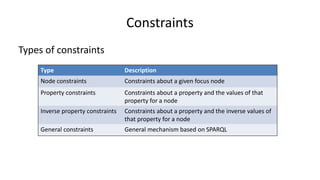
Types of shapes
Type Description
Node shapes Constraints about a given focus node
Property shapes Constraints about a property and the values of a path
for a node
Shape
target declarations
NodeShape PropertyShape
constraint components
sh:path: rdfs:Resource
:alice a :User .
<http://example.org/bob> a :User .
_:1 a :User .
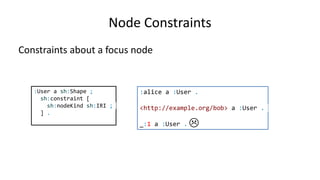
Node Shapes
Constraints about a focus node

:User a sh:NodeShape ;
sh:nodeKind sh:IRI .
Property shapes
Constraints about a given property and its values for the focus node
sh:property associates a shape with a property constraint
sh:path identifies the path
:User a sh:NodeShape ;
sh:property [
sh:path schema:email ;
sh:nodeKind sh:IRI
] .
:alice a :User ;
schema:email <mailto:alice@mail.org> .
:bob a :User;
schema:email <mailto:bob@mail.org> .
:carol a :User;
schema:email "carol@mail.org" .


Paths in property shapes
Example with inverse path
inversePath, zeroOrMorePath, alternativePath,
oneOrMorePath, ...
:User a sh:NodeShape, rdfs:Class ;
sh:property [
sh:path [sh:inversePath schema:follows ];
sh:nodeKind sh:IRI ;
] .
:alice a :User;
schema:follows :bob .
:bob a :User .
:carol a :User;
schema:follows :alice .
_:1 schema:follows :bob .

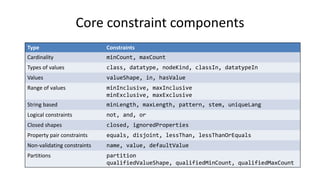
Core constraint components
Type Constraints
Cardinality minCount, maxCount
Types of values class, datatype, nodeKind
Values node, in, hasValue
Range of values minInclusive, maxInclusive
minExclusive, maxExclusive
String based minLength, maxLength, pattern, stem, uniqueLang
Logical constraints not, and, or, xone
Closed shapes closed, ignoredProperties
Property pair constraints equals, disjoint, lessThan, lessThanOrEquals
Non-validating constraints name, value, defaultValue
Qualified shapes qualifiedValueShape, qualifiedMinCount, qualifiedMaxCount
Cardinality constraints
Constraint Description
minCount Restricts minimum number of triples involving the focus
node and a given predicate.
Default value: 0
maxCount Restricts maximum number of triples involving the focus
node and a given predicate.
If not defined = unbounded
Try it. http://goo.gl/9AwtFK
:User a sh:NodeShape ;
sh:property [
sh:path schema:follows ;
sh:minCount 2 ;
sh:maxCount 3 ;
] .
:alice schema:follows :bob,
:carol .
:bob schema:follows :alice .
:carol schema:follows :alice,
:bob,
:carol,
:dave .


Datatypes of values
Constraint Description
datatype Restrict the datatype of all value nodes to a given value
:User a sh:NodeShape ;
sh:property [
sh:path schema:birthDate ;
sh:datatype xsd:date ;
] .
Try it: http://goo.gl/eDwxsU
:alice schema:birthDate "1985-08-20"^^xsd:date .
:bob schema:birthDate "Unknown"^^xsd:date .
:carol schema:birthDate 1990 .


Class of values
Constraint Description
class Verify that each node in an instance of some class
It also allows instances of subclasses*
(*) The notion of SHACL instance is different from RDFS
It is defined as rdfs:subClassOf*/rdf:type
:User a sh:NodeShape, rdfs:Class ;
sh:property [
sh:path schema:follows ;
sh:class :User
] .
:Manager rdfs:subClassOf :User .
:alice a :User;
schema:follows :bob .
:bob a :Manager ;
schema:follows :alice .
:carol a :User;
schema:follows :alice, :dave .
:dave a :Employee .

Kind of values
Constraint Description
nodeKind Possible values:
BlankNode, IRI, Literal,
BlankNodeOrIRI, BlankNodeOrLiteral, IRIOrLiteral
:User a sh:NodeShape, rdfs:Class ;
sh:property [
sh:path schema:name ;
sh:nodeKind sh:Literal ;
];
sh:property [
sh:path schema:follows ;
sh:nodeKind sh:BlankNodeOrIRI
];
sh:nodeKind sh:IRI .
:alice a :User;
schema:name _:1 ;
schema:follows :bob .
:bob a :User;
schema:name "Robert";
schema:follows [ schema:name "Dave" ] .
:carol a :User;
schema:name "Carol" ;
schema:follows "Dave" .
_:1 a :User . 


Constraints on values
Constraint Description
hasValue Verifies that the focus node has a given value
in Enumerates the value nodes that a property may have
:User a sh:NodeShape, rdfs:Class ;
sh:property [
sh:path schema:affiliation ;
sh:hasValue :OurCompany ;
];
sh:property [
sh:path schema:gender ;
sh:in (schema:Male schema:Female)
] .
:alice a :User;
schema:affiliation :OurCompany ;
schema:gender schema:Female .
:bob a :User;
schema:affiliation :AnotherCompany ;
schema:gender schema:Male .
:carol a :User;
schema:affiliation :OurCompany ;
schema:gender schema:Unknown . 

Constraints on values with another shape
Constraint Description
node* All values of a given property must have a given shape
Recursion is not allowed in current SHACL
:User a sh:NodeShape, rdfs:Class ;
sh:property [
sh:path schema:worksFor ;
sh:node :Company ;
] .
:Company a sh:Shape ;
sh:property [
sh:path schema:name ;
sh:datatype xsd:string ;
] .
:alice a :User;
schema:worksFor :OurCompany .
:bob a :User;
schema:worksFor :Another .
:OurCompany
schema:name "OurCompany" .
:Another
schema:name 23 .

*recently renamed as sh:shape
Value shapes and recursion
Could we define cyclic data models as the following?
:User a sh:NodeShape ;
sh:property [
sh:path schema:worksFor ;
sh:node :Company ;
] .
:Company a sh:Shape ;
sh:property [
sh:path schema:name ;
sh:datatype xsd:string ;
] ;
sh:property [
sh:path schema:employee ;
sh:node :User ;
] .
:User :Company
schema:name xsd:string
schema:worksFor
schema:employee
No, current SHACL specification doesn't allow this
:alice schema:worksFor :OneCompany .
:bob schema:worksFor :OneCompany .
:carol schema:worksFor :OneCompany .
:OneCompany schema:name "One" ;
schema:employee :alice, :bob, :carol .
Don't try it 
SHACL approach to avoid recursion
Add rdf:type arcs for every resource and use sh:class
:User a sh:NodeShape ;
sh:property [
sh:path schema:worksFor ;
sh:class :Company ;
] .
:Company a sh:Shape ;
sh:property [
sh:path schema:name ;
sh:datatype xsd:string ;
] ;
sh:property [
sh:path schema:employee ;
sh:class :User ;
] .
:User :Company
schema:name xsd:string
schema:worksFor
schema:employee
Try it: http://goo.gl/wlVZJR
:alice a :User ;
schema:worksFor :OneCompany .
:bob a :User ;
schema:worksFor :OneCompany .
:carol a :User ;
schema:worksFor :Something .
:OneCompany a :Company ;
schema:name "One" ;
schema:employee :alice, :bob, :carol .

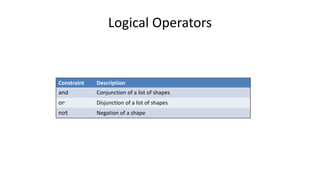
Logical Operators
Constraint Description
and Conjunction of a list of shapes
or Disjunction of a list of shapes
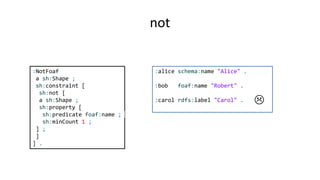
not Negation of a shape
xone Exactly one (similar XOR for 2 arguments)
and
Default behavior
:User a sh:NodeShape ;
sh:and (
[ sh:property [
sh:path schema:name;
sh:minCount 1;
]
]
[ sh:property [
sh:path schema:affiliation;
sh:minCount 1;
]
]
) .
:User a sh:Shape ;
[ sh:property [
sh:path schema:name;
sh:minCount 1;
]
]
[ sh:property [
sh:path schema:affiliation;
sh:minCount 1;
]
]
.
≡
or
:User a sh:NodeShape ;
sh:or (
[ sh:property [
sh:predicate foaf:name;
sh:minCount 1;
]
]
[ sh:property [
sh:predicate schema:name;
sh:minCount 1;
]
]
) .
:alice schema:name "Alice" .
:bob foaf:name "Robert" .
:carol rdfs:label "Carol" . 
not
:NotFoaf a sh:NodeShape ;
sh:not [ a sh:Shape ;
sh:property [
sh:predicate foaf:name ;
sh:minCount 1 ;
] ;
] .
:alice schema:name "Alice" .
:bob foaf:name "Robert" .
:carol rdfs:label "Carol" .

Exactly one
Pending example...
Value ranges
Constraint Description
minInclusive
maxInclusive
minExclusive
maxExclusive
Try it: http://goo.gl/qnd66j
:Rating a sh:NodeShape ;
sh:property [
sh:path schema:ratingValue ;
sh:minInclusive 1 ;
sh:maxInclusive 5 ;
sh:datatype xsd:integer
] .
:bad schema:ratingValue 1 .
:average schema:ratingValue 3 .
:veryGood schema:ratingValue 5 .
:zero schema:ratingValue 0 .
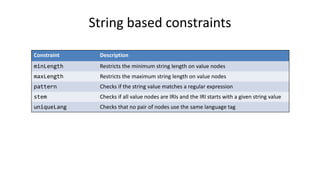
String based constraints
Constraint Description
minLength Restricts the minimum string length on value nodes
maxLength Restricts the maximum string length on value nodes
pattern Checks if the string value matches a regular expression
stem Checks if all value nodes are IRIs and the IRI starts with a given string value
uniqueLang Checks that no pair of nodes use the same language tag
minLength/maxLength
Try it: http://goo.gl/NrJl83
:User a sh:NodeShape ;
sh:property [
sh:path schema:name ;
sh:minLength 4 ;
sh:maxLength 10 ;
] .
:alice schema:name "Alice" .
:bob schema:name "Bob" .
:carol schema:name :Carol .
:strange schema:name _:strange .

Checks the string representation of the value
This cannot be applied to blank nodes
If minLength = 0, no restriction on string length

pattern
Checks if the values matches a regular expression
It can be combined with sh:flags
:Product a sh:NodeShape ;
sh:property [
sh:path schema:productID ;
sh:pattern "^Pd{3,4}" ;
sh:flags "i" ;
] .
:car schema:productID "P2345" .
:bus schema:productID "p567" .
:truck schema:productID "P12" .
:bike schema:productID "B123" . 

Try it: http://goo.gl/BsHpqu
uniqueLang
Checks that no pair of nodes use the same language tag
Try it: http://goo.gl/B1PNcO
:Country a sh:NodeShape ;
sh:property [
sh:path schema:name ;
sh:uniqueLang true
] .
:spain schema:name "Spain"@en,
"España"@es .
:france schema:name "France"@en,
"Francia"@es .
:usa schema:name "USA"@en,
"United States"@en. 
Property pair constraints
Constraint Description
equals The sets of values of both properties at a given focus node must be equal
disjoint The sets of values of both properties at a given focus node must be different
lessThan The values must be smaller than the values of another property
lessThanOrEquals The values must be smaller or equal than the values of another property
Try it: http://goo.gl/BFzMoz
:User a sh:NodeShape ;
sh:property [
sh:path schema:givenName ;
sh:equals foaf:firstName
];
sh:property [
sh:path schema:givenName ;
sh:disjoint schema:lastName
] .
:alice schema:givenName "Alice";
schema:lastName "Cooper";
foaf:firstName "Alice" .
:bob schema:givenName "Bob";
schema:lastName "Smith" ;
foaf:firstName "Robert" .
:carol schema:givenName "Carol";
schema:lastName "Carol" ;
foaf:firstName "Carol" .


Closed shapes
Constraint Description
closed Valid resources must only have values for properties that appear in sh:property
ignoredProperties Optional list of properties that are also permitted
:User a sh:NodeShape ;
sh:closed true ;
sh:ignoredProperties ( rdf:type ) ;
sh:property [
sh:path schema:givenName ;
];
sh:property [
sh:path schema:lastName ;
] .
:alice schema:givenName "Alice";
schema:lastName "Cooper" .
:bob a :Employee ;
schema:givenName "Bob";
schema:lastName "Smith" .
:carol schema:givenName "Carol";
schema:lastName "King" ;
rdfs:label "Carol" .

Try it: http://goo.gl/wcW16o
Non-validating constraints
Can be useful to annotate shapes or design UI forms
Constraint Description
name Provide human-readable labels for a property
description Provide a description of a property
order Relative order of the property
group Group several constraints together
:User a sh:NodeShape ;
sh:property [
sh:path schema:url ;
sh:name "URL";
sh:description "User URL";
sh:order 1
];
sh:property [
sh:path schema:name ;
sh:name "Name";
sh:description "User name";
sh:order 2
] .
Non-validating constraints
:User a sh:NodeShape ;
sh:property [ sh:path schema:url ;
sh:name "URL";
sh:group :userDetails
];
sh:property [ sh:path schema:name ;
sh:name "Name"; sh:group :userDetails
];
sh:property [ sh:path schema:address ;
sh:name "Address"; sh:group :location
];
sh:property [ sh:path schema:country ;
sh:name "Country"; sh:group :location
] .
:userDetails a sh:PropertyGroup ;
sh:order 0 ;
rdfs:label "User details" .
:location a sh:PropertyGroup ;
sh:order 1 ;
rdfs:label "Location" .
User details
URL: _____________________
Name: ___________________
Location
Address: __________________
Country: __________________
An agent could generate a form like:
Partitions and qualified values
Problem with repeated properties
Example: Books have two IDs (an isbn and an internal code)
:Book a sh:Shape ;
sh:property [
sh:predicate schema:productID ;
sh:minCount 1;
sh:datatype xsd:string ;
sh:pattern "^isbn"
];
sh:property [
sh:predicate schema:productID ;
sh:minCount 1;
sh:datatype xsd:string ;
sh:pattern "^code"
] .
:b1 schema:productID "isbn:123-456-789" ;
schema:productID "code234" .
It fails!!
Try it: http://goo.gl/x7oHpi
Partitions and qualified value shapes
Qualified value shapes verify that certain number of values of a given
property have a given shape
:Book a sh:Shape ;
sh:property [
sh:predicate schema:productID ;
sh:minCount 2; sh:maxCount 2; ];
sh:property [
sh:predicate schema:productID ;
sh:qualifiedMinCount 1 ;
sh:qualifiedValueShape [
sh:constraint [sh:pattern "^isbn" ]]];
sh:property [
sh:predicate schema:productID ;
sh:qualifiedMinCount 1 ;
sh:qualifiedValueShape [
sh:constraint [ sh:pattern "^code" ; ]]];
.
Try it: http://goo.gl/v6Zffe
Partitions and qualified value shapes
partition declares a partition on the set of values
:Book a sh:Shape ;
sh:property [
sh:predicate schema:productID ;
sh:partition (
[sh:minCount 1; sh:maxCount 1; sh:pattern "^isbn"]
[sh:minCount 1; sh:maxCount 1; sh:pattern "^code"]
)
] .
Don't try it
Not yet implemented
NOTE:
This feature is under development
The specification defines a Greedy algorithm and the violation errors depend on the order of the elements on the list
This can be tricky when some values overlap several elements in the partition
Filters
Filters limit the nodes that are in scope to those that satisfy the filter
Similar to: "if <filter> then ..."
Try it: http://goo.gl/vadFMk
:User a sh:Shape ;
sh:scopeClass schema:Person ;
sh:filterShape [
a sh:Shape ; # Optional triple
sh:property [
sh:predicate schema:worksFor ;
sh:hasValue :OurCompany ;
]
] ;
sh:property [
sh:predicate schema:url ;
sh:stem "http://ourcompany.org/" ;
] .
:alice a schema:Person ;
schema:worksFor :OurCompany ;
schema:url <http://ourcompany.org/alice> .
:bob a schema:Person ;
schema:worksFor :OurCompany ;
schema:url <http://othercompany.org/bob> .
:carol a schema:Person ;
schema:worksFor :OtherCompany ;
schema:url <http://othercompany.org/carol> .

SPARQL constraints
Constraints based on SPARQL code.
The query returns validation errors
Constraint Description
SPARQLConstraint Type of constraints that will be considered as SPARQL constraints
message Message in case of error
sparql SPARQL code to be executed
prefix Declare reusable prefix
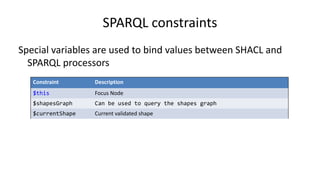
SPARQL constraints
Special variables are used to bind values between SHACL and
SPARQL processors
Constraint Description
$this Focus Node
$shapesGraph Can be used to query the shapes graph
$currentShape Current validated shape
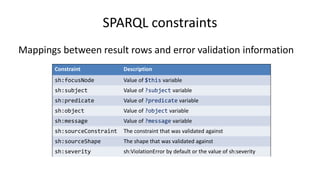
SPARQL constraints
Mappings between result rows and error validation information
Constraint Description
sh:focusNode Value of $this variable
sh:subject Value of ?subject variable
sh:predicate Value of ?predicate variable
sh:object Value of ?object variable
sh:message Value of ?message variable
sh:sourceConstraint The constraint that was validated against
sh:sourceShape The shape that was validated against
sh:severity sh:ViolationError by default or the value of sh:severity
Extension mechanism
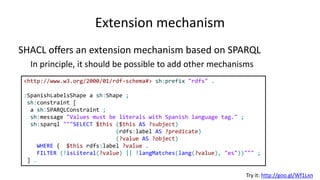
SHACL offers an extension mechanism based on SPARQL
In principle, it should be possible to add other mechanisms
<http://www.w3.org/2000/01/rdf-schema#> sh:prefix "rdfs" .
:SpanishLabelsShape a sh:Shape ;
sh:constraint [
a sh:SPARQLConstraint ;
sh:message "Values must be literals with Spanish language tag." ;
sh:sparql """SELECT $this ($this AS ?subject)
(rdfs:label AS ?predicate)
(?value AS ?object)
WHERE { $this rdfs:label ?value .
FILTER (!isLiteral(?value) || !langMatches(lang(?value), "es"))""" ;
] .
Try it: http://goo.gl/Wf1Lxn
Other features
Several features are currently under discussion
SPARQL scopes and SPARQL functions
Extension mechanism for other languages
Recursion
User-friendly syntax

SHACL by example

  • 1.
    SHACL by example RDFValidation tutorial Eric Prud'hommeaux World Wide Web Consortium MIT, Cambridge, MA, USA Harold Solbrig Mayo Clinic, USA Jose Emilio Labra Gayo WESO Research group University of Oviedo, Spain Iovka Boneva LINKS, INRIA & CNRS University of Lille, France
  • 2.
    SHACL W3c Data ShapesWG deliverable https://www.w3.org/TR/shacl/ Inspired by SPIN, OSLC & bits of ShEx SPARQL based extension mechanism RDF vocabulary Human friendly syntax inspired by ShEx proposed as a WG Note * * https://w3c.github.io/data-shapes/shacl-compact-syntax/
  • 3.
    Some definitions aboutSHACL Shape: collection of targets and constraints components Targets: specify which nodes in the data graph must conform to a shape Constraint components: Determine how to validate a node Shapes graph: an RDF graph that contains shapes Data graph: an RDF graph that contains data to be validated
  • 4.
    Example Try it. RDFShapehttp://goo.gl/FqXQpD prefix : <http://example.org/> prefix sh: <http://www.w3.org/ns/shacl#> prefix xsd: <http://www.w3.org/2001/XMLSchema#> prefix schema: <http://schema.org/> :UserShape a sh:NodeShape ; sh:targetNode :alice, :bob, :carol ; sh:property [ sh:path schema:name ; sh:minCount 1; sh:maxCount 1; sh:datatype xsd:string ; ] ; sh:property [ sh:path schema:email ; sh:minCount 1; sh:maxCount 1; sh:nodeKind sh:IRI ; ] . :alice schema:name "Alice Cooper" ; schema:email <mailto:alice@mail.org> . :bob schema:firstName "Bob" ; schema:email <mailto:bob@mail.org> . :carol schema:name "Carol" ; schema:email "carol@mail.org" . Shapes graph Data graph  
  • 5.
    Target declarations Targets specifynodes that must be validated against the shape Several types Value Description targetNode Directly point to a node targetClass All nodes that have a given type targetProperty All nodes that have a given property target General mechanism based on SPARQL
  • 6.
    Target node Directly declarewhich nodes must validate the against the shape :UserShape a sh:NodeShape ; sh:targetNode :alice, :bob, :carol ; sh:property [ sh:path schema:name ; sh:minCount 1; sh:maxCount 1; sh:datatype xsd:string ; ] ; sh:property [ sh:path schema:email ; sh:minCount 1; sh:maxCount 1; sh:nodeKind sh:IRI ; ] . :alice schema:name "Alice Cooper" ; schema:email <mailto:alice@mail.org> . :bob schema:givenName "Bob" ; schema:email <mailto:bob@mail.org> . :carol schema:name "Carol" ; schema:email "carol@mail.org" .
  • 7.
    Target class Selects allnodes that have a given type Looks for rdf:type declarations* * Also looks for rdfs:subClassOf*/rdf:type declarations :UserShape a sh:NodeShape ; sh:targetClass :User ; sh:property [ sh:path schema:name ; sh:minCount 1; sh:maxCount 1; sh:datatype xsd:string ; ] ; sh:property [ sh:path schema:email ; sh:minCount 1; sh:maxCount 1; sh:nodeKind sh:IRI ; ] . :alice a :User; schema:name "Alice Cooper" ; schema:email <mailto:alice@mail.org> . :bob a :User; schema:givenName "Bob" ; schema:email <mailto:bob@mail.org> . :carol a :User; schema:name "Carol" ; schema:email "carol@mail.org" .
  • 8.
    Implicit target class Ashape with type sh:Shape and rdfs:Class is a scope class of itself The targetClass declaration is implicit :User a sh:NodeShape, rdfs:Class ; sh:property [ sh:path schema:name ; sh:minCount 1; sh:maxCount 1; sh:datatype xsd:string ; ] ; sh:property [ sh:path schema:email ; sh:minCount 1; sh:maxCount 1; sh:nodeKind sh:IRI ; ] . :alice a :User; schema:name "Alice Cooper" ; schema:email <mailto:alice@mail.org> . :bob a :User; schema:givenName "Bob" ; schema:email <mailto:bob@mail.org> . :carol a :User; schema:name "Carol" ; schema:email "carol@mail.org" .
  • 9.
    Types of shapes TypeDescription Node shapes Constraints about a given focus node Property shapes Constraints about a property and the values of a path for a node Shape target declarations NodeShape PropertyShape constraint components constraint components sh:path: rdfs:Resource
  • 10.
    :alice a :User. <http://example.org/bob> a :User . _:1 a :User . Node Shapes Constraints about a focus node  :User a sh:NodeShape ; sh:nodeKind sh:IRI .
  • 11.
    Property shapes Constraints abouta given property and its values for the focus node sh:property associates a shape with a property constraint sh:path identifies the path :User a sh:NodeShape ; sh:property [ sh:path schema:email ; sh:nodeKind sh:IRI ] . :alice a :User ; schema:email <mailto:alice@mail.org> . :bob a :User; schema:email <mailto:bob@mail.org> . :carol a :User; schema:email "carol@mail.org" .  
  • 12.
    Paths in propertyshapes Example with inverse path inversePath, zeroOrMorePath, alternativePath, oneOrMorePath, ... :User a sh:NodeShape, rdfs:Class ; sh:property [ sh:path [sh:inversePath schema:follows ]; sh:nodeKind sh:IRI ; ] . :alice a :User; schema:follows :bob . :bob a :User . :carol a :User; schema:follows :alice . _:1 schema:follows :bob . 
  • 13.
    Core constraint components TypeConstraints Cardinality minCount, maxCount Types of values class, datatype, nodeKind Values node, in, hasValue Range of values minInclusive, maxInclusive minExclusive, maxExclusive String based minLength, maxLength, pattern, stem, uniqueLang Logical constraints not, and, or, xone Closed shapes closed, ignoredProperties Property pair constraints equals, disjoint, lessThan, lessThanOrEquals Non-validating constraints name, value, defaultValue Qualified shapes qualifiedValueShape, qualifiedMinCount, qualifiedMaxCount
  • 14.
    Cardinality constraints Constraint Description minCountRestricts minimum number of triples involving the focus node and a given predicate. Default value: 0 maxCount Restricts maximum number of triples involving the focus node and a given predicate. If not defined = unbounded Try it. http://goo.gl/9AwtFK :User a sh:NodeShape ; sh:property [ sh:path schema:follows ; sh:minCount 2 ; sh:maxCount 3 ; ] . :alice schema:follows :bob, :carol . :bob schema:follows :alice . :carol schema:follows :alice, :bob, :carol, :dave .  
  • 15.
    Datatypes of values ConstraintDescription datatype Restrict the datatype of all value nodes to a given value :User a sh:NodeShape ; sh:property [ sh:path schema:birthDate ; sh:datatype xsd:date ; ] . Try it: http://goo.gl/eDwxsU :alice schema:birthDate "1985-08-20"^^xsd:date . :bob schema:birthDate "Unknown"^^xsd:date . :carol schema:birthDate 1990 .  
  • 16.
    Class of values ConstraintDescription class Verify that each node in an instance of some class It also allows instances of subclasses* (*) The notion of SHACL instance is different from RDFS It is defined as rdfs:subClassOf*/rdf:type :User a sh:NodeShape, rdfs:Class ; sh:property [ sh:path schema:follows ; sh:class :User ] . :Manager rdfs:subClassOf :User . :alice a :User; schema:follows :bob . :bob a :Manager ; schema:follows :alice . :carol a :User; schema:follows :alice, :dave . :dave a :Employee . 
  • 17.
    Kind of values ConstraintDescription nodeKind Possible values: BlankNode, IRI, Literal, BlankNodeOrIRI, BlankNodeOrLiteral, IRIOrLiteral :User a sh:NodeShape, rdfs:Class ; sh:property [ sh:path schema:name ; sh:nodeKind sh:Literal ; ]; sh:property [ sh:path schema:follows ; sh:nodeKind sh:BlankNodeOrIRI ]; sh:nodeKind sh:IRI . :alice a :User; schema:name _:1 ; schema:follows :bob . :bob a :User; schema:name "Robert"; schema:follows [ schema:name "Dave" ] . :carol a :User; schema:name "Carol" ; schema:follows "Dave" . _:1 a :User .   
  • 18.
    Constraints on values ConstraintDescription hasValue Verifies that the focus node has a given value in Enumerates the value nodes that a property may have :User a sh:NodeShape, rdfs:Class ; sh:property [ sh:path schema:affiliation ; sh:hasValue :OurCompany ; ]; sh:property [ sh:path schema:gender ; sh:in (schema:Male schema:Female) ] . :alice a :User; schema:affiliation :OurCompany ; schema:gender schema:Female . :bob a :User; schema:affiliation :AnotherCompany ; schema:gender schema:Male . :carol a :User; schema:affiliation :OurCompany ; schema:gender schema:Unknown .  
  • 19.
    Constraints on valueswith another shape Constraint Description node* All values of a given property must have a given shape Recursion is not allowed in current SHACL :User a sh:NodeShape, rdfs:Class ; sh:property [ sh:path schema:worksFor ; sh:node :Company ; ] . :Company a sh:Shape ; sh:property [ sh:path schema:name ; sh:datatype xsd:string ; ] . :alice a :User; schema:worksFor :OurCompany . :bob a :User; schema:worksFor :Another . :OurCompany schema:name "OurCompany" . :Another schema:name 23 .  *recently renamed as sh:shape
  • 20.
    Value shapes andrecursion Could we define cyclic data models as the following? :User a sh:NodeShape ; sh:property [ sh:path schema:worksFor ; sh:node :Company ; ] . :Company a sh:Shape ; sh:property [ sh:path schema:name ; sh:datatype xsd:string ; ] ; sh:property [ sh:path schema:employee ; sh:node :User ; ] . :User :Company schema:name xsd:string schema:worksFor schema:employee No, current SHACL specification doesn't allow this :alice schema:worksFor :OneCompany . :bob schema:worksFor :OneCompany . :carol schema:worksFor :OneCompany . :OneCompany schema:name "One" ; schema:employee :alice, :bob, :carol . Don't try it 
  • 21.
    SHACL approach toavoid recursion Add rdf:type arcs for every resource and use sh:class :User a sh:NodeShape ; sh:property [ sh:path schema:worksFor ; sh:class :Company ; ] . :Company a sh:Shape ; sh:property [ sh:path schema:name ; sh:datatype xsd:string ; ] ; sh:property [ sh:path schema:employee ; sh:class :User ; ] . :User :Company schema:name xsd:string schema:worksFor schema:employee Try it: http://goo.gl/wlVZJR :alice a :User ; schema:worksFor :OneCompany . :bob a :User ; schema:worksFor :OneCompany . :carol a :User ; schema:worksFor :Something . :OneCompany a :Company ; schema:name "One" ; schema:employee :alice, :bob, :carol . 
  • 22.
    Logical Operators Constraint Description andConjunction of a list of shapes or Disjunction of a list of shapes not Negation of a shape xone Exactly one (similar XOR for 2 arguments)
  • 23.
    and Default behavior :User ash:NodeShape ; sh:and ( [ sh:property [ sh:path schema:name; sh:minCount 1; ] ] [ sh:property [ sh:path schema:affiliation; sh:minCount 1; ] ] ) . :User a sh:Shape ; [ sh:property [ sh:path schema:name; sh:minCount 1; ] ] [ sh:property [ sh:path schema:affiliation; sh:minCount 1; ] ] . ≡
  • 24.
    or :User a sh:NodeShape; sh:or ( [ sh:property [ sh:predicate foaf:name; sh:minCount 1; ] ] [ sh:property [ sh:predicate schema:name; sh:minCount 1; ] ] ) . :alice schema:name "Alice" . :bob foaf:name "Robert" . :carol rdfs:label "Carol" . 
  • 25.
    not :NotFoaf a sh:NodeShape; sh:not [ a sh:Shape ; sh:property [ sh:predicate foaf:name ; sh:minCount 1 ; ] ; ] . :alice schema:name "Alice" . :bob foaf:name "Robert" . :carol rdfs:label "Carol" . 
  • 26.
  • 27.
    Value ranges Constraint Description minInclusive maxInclusive minExclusive maxExclusive Tryit: http://goo.gl/qnd66j :Rating a sh:NodeShape ; sh:property [ sh:path schema:ratingValue ; sh:minInclusive 1 ; sh:maxInclusive 5 ; sh:datatype xsd:integer ] . :bad schema:ratingValue 1 . :average schema:ratingValue 3 . :veryGood schema:ratingValue 5 . :zero schema:ratingValue 0 .
  • 28.
    String based constraints ConstraintDescription minLength Restricts the minimum string length on value nodes maxLength Restricts the maximum string length on value nodes pattern Checks if the string value matches a regular expression stem Checks if all value nodes are IRIs and the IRI starts with a given string value uniqueLang Checks that no pair of nodes use the same language tag
  • 29.
    minLength/maxLength Try it: http://goo.gl/NrJl83 :Usera sh:NodeShape ; sh:property [ sh:path schema:name ; sh:minLength 4 ; sh:maxLength 10 ; ] . :alice schema:name "Alice" . :bob schema:name "Bob" . :carol schema:name :Carol . :strange schema:name _:strange .  Checks the string representation of the value This cannot be applied to blank nodes If minLength = 0, no restriction on string length 
  • 30.
    pattern Checks if thevalues matches a regular expression It can be combined with sh:flags :Product a sh:NodeShape ; sh:property [ sh:path schema:productID ; sh:pattern "^Pd{3,4}" ; sh:flags "i" ; ] . :car schema:productID "P2345" . :bus schema:productID "p567" . :truck schema:productID "P12" . :bike schema:productID "B123" .   Try it: http://goo.gl/BsHpqu
  • 31.
    uniqueLang Checks that nopair of nodes use the same language tag Try it: http://goo.gl/B1PNcO :Country a sh:NodeShape ; sh:property [ sh:path schema:name ; sh:uniqueLang true ] . :spain schema:name "Spain"@en, "España"@es . :france schema:name "France"@en, "Francia"@es . :usa schema:name "USA"@en, "United States"@en. 
  • 32.
    Property pair constraints ConstraintDescription equals The sets of values of both properties at a given focus node must be equal disjoint The sets of values of both properties at a given focus node must be different lessThan The values must be smaller than the values of another property lessThanOrEquals The values must be smaller or equal than the values of another property Try it: http://goo.gl/BFzMoz :User a sh:NodeShape ; sh:property [ sh:path schema:givenName ; sh:equals foaf:firstName ]; sh:property [ sh:path schema:givenName ; sh:disjoint schema:lastName ] . :alice schema:givenName "Alice"; schema:lastName "Cooper"; foaf:firstName "Alice" . :bob schema:givenName "Bob"; schema:lastName "Smith" ; foaf:firstName "Robert" . :carol schema:givenName "Carol"; schema:lastName "Carol" ; foaf:firstName "Carol" .  
  • 33.
    Closed shapes Constraint Description closedValid resources must only have values for properties that appear in sh:property ignoredProperties Optional list of properties that are also permitted :User a sh:NodeShape ; sh:closed true ; sh:ignoredProperties ( rdf:type ) ; sh:property [ sh:path schema:givenName ; ]; sh:property [ sh:path schema:lastName ; ] . :alice schema:givenName "Alice"; schema:lastName "Cooper" . :bob a :Employee ; schema:givenName "Bob"; schema:lastName "Smith" . :carol schema:givenName "Carol"; schema:lastName "King" ; rdfs:label "Carol" .  Try it: http://goo.gl/wcW16o
  • 34.
    Non-validating constraints Can beuseful to annotate shapes or design UI forms Constraint Description name Provide human-readable labels for a property description Provide a description of a property order Relative order of the property group Group several constraints together :User a sh:NodeShape ; sh:property [ sh:path schema:url ; sh:name "URL"; sh:description "User URL"; sh:order 1 ]; sh:property [ sh:path schema:name ; sh:name "Name"; sh:description "User name"; sh:order 2 ] .
  • 35.
    Non-validating constraints :User ash:NodeShape ; sh:property [ sh:path schema:url ; sh:name "URL"; sh:group :userDetails ]; sh:property [ sh:path schema:name ; sh:name "Name"; sh:group :userDetails ]; sh:property [ sh:path schema:address ; sh:name "Address"; sh:group :location ]; sh:property [ sh:path schema:country ; sh:name "Country"; sh:group :location ] . :userDetails a sh:PropertyGroup ; sh:order 0 ; rdfs:label "User details" . :location a sh:PropertyGroup ; sh:order 1 ; rdfs:label "Location" . User details URL: _____________________ Name: ___________________ Location Address: __________________ Country: __________________ An agent could generate a form like:
  • 36.
    Partitions and qualifiedvalues Problem with repeated properties Example: Books have two IDs (an isbn and an internal code) :Book a sh:Shape ; sh:property [ sh:predicate schema:productID ; sh:minCount 1; sh:datatype xsd:string ; sh:pattern "^isbn" ]; sh:property [ sh:predicate schema:productID ; sh:minCount 1; sh:datatype xsd:string ; sh:pattern "^code" ] . :b1 schema:productID "isbn:123-456-789" ; schema:productID "code234" . It fails!! Try it: http://goo.gl/x7oHpi
  • 37.
    Partitions and qualifiedvalue shapes Qualified value shapes verify that certain number of values of a given property have a given shape :Book a sh:Shape ; sh:property [ sh:predicate schema:productID ; sh:minCount 2; sh:maxCount 2; ]; sh:property [ sh:predicate schema:productID ; sh:qualifiedMinCount 1 ; sh:qualifiedValueShape [ sh:constraint [sh:pattern "^isbn" ]]]; sh:property [ sh:predicate schema:productID ; sh:qualifiedMinCount 1 ; sh:qualifiedValueShape [ sh:constraint [ sh:pattern "^code" ; ]]]; . Try it: http://goo.gl/v6Zffe
  • 38.
    Partitions and qualifiedvalue shapes partition declares a partition on the set of values :Book a sh:Shape ; sh:property [ sh:predicate schema:productID ; sh:partition ( [sh:minCount 1; sh:maxCount 1; sh:pattern "^isbn"] [sh:minCount 1; sh:maxCount 1; sh:pattern "^code"] ) ] . Don't try it Not yet implemented NOTE: This feature is under development The specification defines a Greedy algorithm and the violation errors depend on the order of the elements on the list This can be tricky when some values overlap several elements in the partition
  • 39.
    Filters Filters limit thenodes that are in scope to those that satisfy the filter Similar to: "if <filter> then ..." Try it: http://goo.gl/vadFMk :User a sh:Shape ; sh:scopeClass schema:Person ; sh:filterShape [ a sh:Shape ; # Optional triple sh:property [ sh:predicate schema:worksFor ; sh:hasValue :OurCompany ; ] ] ; sh:property [ sh:predicate schema:url ; sh:stem "http://ourcompany.org/" ; ] . :alice a schema:Person ; schema:worksFor :OurCompany ; schema:url <http://ourcompany.org/alice> . :bob a schema:Person ; schema:worksFor :OurCompany ; schema:url <http://othercompany.org/bob> . :carol a schema:Person ; schema:worksFor :OtherCompany ; schema:url <http://othercompany.org/carol> . 
  • 40.
    SPARQL constraints Constraints basedon SPARQL code. The query returns validation errors Constraint Description SPARQLConstraint Type of constraints that will be considered as SPARQL constraints message Message in case of error sparql SPARQL code to be executed prefix Declare reusable prefix
  • 41.
    SPARQL constraints Special variablesare used to bind values between SHACL and SPARQL processors Constraint Description $this Focus Node $shapesGraph Can be used to query the shapes graph $currentShape Current validated shape
  • 42.
    SPARQL constraints Mappings betweenresult rows and error validation information Constraint Description sh:focusNode Value of $this variable sh:subject Value of ?subject variable sh:predicate Value of ?predicate variable sh:object Value of ?object variable sh:message Value of ?message variable sh:sourceConstraint The constraint that was validated against sh:sourceShape The shape that was validated against sh:severity sh:ViolationError by default or the value of sh:severity
  • 43.
    Extension mechanism SHACL offersan extension mechanism based on SPARQL In principle, it should be possible to add other mechanisms <http://www.w3.org/2000/01/rdf-schema#> sh:prefix "rdfs" . :SpanishLabelsShape a sh:Shape ; sh:constraint [ a sh:SPARQLConstraint ; sh:message "Values must be literals with Spanish language tag." ; sh:sparql """SELECT $this ($this AS ?subject) (rdfs:label AS ?predicate) (?value AS ?object) WHERE { $this rdfs:label ?value . FILTER (!isLiteral(?value) || !langMatches(lang(?value), "es"))""" ; ] . Try it: http://goo.gl/Wf1Lxn
  • 44.
    Other features Several featuresare currently under discussion SPARQL scopes and SPARQL functions Extension mechanism for other languages Recursion User-friendly syntax