RDF Semantics
               by Patrick Hayes
             W3C Recommendation

        http://www.w3.org/TR/rdf-mt/

                 Presented by Jie Bao
                         RPI
                     Sept 4, 2008

           Part 1 of RDF/OWL Semantics Tutorial
http://tw.rpi.edu/wiki/index.php/RDF_and_OWL_Semantics
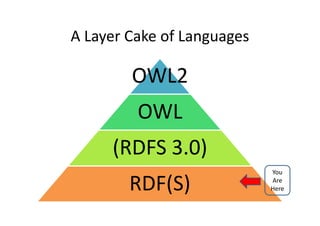
A Layer Cake of Languages

        OWL2
         OWL
     (RDFS 3.0)
                            You

        RDF(S)              Are
                            Here
Outline
•   What is Semantics?
•   RDF: Syntax
•   RDF Graph and Simple Entailment
•   RDF Interpretation
•   RDFS Interpretation
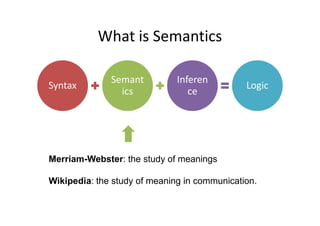
What is Semantics

              Semant          Inferen
Syntax                                        Logic
                ics              ce


Merriam-Webster: the study of meanings

Wikipedia: the study of meaning in communication.
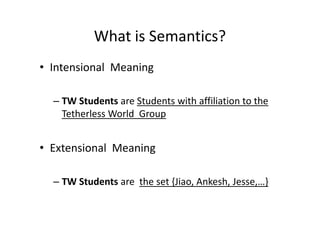
What is Semantics?
• Intensional Meaning

  – TW Students are Students with affiliation to the
    Tetherless World Group


• Extensional Meaning

  – TW Students are the set {Jiao, Ankesh, Jesse,…}
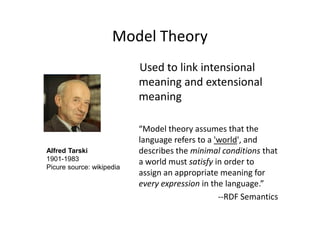
Model Theory
                           Used to link intensional
                           meaning and extensional
                           meaning

                           “Model theory assumes that the
                           language refers to a 'world', and
Alfred Tarski              describes the minimal conditions that
1901-1983                  a world must satisfy in order to
Picure source: wikipedia
                           assign an appropriate meaning for
                           every expression in the language.”
                                                 --RDF Semantics
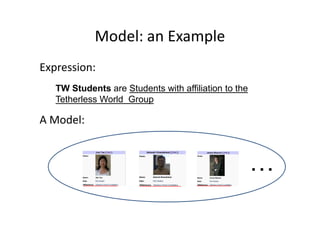
Model: an Example
Expression:
   TW Students are Students with affiliation to the
   Tetherless World Group

A Model:


                                                      …
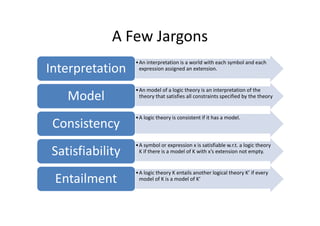
A Few Jargons
                 • An interpretation is a world with each symbol and each
Interpretation     expression assigned an extension.


                 • An model of a logic theory is an interpretation of the
   Model           theory that satisfies all constraints specified by the theory


                 • A logic theory is consistent if it has a model.
 Consistency
                 • A symbol or expression x is satisfiable w.r.t. a logic theory
Satisfiability     K if there is a model of K with x’s extension not empty.


                 • A logic theory K entails another logical theory K’ if every
 Entailment        model of K is a model of K’
Outline
•   What is Semantics?
•   RDF: Syntax
•   RDF Graph and Simple Entailment
•   RDF Interpretation
•   RDFS Interpretation
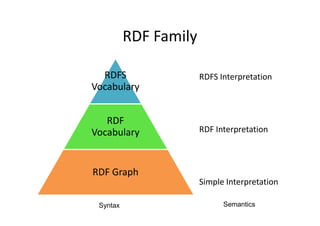
RDF Family

  RDFS                 RDFS Interpretation
Vocabulary


   RDF
Vocabulary             RDF Interpretation


RDF Graph
                       Simple Interpretation

 Syntax                      Semantics
Not Covered in the Talk
•   Blank Node (b-Node)
•   Literals (Datatypes)
•   Containers
•   Collections
•   Reification
•   Annotation
•   Entailment rules (rule inference)
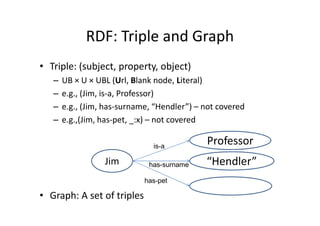
RDF: Triple and Graph
• Triple: (subject, property, object)
   –   UB × U × UBL (Url, Blank node, Literal)
   –   e.g., (Jim, is-a, Professor)
   –   e.g., (Jim, has-surname, “Hendler”) – not covered
   –   e.g.,(Jim, has-pet, _:x) – not covered

                               is-a
                                             Professor
                  Jim         has-surname    “Hendler”
                             has-pet

• Graph: A set of triples
Outline
•   What is Semantics?
•   RDF: Syntax
•   RDF Graph and Simple Entailment
•   RDF Interpretation
•   RDFS Interpretation
Simple Interpretation
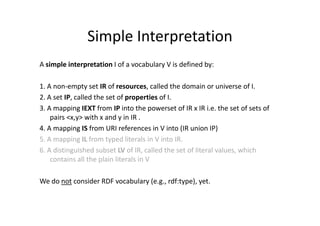
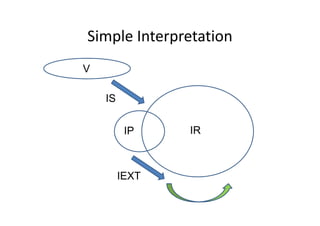
A simple interpretation I of a vocabulary V is defined by:

1. A non-empty set IR of resources, called the domain or universe of I.
2. A set IP, called the set of properties of I.
3. A mapping IEXT from IP into the powerset of IR x IR i.e. the set of sets of
    pairs <x,y> with x and y in IR .
4. A mapping IS from URI references in V into (IR union IP)
5. A mapping IL from typed literals in V into IR.
6. A distinguished subset LV of IR, called the set of literal values, which
    contains all the plain literals in V

We do not consider RDF vocabulary (e.g., rdf:type), yet.
Simple Interpretation
V

    IS


          IP    IR


         IEXT
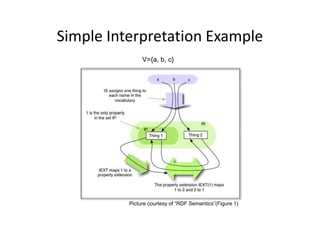
Simple Interpretation Example
               V={a, b, c}


          Picture courtesy of “RDF Semantics”(Figure 1)
Simple Semantic Conditions
• if E is a URI reference in V then I(E) = IS(E)
• if E is a ground triple s p o. then I(E) = true if s, p and o are in
  V, I(p) is in IP and <I(s),I(o)> is in IEXT(I(p)) otherwise I(E)=
  false.
• if E is a ground RDF graph then I(E) = false if I(E') = false for
  some triple E' in E, otherwise I(E) =true
• if E is a plain literal "aaa" in V then I(E) = aaa
• if E is a plain literal "aaa"@ttt in V then I(E) = <aaa, ttt>
• if E is a typed literal in V then I(E) = IL(E)
• If E is a blank node and A(E) is defined then [I+A](E) = A(E)
• If E is an RDF graph then I(E) = true if [I+A'](E) = true for some
  mapping A' from blank(E) to IR, otherwise I(E)= false
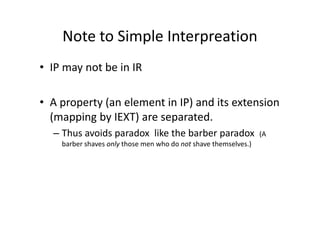
Note to Simple Interpreation
• IP may not be in IR

• A property (an element in IP) and its extension
  (mapping by IEXT) are separated.
  – Thus avoids paradox like the barber paradox                  (A
    barber shaves only those men who do not shave themselves.)
Outline
•   What is Semantics?
•   RDF: Syntax
•   RDF Graph and Simple Entailment
•   RDF Interpretation
•   RDFS Interpretation
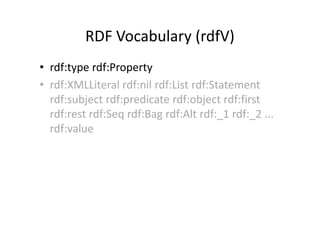
RDF Vocabulary (rdfV)
• rdf:type rdf:Property
• rdf:XMLLiteral rdf:nil rdf:List rdf:Statement
  rdf:subject rdf:predicate rdf:object rdf:first
  rdf:rest rdf:Seq rdf:Bag rdf:Alt rdf:_1 rdf:_2 ...
  rdf:value
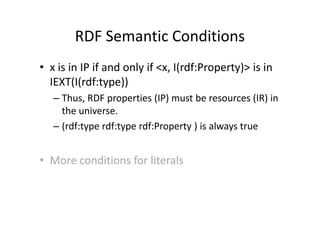
RDF Semantic Conditions
• x is in IP if and only if <x, I(rdf:Property)> is in
  IEXT(I(rdf:type))
   – Thus, RDF properties (IP) must be resources (IR) in
     the universe.
   – (rdf:type rdf:type rdf:Property ) is always true


• More conditions for literals
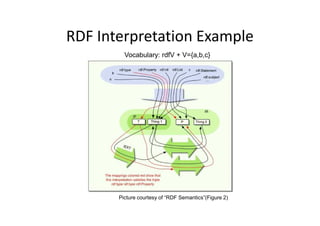
RDF Interpretation Example
         Vocabulary: rdfV + V={a,b,c}


       Picture courtesy of “RDF Semantics”(Figure 2)
Outline
•   What is Semantics?
•   RDF: Syntax
•   RDF Graph and Simple Entailment
•   RDF Interpretation
•   RDFS Interpretation
RDFS Vocabulary (rdfsV)
• rdfs:domain rdfs:range rdfs:Resource
• rdfs:Class rdfs:subClassOf rdfs:subPropertyOf
• rdfs:Literal rdfs:Datatype
• rdfs:member rdfs:Container
  rdfs:ContainerMembershipProperty
• rdfs:comment rdfs:seeAlso rdfs:isDefinedBy
  rdfs:label
RDFS Semantic Conditions
On classes
• x is in ICEXT(y) if and only if <x,y> is in IEXT(I(rdf:type))
    – IC = ICEXT(I(rdfs:Class))
    – IR = ICEXT(I(rdfs:Resource))
    – LV = ICEXT(I(rdfs:Literal))
• If x is in IC then <x, I(rdfs:Resource)> is in
  IEXT(I(rdfs:subClassOf))
• If <x,y> is in IEXT(I(rdfs:subClassOf)) then x and y are in IC and
  ICEXT(x) is a subset of ICEXT(y)
• IEXT(I(rdfs:subClassOf)) is transitive and reflexive on IC
RDFS Semantic Conditions
On properties
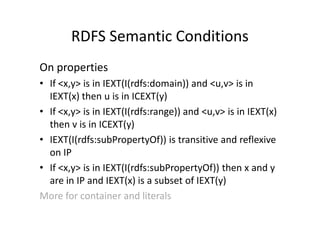
• If <x,y> is in IEXT(I(rdfs:domain)) and <u,v> is in
  IEXT(x) then u is in ICEXT(y)
• If <x,y> is in IEXT(I(rdfs:range)) and <u,v> is in IEXT(x)
  then v is in ICEXT(y)
• IEXT(I(rdfs:subPropertyOf)) is transitive and reflexive
  on IP
• If <x,y> is in IEXT(I(rdfs:subPropertyOf)) then x and y
  are in IP and IEXT(x) is a subset of IEXT(y)
More for container and literals
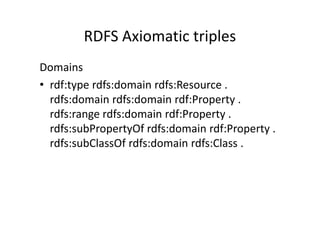
RDFS Axiomatic triples
Domains
• rdf:type rdfs:domain rdfs:Resource .
  rdfs:domain rdfs:domain rdf:Property .
  rdfs:range rdfs:domain rdf:Property .
  rdfs:subPropertyOf rdfs:domain rdf:Property .
  rdfs:subClassOf rdfs:domain rdfs:Class .
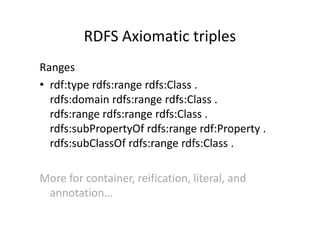
RDFS Axiomatic triples
Ranges
• rdf:type rdfs:range rdfs:Class .
  rdfs:domain rdfs:range rdfs:Class .
  rdfs:range rdfs:range rdfs:Class .
  rdfs:subPropertyOf rdfs:range rdf:Property .
  rdfs:subClassOf rdfs:range rdfs:Class .

More for container, reification, literal, and
 annotation…
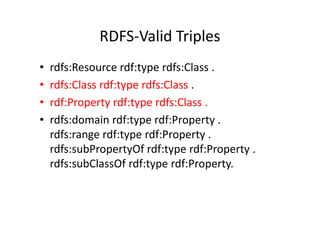
RDFS-Valid Triples
•   rdfs:Resource rdf:type rdfs:Class .
•   rdfs:Class rdf:type rdfs:Class .
•   rdf:Property rdf:type rdfs:Class .
•   rdfs:domain rdf:type rdf:Property .
    rdfs:range rdf:type rdf:Property .
    rdfs:subPropertyOf rdf:type rdf:Property .
    rdfs:subClassOf rdf:type rdf:Property.
Conclusions
• Model Theory gives semantics to RDF(S)
• RDF and RDFS vocabularies pose semantic
  constraints on interpretations
  – RDF: type, Property
  – RDFS: domain, range, Resource, Class, subClassOf
    subPropertyOf
• Will see OWL 1 and OWL 2 extensions to
  RDF(S) in the future
More on RDF Semantics
• Herman J. ter Horst - Completeness, decidability and
  complexity of entailment for RDF Schema and a
  semantic extension involving the OWL vocabulary. In
  J. Web Sem. 3(2-3):79-115, 2005.
• Jos de Bruijn, Stijn Heymans - Logical Foundations of
  (e)RDF(S): Complexity and Reasoning. In ISWC/ASWC
  pp. 86-99, 2007.
• Jeff Z. Pan, Ian Horrocks - RDFS(FA) and RDF MT: Two
  Semantics for RDFS. In International Semantic Web
  Conference pp. 30-46, 2003.

RDF Semantics

  • 1.
    RDF Semantics by Patrick Hayes W3C Recommendation http://www.w3.org/TR/rdf-mt/ Presented by Jie Bao RPI Sept 4, 2008 Part 1 of RDF/OWL Semantics Tutorial http://tw.rpi.edu/wiki/index.php/RDF_and_OWL_Semantics
  • 2.
    A Layer Cakeof Languages OWL2 OWL (RDFS 3.0) You RDF(S) Are Here
  • 3.
    Outline • What is Semantics? • RDF: Syntax • RDF Graph and Simple Entailment • RDF Interpretation • RDFS Interpretation
  • 4.
    What is Semantics Semant Inferen Syntax Logic ics ce Merriam-Webster: the study of meanings Wikipedia: the study of meaning in communication.
  • 5.
    What is Semantics? •Intensional Meaning – TW Students are Students with affiliation to the Tetherless World Group • Extensional Meaning – TW Students are the set {Jiao, Ankesh, Jesse,…}
  • 6.
    Model Theory Used to link intensional meaning and extensional meaning “Model theory assumes that the language refers to a 'world', and Alfred Tarski describes the minimal conditions that 1901-1983 a world must satisfy in order to Picure source: wikipedia assign an appropriate meaning for every expression in the language.” --RDF Semantics
  • 7.
    Model: an Example Expression: TW Students are Students with affiliation to the Tetherless World Group A Model: …
  • 8.
    A Few Jargons • An interpretation is a world with each symbol and each Interpretation expression assigned an extension. • An model of a logic theory is an interpretation of the Model theory that satisfies all constraints specified by the theory • A logic theory is consistent if it has a model. Consistency • A symbol or expression x is satisfiable w.r.t. a logic theory Satisfiability K if there is a model of K with x’s extension not empty. • A logic theory K entails another logical theory K’ if every Entailment model of K is a model of K’
  • 9.
    Outline • What is Semantics? • RDF: Syntax • RDF Graph and Simple Entailment • RDF Interpretation • RDFS Interpretation
  • 10.
    RDF Family RDFS RDFS Interpretation Vocabulary RDF Vocabulary RDF Interpretation RDF Graph Simple Interpretation Syntax Semantics
  • 11.
    Not Covered inthe Talk • Blank Node (b-Node) • Literals (Datatypes) • Containers • Collections • Reification • Annotation • Entailment rules (rule inference)
  • 12.
    RDF: Triple andGraph • Triple: (subject, property, object) – UB × U × UBL (Url, Blank node, Literal) – e.g., (Jim, is-a, Professor) – e.g., (Jim, has-surname, “Hendler”) – not covered – e.g.,(Jim, has-pet, _:x) – not covered is-a Professor Jim has-surname “Hendler” has-pet • Graph: A set of triples
  • 13.
    Outline • What is Semantics? • RDF: Syntax • RDF Graph and Simple Entailment • RDF Interpretation • RDFS Interpretation
  • 14.
    Simple Interpretation A simpleinterpretation I of a vocabulary V is defined by: 1. A non-empty set IR of resources, called the domain or universe of I. 2. A set IP, called the set of properties of I. 3. A mapping IEXT from IP into the powerset of IR x IR i.e. the set of sets of pairs <x,y> with x and y in IR . 4. A mapping IS from URI references in V into (IR union IP) 5. A mapping IL from typed literals in V into IR. 6. A distinguished subset LV of IR, called the set of literal values, which contains all the plain literals in V We do not consider RDF vocabulary (e.g., rdf:type), yet.
  • 15.
  • 16.
    Simple Interpretation Example V={a, b, c} Picture courtesy of “RDF Semantics”(Figure 1)
  • 17.
    Simple Semantic Conditions •if E is a URI reference in V then I(E) = IS(E) • if E is a ground triple s p o. then I(E) = true if s, p and o are in V, I(p) is in IP and <I(s),I(o)> is in IEXT(I(p)) otherwise I(E)= false. • if E is a ground RDF graph then I(E) = false if I(E') = false for some triple E' in E, otherwise I(E) =true • if E is a plain literal "aaa" in V then I(E) = aaa • if E is a plain literal "aaa"@ttt in V then I(E) = <aaa, ttt> • if E is a typed literal in V then I(E) = IL(E) • If E is a blank node and A(E) is defined then [I+A](E) = A(E) • If E is an RDF graph then I(E) = true if [I+A'](E) = true for some mapping A' from blank(E) to IR, otherwise I(E)= false
  • 18.
    Note to SimpleInterpreation • IP may not be in IR • A property (an element in IP) and its extension (mapping by IEXT) are separated. – Thus avoids paradox like the barber paradox (A barber shaves only those men who do not shave themselves.)
  • 19.
    Outline • What is Semantics? • RDF: Syntax • RDF Graph and Simple Entailment • RDF Interpretation • RDFS Interpretation
  • 20.
    RDF Vocabulary (rdfV) •rdf:type rdf:Property • rdf:XMLLiteral rdf:nil rdf:List rdf:Statement rdf:subject rdf:predicate rdf:object rdf:first rdf:rest rdf:Seq rdf:Bag rdf:Alt rdf:_1 rdf:_2 ... rdf:value
  • 21.
    RDF Semantic Conditions •x is in IP if and only if <x, I(rdf:Property)> is in IEXT(I(rdf:type)) – Thus, RDF properties (IP) must be resources (IR) in the universe. – (rdf:type rdf:type rdf:Property ) is always true • More conditions for literals
  • 22.
    RDF Interpretation Example Vocabulary: rdfV + V={a,b,c} Picture courtesy of “RDF Semantics”(Figure 2)
  • 23.
    Outline • What is Semantics? • RDF: Syntax • RDF Graph and Simple Entailment • RDF Interpretation • RDFS Interpretation
  • 24.
    RDFS Vocabulary (rdfsV) •rdfs:domain rdfs:range rdfs:Resource • rdfs:Class rdfs:subClassOf rdfs:subPropertyOf • rdfs:Literal rdfs:Datatype • rdfs:member rdfs:Container rdfs:ContainerMembershipProperty • rdfs:comment rdfs:seeAlso rdfs:isDefinedBy rdfs:label
  • 25.
    RDFS Semantic Conditions Onclasses • x is in ICEXT(y) if and only if <x,y> is in IEXT(I(rdf:type)) – IC = ICEXT(I(rdfs:Class)) – IR = ICEXT(I(rdfs:Resource)) – LV = ICEXT(I(rdfs:Literal)) • If x is in IC then <x, I(rdfs:Resource)> is in IEXT(I(rdfs:subClassOf)) • If <x,y> is in IEXT(I(rdfs:subClassOf)) then x and y are in IC and ICEXT(x) is a subset of ICEXT(y) • IEXT(I(rdfs:subClassOf)) is transitive and reflexive on IC
  • 26.
    RDFS Semantic Conditions Onproperties • If <x,y> is in IEXT(I(rdfs:domain)) and <u,v> is in IEXT(x) then u is in ICEXT(y) • If <x,y> is in IEXT(I(rdfs:range)) and <u,v> is in IEXT(x) then v is in ICEXT(y) • IEXT(I(rdfs:subPropertyOf)) is transitive and reflexive on IP • If <x,y> is in IEXT(I(rdfs:subPropertyOf)) then x and y are in IP and IEXT(x) is a subset of IEXT(y) More for container and literals
  • 27.
    RDFS Axiomatic triples Domains •rdf:type rdfs:domain rdfs:Resource . rdfs:domain rdfs:domain rdf:Property . rdfs:range rdfs:domain rdf:Property . rdfs:subPropertyOf rdfs:domain rdf:Property . rdfs:subClassOf rdfs:domain rdfs:Class .
  • 28.
    RDFS Axiomatic triples Ranges •rdf:type rdfs:range rdfs:Class . rdfs:domain rdfs:range rdfs:Class . rdfs:range rdfs:range rdfs:Class . rdfs:subPropertyOf rdfs:range rdf:Property . rdfs:subClassOf rdfs:range rdfs:Class . More for container, reification, literal, and annotation…
  • 29.
    RDFS-Valid Triples • rdfs:Resource rdf:type rdfs:Class . • rdfs:Class rdf:type rdfs:Class . • rdf:Property rdf:type rdfs:Class . • rdfs:domain rdf:type rdf:Property . rdfs:range rdf:type rdf:Property . rdfs:subPropertyOf rdf:type rdf:Property . rdfs:subClassOf rdf:type rdf:Property.
  • 30.
    Conclusions • Model Theorygives semantics to RDF(S) • RDF and RDFS vocabularies pose semantic constraints on interpretations – RDF: type, Property – RDFS: domain, range, Resource, Class, subClassOf subPropertyOf • Will see OWL 1 and OWL 2 extensions to RDF(S) in the future
  • 31.
    More on RDFSemantics • Herman J. ter Horst - Completeness, decidability and complexity of entailment for RDF Schema and a semantic extension involving the OWL vocabulary. In J. Web Sem. 3(2-3):79-115, 2005. • Jos de Bruijn, Stijn Heymans - Logical Foundations of (e)RDF(S): Complexity and Reasoning. In ISWC/ASWC pp. 86-99, 2007. • Jeff Z. Pan, Ian Horrocks - RDFS(FA) and RDF MT: Two Semantics for RDFS. In International Semantic Web Conference pp. 30-46, 2003.