OWL Briefing
     Frank van Harmelen
Vrije Universiteit Amsterdam
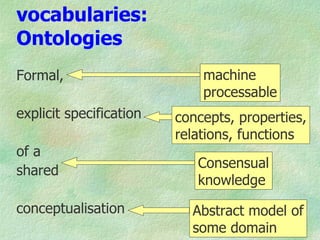
vocabularies:
Ontologies
Formal,                      machine
                             processable
explicit specification   concepts, properties,
                         relations, functions
of a
                            Consensual
shared
                            knowledge
conceptualisation          Abstract model of
                           some domain
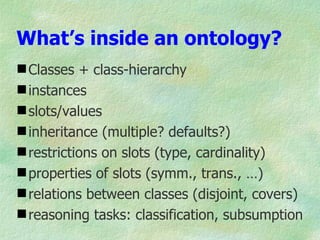
What’s inside an ontology?
 Classes + class-hierarchy
 instances
 slots/values
 inheritance (multiple? defaults?)
 restrictions on slots (type, cardinality)
 properties of slots (symm., trans., …)
 relations between classes (disjoint, covers)
 reasoning tasks: classification, subsumption
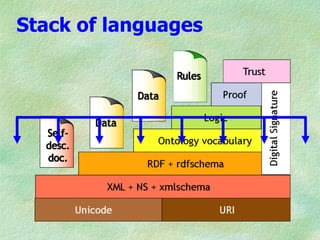
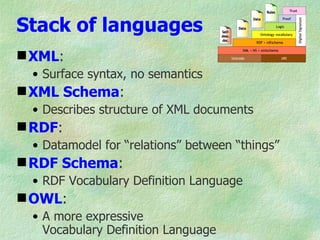
Stack of languages
Stack of languages
 XML:
  • Surface syntax, no semantics
 XML Schema:
  • Describes structure of XML documents
 RDF:
  • Datamodel for “relations” between “things”
 RDF Schema:
  • RDF Vocabulary Definition Language
 OWL:
  • A more expressive
    Vocabulary Definition Language
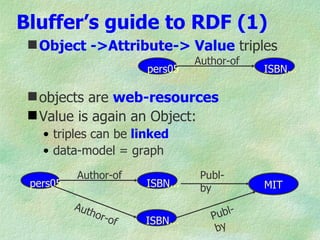
Bluffer’s guide to RDF (1)
  Object ->Attribute-> Value triples
                                    Author-of
                          pers05                ISBN...

  objects are web-resources
  Value is again an Object:
   • triples can be linked
   • data-model = graph
          Author-of                  Publ-
 pers05                   ISBN...    by         MIT
          Au t
              hor
                    -of                Pub l-
                          ISBN...
                                        by
Bluffer’s guide to RDF (2)
  Every identifier is a URL
    = world-wide unique naming!
  Has XML syntax    <rdf:Description rdf:about=“#pers05”>
                       <authorOf>ISBN...</authorOf>
                     </rdf:Description>


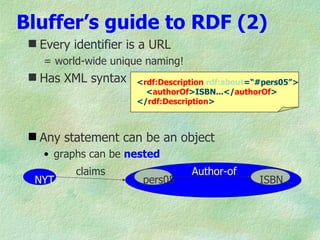
  Any statement can be an object
    • graphs can be nested
          claims                  Author-of
  NYT                  pers05                    ISBN...
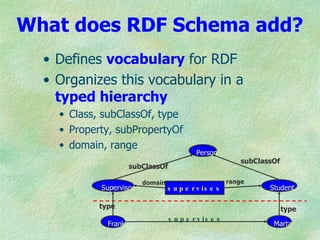
What does RDF Schema add?
  • Defines vocabulary for RDF
  • Organizes this vocabulary in a
    typed hierarchy
    • Class, subClassOf, type
    • Property, subPropertyOf
    • domain, range
                                            Person
                                                            subClassOf
                      subClassOf

                         domain                         range
            Supervisor            s u p e r v is e s               Student

            type                                                         type
                                   s u p e r v is e s
              Frank                                                 Marta
Things RDF(S) can’t do
 (in)equality
 enumeration
 boolean algebra
  • Union, complement
 number restrictions
  • Single-valued/multi-valued
  • Optional/required values
 inverse, symmetric, transitive
…
Use Cases for ontologies
(from OWL requirements doc.)
 Web portal
   ontology-based
 Multi-media collections
   annotating, searching
 Corporate Website
   knowledge management
 Documentation
   engineering & design
 Agents & Services
 Ubiquitous computing
   interoperability
Design Goals for OWL
   Shareable
   Changing over time
   Interoperability between ontologies
   Inconsisteny detection (requires a logic)
   Balancing expressivity and complexity
   Ease of use
   Compatible with existing standards
   Internationalisation
Requirements for OWL
   Ontologies are objects on the Web
   with their own meta-data, versioning, etc
   Ontologies are extendable
   They contain classes, properties,
    data-types, range/domain, individuals
   Equality (for classes, for individuals)
   Classes as instances
   Cardinality constraints
   XML syntax
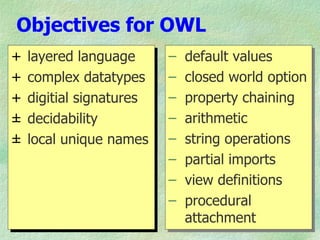
Objectives for OWL
+   layered language      –   default values
+   complex datatypes     –   closed world option
+   digitial signatures   –   property chaining
±   decidability          –   arithmetic
±   local unique names    –   string operations
                          –   partial imports
                          –   view definitions
                          –   procedural
                              attachment
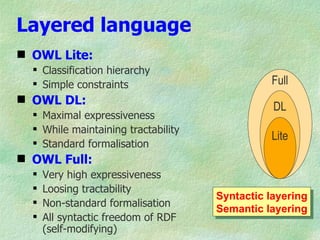
Layered language
 OWL Lite:
   Classification hierarchy
   Simple constraints                         Full
 OWL DL:
                                                DL
   Maximal expressiveness
   While maintaining tractability
                                               Lite
   Standard formalisation
 OWL Full:
     Very high expressiveness
     Loosing tractability
                                     Syntactic layering
     Non-standard formalisation
                                     Semantic layering
     All syntactic freedom of RDF
      (self-modifying)
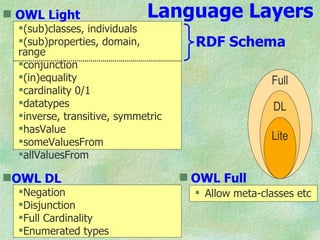
 OWL Light                  Language Layers
  (sub)classes, individuals
  (sub)properties, domain,           RDF Schema
  range
  conjunction
  (in)equality                                      Full
  cardinality 0/1
  datatypes                                          DL
  inverse, transitive, symmetric
  hasValue
  someValuesFrom                                    Lite
  allValuesFrom

OWL DL                              OWL Full
  Negation                            Allow meta-classes etc
  Disjunction
  Full Cardinality
  Enumerated types
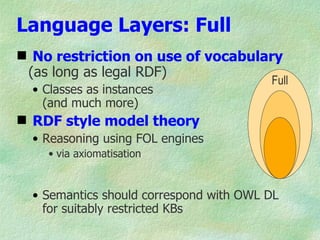
Language Layers: Full
 No restriction on use of vocabulary
 (as long as legal RDF)
                                         Full
  • Classes as instances
    (and much more)
 RDF style model theory
  • Reasoning using FOL engines
    • via axiomatisation


  • Semantics should correspond with OWL DL
    for suitably restricted KBs
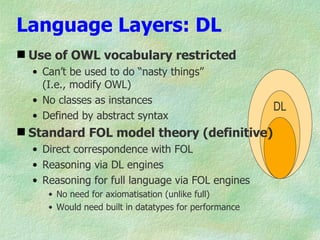
Language Layers: DL
 Use of OWL vocabulary restricted
  • Can’t be used to do “nasty things”
    (I.e., modify OWL)
  • No classes as instances
                                                       DL
  • Defined by abstract syntax
 Standard FOL model theory (definitive)
  • Direct correspondence with FOL
  • Reasoning via DL engines
  • Reasoning for full language via FOL engines
     • No need for axiomatisation (unlike full)
     • Would need built in datatypes for performance
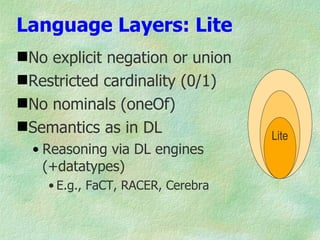
Language Layers: Lite
No explicit negation or union
Restricted cardinality (0/1)
No nominals (oneOf)
Semantics as in DL                Lite
  • Reasoning via DL engines
    (+datatypes)
    • E.g., FaCT, RACER, Cerebra
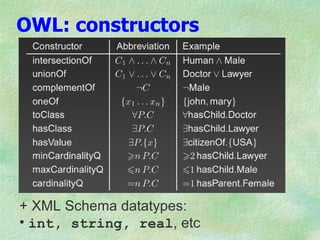
OWL: constructors


+ XML Schema datatypes:
• int, string, real, etc
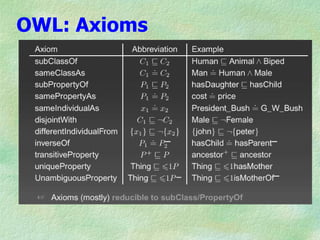
OWL: Axioms
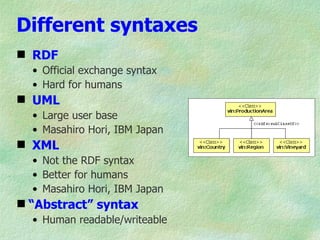
Different syntaxes
 RDF
  • Official exchange syntax
  • Hard for humans
 UML
  • Large user base
  • Masahiro Hori, IBM Japan
 XML
  • Not the RDF syntax
  • Better for humans
  • Masahiro Hori, IBM Japan
 “Abstract” syntax
  • Human readable/writeable
Things OWL doesn’t do
    –   default values
    –   closed world option
    –   property chaining
    –   arithmetic
    –   string operations
    –   partial imports
    –   view definitions
    –   procedural
        attachment
Illustrating OWL
in its abstract syntax
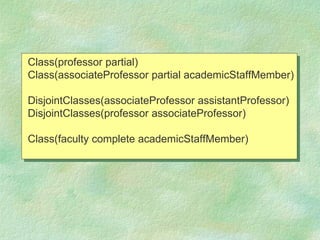
Class(professor partial)
Class(associateProfessor partial academicStaffMember)

DisjointClasses(associateProfessor assistantProfessor)
DisjointClasses(professor associateProfessor)

Class(faculty complete academicStaffMember)
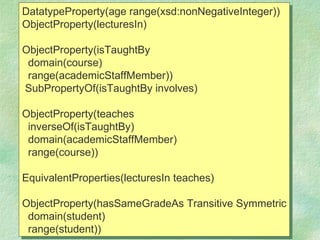
DatatypeProperty(age range(xsd:nonNegativeInteger))
ObjectProperty(lecturesIn)

ObjectProperty(isTaughtBy
 domain(course)
 range(academicStaffMember))
SubPropertyOf(isTaughtBy involves)

ObjectProperty(teaches
 inverseOf(isTaughtBy)
 domain(academicStaffMember)
 range(course))

EquivalentProperties(lecturesIn teaches)

ObjectProperty(hasSameGradeAs Transitive Symmetric
 domain(student)
 range(student))
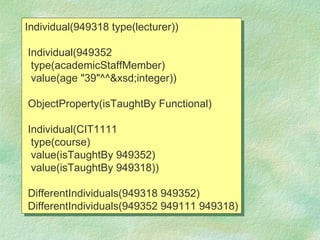
Individual(949318 type(lecturer))

Individual(949352
 type(academicStaffMember)
 value(age "39"^^&xsd;integer))

ObjectProperty(isTaughtBy Functional)

Individual(CIT1111
 type(course)
 value(isTaughtBy 949352)
 value(isTaughtBy 949318))

DifferentIndividuals(949318 949352)
DifferentIndividuals(949352 949111 949318)
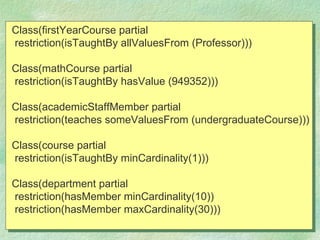
Class(firstYearCourse partial
restriction(isTaughtBy allValuesFrom (Professor)))

Class(mathCourse partial
restriction(isTaughtBy hasValue (949352)))

Class(academicStaffMember partial
restriction(teaches someValuesFrom (undergraduateCourse)))

Class(course partial
restriction(isTaughtBy minCardinality(1)))

Class(department partial
restriction(hasMember minCardinality(10))
restriction(hasMember maxCardinality(30)))
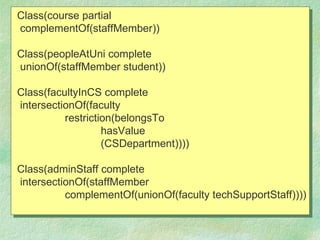
Class(course partial
complementOf(staffMember))

Class(peopleAtUni complete
unionOf(staffMember student))

Class(facultyInCS complete
intersectionOf(faculty
          restriction(belongsTo
                   hasValue
                   (CSDepartment))))

Class(adminStaff complete
intersectionOf(staffMember
          complementOf(unionOf(faculty techSupportStaff))))
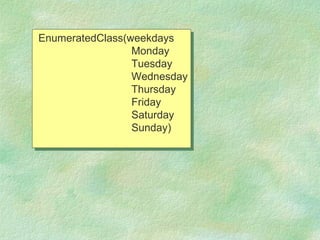
EnumeratedClass(weekdays
                 Monday
                 Tuesday
                 Wednesday
                 Thursday
                 Friday
                 Saturday
                 Sunday)

OWL briefing

  • 1.
    OWL Briefing Frank van Harmelen Vrije Universiteit Amsterdam
  • 2.
    vocabularies: Ontologies Formal, machine processable explicit specification concepts, properties, relations, functions of a Consensual shared knowledge conceptualisation Abstract model of some domain
  • 3.
    What’s inside anontology?  Classes + class-hierarchy  instances  slots/values  inheritance (multiple? defaults?)  restrictions on slots (type, cardinality)  properties of slots (symm., trans., …)  relations between classes (disjoint, covers)  reasoning tasks: classification, subsumption
  • 4.
  • 5.
    Stack of languages XML: • Surface syntax, no semantics  XML Schema: • Describes structure of XML documents  RDF: • Datamodel for “relations” between “things”  RDF Schema: • RDF Vocabulary Definition Language  OWL: • A more expressive Vocabulary Definition Language
  • 6.
    Bluffer’s guide toRDF (1)  Object ->Attribute-> Value triples Author-of pers05 ISBN...  objects are web-resources  Value is again an Object: • triples can be linked • data-model = graph Author-of Publ- pers05 ISBN... by MIT Au t hor -of Pub l- ISBN... by
  • 7.
    Bluffer’s guide toRDF (2)  Every identifier is a URL = world-wide unique naming!  Has XML syntax <rdf:Description rdf:about=“#pers05”> <authorOf>ISBN...</authorOf> </rdf:Description>  Any statement can be an object • graphs can be nested claims Author-of NYT pers05 ISBN...
  • 8.
    What does RDFSchema add? • Defines vocabulary for RDF • Organizes this vocabulary in a typed hierarchy • Class, subClassOf, type • Property, subPropertyOf • domain, range Person subClassOf subClassOf domain range Supervisor s u p e r v is e s Student type type s u p e r v is e s Frank Marta
  • 9.
    Things RDF(S) can’tdo  (in)equality  enumeration  boolean algebra • Union, complement  number restrictions • Single-valued/multi-valued • Optional/required values  inverse, symmetric, transitive …
  • 10.
    Use Cases forontologies (from OWL requirements doc.)  Web portal  ontology-based  Multi-media collections  annotating, searching  Corporate Website  knowledge management  Documentation  engineering & design  Agents & Services  Ubiquitous computing  interoperability
  • 11.
    Design Goals forOWL  Shareable  Changing over time  Interoperability between ontologies  Inconsisteny detection (requires a logic)  Balancing expressivity and complexity  Ease of use  Compatible with existing standards  Internationalisation
  • 12.
    Requirements for OWL  Ontologies are objects on the Web  with their own meta-data, versioning, etc  Ontologies are extendable  They contain classes, properties, data-types, range/domain, individuals  Equality (for classes, for individuals)  Classes as instances  Cardinality constraints  XML syntax
  • 13.
    Objectives for OWL + layered language – default values + complex datatypes – closed world option + digitial signatures – property chaining ± decidability – arithmetic ± local unique names – string operations – partial imports – view definitions – procedural attachment
  • 14.
    Layered language  OWLLite:  Classification hierarchy  Simple constraints Full  OWL DL: DL  Maximal expressiveness  While maintaining tractability Lite  Standard formalisation  OWL Full:  Very high expressiveness  Loosing tractability Syntactic layering  Non-standard formalisation Semantic layering  All syntactic freedom of RDF (self-modifying)
  • 15.
     OWL Light Language Layers (sub)classes, individuals (sub)properties, domain, RDF Schema range conjunction (in)equality Full cardinality 0/1 datatypes DL inverse, transitive, symmetric hasValue someValuesFrom Lite allValuesFrom OWL DL  OWL Full Negation  Allow meta-classes etc Disjunction Full Cardinality Enumerated types
  • 16.
    Language Layers: Full No restriction on use of vocabulary (as long as legal RDF) Full • Classes as instances (and much more)  RDF style model theory • Reasoning using FOL engines • via axiomatisation • Semantics should correspond with OWL DL for suitably restricted KBs
  • 17.
    Language Layers: DL Use of OWL vocabulary restricted • Can’t be used to do “nasty things” (I.e., modify OWL) • No classes as instances DL • Defined by abstract syntax  Standard FOL model theory (definitive) • Direct correspondence with FOL • Reasoning via DL engines • Reasoning for full language via FOL engines • No need for axiomatisation (unlike full) • Would need built in datatypes for performance
  • 18.
    Language Layers: Lite Noexplicit negation or union Restricted cardinality (0/1) No nominals (oneOf) Semantics as in DL Lite • Reasoning via DL engines (+datatypes) • E.g., FaCT, RACER, Cerebra
  • 19.
    OWL: constructors + XMLSchema datatypes: • int, string, real, etc
  • 20.
  • 21.
    Different syntaxes  RDF • Official exchange syntax • Hard for humans  UML • Large user base • Masahiro Hori, IBM Japan  XML • Not the RDF syntax • Better for humans • Masahiro Hori, IBM Japan  “Abstract” syntax • Human readable/writeable
  • 22.
    Things OWL doesn’tdo – default values – closed world option – property chaining – arithmetic – string operations – partial imports – view definitions – procedural attachment
  • 23.
    Illustrating OWL in itsabstract syntax
  • 24.
    Class(professor partial) Class(associateProfessor partialacademicStaffMember) DisjointClasses(associateProfessor assistantProfessor) DisjointClasses(professor associateProfessor) Class(faculty complete academicStaffMember)
  • 25.
    DatatypeProperty(age range(xsd:nonNegativeInteger)) ObjectProperty(lecturesIn) ObjectProperty(isTaughtBy domain(course) range(academicStaffMember)) SubPropertyOf(isTaughtBy involves) ObjectProperty(teaches inverseOf(isTaughtBy) domain(academicStaffMember) range(course)) EquivalentProperties(lecturesIn teaches) ObjectProperty(hasSameGradeAs Transitive Symmetric domain(student) range(student))
  • 26.
    Individual(949318 type(lecturer)) Individual(949352 type(academicStaffMember) value(age "39"^^&xsd;integer)) ObjectProperty(isTaughtBy Functional) Individual(CIT1111 type(course) value(isTaughtBy 949352) value(isTaughtBy 949318)) DifferentIndividuals(949318 949352) DifferentIndividuals(949352 949111 949318)
  • 27.
    Class(firstYearCourse partial restriction(isTaughtBy allValuesFrom(Professor))) Class(mathCourse partial restriction(isTaughtBy hasValue (949352))) Class(academicStaffMember partial restriction(teaches someValuesFrom (undergraduateCourse))) Class(course partial restriction(isTaughtBy minCardinality(1))) Class(department partial restriction(hasMember minCardinality(10)) restriction(hasMember maxCardinality(30)))
  • 28.
    Class(course partial complementOf(staffMember)) Class(peopleAtUni complete unionOf(staffMemberstudent)) Class(facultyInCS complete intersectionOf(faculty restriction(belongsTo hasValue (CSDepartment)))) Class(adminStaff complete intersectionOf(staffMember complementOf(unionOf(faculty techSupportStaff))))
  • 29.
    EnumeratedClass(weekdays Monday Tuesday Wednesday Thursday Friday Saturday Sunday)