Downloaded 87 times
![Ontology modeling quick guide Experiences on Taxonomy and Ontology development work heimo hanninen Tieto, [email_address]](https://image.slidesharecdn.com/ontologyandtaxonomymodelingquickguideheimohanninen-13139947908563-phpapp01-110822013652-phpapp01/85/Ontology-And-Taxonomy-Modeling-Quick-Guide-1-320.jpg)
![Ontology modeling quick guide Experiences on Taxonomy and Ontology development work heimo hanninen Tieto, [email_address]](https://image.slidesharecdn.com/ontologyandtaxonomymodelingquickguideheimohanninen-13139947908563-phpapp01-110822013652-phpapp01/75/Ontology-And-Taxonomy-Modeling-Quick-Guide-1-2048.jpg)
![Why do we need better concepts for organizing information? 2011-02-09 [email_address]](https://image.slidesharecdn.com/ontologyandtaxonomymodelingquickguideheimohanninen-13139947908563-phpapp01-110822013652-phpapp01/85/Ontology-And-Taxonomy-Modeling-Quick-Guide-2-320.jpg)
![Information is Constantly in Motion – - a need for better management 30% of people’s time is spent searching for relevant information Only one-third of CFOs believe that the information is easy to use, tailored, cost-effective or integrated 17% of IT budgets for storage hardware and storage management software and people More than 60% of CEOs believe their business needs to access and understand information faster to make swift decisions 30–50% of design time is copy management 85% of information is unstructured 37% growth of disk storage in 2005 40% of IT budgets may be spent on integration Source: IBM [email_address] Documents Transactions Customers Partners Employees Organizations Financials Products E-mails Databases Media Web content Reports](https://image.slidesharecdn.com/ontologyandtaxonomymodelingquickguideheimohanninen-13139947908563-phpapp01-110822013652-phpapp01/85/Ontology-And-Taxonomy-Modeling-Quick-Guide-3-320.jpg)
![Corporate information in silos – a need for connecting layer 2011-05-11 [email_address] Partners R&D Production ICT Sales & Marketing HR](https://image.slidesharecdn.com/ontologyandtaxonomymodelingquickguideheimohanninen-13139947908563-phpapp01-110822013652-phpapp01/85/Ontology-And-Taxonomy-Modeling-Quick-Guide-4-320.jpg)
![Phased modelling work 2011-06-17 Preparation [email_address] iterative iterative](https://image.slidesharecdn.com/ontologyandtaxonomymodelingquickguideheimohanninen-13139947908563-phpapp01-110822013652-phpapp01/85/Ontology-And-Taxonomy-Modeling-Quick-Guide-7-320.jpg)
![Recursive ontology development [email_address] 2011-02-09 Visualize Formalize Populate Analyze & Refine Biz reqs Value chain User study Conceptual model Cmap Logical model UML class diagram Implementation model RDF(S), OWL, Topic Maps, XML schema test Use case Prototype Pilot Use case Process walk](https://image.slidesharecdn.com/ontologyandtaxonomymodelingquickguideheimohanninen-13139947908563-phpapp01-110822013652-phpapp01/85/Ontology-And-Taxonomy-Modeling-Quick-Guide-8-320.jpg)
![About the design work A kind of data modeling and knowledge engineering 80% of communication, 20% of design Top down: business needs the information Bottom up: inventorying where to get the data Middle out: start with a motivated gang, a small system Skills required: SMEs, often a guy who has been around long enough (find them) Communication and facilitation skills Data modeling (visualization) skills Team work: to create understanding on situation and common goal Deliver something tangible to review (PoC approach) Focus on the business not on the technology “ Keep stakeholders close and enemies closer” 2011-02-09 [email_address]](https://image.slidesharecdn.com/ontologyandtaxonomymodelingquickguideheimohanninen-13139947908563-phpapp01-110822013652-phpapp01/85/Ontology-And-Taxonomy-Modeling-Quick-Guide-9-320.jpg)
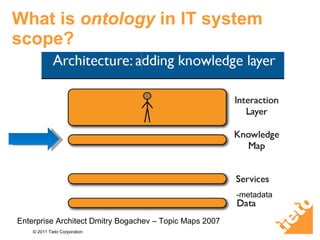
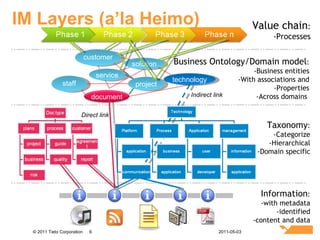
![System development with semantic technology approach Understanding semantics of biz entities and taking good care of managing identities of entities and information related. Understand business (value proposition & process) Extract info objects needed in process: Entities, their relationship, properties and info resources (links to docs) Model the formal ontology in W3C: RDF/OWL or ISO: Topic Maps Analyze and build adapters to sources (mapping) Analyze biz app interface and provide methods and Create ontology queries and package results for methods 2011-03-04 [email_address]](https://image.slidesharecdn.com/ontologyandtaxonomymodelingquickguideheimohanninen-13139947908563-phpapp01-110822013652-phpapp01/85/Ontology-And-Taxonomy-Modeling-Quick-Guide-10-320.jpg)
![Finding critical information assets and mapping them to business objects 1. Biz Process Walk through 2. Describe biz entities, properties and relations in common biz language 3. Identify sources. Understand local glossaries 4. Create mapping from local to global glossary Business ontology Heimo Hänninen [email_address] R&D Logistics Manufac- turing Marketing Sales Distri- bution Customer Support Product Design PDM, ERP CMS BI Sales & Marketing Partner’s data CRM](https://image.slidesharecdn.com/ontologyandtaxonomymodelingquickguideheimohanninen-13139947908563-phpapp01-110822013652-phpapp01/85/Ontology-And-Taxonomy-Modeling-Quick-Guide-11-320.jpg)
![Faced problems in the real world Poor data quality in source systems missing metadata, no identifiers, ad hoc field naming etc. Security mgt. do you have to copy ACL or request it while user runs a query? Performance if running complex queries Governance difficult to define, who owns centralized knowledge service (it's not CMS, nor DW, nor CRM, nor PDM but can benefit from those all). Usage: everyone want to ride on a bus but nobody wants to run the bus company. Ontology is redundant metadata about data in other systems. Not good for real time critical systems. Virtual ontology engine which reads data directly from source is not here yet. Difficult to calculate the business case. Not in ICT main stream. Educate and lobby managers, train developers to use sem tech [email_address] 2011-03-04](https://image.slidesharecdn.com/ontologyandtaxonomymodelingquickguideheimohanninen-13139947908563-phpapp01-110822013652-phpapp01/85/Ontology-And-Taxonomy-Modeling-Quick-Guide-12-320.jpg)

The document discusses the need for better organizing information through taxonomy and ontology development due to issues like information silos, inefficient searching, and lack of integration. It then provides an overview of an iterative phased approach to ontology modeling that involves preparation, conceptual modeling, logical modeling, implementation modeling, testing, and use case prototyping. The approach focuses on understanding business needs, extracting relevant entities, properties and relationships, and formally modeling and mapping the ontology.


