16.11.15
Online VideoHow It Changes & Enhances the Way We Learn!
Lynda.comA L I N K E D I N C O M P A N Y
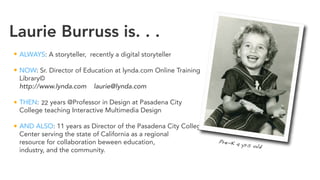
Laurie Burruss is. . .
ALWAYS: A storyteller, recently a digital storyteller
NOW: Sr. Director of Education at lynda.com Online Training
Library©
http://www.lynda.com laurie@lynda.com
THEN: 16 years @Professor in Design at Pasadena City
College teaching Interactive Multimedia Design
AND ALSO: 11 years as Director of the Pasadena City College Digital Media
Center serving the state of California as a regional
resource for collaboration beween education,
industry, and the community.
http://www.dmc-pcc.org cosmodog@pacbell.net
Pre-K 4 yrs old
22
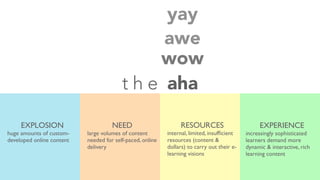
EXPERIENCE
increasingly sophisticated
learners demand more
dynamic & interactive, rich
learning content
RESOURCES
internal, limited, insufficient
resources (content &
dollars) to carry out their e-
learning visions
t h e aha
NEED
large volumes of content
needed for self-paced, online
delivery
EXPLOSION
huge amounts of custom-
developed online content
wow
awe
yay
What is out there right now?
learning with online video
3 case studies
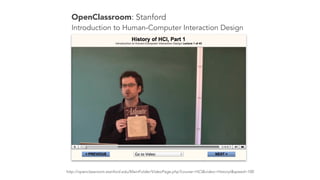
http://openclassroom.stanford.edu/MainFolder/VideoPage.php?course=HCI&video=HistoryI&speed=100
OpenClassroom: Stanford
Introduction to Human-Computer Interaction Design
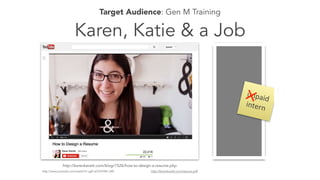
Target Audience: Gen M Training
Karen, Katie & a Job
http://karenkavett.com/blog/1526/how-to-design-a-resume.php
http://karenkavett.com/resume.pdfhttp://www.youtube.com/watch?v=gKl-aGY6TrI#t=345
unpaid
intern
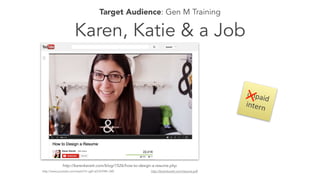
Target Audience: Gen M Training
Karen, Katie & a Job
http://karenkavett.com/blog/1526/how-to-design-a-resume.php
http://karenkavett.com/resume.pdfhttp://www.youtube.com/watch?v=gKl-aGY6TrI#t=345
unpaid
intern
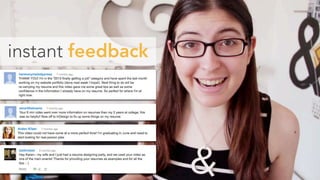
instant feedback
What do we know?
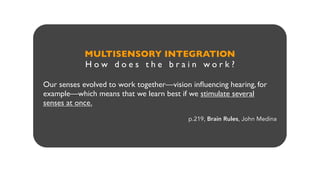
MULTISENSORY INTEGRATION
H o w d o e s t h e b r a i n w o r k ?
Our senses evolved to work together—vision influencing hearing, for
example—which means that we learn best if we stimulate several
senses at once.
p.219, Brain Rules, John Medina
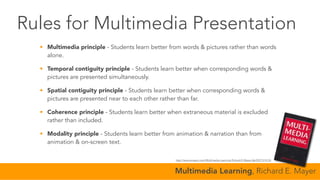
Rules for Multimedia Presentation
• Multimedia principle - Students learn better from words & pictures rather than words
alone.
• Temporal contiguity principle - Students learn better when corresponding words &
pictures are presented simultaneously.
• Spatial contiguity principle - Students learn better when corresponding words &
pictures are presented near to each other rather than far.
• Coherence principle - Students learn better when extraneous material is excluded
rather than included.
• Modality principle - Students learn better from animation & narration than from
animation & on-screen text.
Multimedia Learning, Richard E. Mayer
http://www.amazon.com/Multimedia-Learning-Richard-E-Mayer/dp/0521514126
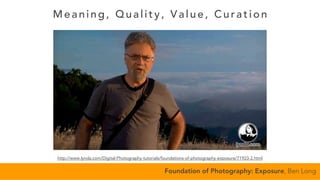
Meaning, Quality, Va l ue, Cura ti on
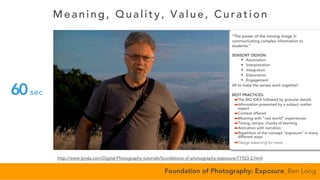
Foundation of Photography: Exposure, Ben Long
http://www.lynda.com/Digital-Photography-tutorials/foundations-of-photography-exposure/71923-2.html
Meaning, Quality, Va l ue, Cura ti on
Foundation of Photography: Exposure, Ben Long
http://www.lynda.com/Digital-Photography-tutorials/foundations-of-photography-exposure/71923-2.html
“The power of the moving image in
communicating complex information to
students.”
SENSORY DESIGN:
• Association
• Interpretation
• Integration
• Elaboration
• Engagement
All to make the senses work together!
BEST PRACTICES:
➡The BIG IDEA followed by granular details
➡Information presented by a subject matter
expert
➡Context offered
➡Meaning with “real world” experiences
➡Timing, tempo, chunks of learning
➡Animation with narration
➡Repetition of the concept “exposure” in many
different ways
➡Design elearning for more . . .
60sec
learning better
learning differently
What are current “best practices”?
‣Bite-sized: short, to-the-point, searchable
‣Audio:Teacher’s voice “speaks” to
the student - no attention wandering.
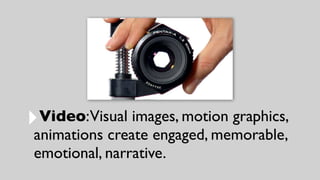
‣Video:Visual images, motion graphics,
animations create engaged, memorable,
emotional, narrative.
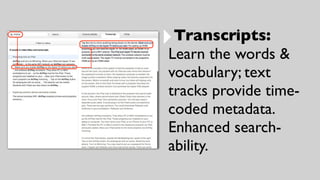
‣Transcripts:
Learn the words &
vocabulary; text
tracks provide time-
coded metadata.
Enhanced search-
ability.
‣Repetition & Failure: Watching
a video repetitively or as much as
needed to get it; no failure - as many
chances as the learner needs or
wants.
‣No tests, no stress: Anonymous
learning makes it safe to “not know”
something, allows vulnerability to
transform into confidence.
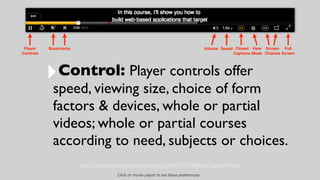
‣Control: Player controls offer
speed, viewing size, choice of form
factors & devices, whole or partial
videos; whole or partial courses
according to need, subjects or choices.
http://www.lynda.com/player/popup?lpk4=79343&playChapter=False
Player
Controls
Bookmarks Volume Speed Closed
Captions
Full
Screen
View
Mode
Screen
Choices
Click on movie player to set these preferences
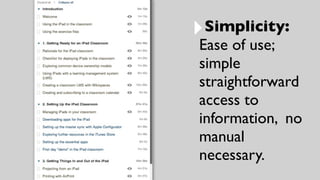
‣Simplicity:
Ease of use;
simple
straightforward
access to
information, no
manual
necessary.
‣Choice: No “right or wrong” way
to view a movie; no left to right or
top to bottom; searchable/retrievable
video clips selection allows the
learner to determine the order. Lots
of variety - lots of classes and
teachers.
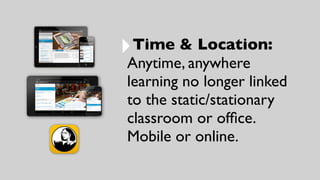
‣Time & Location:
Anytime, anywhere
learning no longer linked
to the static/stationary
classroom or office.
Mobile or online.
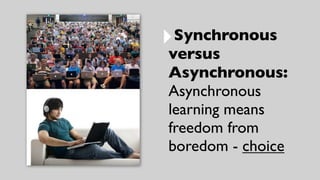
‣Synchronous
versus
Asynchronous:
Asynchronous
learning means
freedom from
boredom - choice
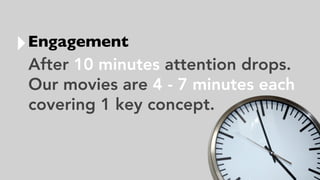
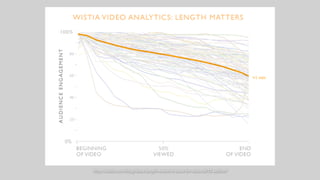
After 10 minutes attention drops.
Our movies are 4 - 7 minutes each
covering 1 key concept.
‣Engagement
http://wistia.com/blog/does-length-matter-it-does-for-video-2k12-edition/
HOW WE LEARN:
http://www.brainrules.net/
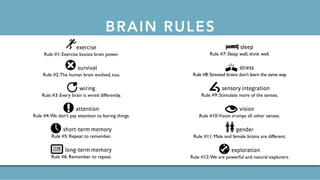
BRAIN RULESthe 12 brain rules
exercise
Rule #1: Exercise boosts brain power.
survival
Rule #2:The human brain evolved, too.
wiring
Rule #3: Every brain is wired differently.
attention
Rule #4:We don’t pay attention to boring things.
short-term memory
Rule #5: Repeat to remember.
long-term memory
Rule #6: Remember to repeat.
sleep
Rule #7: Sleep well, think well.
net
short-term memory
Rule #5: Repeat to remember.
long-term memory
Rule #6: Remember to repeat.
sleep
Rule #7: Sleep well, think well.
stress
Rule #8:Stressed brains don’t learn the same way.
sensory integration
Rule #9: Stimulate more of the senses.
vision
Rule #10:Vision trumps all other senses.
gender
Rule #11: Male and female brains are different.
exploration
Rule #12:We are powerful and natural explorers.
BRAIN RULES
short-term memory
Rule #5: Repeat to remember.
long-term memory
Rule #6: Remember to repeat.
sleep
Rule #7: Sleep well, think well.
stress
Rule #8:Stressed brains don’t learn the same way.
sensory integration
Rule #9: Stimulate more of the senses.
vision
Rule #10:Vision trumps all other senses.
gender
Rule #11: Male and female brains are different.
exploration
Rule #12:We are powerful and natural explorers.
Rule #2:The human brain evolved, too.
wiring
Rule #3: Every brain is wired differently.
attention
Rule #4:We don’t pay attention to boring things.
short-term memory
Rule #5: Repeat to remember.
BRAIN RULES
short-term memory
Rule #5: Repeat to remember.
long-term memory
Rule #6: Remember to repeat.
sleep
Rule #7: Sleep well, think well.
stress
Rule #8:Stressed brains don’t learn the same way.
sensory integration
Rule #9: Stimulate more of the senses.
vision
Rule #10:Vision trumps all other senses.
gender
Rule #11: Male and female brains are different.
exploration
Rule #12:We are powerful and natural explorers.
Rule #3: Every brain is wired differently.
attention
Rule #4:We don’t pay attention to boring things.
short-term memory
Rule #5: Repeat to remember.
long-term memory
Rule #6: Remember to repeat.
BRAIN RULES
short-term memory
Rule #5: Repeat to remember.
long-term memory
Rule #6: Remember to repeat.
sleep
Rule #7: Sleep well, think well.
stress
Rule #8:Stressed brains don’t learn the same way.
sensory integration
Rule #9: Stimulate more of the senses.
vision
Rule #10:Vision trumps all other senses.
gender
Rule #11: Male and female brains are different.
exploration
Rule #12:We are powerful and natural explorers.
Rule #6: Remember to repeat.
long-term memory
x
BRAIN RULESthe 12 brain rules
exercise
Rule #1: Exercise boosts brain power.
survival
Rule #2:The human brain evolved, too.
wiring
Rule #3: Every brain is wired differently.
attention
Rule #4:We don’t pay attention to boring things.
short-term memory
Rule #5: Repeat to remember.
long-term memory
Rule #6: Remember to repeat.
sleep
Rule #7: Sleep well, think well.
net
Rule #7: Sleep well, think well.
stress
Rule #8:Stressed brains don’t learn the same way.
sensory integration
Rule #9: Stimulate more of the senses.
vision
Rule #10:Vision trumps all other senses.
BRAIN RULESthe 12 brain rules
exercise
Rule #1: Exercise boosts brain power.
survival
Rule #2:The human brain evolved, too.
wiring
Rule #3: Every brain is wired differently.
attention
Rule #4:We don’t pay attention to boring things.
short-term memory
Rule #5: Repeat to remember.
long-term memory
Rule #6: Remember to repeat.
sleep
Rule #7: Sleep well, think well.
net
sensory integration
Rule #9: Stimulate more of the senses.
vision
Rule #10:Vision trumps all other senses.
gender
Rule #11: Male and female brains are different.
BRAIN RULESthe 12 brain rules
exercise
Rule #1: Exercise boosts brain power.
survival
Rule #2:The human brain evolved, too.
wiring
Rule #3: Every brain is wired differently.
attention
Rule #4:We don’t pay attention to boring things.
short-term memory
Rule #5: Repeat to remember.
long-term memory
Rule #6: Remember to repeat.
sleep
Rule #7: Sleep well, think well.
net
Rule #10:Vision trumps all other senses.
gender
Rule #11: Male and female brains are different.
exploration
Rule #12:We are powerful and natural explorers.
BRAIN RULESthe 12 brain rules
exercise
Rule #1: Exercise boosts brain power.
survival
Rule #2:The human brain evolved, too.
wiring
Rule #3: Every brain is wired differently.
attention
Rule #4:We don’t pay attention to boring things.
short-term memory
Rule #5: Repeat to remember.
long-term memory
Rule #6: Remember to repeat.
sleep
Rule #7: Sleep well, think well.
net
Rule #10:Vision trumps all other senses.
gender
Rule #11: Male and female brains are different.
exploration
Rule #12:We are powerful and natural explorers.
[Experts’] knowledge is not simply a list of facts and
formulas that are relevant. . .their knowledge is
organized around core concepts and ‘big ideas’ that
guide their thinking about the domains.
How People Learn, John Bransford
We are natural explorers.
The tendency is so strong, it is capable of turning us
into lifelong learners. . .
BRAIN RULES, John Medina, p. 264
EXPLORERSthe 12 brain rules
exercise
Rule #1: Exercise boosts brain power.
survival
Rule #2:The human brain evolved, too.
wiring
Rule #3: Every brain is wired differently.
attention
Rule #4:We don’t pay attention to boring things.
short-term memory
Rule #5: Repeat to remember.
long-term memory
Rule #6: Remember to repeat.
sleep
Rule #7: Sleep well, think well.
net
Online Video: Anyone can do it and they are!
Sal Kahn, The Kahn Academy [FREE] USC [archiving the BEST storytellers]
MIT > TechTV [library + annotation]
Class Central: MOOC aggregator TED Talks [bite-size, world-class + FREE] Direct TV [Netflix - anywhere, anytime video]
EXPLORERS
Online Video: Anyone can do it and they are!
Stanford’s Entrepreneurship
eCorner [FREE]
udemy.com [FREE - $$$]
Online Courses from the World’s Experts
vimeo.com | video school [FREE]
Google’s Learn - Promoting a business
online [FREE]
pluralsight: hardcore dev and IT training
CodeAcademy.com | Learn to code!
EXPLORERS
Video in the Classroom
BEST PRACTICES
OYO: On-Your-Own Learning
the SPACE
between OYO learning
and face-to-face [F2F]
• Custom Editable Shareable Playlists
• Annotated lessons to accompany
online video tutorials, projects, &
researched URLs
• Textbook replacement
the benefits
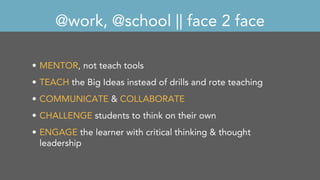
@work, @school || face 2 face
• MENTOR, not teach tools
• TEACH the Big Ideas instead of drills and rote teaching
• COMMUNICATE & COLLABORATE
• CHALLENGE students to think on their own
• ENGAGE the learner with critical thinking & thought
leadership
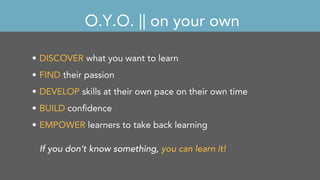
• DISCOVER what you want to learn
• FIND their passion
• DEVELOP skills at their own pace on their own time
• BUILD confidence
• EMPOWER learners to take back learning
If you don’t know something, you can learn it!
O.Y.O. || on your own
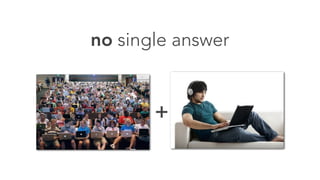
no single answer
+
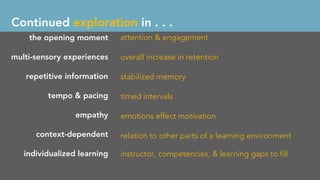
the opening moment
multi-sensory experiences
repetitive information
tempo & pacing
empathy
context-dependent
individualized learning
attention & engagement
overall increase in retention
stabilized memory
timed intervals
emotions effect motivation
relation to other parts of a learning environment
instructor, competencies, & learning gaps to fill
Continued exploration in . . .
Laurie Burruss
Sr Director of Education
lynda.com
laurie@lynda.com
for the love of learning
Education Innovation Advisor
bonus
the hurdles
10 common problems
10 common nightmares
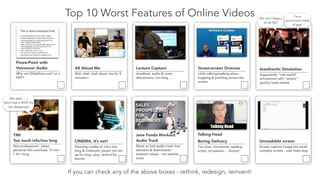
If you can check any of the above boxes - rethink, redesign, reinvent!
You don’t keep a
to-do list?
I’m a
spontaneous kind
of guy!
(fire siren . . .)
Don’t live in NYC! It’s
too dangerous!
Inauthentic Simulation
Supposedly “real world”
simulations with “actors;”
quickly looks dated. . .
Green-screen Overuse
Little talking/walking elves -
hopping & pointing across the
screen
Lecture Capture
Unedited, audio & room
distractions, too long. . .
All About Me
Blah, blah, blah about me for 5
minutes+
PowerPoint with
Voiceover Audio
Why not SlideShare.net? or a
PDF?
Unreadable screen
Screen capture image too small,
complex screen - user loses way
CINEMA, it’s not!
Opening credits or intro too
long & irrelevant; player not set
up for stop, play, rewind for
learner
Talking Head
Boring Delivery
Too slow, monotone, reading
script, no passion. . .Zzzzzz!
Jane Fonda Workout
Audio Track
Music or bad audio track that
distracts & disenchants -
ambient noises - not teacher
voice
TMI
Too much info/too long
Not professional - jokes,
personal info overload, 15 min -
1 hr+ long. . .
Top 10 Worst Features of Online Videos
Online Video: How It Changes & Enhances The Way We Learn

Online Video: How It Changes & Enhances The Way We Learn

  • 1.
    16.11.15 Online VideoHow ItChanges & Enhances the Way We Learn! Lynda.comA L I N K E D I N C O M P A N Y
  • 2.
    Laurie Burruss is.. . ALWAYS: A storyteller, recently a digital storyteller NOW: Sr. Director of Education at lynda.com Online Training Library© http://www.lynda.com laurie@lynda.com THEN: 16 years @Professor in Design at Pasadena City College teaching Interactive Multimedia Design AND ALSO: 11 years as Director of the Pasadena City College Digital Media Center serving the state of California as a regional resource for collaboration beween education, industry, and the community. http://www.dmc-pcc.org cosmodog@pacbell.net Pre-K 4 yrs old 22
  • 3.
    EXPERIENCE increasingly sophisticated learners demandmore dynamic & interactive, rich learning content RESOURCES internal, limited, insufficient resources (content & dollars) to carry out their e- learning visions t h e aha NEED large volumes of content needed for self-paced, online delivery EXPLOSION huge amounts of custom- developed online content wow awe yay
  • 4.
    What is outthere right now?
  • 5.
    learning with onlinevideo 3 case studies
  • 6.
  • 8.
    Target Audience: GenM Training Karen, Katie & a Job http://karenkavett.com/blog/1526/how-to-design-a-resume.php http://karenkavett.com/resume.pdfhttp://www.youtube.com/watch?v=gKl-aGY6TrI#t=345 unpaid intern
  • 9.
    Target Audience: GenM Training Karen, Katie & a Job http://karenkavett.com/blog/1526/how-to-design-a-resume.php http://karenkavett.com/resume.pdfhttp://www.youtube.com/watch?v=gKl-aGY6TrI#t=345 unpaid intern
  • 10.
  • 11.
  • 12.
    MULTISENSORY INTEGRATION H ow d o e s t h e b r a i n w o r k ? Our senses evolved to work together—vision influencing hearing, for example—which means that we learn best if we stimulate several senses at once. p.219, Brain Rules, John Medina
  • 13.
    Rules for MultimediaPresentation • Multimedia principle - Students learn better from words & pictures rather than words alone. • Temporal contiguity principle - Students learn better when corresponding words & pictures are presented simultaneously. • Spatial contiguity principle - Students learn better when corresponding words & pictures are presented near to each other rather than far. • Coherence principle - Students learn better when extraneous material is excluded rather than included. • Modality principle - Students learn better from animation & narration than from animation & on-screen text. Multimedia Learning, Richard E. Mayer http://www.amazon.com/Multimedia-Learning-Richard-E-Mayer/dp/0521514126
  • 14.
    Meaning, Quality, Val ue, Cura ti on Foundation of Photography: Exposure, Ben Long http://www.lynda.com/Digital-Photography-tutorials/foundations-of-photography-exposure/71923-2.html
  • 15.
    Meaning, Quality, Val ue, Cura ti on Foundation of Photography: Exposure, Ben Long http://www.lynda.com/Digital-Photography-tutorials/foundations-of-photography-exposure/71923-2.html “The power of the moving image in communicating complex information to students.” SENSORY DESIGN: • Association • Interpretation • Integration • Elaboration • Engagement All to make the senses work together! BEST PRACTICES: ➡The BIG IDEA followed by granular details ➡Information presented by a subject matter expert ➡Context offered ➡Meaning with “real world” experiences ➡Timing, tempo, chunks of learning ➡Animation with narration ➡Repetition of the concept “exposure” in many different ways ➡Design elearning for more . . . 60sec
  • 16.
  • 17.
  • 18.
    What are current“best practices”?
  • 19.
  • 20.
    ‣Audio:Teacher’s voice “speaks”to the student - no attention wandering.
  • 21.
    ‣Video:Visual images, motiongraphics, animations create engaged, memorable, emotional, narrative.
  • 22.
    ‣Transcripts: Learn the words& vocabulary; text tracks provide time- coded metadata. Enhanced search- ability.
  • 23.
    ‣Repetition & Failure:Watching a video repetitively or as much as needed to get it; no failure - as many chances as the learner needs or wants.
  • 24.
    ‣No tests, nostress: Anonymous learning makes it safe to “not know” something, allows vulnerability to transform into confidence.
  • 25.
    ‣Control: Player controlsoffer speed, viewing size, choice of form factors & devices, whole or partial videos; whole or partial courses according to need, subjects or choices. http://www.lynda.com/player/popup?lpk4=79343&playChapter=False Player Controls Bookmarks Volume Speed Closed Captions Full Screen View Mode Screen Choices Click on movie player to set these preferences
  • 26.
  • 27.
    ‣Choice: No “rightor wrong” way to view a movie; no left to right or top to bottom; searchable/retrievable video clips selection allows the learner to determine the order. Lots of variety - lots of classes and teachers.
  • 28.
    ‣Time & Location: Anytime,anywhere learning no longer linked to the static/stationary classroom or office. Mobile or online.
  • 29.
  • 30.
    After 10 minutesattention drops. Our movies are 4 - 7 minutes each covering 1 key concept. ‣Engagement
  • 31.
  • 32.
  • 33.
    BRAIN RULESthe 12brain rules exercise Rule #1: Exercise boosts brain power. survival Rule #2:The human brain evolved, too. wiring Rule #3: Every brain is wired differently. attention Rule #4:We don’t pay attention to boring things. short-term memory Rule #5: Repeat to remember. long-term memory Rule #6: Remember to repeat. sleep Rule #7: Sleep well, think well. net short-term memory Rule #5: Repeat to remember. long-term memory Rule #6: Remember to repeat. sleep Rule #7: Sleep well, think well. stress Rule #8:Stressed brains don’t learn the same way. sensory integration Rule #9: Stimulate more of the senses. vision Rule #10:Vision trumps all other senses. gender Rule #11: Male and female brains are different. exploration Rule #12:We are powerful and natural explorers.
  • 34.
    BRAIN RULES short-term memory Rule#5: Repeat to remember. long-term memory Rule #6: Remember to repeat. sleep Rule #7: Sleep well, think well. stress Rule #8:Stressed brains don’t learn the same way. sensory integration Rule #9: Stimulate more of the senses. vision Rule #10:Vision trumps all other senses. gender Rule #11: Male and female brains are different. exploration Rule #12:We are powerful and natural explorers. Rule #2:The human brain evolved, too. wiring Rule #3: Every brain is wired differently. attention Rule #4:We don’t pay attention to boring things. short-term memory Rule #5: Repeat to remember.
  • 35.
    BRAIN RULES short-term memory Rule#5: Repeat to remember. long-term memory Rule #6: Remember to repeat. sleep Rule #7: Sleep well, think well. stress Rule #8:Stressed brains don’t learn the same way. sensory integration Rule #9: Stimulate more of the senses. vision Rule #10:Vision trumps all other senses. gender Rule #11: Male and female brains are different. exploration Rule #12:We are powerful and natural explorers. Rule #3: Every brain is wired differently. attention Rule #4:We don’t pay attention to boring things. short-term memory Rule #5: Repeat to remember. long-term memory Rule #6: Remember to repeat.
  • 36.
    BRAIN RULES short-term memory Rule#5: Repeat to remember. long-term memory Rule #6: Remember to repeat. sleep Rule #7: Sleep well, think well. stress Rule #8:Stressed brains don’t learn the same way. sensory integration Rule #9: Stimulate more of the senses. vision Rule #10:Vision trumps all other senses. gender Rule #11: Male and female brains are different. exploration Rule #12:We are powerful and natural explorers. Rule #6: Remember to repeat. long-term memory x
  • 37.
    BRAIN RULESthe 12brain rules exercise Rule #1: Exercise boosts brain power. survival Rule #2:The human brain evolved, too. wiring Rule #3: Every brain is wired differently. attention Rule #4:We don’t pay attention to boring things. short-term memory Rule #5: Repeat to remember. long-term memory Rule #6: Remember to repeat. sleep Rule #7: Sleep well, think well. net Rule #7: Sleep well, think well. stress Rule #8:Stressed brains don’t learn the same way. sensory integration Rule #9: Stimulate more of the senses. vision Rule #10:Vision trumps all other senses.
  • 38.
    BRAIN RULESthe 12brain rules exercise Rule #1: Exercise boosts brain power. survival Rule #2:The human brain evolved, too. wiring Rule #3: Every brain is wired differently. attention Rule #4:We don’t pay attention to boring things. short-term memory Rule #5: Repeat to remember. long-term memory Rule #6: Remember to repeat. sleep Rule #7: Sleep well, think well. net sensory integration Rule #9: Stimulate more of the senses. vision Rule #10:Vision trumps all other senses. gender Rule #11: Male and female brains are different.
  • 39.
    BRAIN RULESthe 12brain rules exercise Rule #1: Exercise boosts brain power. survival Rule #2:The human brain evolved, too. wiring Rule #3: Every brain is wired differently. attention Rule #4:We don’t pay attention to boring things. short-term memory Rule #5: Repeat to remember. long-term memory Rule #6: Remember to repeat. sleep Rule #7: Sleep well, think well. net Rule #10:Vision trumps all other senses. gender Rule #11: Male and female brains are different. exploration Rule #12:We are powerful and natural explorers.
  • 40.
    BRAIN RULESthe 12brain rules exercise Rule #1: Exercise boosts brain power. survival Rule #2:The human brain evolved, too. wiring Rule #3: Every brain is wired differently. attention Rule #4:We don’t pay attention to boring things. short-term memory Rule #5: Repeat to remember. long-term memory Rule #6: Remember to repeat. sleep Rule #7: Sleep well, think well. net Rule #10:Vision trumps all other senses. gender Rule #11: Male and female brains are different. exploration Rule #12:We are powerful and natural explorers. [Experts’] knowledge is not simply a list of facts and formulas that are relevant. . .their knowledge is organized around core concepts and ‘big ideas’ that guide their thinking about the domains. How People Learn, John Bransford We are natural explorers. The tendency is so strong, it is capable of turning us into lifelong learners. . . BRAIN RULES, John Medina, p. 264
  • 41.
    EXPLORERSthe 12 brainrules exercise Rule #1: Exercise boosts brain power. survival Rule #2:The human brain evolved, too. wiring Rule #3: Every brain is wired differently. attention Rule #4:We don’t pay attention to boring things. short-term memory Rule #5: Repeat to remember. long-term memory Rule #6: Remember to repeat. sleep Rule #7: Sleep well, think well. net Online Video: Anyone can do it and they are! Sal Kahn, The Kahn Academy [FREE] USC [archiving the BEST storytellers] MIT > TechTV [library + annotation] Class Central: MOOC aggregator TED Talks [bite-size, world-class + FREE] Direct TV [Netflix - anywhere, anytime video]
  • 42.
    EXPLORERS Online Video: Anyonecan do it and they are! Stanford’s Entrepreneurship eCorner [FREE] udemy.com [FREE - $$$] Online Courses from the World’s Experts vimeo.com | video school [FREE] Google’s Learn - Promoting a business online [FREE] pluralsight: hardcore dev and IT training CodeAcademy.com | Learn to code!
  • 43.
    EXPLORERS Video in theClassroom BEST PRACTICES OYO: On-Your-Own Learning the SPACE between OYO learning and face-to-face [F2F] • Custom Editable Shareable Playlists • Annotated lessons to accompany online video tutorials, projects, & researched URLs • Textbook replacement
  • 44.
  • 45.
    @work, @school ||face 2 face • MENTOR, not teach tools • TEACH the Big Ideas instead of drills and rote teaching • COMMUNICATE & COLLABORATE • CHALLENGE students to think on their own • ENGAGE the learner with critical thinking & thought leadership
  • 46.
    • DISCOVER whatyou want to learn • FIND their passion • DEVELOP skills at their own pace on their own time • BUILD confidence • EMPOWER learners to take back learning If you don’t know something, you can learn it! O.Y.O. || on your own
  • 47.
  • 48.
    the opening moment multi-sensoryexperiences repetitive information tempo & pacing empathy context-dependent individualized learning attention & engagement overall increase in retention stabilized memory timed intervals emotions effect motivation relation to other parts of a learning environment instructor, competencies, & learning gaps to fill Continued exploration in . . .
  • 49.
    Laurie Burruss Sr Directorof Education lynda.com laurie@lynda.com for the love of learning Education Innovation Advisor
  • 50.
  • 51.
  • 52.
  • 53.
  • 54.
    If you cancheck any of the above boxes - rethink, redesign, reinvent! You don’t keep a to-do list? I’m a spontaneous kind of guy! (fire siren . . .) Don’t live in NYC! It’s too dangerous! Inauthentic Simulation Supposedly “real world” simulations with “actors;” quickly looks dated. . . Green-screen Overuse Little talking/walking elves - hopping & pointing across the screen Lecture Capture Unedited, audio & room distractions, too long. . . All About Me Blah, blah, blah about me for 5 minutes+ PowerPoint with Voiceover Audio Why not SlideShare.net? or a PDF? Unreadable screen Screen capture image too small, complex screen - user loses way CINEMA, it’s not! Opening credits or intro too long & irrelevant; player not set up for stop, play, rewind for learner Talking Head Boring Delivery Too slow, monotone, reading script, no passion. . .Zzzzzz! Jane Fonda Workout Audio Track Music or bad audio track that distracts & disenchants - ambient noises - not teacher voice TMI Too much info/too long Not professional - jokes, personal info overload, 15 min - 1 hr+ long. . . Top 10 Worst Features of Online Videos