Accelerated Learning 2.0
Accelerated Learning a…  "learn how to learn" program.
We each have a preferred learning style….
If you know and use the techniques that match your preferred way of learning…
… you learn more naturally Because it is more natural for you, it becomes easier. And because it is easier, it is quicker. Hence the name… … Accelerated Learning.
1. You can learn anything you want to learn
2. Learning how to learn is the most important thing you can do
3. You can learn faster by knowing how the brain works
4. To   earn   more you need to learn more
5. You can achieve any goal by developing the skill needed to achieve it
Brian Tracy "It used to be that the main difference between people in our society was between those who  'have more' versus those who 'have less .'  Today, however, the difference is between those who   'know more' and those who 'know less. '  says Brian Tracy
It’s a Changing World
"According to an IBM study, by 2010,  the amount of digital information in the world will double  every 11 hours."
The digital universe in 2007 was equal to almost 45 gigabytes (GB) of digital information for every person on earth … … or the equivalent of  over 17 billion 8 GB iPhones.
DISAPPEARING JOBS Economists at the University of California  2004 report predicts...
...that, by 2015, approximately  3.5 million white-collar jobs representing $151 billion in wages will move overseas.  By the end of this year, the report sees  830,000 jobs leaving.
UNCERTAINTY You can no longer buy  success tomorrow  with what you  know today . You can no longer rely on your employer to provide a  job for life. There is no security on this earth; there is only opportunity. GENERAL DOUGLAS MACARTHUR
9 29 Assoc. Deg. Bachelor Degree Start School 100 Finish H.S. 80 Start College 52 SCHOOL DROPOUTS 20 28 14 62  No post high school degree EDUCATIONAL ATTAINMENT  U. S. AGE 25+
So What Can We Do About  It?...
Learning how to learn  needs to take priority over what we learn… Learning how to  think logically and creatively  is critical if we are to solve complex personal and social problems effectively.
Your  Brain and how it Works
Your Brain
Your Three Brains Reptilian or Primitive Brain Limbic or Mammalian Brain" Neocortex, cerebrum or Human Brain
Your Three Brains 2 Reptilian   Related to actual physical survival and maintenance of the body.  Limbic  Primary centers of emotion Neocortex Language, including speech and writing
Left and Right Brain Photo Source: Wired Magazine Right Brain  Random Intuitive Holistic Synthesizing Subjective Looks at wholes Left Brain  Logical Sequential Rational Analytical Objective Looks at parts
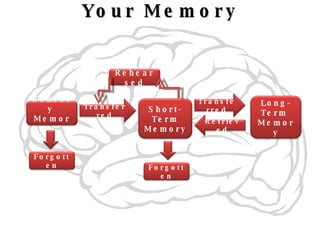
Your Memory Sensory  Memory Forgotten Transferred Rehearsed Long-Term  Memory Short-Term Memory Transferred Retrieved Forgotten
6 Step  M. A. S. T. E. R.   Plan To Accelerated Learning 1 – Relaxed  M ind 2 –  A cquire Facts 3 –  S earch Out The Meaning 4 –  T rigger Memory 5 –  E xhibit What You Know 6 –  R eflect On What You Know
1 – Relaxed  M ind
2 –  A cquire Facts Learning Styles
Learning Styles Find a subject’s natural order of learning Our eyes can process much faster than our ears.  Processing a picture is much faster than reading a paragraph with its hundreds of symbols.  Pondering the meaning of new information is crucial to mastering it. Ponder time should be up to the student, not the teacher or the electronic delivery. Visual Auditory Kinesthetic  (Physical)
Multi-Sensory Learning
3 –  S earch Out The Meaning
No Learning Without Emotion! Pondering adds emotion to what is being learned Positive and productive emotions aid learning Negative emotions can block learning When a purposeful choice is required, emotion comes into play Something viewed as valuable brings emotion to the table Emotion forms the cement of memory Emotion generates the motivation for learning
4 –  T rigger Memory Ideal Sequence Relax/deep breath Learn Break Summarize Make notes Brief review Sleep Brief review
5 –  E xhibit What You Know
6 –  R eflect On What You Know
Summary You can learn  anything you want to learn Learning  how to learn  is the most important thing you can do You can  learn faster  by knowing how the brain works To  earn more  you need to learn more You can  achieve any goal  by developing the skill needed to achieve it with   Accelerated Learning
Sources of Information Accelerated Learning  by Colin Rose and Malcolm J. Nicholl with Brian Tracy   The Brain Book  by Peter Russell Multimedia Learning  by Richard E. Mayer  Brain Rules  by John Medina The Back of the Napkin  by Dan Roam A Whole New Mind  by Daniel H. Pink Age Proof Your Brain  by Tony Buzan Tony Buzan's  The Mind Map Book  Software used:  iMindMap by Tony Buzan Photos:  Photos.com and ClipArt.com
Produced by Harold Carey Jr.  Instructional Design  and Internet Consultant http://elearning101.org/ [email_address] 801-376-9280

Accelerated Learning 2.0

  • 1.
  • 2.
    Accelerated Learning a… "learn how to learn" program.
  • 3.
    We each havea preferred learning style….
  • 4.
    If you knowand use the techniques that match your preferred way of learning…
  • 5.
    … you learnmore naturally Because it is more natural for you, it becomes easier. And because it is easier, it is quicker. Hence the name… … Accelerated Learning.
  • 6.
    1. You canlearn anything you want to learn
  • 7.
    2. Learning howto learn is the most important thing you can do
  • 8.
    3. You canlearn faster by knowing how the brain works
  • 9.
    4. To earn more you need to learn more
  • 10.
    5. You canachieve any goal by developing the skill needed to achieve it
  • 11.
    Brian Tracy "Itused to be that the main difference between people in our society was between those who 'have more' versus those who 'have less .' Today, however, the difference is between those who 'know more' and those who 'know less. ' says Brian Tracy
  • 12.
  • 13.
    "According to anIBM study, by 2010, the amount of digital information in the world will double every 11 hours."
  • 14.
    The digital universein 2007 was equal to almost 45 gigabytes (GB) of digital information for every person on earth … … or the equivalent of over 17 billion 8 GB iPhones.
  • 15.
    DISAPPEARING JOBS Economistsat the University of California 2004 report predicts...
  • 16.
    ...that, by 2015,approximately 3.5 million white-collar jobs representing $151 billion in wages will move overseas. By the end of this year, the report sees 830,000 jobs leaving.
  • 17.
    UNCERTAINTY You canno longer buy success tomorrow with what you know today . You can no longer rely on your employer to provide a job for life. There is no security on this earth; there is only opportunity. GENERAL DOUGLAS MACARTHUR
  • 18.
    9 29 Assoc.Deg. Bachelor Degree Start School 100 Finish H.S. 80 Start College 52 SCHOOL DROPOUTS 20 28 14 62 No post high school degree EDUCATIONAL ATTAINMENT U. S. AGE 25+
  • 19.
    So What CanWe Do About It?...
  • 20.
    Learning how tolearn needs to take priority over what we learn… Learning how to think logically and creatively is critical if we are to solve complex personal and social problems effectively.
  • 21.
    Your Brainand how it Works
  • 22.
  • 23.
    Your Three BrainsReptilian or Primitive Brain Limbic or Mammalian Brain" Neocortex, cerebrum or Human Brain
  • 24.
    Your Three Brains2 Reptilian Related to actual physical survival and maintenance of the body. Limbic Primary centers of emotion Neocortex Language, including speech and writing
  • 25.
    Left and RightBrain Photo Source: Wired Magazine Right Brain Random Intuitive Holistic Synthesizing Subjective Looks at wholes Left Brain Logical Sequential Rational Analytical Objective Looks at parts
  • 26.
    Your Memory Sensory Memory Forgotten Transferred Rehearsed Long-Term Memory Short-Term Memory Transferred Retrieved Forgotten
  • 27.
    6 Step M. A. S. T. E. R. Plan To Accelerated Learning 1 – Relaxed M ind 2 – A cquire Facts 3 – S earch Out The Meaning 4 – T rigger Memory 5 – E xhibit What You Know 6 – R eflect On What You Know
  • 28.
  • 29.
    2 – A cquire Facts Learning Styles
  • 30.
    Learning Styles Finda subject’s natural order of learning Our eyes can process much faster than our ears. Processing a picture is much faster than reading a paragraph with its hundreds of symbols. Pondering the meaning of new information is crucial to mastering it. Ponder time should be up to the student, not the teacher or the electronic delivery. Visual Auditory Kinesthetic (Physical)
  • 31.
  • 32.
    3 – S earch Out The Meaning
  • 33.
    No Learning WithoutEmotion! Pondering adds emotion to what is being learned Positive and productive emotions aid learning Negative emotions can block learning When a purposeful choice is required, emotion comes into play Something viewed as valuable brings emotion to the table Emotion forms the cement of memory Emotion generates the motivation for learning
  • 34.
    4 – T rigger Memory Ideal Sequence Relax/deep breath Learn Break Summarize Make notes Brief review Sleep Brief review
  • 35.
    5 – E xhibit What You Know
  • 36.
    6 – R eflect On What You Know
  • 37.
    Summary You canlearn anything you want to learn Learning how to learn is the most important thing you can do You can learn faster by knowing how the brain works To earn more you need to learn more You can achieve any goal by developing the skill needed to achieve it with Accelerated Learning
  • 38.
    Sources of InformationAccelerated Learning by Colin Rose and Malcolm J. Nicholl with Brian Tracy   The Brain Book by Peter Russell Multimedia Learning by Richard E. Mayer Brain Rules by John Medina The Back of the Napkin by Dan Roam A Whole New Mind by Daniel H. Pink Age Proof Your Brain by Tony Buzan Tony Buzan's The Mind Map Book Software used: iMindMap by Tony Buzan Photos: Photos.com and ClipArt.com
  • 39.
    Produced by HaroldCarey Jr. Instructional Design and Internet Consultant http://elearning101.org/ [email_address] 801-376-9280