Online community ”deaths”
and planning exits
Miia Kosonen
Presentation at Community Manager Master Class II
1st Jun 2015
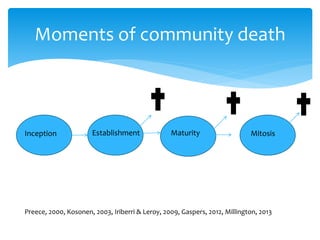
Moments of community death
Inception Establishment Maturity Mitosis
Preece, 2000, Kosonen, 2003, Iriberri & Leroy, 2009, Gaspers, 2012, Millington, 2013
 No commitment, lost sense of community, no
participation, unpurposeful contributions (Anne-Sophie
Gaspers)
 Community is asleep, platforms have changed, the
bugdet runs out, the hosting organization no longer
exists (Jenn Pedde)
Why online communities die
1) The core group excludes new members with inappropriate
behaviour
2) Self-satisfaction: the community overestimates its own value *
3) Development and progress in the hosting organization may turn out
as severe conflicts in the community
4) Community managers and admins tend to be most committed to
the community, and at times they just need to take a break.
Martin Belam, 2015
* Example: less than 0,004 % of visitors produce 20 % of comments on Guardian’s site
Why online communities die
 External factors – e.g. platform no longer supported
 Organizational factors – e.g. no more host organization
 Social factors – e.g. bullying, excessive trolling
 Lack of resources – no one to cultivate conversations
 Members are bored or their needs already met
 Not capable of renewing itself – exclusive core group
Reasons for community crises
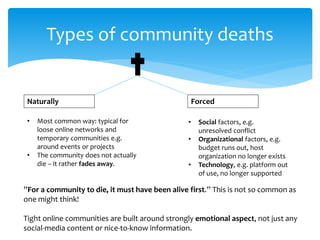
Types of community deaths
Naturally Forced
”For a community to die, it must have been alive first.” This is not so common as
one might think!
Tight online communities are built around strongly emotional aspect, not just any
social-media content or nice-to-know information.
• Most common way: typical for
loose online networks and
temporary communities e.g.
around events or projects
• The community does not actually
die – it rather fades away.
• Social factors, e.g.
unresolved conflict
• Organizational factors, e.g.
budget runs out, host
organization no longer exists
• Technology, e.g. platform out
of use, no longer supported
Do not be afraid of community deaths and crises.
They are ways to learn and renew. For members,
those moments are often the most memorable ones!
As a Community Manager, share your experiences
openly and tell what you have learnt from the crisis.
 People spend less time within the community
 No active participation or only a few active
participants *
 Less interaction: ego-posting and monologues
* Network structure determines community viability, not e.g. growth
rate (Kairam et al. 2012). The most valuable medicine against community
deaths is a strong main clique where a broad base of members all know
each other but also have connections outside the core group. Use social
network analysis and consider exit when there is a critical change!
When to start implementing exit plans?
The community is most viable when having
a strong but non-exclusive clique.
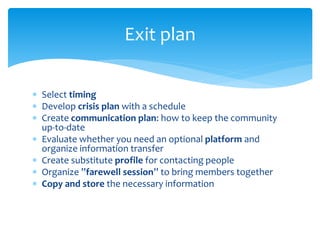
 Select timing
 Develop crisis plan with a schedule
 Create communication plan: how to keep the community
up-to-date
 Evaluate whether you need an optional platform and
organize information transfer
 Create substitute profile for contacting people
 Organize ”farewell session” to bring members together
 Copy and store the necessary information
Exit plan
As a Community Manager, you
need courage to decide when it is
time to exit. Also do not hesitate
to say if you are tired of hosting!
 Preece, Jenny. 2000. Online communities: designing usability, supporting
sociability. Chichester: John Wiley.
 Kosonen, Miia. 2003. Virtuaaliyhteisön kehittämisprosessi [Virtual community’s
development process]. Master’s thesis, Lappeenranta University of Technology.
 Iriberri, Alicia & Leroy, Gondy. 2009. A life-cycle perspective on online
community success. ACM Computing Surveys, 41(2).
 Kairam, S., Wang, D.J. & Leskovec, J. 2012. The life and death of online groups:
predicting group growth and longevity. WSDM’12, February 8-12, Seattle,
Washington, USA.
 Gaspers, Anne-Sophie, 2012. How online communities work: how do online
communities evolve? Community life-cycle model.
http://thinkonlinecommunity.com
 Millington, Richard. http://FeverBee.com
 Pedde, Jenn. http://communitymanager.com
References
Thanks for your attention!
So you need CM?
That’s a deal!
Contact me:
Miia Kosonen
PhD, Knowledge Management, Trainer, Researcher
Ruokolahti, Finland
https://twitter.com/MiiaKosonen
http://slideshare.net/miiak
https://fi.linkedin.com/in/miiakosonen
koomikoo ( at ) gmail.com
Blog mainly in Finnish:
http://tohtorilletoita.wordpress.com

Online community death

  • 1.
    Online community ”deaths” andplanning exits Miia Kosonen Presentation at Community Manager Master Class II 1st Jun 2015
  • 2.
    Moments of communitydeath Inception Establishment Maturity Mitosis Preece, 2000, Kosonen, 2003, Iriberri & Leroy, 2009, Gaspers, 2012, Millington, 2013
  • 3.
     No commitment,lost sense of community, no participation, unpurposeful contributions (Anne-Sophie Gaspers)  Community is asleep, platforms have changed, the bugdet runs out, the hosting organization no longer exists (Jenn Pedde) Why online communities die
  • 4.
    1) The coregroup excludes new members with inappropriate behaviour 2) Self-satisfaction: the community overestimates its own value * 3) Development and progress in the hosting organization may turn out as severe conflicts in the community 4) Community managers and admins tend to be most committed to the community, and at times they just need to take a break. Martin Belam, 2015 * Example: less than 0,004 % of visitors produce 20 % of comments on Guardian’s site Why online communities die
  • 5.
     External factors– e.g. platform no longer supported  Organizational factors – e.g. no more host organization  Social factors – e.g. bullying, excessive trolling  Lack of resources – no one to cultivate conversations  Members are bored or their needs already met  Not capable of renewing itself – exclusive core group Reasons for community crises
  • 6.
    Types of communitydeaths Naturally Forced ”For a community to die, it must have been alive first.” This is not so common as one might think! Tight online communities are built around strongly emotional aspect, not just any social-media content or nice-to-know information. • Most common way: typical for loose online networks and temporary communities e.g. around events or projects • The community does not actually die – it rather fades away. • Social factors, e.g. unresolved conflict • Organizational factors, e.g. budget runs out, host organization no longer exists • Technology, e.g. platform out of use, no longer supported
  • 7.
    Do not beafraid of community deaths and crises. They are ways to learn and renew. For members, those moments are often the most memorable ones! As a Community Manager, share your experiences openly and tell what you have learnt from the crisis.
  • 8.
     People spendless time within the community  No active participation or only a few active participants *  Less interaction: ego-posting and monologues * Network structure determines community viability, not e.g. growth rate (Kairam et al. 2012). The most valuable medicine against community deaths is a strong main clique where a broad base of members all know each other but also have connections outside the core group. Use social network analysis and consider exit when there is a critical change! When to start implementing exit plans?
  • 9.
    The community ismost viable when having a strong but non-exclusive clique.
  • 10.
     Select timing Develop crisis plan with a schedule  Create communication plan: how to keep the community up-to-date  Evaluate whether you need an optional platform and organize information transfer  Create substitute profile for contacting people  Organize ”farewell session” to bring members together  Copy and store the necessary information Exit plan
  • 11.
    As a CommunityManager, you need courage to decide when it is time to exit. Also do not hesitate to say if you are tired of hosting!
  • 12.
     Preece, Jenny.2000. Online communities: designing usability, supporting sociability. Chichester: John Wiley.  Kosonen, Miia. 2003. Virtuaaliyhteisön kehittämisprosessi [Virtual community’s development process]. Master’s thesis, Lappeenranta University of Technology.  Iriberri, Alicia & Leroy, Gondy. 2009. A life-cycle perspective on online community success. ACM Computing Surveys, 41(2).  Kairam, S., Wang, D.J. & Leskovec, J. 2012. The life and death of online groups: predicting group growth and longevity. WSDM’12, February 8-12, Seattle, Washington, USA.  Gaspers, Anne-Sophie, 2012. How online communities work: how do online communities evolve? Community life-cycle model. http://thinkonlinecommunity.com  Millington, Richard. http://FeverBee.com  Pedde, Jenn. http://communitymanager.com References
  • 13.
    Thanks for yourattention! So you need CM? That’s a deal! Contact me: Miia Kosonen PhD, Knowledge Management, Trainer, Researcher Ruokolahti, Finland https://twitter.com/MiiaKosonen http://slideshare.net/miiak https://fi.linkedin.com/in/miiakosonen koomikoo ( at ) gmail.com Blog mainly in Finnish: http://tohtorilletoita.wordpress.com