Service Management 
(Online Community) 
Presented by: 
Rafael Y. Paragas 
Dr. Sonia Dela Cruz 
Professorial Lecturer
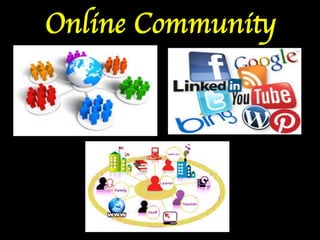
Online Community
Online Community 
 Developing an Online Community 
 Strategy for Building Online Community 
 Community Life Cycle 
 Types of Online Community 
 Domains of Online Community 
 Rules in Making an Online Community 
 Netiquette 
 Safety and Privacy
What is an Online 
Community 
An online community is a virtual 
community whose members interact with 
each other primarily via the Internet. Those 
who wish to be a part of an online 
community usually have to become a 
member via a specific site. An online 
community can also act as an information 
system where members can post, comment 
on discussions, give advice or collaborate.
Developing an Online 
Community 
When developing an online 
community, it is important to have the 
technologies necessary to keep members 
interested, manage assets, and uphold 
community relations. Developers take into 
consideration whether all the online 
community members are good at using 
technology. If an online community is not 
workable for some users, they may be 
discouraged.
Developing an Online 
Community 
Online communities are developed to 
encourage individuals to come together to 
teach and learn from one another. They 
encourage self learners to discuss and 
learn about real-world problems/situations 
as well as focus on things such as 
teamwork, collaborative thinking, personal 
experiences.
Developing an Online 
Community 
A developer's main focus is to 
create a technology that adheres to 
the interests, as well as the social 
and basic needs, of the community. An 
online community's main goal is to 
serve as a common ground for people 
who share the same interests.
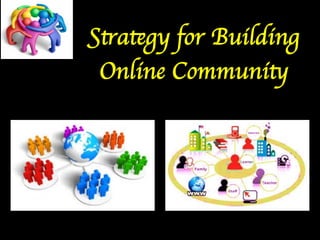
Strategy for Building 
Online Community
1 - Let Your Members  
Know Why 
• Let the potential members of the 
community know why you are 
providing an online community, and 
how being an active member of a 
community would benefit them.
Tactic 2 - Showcase Your 
Community 
2- Use every opportunity to 
showcase your online community 
a) Introduce it to your members in an 
initial introductory email, and then in 
periodic follow up emails. 
b) In regular newsletter, mention or 
welcome new groups that have been 
formed.
2- Showcase Your Community cont… 
c) Put into the community library all 
documents and files that your 
organization would like to make 
available to your members. 
d) Set up occasional forums on topical 
events to keep refreshing the content.
3 - Seed the Community 
• Seed the community with groups, forum 
postings, blogs, etc., so that early 
adopters aren’t faced with an “empty” 
community.  
 
Invite selected members prior to public 
launch to participate and to help seed 
the community with comment and other 
content.
4 - Make it Easy 
• Make it as easy as possible for 
people to sign up and to use the 
community tools.  
 
If your community is closed to non-members, 
be sure to add accessible 
descriptions of the community in 
your list of membership benefits to 
entice non-members to become 
members.
5 - Designate a Facilitator or 
Moderator 
• Designate a staff person to be the 
facilitator or moderator of the 
community, checking periodically to make 
sure that members are using the forums 
and other tools as intended, encouraging 
members to “speak up”, enforcing the 
rules if necessary and making sure that 
comments  questions about the 
organization are acknowledged and 
answered, as appropriate.
6 - Acknowledge Community 
Members 
• Acknowledge those members who use 
the community frequently.  
 
This acknowledgment can be made 
within the community site itself, in 
the organization’s newsletters, or 
the organization’s main website.
7 - Seek and Use  
Members’ Input 
Seek input from the members on your 
organization’s agenda and other organizational 
issues.  
Consider polling members within the 
community on a regular basis. Take what you 
learn from the community and put it into 
practice in the organization.  
Give credit to the community for their 
input. Once members discover that their 
participation in the community can actually have 
an impact on the organization itself, interest in 
the community will be that much stronger.
8 – Use Forum for  
Announcements 
Use forum or an avenue to publish 
ongoing lists of group events, and have 
members participate by adding other 
events that they consider relevant to 
other members.  
Encourage users to use forum by 
seeking their input directly into 
organizational planning (e.g., by putting 
drafts of tributes, awards, mission 
statements, and then seeking input from 
members).
9 - Announce News First in 
Community 
Announce new initiatives and 
other important organizational news in 
the community first. This will help 
establish the community as a living, 
informative part of your online 
presence.
10 - Keep the Community 
Fresh 
• Keep the community fresh.  
 
Pay attention to what elements of 
the community are being used heavily, 
and which are not.  
If you find a lot of discussion on a 
particular topic, consider creating a 
forum and/or group especially for that 
topic. Consider archiving outdated library 
items.
On-Board: This is the starting 
p o i n t o f a n y c o m m u n i t y , 
characterized by people (seekers) 
looking for value (content), most of 
whi c h i s c r e a t e d b y t h e 
community’s founders.
Established: The community is 
becoming self-sustaining, with the 
members (influencers, originators, 
etc.) creating and maintaining value 
within the community, although some 
reliance on the founders is still 
necessary.
Mature: Users are organized into 
clear types (influencers, seekers, 
moderators, originators, etc.) and 
ta k e f u l l o w n e r s h i p a n d 
responsibility for content. Little to 
no supervision is required by the 
founders, who become no more than 
credible participants.
Types of Online 
Communities
Gender based Virtual 
Communities 
• Online communication is more equal, 
that women are able to participate 
and complete thoughts, in effect 
softening social barriers. (Shapiro 
1999) 
• Online interaction is merely a 
reflection of real world conversation 
where men dominate.
Cyber Activism 
• Use communication technologies for 
faster communications by citizen 
movements and deliver a message to a 
large audience. 
• Internet technologies used for cause-r 
e l a t e d f u n d r a i s i n g , l obby i n g , 
volunteering, community building, and 
organizing.
Cyber Activism-Criticisms 
• Marginalizing minorities and elderly 
citizens due to lack of access to or 
confidence in emerging technologies 
• Make public feel involved rather than 
to advance actual participation. 
• Impression of being part of a much 
larger network than is necessarily the 
case.
Marketing through 
Online Communities 
• C ommuni t y m a r k e t i n g c r e a t e s 
communities around products. 
• Able to engage your customer base in a 
natural setting. 
• Can strengthen bond between company 
and consumer - create loyalty through 
personal investment. 
• Can be used to reinforce, or manipulate 
brand image.
Implications on Traditional 
Communities? 
• Many claim off line interpersonal relationships 
are affected-No longer know how to 
communicate in face to face situations. 
• More people looking for partners online rather 
than in bars or cafes or through off line 
friends. 
• Claims that marriages are destroyed due to 
online affairs through communities 
• Claims that virtual communities are an escape 
from real world problems. 
• More people stay at home rather than to go 
out and socialize - Meetup.com tries to fix 
that!
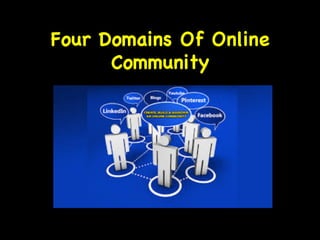
Four Domains Of Online 
Community
Four Domains Of 
Online Community 
a. Social 
– Social interaction 
– Solidarity 
– Individual  Institutional relations
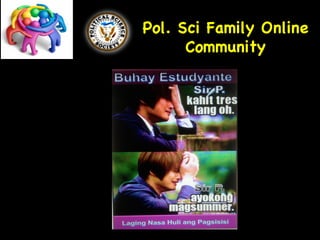
Pol. Sci Family Online 
Community
Four Domains Of 
Online Community 
b. Political 
– Collective formation of goals 
– Implementation of policy 
– online voting 
– online campaigning
Four Domains Of 
c. Economic 
Online Community 
– Production, distribution  consumption 
of goods and services 
– company blogs (promote branding, 
image) 
– online stores 
– netizens sell things online (community: 
a small word-of-mouth-built fanbase) 
– price comparisons
Four Domains Of 
d. Cultural 
Online Community 
– Examines shared values  symbol 
systems 
– gathering of people based on common 
themes, lifestyles 
– religious communities, art communities, 
music communities 
• Different Cultures, Different 
Channels
Rules For Making Online 
Communities Work 
1. Define the purpose of the 
community. 
2. Create member profiles that 
evolve over time. 
3. Promote effective leadership.
Rules For Making Online 
Communities Work 
4. Define a clear, yet flexible, code 
of conduct. 
5. Organize and promote cyclic 
events. 
6. Provide range of roles that couple 
power with responsibility.
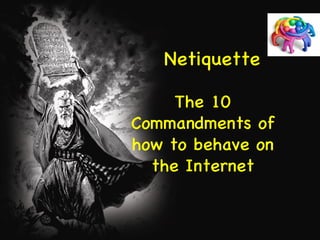
Netiquette 
The 10 
Commandments of 
how to behave on 
the Internet
Netiquette 
Rule 1: Remember the Human 
Rule 2: Adhere to the same standards of 
behavior online that you follow in real 
life. 
Rule 3: Know where you are in cyberspace 
Rule 4: Respect other people’s time. 
Rule 5: Make yourself look good online.
Netiquette 
Rule 6: Share expert knowledge 
Rule 7: Help keep flame wars under 
control. 
Rule 8: Respect other people’s 
privacy. 
Rule 9: Don’t abuse your power. 
Rule 10: Be forgiving of other 
people’s mistakes.
Safety and Privacy 
Issues 
Online Harassment 
a. Flaming- According to a study 
conducted by Peter J. Moor, flaming is 
defined as displaying hostility by insulting, 
swearing or using otherwise offensive 
language. 
Flaming can be done in either a group 
style format (the comments section on 
YouTube) or in a one-on-one format 
(private messaging on Facebook).
Safety and Privacy 
Issues 
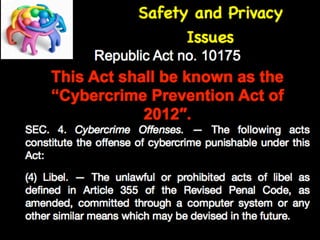
Republic Act no. 10175 
AN ACT DEFINING CYBERCRIME, PROVIDING 
FOR THE PREVENTION, INVESTIGATION, 
SUPPRESSION AND THE IMPOSITION OF 
PENALTIES THEREFOR AND FOR OTHER 
PURPOSES. 
This Act shall be known as the 
“Cybercrime Prevention Act of 
2012″.
Safety and Privacy 
Issues 
b. Cyber bullying is also prominent 
online. Cyber bullying is defined as 
willful and repeated harm inflicted 
towards another. Cyber bullying 
victimization has ascended to the 
forefront of the public agenda after 
a number of news stories came out on 
the topic.
Safety and Privacy 
Issues 
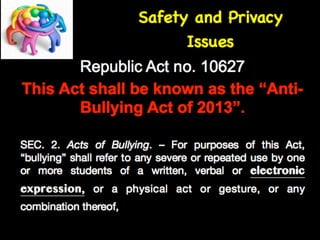
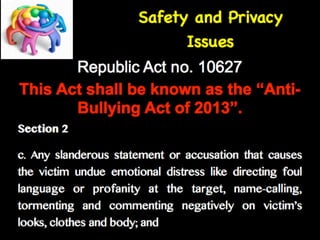
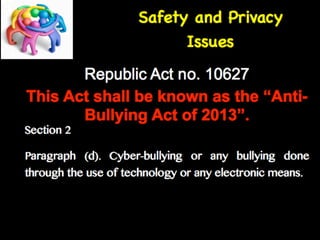
Republic Act no. 10627 
AN ACT REQUIRING ALL ELEMENTARY AND 
SECONDARY SCHOOLS TO ADOPT POLICIES 
TO PREVENT AND ADDRESS THE ACTS OF 
BULLYING IN THEIR INSTITUTIONS 
This Act shall be known as the 
“Anti-Bullying Act of 2013”.
Reference 
s 
http://www.usdoj.gov/criminal/cybercrime/ 
cyberstalking.htm 
http://www.gov.ph/2012/09/12/republic-act-no- 
10175/ 
http://en.wikipedia.org/wiki/Internet_activism

Online community

  • 1.
    Service Management (OnlineCommunity) Presented by: Rafael Y. Paragas Dr. Sonia Dela Cruz Professorial Lecturer
  • 2.
  • 3.
    Online Community Developing an Online Community  Strategy for Building Online Community  Community Life Cycle  Types of Online Community  Domains of Online Community  Rules in Making an Online Community  Netiquette  Safety and Privacy
  • 4.
    What is anOnline Community An online community is a virtual community whose members interact with each other primarily via the Internet. Those who wish to be a part of an online community usually have to become a member via a specific site. An online community can also act as an information system where members can post, comment on discussions, give advice or collaborate.
  • 5.
    Developing an Online Community When developing an online community, it is important to have the technologies necessary to keep members interested, manage assets, and uphold community relations. Developers take into consideration whether all the online community members are good at using technology. If an online community is not workable for some users, they may be discouraged.
  • 6.
    Developing an Online Community Online communities are developed to encourage individuals to come together to teach and learn from one another. They encourage self learners to discuss and learn about real-world problems/situations as well as focus on things such as teamwork, collaborative thinking, personal experiences.
  • 7.
    Developing an Online Community A developer's main focus is to create a technology that adheres to the interests, as well as the social and basic needs, of the community. An online community's main goal is to serve as a common ground for people who share the same interests.
  • 8.
    Strategy for Building Online Community
  • 9.
    1 - LetYour Members Know Why • Let the potential members of the community know why you are providing an online community, and how being an active member of a community would benefit them.
  • 10.
    Tactic 2 -Showcase Your Community 2- Use every opportunity to showcase your online community a) Introduce it to your members in an initial introductory email, and then in periodic follow up emails. b) In regular newsletter, mention or welcome new groups that have been formed.
  • 11.
    2- Showcase YourCommunity cont… c) Put into the community library all documents and files that your organization would like to make available to your members. d) Set up occasional forums on topical events to keep refreshing the content.
  • 12.
    3 - Seedthe Community • Seed the community with groups, forum postings, blogs, etc., so that early adopters aren’t faced with an “empty” community. Invite selected members prior to public launch to participate and to help seed the community with comment and other content.
  • 13.
    4 - Makeit Easy • Make it as easy as possible for people to sign up and to use the community tools. If your community is closed to non-members, be sure to add accessible descriptions of the community in your list of membership benefits to entice non-members to become members.
  • 14.
    5 - Designatea Facilitator or Moderator • Designate a staff person to be the facilitator or moderator of the community, checking periodically to make sure that members are using the forums and other tools as intended, encouraging members to “speak up”, enforcing the rules if necessary and making sure that comments questions about the organization are acknowledged and answered, as appropriate.
  • 15.
    6 - AcknowledgeCommunity Members • Acknowledge those members who use the community frequently. This acknowledgment can be made within the community site itself, in the organization’s newsletters, or the organization’s main website.
  • 16.
    7 - Seekand Use Members’ Input Seek input from the members on your organization’s agenda and other organizational issues. Consider polling members within the community on a regular basis. Take what you learn from the community and put it into practice in the organization. Give credit to the community for their input. Once members discover that their participation in the community can actually have an impact on the organization itself, interest in the community will be that much stronger.
  • 17.
    8 – UseForum for Announcements Use forum or an avenue to publish ongoing lists of group events, and have members participate by adding other events that they consider relevant to other members. Encourage users to use forum by seeking their input directly into organizational planning (e.g., by putting drafts of tributes, awards, mission statements, and then seeking input from members).
  • 18.
    9 - AnnounceNews First in Community Announce new initiatives and other important organizational news in the community first. This will help establish the community as a living, informative part of your online presence.
  • 19.
    10 - Keepthe Community Fresh • Keep the community fresh. Pay attention to what elements of the community are being used heavily, and which are not. If you find a lot of discussion on a particular topic, consider creating a forum and/or group especially for that topic. Consider archiving outdated library items.
  • 20.
    On-Board: This isthe starting p o i n t o f a n y c o m m u n i t y , characterized by people (seekers) looking for value (content), most of whi c h i s c r e a t e d b y t h e community’s founders.
  • 21.
    Established: The communityis becoming self-sustaining, with the members (influencers, originators, etc.) creating and maintaining value within the community, although some reliance on the founders is still necessary.
  • 22.
    Mature: Users areorganized into clear types (influencers, seekers, moderators, originators, etc.) and ta k e f u l l o w n e r s h i p a n d responsibility for content. Little to no supervision is required by the founders, who become no more than credible participants.
  • 23.
    Types of Online Communities
  • 24.
    Gender based Virtual Communities • Online communication is more equal, that women are able to participate and complete thoughts, in effect softening social barriers. (Shapiro 1999) • Online interaction is merely a reflection of real world conversation where men dominate.
  • 25.
    Cyber Activism •Use communication technologies for faster communications by citizen movements and deliver a message to a large audience. • Internet technologies used for cause-r e l a t e d f u n d r a i s i n g , l obby i n g , volunteering, community building, and organizing.
  • 26.
    Cyber Activism-Criticisms •Marginalizing minorities and elderly citizens due to lack of access to or confidence in emerging technologies • Make public feel involved rather than to advance actual participation. • Impression of being part of a much larger network than is necessarily the case.
  • 27.
    Marketing through OnlineCommunities • C ommuni t y m a r k e t i n g c r e a t e s communities around products. • Able to engage your customer base in a natural setting. • Can strengthen bond between company and consumer - create loyalty through personal investment. • Can be used to reinforce, or manipulate brand image.
  • 28.
    Implications on Traditional Communities? • Many claim off line interpersonal relationships are affected-No longer know how to communicate in face to face situations. • More people looking for partners online rather than in bars or cafes or through off line friends. • Claims that marriages are destroyed due to online affairs through communities • Claims that virtual communities are an escape from real world problems. • More people stay at home rather than to go out and socialize - Meetup.com tries to fix that!
  • 29.
    Four Domains OfOnline Community
  • 30.
    Four Domains Of Online Community a. Social – Social interaction – Solidarity – Individual Institutional relations
  • 31.
    Pol. Sci FamilyOnline Community
  • 32.
    Four Domains Of Online Community b. Political – Collective formation of goals – Implementation of policy – online voting – online campaigning
  • 33.
    Four Domains Of c. Economic Online Community – Production, distribution consumption of goods and services – company blogs (promote branding, image) – online stores – netizens sell things online (community: a small word-of-mouth-built fanbase) – price comparisons
  • 34.
    Four Domains Of d. Cultural Online Community – Examines shared values symbol systems – gathering of people based on common themes, lifestyles – religious communities, art communities, music communities • Different Cultures, Different Channels
  • 35.
    Rules For MakingOnline Communities Work 1. Define the purpose of the community. 2. Create member profiles that evolve over time. 3. Promote effective leadership.
  • 36.
    Rules For MakingOnline Communities Work 4. Define a clear, yet flexible, code of conduct. 5. Organize and promote cyclic events. 6. Provide range of roles that couple power with responsibility.
  • 37.
    Netiquette The 10 Commandments of how to behave on the Internet
  • 38.
    Netiquette Rule 1:Remember the Human Rule 2: Adhere to the same standards of behavior online that you follow in real life. Rule 3: Know where you are in cyberspace Rule 4: Respect other people’s time. Rule 5: Make yourself look good online.
  • 39.
    Netiquette Rule 6:Share expert knowledge Rule 7: Help keep flame wars under control. Rule 8: Respect other people’s privacy. Rule 9: Don’t abuse your power. Rule 10: Be forgiving of other people’s mistakes.
  • 40.
    Safety and Privacy Issues Online Harassment a. Flaming- According to a study conducted by Peter J. Moor, flaming is defined as displaying hostility by insulting, swearing or using otherwise offensive language. Flaming can be done in either a group style format (the comments section on YouTube) or in a one-on-one format (private messaging on Facebook).
  • 41.
    Safety and Privacy Issues Republic Act no. 10175 AN ACT DEFINING CYBERCRIME, PROVIDING FOR THE PREVENTION, INVESTIGATION, SUPPRESSION AND THE IMPOSITION OF PENALTIES THEREFOR AND FOR OTHER PURPOSES. This Act shall be known as the “Cybercrime Prevention Act of 2012″.
  • 43.
    Safety and Privacy Issues b. Cyber bullying is also prominent online. Cyber bullying is defined as willful and repeated harm inflicted towards another. Cyber bullying victimization has ascended to the forefront of the public agenda after a number of news stories came out on the topic.
  • 44.
    Safety and Privacy Issues Republic Act no. 10627 AN ACT REQUIRING ALL ELEMENTARY AND SECONDARY SCHOOLS TO ADOPT POLICIES TO PREVENT AND ADDRESS THE ACTS OF BULLYING IN THEIR INSTITUTIONS This Act shall be known as the “Anti-Bullying Act of 2013”.
  • 49.
    Reference s http://www.usdoj.gov/criminal/cybercrime/ cyberstalking.htm http://www.gov.ph/2012/09/12/republic-act-no- 10175/ http://en.wikipedia.org/wiki/Internet_activism